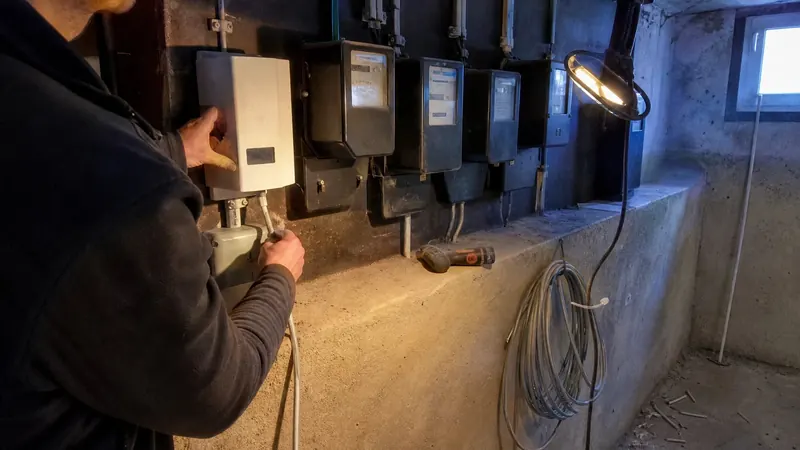
Smart metering covers the rollout of intelligent metering systems, the administration of smart meter gateways and grid-oriented control under §14a EnWG. The strands run in parallel and depend on each other: no gateway, no control box; no clean meter data processing, no 15-minute values. Plan them as separate projects and the supervisory proceeding will say so.
Rollout quotas, supervisory proceedings, gateway administration and control under §14a EnWG run in parallel and depend on each other. We connect rollout, gateway, control box and meter data processing into one programme that holds up technically and meets the metering operator's obligations on time.
innobu has delivered in this field as part of the ongoing mandate.
Services for this field
Tools and frameworks
Articles in this field (23)
Fallback metering operator under section 11 MsbG
When a default metering operator fails, the fallback operator steps in. Six months later the default responsibility is gone. What the 2026 list shows.
Read →Generation Rollout Quota: Capacity, Not Meter Numbers
The 31 December 2026 quota measures installed capacity, not installation cases. What section 45(1) no. 2(a) MsbG asks for and how to sort the work.
Read →Rollout Quota 2026: The Period Quota under Section 45 MsbG
The 31.12.2026 quota does not measure the installed base but the metering points that newly fell due since February 2025. What that means for rollout planning.
Read →Control Box Rollout 2026: Fitting and Proof
A 23.3 percent smart meter quota and eight certified control boxes, yet the mass rollout stalls. What meter operators must settle in 2026.
Read →CLS Management and the aEMT Role
CLS management is an operating function, not hardware. What the aEMT role demands and what German utilities must have running by the end of 2026.
Read →Virtual Sum Meter: Tenant Electricity in Apartment Buildings
The virtual sum meter and Solar Package I make tenant electricity in apartment buildings affordable: metering concept, GGV under section 42b EnWG and rollout explained.
Read →FFVAV: Remote-Readable Heat Meters Mandatory by End of 2026
The FFVAV requires district-heating suppliers to make all heat meters remotely readable by 31 Dec 2026 and deliver monthly consumption info. What to do now.
Read →Direct Marketing: Remote Control via Smart Meter Gateway from 2028
Renewable plants in direct marketing must be remote-controllable via the smart meter gateway from 2028, Section 10b EEG.
Read →GPKE and Feed-in Processes: Integrating the MPES Processes in 2025
On 6 June 2025 the MPES feed-in processes move into the GPKE. What the generating metering point, the new GPKE structure and the end of the MPES mean for direct marketers.
Read →BSI TR-03109-6 v2.0: What Gateway Administrators Must Meet From 2027
BSI TR-03109-6 v2.0 has been out since December 2025 and is binding from 2027 with the next recertification. What gateway administrators must mind on ISMS, audit and Section 25 MsbG.
Read →Gateway Administrator Switch at Scale: How SMGW Administration Is Handed Over
How the administration of thousands of smart meter gateways is handed over remotely when the metering operator changes. switchGWA, the VDE-FNN note, WiM Strom and what practice shows.
Read →Standardised Metering Contracts from 2026: What BK6-24-125 Means for the gMSB
BK6-24-125 makes three standard contracts in electricity metering binding from 1 July 2026. What MSB-RV, MSV-AN and MSV-LF, the new penalty and the changeover mean for the gMSB.
Read →Smart Meter Rollout: 77 Cases and the BNetzA Sanction Regime
The BNetzA has opened 77 supervisory procedures against late metering operators. What Section 76 MsbG, the penalty payment and the procedure mean for the gMSB.
Read →Heating Costs Ordinance: Remote Reading Mandatory by the End of 2026
By 31 December 2026 heat metering must be remotely readable. What the Heating Costs Ordinance requires on deadlines, monthly consumption information and reduction rights.
Read →MsbG Amendment 2025: Higher Price Caps and New Duties
The 2025 MsbG amendment raises the price caps for smart metering for the first time since 2016. What changes on charges, the holding period and data duties.
Read →Scaling the SMGW Backend: Meter Data Management and PKI for Millions of Devices
How to scale the SMGW backend of GWA system, head-end system and meter data management in a PKI-compliant way to millions of devices.
Read →EEBUS and IEC 63380: The Common Language of Energy Devices
EEBUS connects heat pump, wallbox, HEMS and smart meter gateway. What IEC 63380 actually covers, how SPINE and SHIP work and what it means for Section 14a.
Read →The Next-Generation Smart Meter Gateway: Tariff Use Cases and WAN Technology
The next-generation smart meter gateway supports more tariff use cases and new radio technologies. What TAF 7, dynamic tariffs and LTE-450 mean.
Read →Solar Peak Law 2025: what applies to new PV systems from 2 kWp
The solar peak law has applied since February 2025. No payment at negative prices and a 60 percent feed-in cap for new PV systems from 2 kW: what operators need to know.
Read →Competitive metering point operation: the make-or-buy decision 2025-2027
Grid-responsible and competitive metering point operation compared: gMSB, wMSB and the make-or-buy decision 2025-2027. What quotas, BK6-24-125 and outsourcing models mean for utilities.
Read →Multi-utility remote reading via the SMGW: gas, water and heat at the LMN
How gas, water and heat meters bind to the smart meter gateway over wireless M-Bus. The LMN interface, OMS Security Profile B, TAF 6 and 7, section 6 MsbG and the municipal-utility advantage.
Read →Control Box & Section 14a: Grid Control 2026
The control box puts section 14a EnWG into action at the device. In 2026 the hardware is certified, yet grid operators send almost no commands. The last mile.
Read →Smart Meter Rollout 2026: Data Base for AI Grids
By end 2025 only 5.5 percent smart meters; in March 2026 the regulator opened 77 proceedings. Why the stalled rollout starves AI grid management of data.
Read →