Virtual sum meter: how tenant electricity in apartment buildings goes digital
This article frames the metering concept for landlords, utilities and the housing sector: how the virtual sum meter works, what community building supply under section 42b EnWG delivers and why the rollout depends on market communication and smart meters. Related topics are energy sharing under section 42c EnWG and the smart meter rollout with its sanctions.
The virtual sum meter makes tenant electricity affordable in buildings where a physical sum meter would never have paid off. Instead of a central meter with instrument transformers, a balancing model aggregates the quarter-hourly readings of individual smart meters. That saves roughly EUR 8,000 to 10,000 per grid connection, about a fifth of project cost, and makes around 50 percent more buildings economical according to inexogy. The legal basis is section 20 (1d) sentence 3 EnWG, permitted since May 2023. On top of that came community building supply under section 42b EnWG with the Solar Package I in May 2024, a leaner model than classic tenant electricity. The catch is implementation. The Bundesnetzagentur has not yet fully specified the virtual sum meter as a mass process in market communication, so many grid operators handle it manually. And everything hangs on the smart meter rollout, which lags: at the end of 2025 only around 5.5 percent of all metering points carried a smart metering system, and the regulator opened 77 supervisory proceedings in March 2026. The potential is large, up to 20.4 million flats and up to 60 GW of PV in the building sector, yet by spring 2024 only around 9,000 tenant electricity systems were running.
What the virtual sum meter changes
The virtual sum meter makes tenant electricity affordable where a physical sum meter concept would never have paid off. The trick: instead of installing and wiring a central meter with instrument transformers, a calculation model aggregates the readings of many smart meters. Metering moves out of the meter cabinet and into software.
The difference is not a detail, it decides the economics. A physical sum meter with instrument transformers and wiring quickly costs EUR 8,000 to 10,000 per grid connection, about a fifth of a tenant electricity project. Remove that item and suddenly smaller buildings add up too. inexogy puts it at around 50 percent more suitable houses. For a landlord that means a project that failed with a physical sum meter can carry with a virtual one.
How the virtual sum meter works
Every metering point in the property gets a smart metering system, the PV array as much as each flat. A balancing model aggregates the quarter-hourly readings digitally and assigns each party its share of self-generated solar power and its grid draw. No central meter, no transformers, no shared metering wiring.
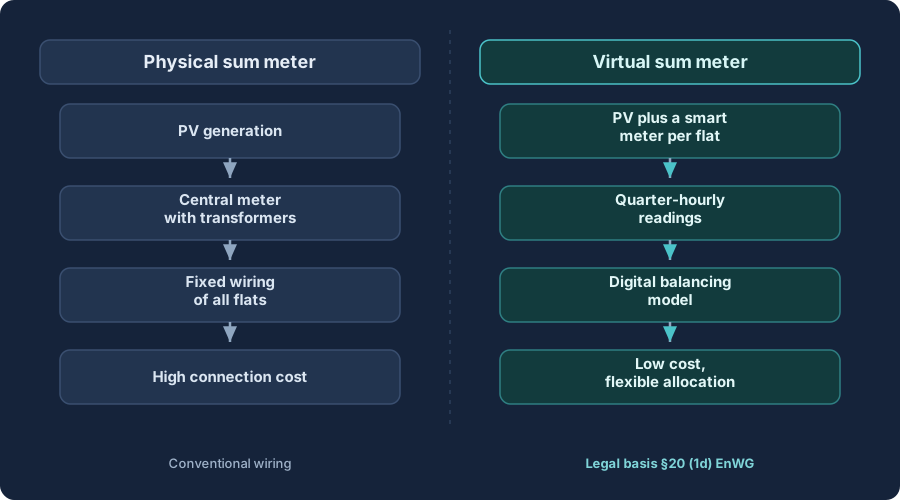
Two properties make the everyday difference. First the resolution: generation and consumption are recorded and netted every quarter-hour, not once a year. That captures how much solar power a flat really uses in the moment the sun shines. Second the flexibility. When a tenant moves out, they are taken out of the bundle without an electrician turning up. With a physical sum meter that was often a structural job.
The condition, though, is that every metering point really has a smart metering system. If one flat lacks its meter, the quarter-hour value is missing and the balance does not add up. This is exactly where the concept meets the sluggish rollout, more on that below.
Solar Package I and community building supply
The Solar Package I took effect in May 2024 and brought a second, leaner model through section 42b EnWG: community building supply, or GGV. Residents share the solar power from their own building directly, without the operator becoming a full supplier with all supplier obligations. That takes a lot of paperwork off a housing company.
The difference from classic tenant electricity lies in the obligations. Under the EEG tenant electricity model the operator supplies the entire electricity, PV plus residual grid power, and takes on the full duties of an energy supplier. In return there is the tenant electricity surcharge. The GGV drops the residual supply contract through the operator and the surcharge, and is much simpler to set up.
- Classic tenant electricity: operator supplies PV and residual power, full supplier obligations, in return the tenant electricity surcharge under the EEG.
- Community building supply (section 42b EnWG): residents share only the PV power, no residual supply contract through the operator, no surcharge, less bureaucracy.
- In common: both models can use the virtual sum meter as their metering concept and need a smart metering system at every metering point.
Which model fits depends on the building. A small owners' association that wants to avoid the effort is often better off with the GGV. A housing company that wants to take the surcharge and offer a full electricity product stays with the classic model. The metering concept is the same in both cases. Both stop at the house connection, though. Sharing electricity across the public grid means section 42c EnWG, and there the community reaches into the neighbouring grid operator's area from June 2028.
Why implementation stalls
The legal claim exists, the processes do not. Landlords have a claim to the virtual sum meter under section 20 (1d) EnWG and to the GGV under section 42b EnWG. In practice many still hit refusal or months of waiting, because the mass processes are not in place everywhere.

The core of the problem is market communication. The Bundesnetzagentur has not yet fully specified the virtual sum meter there as an automated process. Where the format is missing, the grid operator has to set up and maintain the calculation by hand, for each project individually, instead of by mass process. That is laborious and explains why some operators hesitate or invoke unreasonableness under section 20 (2) EnWG.
The Solarenergie-Förderverein pushes back: impossibility or unreasonableness barely hold when other grid operators implement the concept already. Anyone refused has two levers. A complaint to the Bundesnetzagentur under section 30 EnWG and, if the default metering point operator does not deliver, appointing an alternative metering point operator under section 5 MsbG.
The rollout bottleneck
No smart meters, no virtual sum meter. This is where it jams the most. At the end of 2025 the smart metering share stood at only around 5.5 percent of all metering points, roughly 3 million devices among nearly 56.5 million connections. Among the mandatory installation cases it was 23.3 percent, just above the 20 percent target, but many metering point operators lag well behind.
The delay is no longer a fringe issue. On 27 March 2026 the Bundesnetzagentur opened 77 supervisory proceedings against metering point operators behind schedule. By 2030 at least 95 percent of the mandatory cases are meant to have a smart metering system. For a property that wants to switch to tenant electricity, the metering point operator becomes the scheduling bottleneck: quarter-hourly balancing runs cleanly only once every metering point carries a smart meter. The detail sits in the article on the smart meter rollout and its control.
The market potential
The scale here is large. According to an analysis by IW Köln, up to 20.4 million flats in around 3 million apartment buildings are technically suitable for tenant electricity. That equals up to 60 GW of photovoltaics in the building sector alone, nearly a third of Germany's PV target of 215 GW by 2030.

Set against that is what has been built. By spring 2024 only around 9,000 tenant electricity systems were running on apartment buildings nationwide, a fraction of what is possible. Expansion long ran through single and two-family homes and large ground-mounted arrays, while the apartment building stayed underserved. Yet a roof array covers up to 60 percent of the annual electricity demand on-site, depending on the design. This is exactly the gap the virtual sum meter is meant to help close, by lowering the economic threshold.
Challenges and risks
The model is not a sure thing. The biggest brake is the inconsistent practice of grid operators. There is no nationwide, mandatory standard for the virtual sum meter, only non-binding industry guidance. Anyone building in two grid areas can meet two entirely different procedures.
There is also an open legal question. A ruling by the European Court of Justice on how customer installations are classified created uncertainty about how such constructs will be treated. The Bundestag passed a transition rule through the end of 2028 that gives existing systems planning security. For new projects a durably clear, nationwide standard is still missing.
And then there is data quality. A balancing model is only as good as the assignment behind it. If a flat is linked wrongly in the bundle or a reading is missing, the billing is off, and the error often shows up late. Tenant electricity through the virtual sum meter is therefore a data topic too, not only a solar one.
What landlords should do now
Anyone planning tenant electricity clarifies the metering concept and the metering point operator first, not the modules. The order decides whether a project holds.
Four steps before the project
-
Choose the model
Weigh the GGV under section 42b EnWG against classic tenant electricity, by building size, number of parties and the question of whether the surcharge is worth the extra effort. For small units the GGV is often the leaner route.
-
Ask the grid operator early
Clarify whether the grid operator offers the virtual sum meter as a running process or handles it manually. The answer drives the schedule. If it runs by hand, buffers and a written record of the claim belong in the plan.
-
Plan the smart meter install as a scheduling risk
The virtual sum meter needs a smart metering system at every metering point. Ask the default metering point operator for the date and, if it does not deliver, check an alternative metering point operator under section 5 MsbG.
-
Pursue the claim if refused
If the grid operator invokes unreasonableness, document the reasoning and point to other grid areas that implement the concept. The route via a complaint to the Bundesnetzagentur under section 30 EnWG should be known before you need it.
Further reading
Frequently asked questions
A virtual sum meter is a digital metering concept for tenant electricity. Instead of a physical sum meter with instrument transformers, a balancing model aggregates the quarter-hourly readings of individual smart meters. Each flat gets its own smart metering system and the software assigns the PV share and the grid draw. Its legal basis is section 20 (1d) sentence 3 EnWG, permitted since May 2023.
It removes the hardware of a central sum meter with instrument transformers, roughly EUR 8,000 to 10,000 per grid connection or about 20 percent of project cost. According to inexogy this makes around 50 percent more buildings economical for PV tenant electricity. Tenants can be taken out of the bundle without an electrician, so a move-out needs no rebuild.
Community building supply (GGV) arrived with the Solar Package I in May 2024 through section 42b EnWG. Residents share the PV power from their own building directly, without the operator becoming a full supplier with all supplier obligations. It is leaner than the classic tenant electricity model under the EEG, but there is no tenant electricity surcharge. Both models can use the virtual sum meter as their metering concept.
The legal claim exists, the mass processes do not. The Bundesnetzagentur has not yet fully specified the virtual sum meter as an automated process in market communication, so many grid operators handle it manually. On top of that everything depends on the smart meter rollout: at the end of 2025 only around 5.5 percent of all metering points had a smart metering system.
The claim to a virtual sum meter follows from section 20 (1d) EnWG. If the grid operator invokes unreasonableness, document it. Options are a complaint to the Bundesnetzagentur under section 30 EnWG and appointing an alternative metering point operator under section 5 MsbG when the default operator does not deliver.
Let's collaborate
One contact, a team behind it
Thirty minutes on what you're working on, whether grid, metering, market processes, IT architecture or AI. Afterwards you'll know how we'd approach it and who would sit at the table.
Energy and measurement technology since 2010 · innobu GmbH since 2014 · Based in Schleswig-Holstein, Germany
Whoever pitches also delivers: whoever leads the first call stays your contact right through to the steering committee, with established partners in the project. Direct: info@innobu.com