The generation rollout quota: why kilowatts count and meter numbers do not
This article sets out what section 45(1) no. 2(a) MsbG asks for by 31 December 2026, why the measurement window closes three months earlier, and how a default metering point operator sorts the remaining appointments of the year.
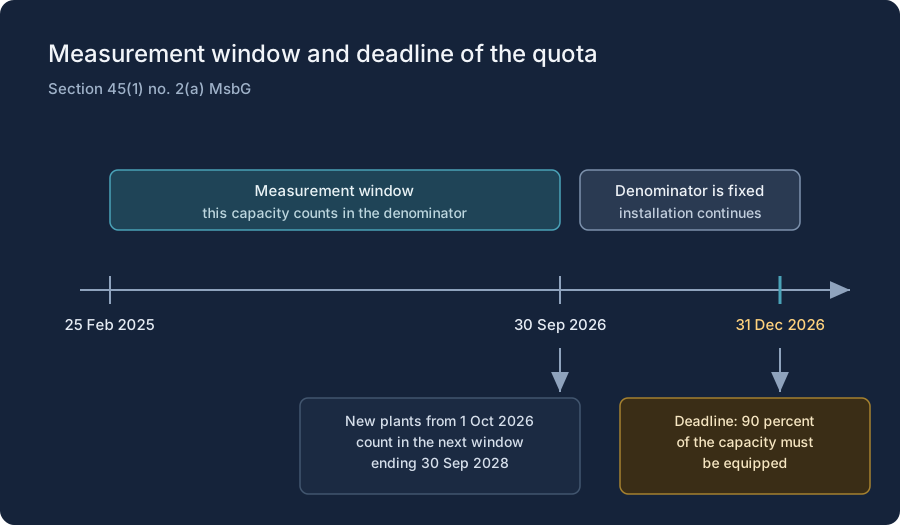
The generation equipment quota is an obligation on the default metering point operator measured in installed capacity, and its next deadline falls on 31 December 2026. Section 45(1) no. 2(a) MsbG requires that the metering points equipped by then cover at least 90 percent of the capacity newly commissioned between 25 February 2025 and 30 September 2026. It applies to the installation case groups below 100 kilowatts, meaning plants above 7 and up to 100 kilowatts; anything larger sits under no. 1 and is equipped only from 2028. The measurement window closes three months before the deadline, after which the denominator is fixed and only the numerator moves. For renewable plants above 7 kilowatts a control box goes in alongside the metering system. Germany's rollout stands at 5.5 percent of all metering locations and 3,094,346 reported smart metering systems, per the Bundesnetzagentur monitoring of 27 March 2026. If the quota is missed, section 45(2) MsbG points to measures under section 76.
Two ladders in one provision
Track a single rollout figure in the business and you are tracking the wrong one for the generation side.
The better known ladder sits in no. 4, explained in the article on the period quota under section 45 MsbG . Next to it sits no. 2, and it counts differently.
What 31 December 2026 requires
The requirement is 90 percent of the installed capacity commissioned between 25 February 2025 and the end of 30 September 2026. That capacity has to be equipped by the end of 31 December 2026.
Three details hide in that sentence, and all three are awkward. The yardstick is capacity. The window opens on a date in the middle of February. And it closes three months before the deadline.
The ladder then continues. By 31 December 2028 the provision asks for 90 percent of the capacity from the window between 1 October 2026 and 30 September 2028, plus at least 50 percent of the capacity installed between 1 January 2018 and 25 February 2025. The existing fleet follows, just later.
Plants above 100 kilowatts fall under no. 1, where equipping starts in 2028 at the earliest and the first deadline is 31 December 2028. The large ground-mounted arrays built in 2025 and 2026 therefore do not count towards this quota.
Capacity, not case count
Sort the plant list by kilowatts, descending. That is the whole insight, and it cuts across what field scheduling normally does.

A 90 kilowatt commercial roof delivers as much quota as eleven family homes at 8 kilowatts each. It costs one appointment instead of eleven, one journey instead of eleven, one scheduling call instead of eleven. Work through the list by date of receipt and you give that lever away.
The band between 25 and 100 kilowatts carries most of the load: halls, farms, municipal properties, commercial roofs. Section 30(1) MsbG already draws its own installation case group there, with a price cap of 220 euros gross per year. Below it sit 190 euros for 15 to 25 kilowatts and 130 euros for 7 to 15 kilowatts.
None of this means the small plants can wait. It means the order of work is different from what it used to be.
The quarter between window and deadline
From 1 October 2026 the denominator is fixed. It is the only phase in this quota cycle where the target stops moving while you walk towards it.
Until then the reference figure climbs with every commissioning. Each new roof array in September enlarges the base that you have to cover to 90 percent by year end. From October that stops.
Plants from the fourth quarter should of course still be equipped. They simply do not help the 2026 quota. They count towards the next window, which runs to 30 September 2028.
One detail can get expensive: what counts is the commissioning date, not the registration date. A plant that went live in August 2026 and only shows up in the Marktstammdatenregister in November lands in your denominator retroactively. Calculate in October, receive late registrations in December, and the sum was wrong.
More than a meter swap
For renewable plants above 7 kilowatts the appointment does not end with the smart metering system. A control box goes in as well.

What that means at volume is covered in the article on the control box rollout . In short: a second device, a second connection, and a commissioning step the grid operator has to carry too.
Which brings in the grid operator. Section 45(3) MsbG obliges default metering point operators to coordinate regularly with the distribution grid operators in their area and to take their operational requirements into account. That is the soft version.
The hard version sits in the same paragraph. Both sides may conclude binding agreements on implementation, and those agreements may expressly govern the timing and the geographic priority of installation cases. Where a Bundesnetzagentur determination under section 33(1) allows it, they may even set metering charges that depart from section 30, with correspondingly higher overall price caps. Almost nobody uses this instrument, and it sits exactly where quota logic and grid logic pull apart.
What can go wrong
The quota is not purely an installation problem. It rests on data, on hardware and on people, and it carries a sanction.
Both things are true at once. The hard part is not the volume, it is the change of steering: away from case counts, towards capacity.
What happens when the quota breaks is set out in section 45(2) MsbG. The Bundesnetzagentur can then order measures under section 76. How such a procedure runs is described in the article on the regulator's sanctions in the smart meter rollout .
What to do now
Two weeks remain until the measurement window closes, three months until the deadline. The first step is analysis.
Four steps before year end
-
Build the denominator in kilowatts
Bring together every generation plant above 7 and up to 100 kilowatts commissioned between 25 February 2025 and 30 September 2026, from your own records and from the Marktstammdatenregister. Add up the installed capacity, not the rows. If your system does not carry capacity per plant cleanly, that is the real job of the next two weeks.
-
Sort by capacity and book the appointments accordingly
Largest plants first. The fourth quarter belongs to the cohort from the measurement window, not to conveniently located new cases from October.
-
Check material for two devices, not one
Control boxes are the bottleneck, not metering systems.
-
Consider an agreement under section 45(3) MsbG
Where the distribution grid operator needs a different order for grid reasons than you need for quota reasons, the binding agreement is the instrument the law provides. It can fix priority in time and by location. Left unused it helps nobody.
And build the evidence trail as you go. The position on 31 December has to be documented, not reconstructed in February.
Further reading
Frequently asked questions
What does the generation rollout quota require by 31 December 2026?
Section 45(1) no. 2(a) MsbG requires that the metering points equipped by the end of 31 December 2026 cover at least 90 percent of the installed capacity newly commissioned between 25 February 2025 and the end of 30 September 2026. The measure is capacity in kilowatts, not the number of installation cases.
Which plants fall under this quota?
Plants in the installation case groups below the 100 kilowatt threshold, which under section 30(1) MsbG means more than 7 kilowatts up to and including 100 kilowatts of installed capacity. Plants above 100 kilowatts sit in the group under no. 1, where equipping starts only in 2028 with a first deadline on 31 December 2028.
Why does the measurement window end on 30 September 2026?
Because the law separates the denominator from the deadline. The denominator covers capacity commissioned up to the end of 30 September 2026. That capacity has to be equipped by 31 December 2026. Plants commissioned from 1 October 2026 count towards the next window, which runs to 30 September 2028.
Is a meter exchange enough for a generation plant?
For renewable plants above 7 kilowatts of installed capacity a control box goes in alongside the smart metering system. That means a second device, a longer appointment and material that has to be ordered well ahead.
What happens if the quota is missed?
Section 45(2) MsbG points to section 76: if the default metering point operator fails to meet its obligations, the Bundesnetzagentur can order measures. After the 20 percent quota was missed at the end of 2025 the regulator already took that route.