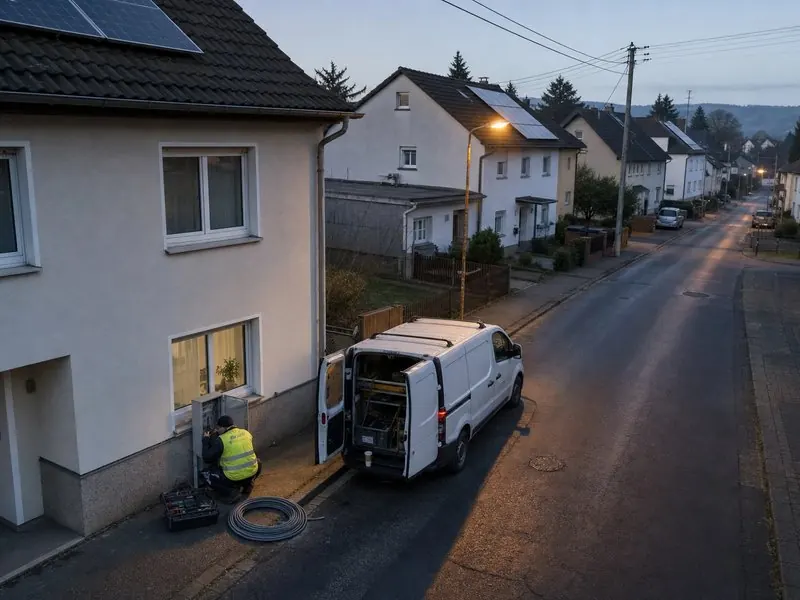
Smart Meter Rollout 2026: The Stalled Data Base for the AI Grid
Smart meters supply the high-resolution consumption data that load forecasting, congestion control and dynamic tariffs rely on. In Germany that base is largely missing. In March 2026 the federal regulator opened 77 supervisory proceedings against lagging metering operators for the first time, while a technical study judged the planned mass rollout unfeasible.
The smart meter rollout decides whether AI can control the German power grid, because intelligent metering systems supply the 15-minute consumption data on which load forecasting, congestion control and dynamic tariffs depend. Yet by the end of 2025 only around 2.4 million smart meters were installed according to the Bundesnetzagentur's corrected figures, 4.4 percent of metering points, and among the mandatory cases only about one fifth had been equipped; by mid-2026 the overall share was 5.9 percent. On 27 March 2026 the Bundesnetzagentur opened the first 77 supervisory proceedings against metering operators that missed the 20 percent quota, while a Horizonte Group study judged the 2026 mass rollout technically unfeasible. The smart meter gateway, certified by the Federal Office for Information Security, is the encrypted data hub between household, grid operator and supplier and the basis for control under section 14a EnWG. For companies the order is clear: first build clean, interoperable metering data, then use AI applications and dynamic tariffs.
Why the stalled meter swap is an AI problem
The smart meter rollout decides whether AI can control the German power grid. Intelligent metering systems supply the high-resolution consumption data on which load forecasting, congestion control and dynamic tariffs are built. By the end of 2025, however, penetration stood at only 4.4 percent (5.9 percent by mid-2026), and the backlog is becoming the bottleneck for digitalising the energy transition. The Bundesnetzagentur had first reported 5.5 percent for the end of 2025 and corrected the figure in September 2026 because the totals contained double counts.
The link is simple: AI models for the grid and the market need metering data in 15-minute intervals. Without a meter base they lack the input and stay blind across large parts of the grid. How AI helps catch load peaks in an emergency is covered in innobu's article on AI-driven blackout prevention. The precondition for it is the data base discussed here.
What a smart meter can do and how the gateway works
An intelligent metering system consists of a modern metering unit plus the smart meter gateway, the communication unit certified by the Federal Office for Information Security. The gateway encrypts the readings and distributes them to authorised market participants. It is the data hub between household, grid operator and supplier.
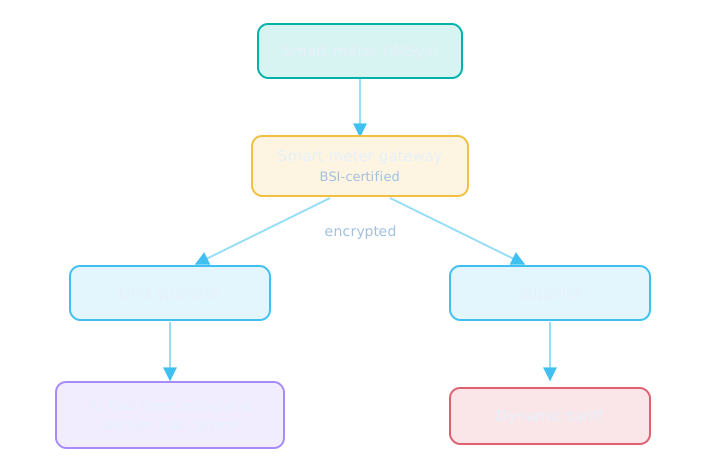
The security-critical component is the gateway. Certification by the Federal Office for Information Security, with requirements at a high security level, delayed the market launch for years. That protection is justified, because 15-minute profiles are sensitive data, but it adds complexity and therefore installation cost.

The use cases reach well beyond billing. The gateway's data base supports dynamic tariffs, grid-friendly control under section 14a, integration into virtual power plants and, in time, the bidirectional charging of electric cars.
The mandatory schedule: who gets a meter when
The Metering Operation Act obliges the basic metering point operators to roll out in stages. Mandatory cases are consumers above 6,000 kilowatt hours of annual use and generation systems above 7 kilowatts, so many households with photovoltaics or a heat pump; the plant side carries its own generation rollout quota, measured in kilowatts. Since 2025 any household can also actively request installation.
20 percent of mandatory cases
First stage of the schedule. Met in aggregate, but many individual operators stayed below it, which triggered the proceedings.
50 percent of mandatory cases
Second stage. Assumes that market communication and back-office processes are noticeably automated by then.
95 percent of mandatory cases
Near-complete coverage of the mandatory cases. The optional installation group follows by 2032.
Installation on request
Any household can request early installation, with a deadline of around four months at the basic metering point operator.
The obstacle lies in the structure. Across Germany 813 metering point operators are responsible, many of them small municipal utilities without enough IT and staff. This fragmentation explains why the same duty is met very differently from region to region.
German perspective: the regulator acts, a study brakes
On 27 March 2026 the Bundesnetzagentur opened 77 supervisory proceedings against metering operators that, despite warnings, had installed no or too few meters. At the same time a technical study warns that the planned mass rollout for 2026 cannot be achieved. Both show the tension between political pressure and real feasibility.
Smart meter installation plays a central role in digitalising our power system. The agency is pursuing implementation with determination.
Klaus Müller, President of the Bundesnetzagentur, paraphrased on the opening of proceedingsThe agency threatens penalty payments and has announced further proceedings against smaller operators. On the other side, the Horizonte Group technical study from November 2025 concludes that the mass rollout for new systems in 2026 is technically not feasible. It cites back-office bottlenecks and a lack of interoperability between IT systems.
Fax meets AI agent: How deep the fragmentation runs is shown by one example from practice. A modern provider already files transactions through a software agent, while at the counterpart the same request lands in a fax machine. The rollout therefore depends less on the devices than on market communication between the parties.
Section 14a and dynamic tariffs: what the data is for
Smart meters are the precondition for grid-friendly control and time-variable prices. Section 14a EnWG allows grid operators to dim controllable loads such as heat pumps and wallboxes to 4.2 kilowatts during a bottleneck instead of switching them off. In return grid fees fall through three modules.
Flat reduction of grid fees, roughly 110 to 190 euros per year depending on the grid. Mandatory for new controllable devices.
Percentage reduction of the grid fee energy price by 60 percent. Rules out combining it with module 3.
Time-variable grid charges with a low, standard and high-load tariff. Grid operators have had to offer this module since April 2025.

On the supplier side too the data hangs on the meter. Since 2025 electricity suppliers have had to offer at least one dynamic tariff that tracks the hourly spot market price. Such tariffs require an intelligent metering system. The nationwide spread between the standard and low tariff in 2026 averages 5.1 cents per kilowatt hour net, a real incentive to shift consumption into cheaper hours.
Where AI uses the data and where the limits are
Once the data is available, AI does concrete work in the distribution grid. Studies report load forecasts with an error below two percent. At the same time technology alone does not solve the control problem, and dynamic prices in particular have a downside.
Load forecasting
Short-term prediction of consumption and generation from weather, real-time data and history. Reported error rates fall below two percent.
Congestion detection
Models predict local grid bottlenecks and estimate where and how much flexibility is needed to avoid them.
Anomaly and loss
Detection of metering errors, technical losses and unusual patterns up to manipulation, based on the meter profiles.
Topology
Inference of the actual grid structure from metering data where plans are incomplete, as a basis for planning and control.
Flexible loads
Integration of heat pumps, wallboxes and storage into control, and their aggregation into virtual power plants.
Market optimisation
Matching consumption and spot price so that dynamic tariffs and self-generation work together sensibly.
A critical voice from research: Fraunhofer IEE warns that purely market-driven dynamic prices do not address local grid bottlenecks and can even amplify synchronisation effects. If every wallbox charges in the same cheap hour, a new load peak appears. AI on metering data and local grid signals must therefore work together, not the market price alone.
Challenges and risks
The rollout depends on organisation, not only on technology. Fragmentation, manual processes and a dispute over market structure brake it more than the devices themselves. An honest balance shows what already holds and what is still missing.
On top comes the political dispute over market structure. A proposal to concentrate the rollout more with the basic operator prompted more than 36 companies and associations to issue a joint warning against re-monopolisation. Data protection and IT security remain a standing task, because 15-minute profiles allow deep insight into a daily routine, which in Europe falls under the GDPR.
What companies should do now
Municipal utilities, grid operators and larger consumers should treat the backlog as a plannable project, not a tick-box duty. Whoever builds the data base early can use AI applications and dynamic tariffs first. Four steps help you prepare.
-
Align the rollout with the schedule
Metering operators should align their installation plan clearly with the quotas for 2028 and 2030 and prioritise the mandatory cases with high consumption and generation.
-
Automate market communication
The biggest lever sits in the back office. Replacing manual and paper-based processes with interoperable interfaces lifts the real bottleneck of the rollout.
-
Data strategy before AI project
Without clean, interoperable metering data every AI load forecast stays theoretical. Data quality, access rights and data protection belong at the start, not the end.
-
Let consumers take the initiative
Industry and commerce above 6,000 kilowatt hours should request installation actively and check load flexibility and the section 14a modules for their benefit.
In 2026 the smart meter rollout is no longer a mere duty but the precondition for any serious AI control in the grid. Whoever orders the meter base and market communication now can use load forecasting, congestion control and dynamic tariffs as soon as the data flows. How AI is changing the distribution grids in the DACH region is explored in the article on the Digital Grid Insights and the digitalisation of distribution networks.
Further reading
Frequently asked questions
A smart meter, called an intelligent metering system or iMSys in German law, consists of a modern digital metering unit plus the smart meter gateway. The gateway is the communication unit certified by the Federal Office for Information Security. It measures consumption in 15-minute intervals, encrypts the values and distributes them to authorised market participants such as the grid operator and supplier.
By the end of 2025 around 2.4 million intelligent metering systems were installed according to the Bundesnetzagentur's corrected figures, 4.4 percent of all metering points; by mid-2026 it was around 3.17 million, or 5.9 percent. Around half of all meters are digital, that is modern metering units, but without a gateway and therefore not able to communicate. Among the legally defined mandatory cases only about one fifth had been equipped by the end of 2025.
The Metering Operation Act obliges the basic metering point operators to install meters for consumers above 6,000 kilowatt hours of annual use and for generation systems above 7 kilowatts, for example households with photovoltaics or a heat pump. Since 2025 any household can also actively request installation, with a deadline of around four months.
Section 14a EnWG allows grid operators to dim controllable loads such as heat pumps and wallboxes to 4.2 kilowatts during a grid bottleneck instead of switching them off. The precondition is an intelligent metering system. In return grid fees fall: through a flat reduction, a percentage reduction, or since April 2025 through time-variable grid charges in module 3.
AI models for load forecasting, congestion detection and the control of flexible loads need metering data in 15-minute intervals. Without widespread smart meters this input is missing, and the models stay blind across large parts of the grid. At 5.9 percent penetration by mid-2026 the data base for broad AI-driven grid control does not yet exist.
Let's collaborate
One contact, a team behind it
Thirty minutes on what you're working on, whether grid, metering, market processes, IT architecture or AI. Afterwards you'll know how we'd approach it and who would sit at the table.
Energy and measurement technology since 2010 · innobu GmbH since 2014 · Based in Schleswig-Holstein, Germany
Whoever pitches also delivers: whoever leads the first call stays your contact right through to the steering committee, with established partners in the project. Direct: info@innobu.com