MsbG amendment 2025: higher price caps and new duties
This is a regulatory and billing article. It looks at the financial and operational changes the amendment to the Messstellenbetriebsgesetz (MsbG) brings: the higher price caps per band, the split between the network operator share and the connected user share, the two-year holding period, the 15-minute data provision with a smart meter app, and the preferred-date charge. The rollout quotas and their sanctions are a separate topic, covered in the article on rollout quotas and sanctions: this piece treats them only as context. Where the brief writes gMSB, that is the basic metering point operator. The terms are used as plain English: price cap, holding period, connected user share and preferred date.
The 2025 amendment to the Metering Point Operation Act (Messstellenbetriebsgesetz, MsbG) came into force on 25 February 2025, with the new price caps applying retroactively from 1 January 2025. It raises the price caps for smart metering for the first time since 2016, by around 30 percent on average, because the old rates were below the real cost. The largest jump is for feed-in operators of 15 to 25 kilowatts, from 50 to 110 euro per year. Not every band is raised: the iMSys band from 10,001 to 20,000 kilowatt hours stays at 50 euro. The total price cap splits into a network operator share, capped at 80 euro per year, and a connected user share that the end customer sees on the bill, and sources often mix the two readings. Beyond the money, the amendment adds a two-year holding period after installation (Section 5), the provision of consumption data within 15 minutes via an app or portal (Sections 61 and 62), quarter-hourly data delivery to the network operator on request (Section 60) and a preferred-date installation right with a one-off charge of at most 100 euro plus at most 30 euro per year. Section 30 MsbG requires economic viability, and the higher caps are meant to improve the refinancing of quota compliance. The rollout quotas and supervisory procedures themselves are a separate article. Companies should update price sheets and billing to the new caps retroactively to 1 January 2025, set up the 15-minute data path, map the holding period and preferred date in CRM and ERP, and recalculate economic viability per band.
What the 2025 MsbG amendment is
The amendment is more than a tightening of the quotas. It came into force on 25 February 2025, and the new price caps apply retroactively from 1 January 2025. It is part of an energy law amendment that adjusts the Metering Point Operation Act (Messstellenbetriebsgesetz, MsbG), the Renewable Energy Sources Act (EEG) and the Energy Industry Act (EnWG) together, so it has to be read as one package rather than a single isolated change.
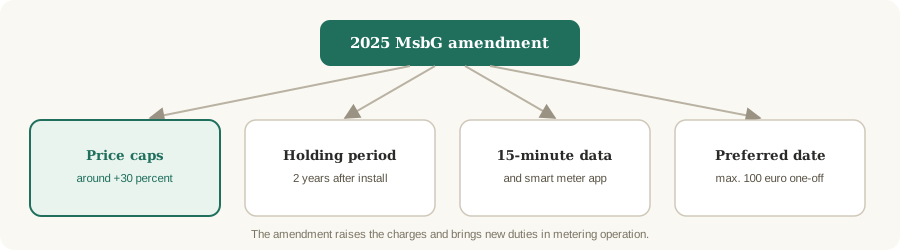
The amendment pulls four levers at once. The first is the price caps, raised for the first time since 2016. The second is a two-year holding period after the installation of a smart metering system. The third is a set of new data duties, including the provision of consumption data within 15 minutes via an app. The fourth is a preferred-date installation right with a capped charge. The most consequential of the four, for a metering point operator, is the first.
One boundary is worth stating clearly. The quotas and their enforcement are a separate topic and are not the subject of this article. They are covered in the piece on rollout quotas and sanctions. Here they appear only as context, because the higher caps are the financial counterpart to the tighter quotas, not as the main thread.
The higher price caps
At the core is money. What a metering point operator may charge a connected user per year rises in almost all bands, the increase being around 30 percent on average versus the level fixed in 2016. The reason is plain: the old rates were below the real cost, so the rollout was hard to refinance at the previous caps.

The largest single jump is for feed-in operators of 15 to 25 kilowatts, where the cap moves from 50 to 110 euro. Not every band is raised, though: the iMSys band from 10,001 to 20,000 kilowatt hours stays unchanged at 50 euro, so it would be wrong to say all caps went up. Where a metering point hosts more than one metering system, the cap can be charged separately for each additional system.
| Band | 2024 | from 2025 |
|---|---|---|
| Modern metering device (mME) | 20 euro | 25 euro |
| iMSys up to 6,000 kWh | 20 euro | 30 euro |
| iMSys 6,001 to 10,000 kWh | 20 euro | 40 euro |
| iMSys 10,001 to 20,000 kWh | 50 euro | 50 euro |
| iMSys 20,001 to 50,000 kWh | 90 euro | 110 euro |
| Feed-in EEG 7 to 15 kW | 20 euro | 50 euro |
| Feed-in EEG 15 to 25 kW | 50 euro | 110 euro |
These figures are the connected-user share, the part the end customer sees on the bill. Source: Pfalzwerke Netz. They should not be confused with the total cap, which also includes the network operator share treated in the next section.
Holding period, 15-minute data and the smart meter app
Alongside the money come new duties. They affect the switching process, the provision of data and the interface to the customer, and they are where most of the operational work sits.

The first new duty is the holding period. After a smart metering system is installed, a two-year holding period applies under Section 5. The right to choose a different metering point operator can only be exercised once that period has passed, which gives the installing operator a planning horizon for the rollout.
The second is data provision to the customer. Consumption data must in future be made available within 15 minutes via an app or a portal of the metering point operator, under Sections 61 and 62. That is a step up from the slow feedback of the past and turns the meter into a near-live information source for the household.
- Holding period: two years after installation of a smart metering system (Section 5).
- Customer data: consumption data within 15 minutes via app or portal (Sections 61 and 62).
- Network operator data: quarter-hourly data delivery to the network operator on request (Section 60).
- Market roles: new market roles and bundled offers across the sectors.
The third duty points the other way, toward the grid. On request the metering point operator must deliver quarter-hourly data to the network operator under Section 60. Together with the new market roles and bundled offers across sectors, this widens the data flows the metering point operator has to support, not just toward the customer but toward the grid as well.
Economic viability, preferred date and the quotas
The increase has a purpose. Section 30 MsbG requires economic viability, and the old rates fell short of it because they were set below cost. Raising the caps is the way the legislator tries to put the metering business back on a refinanceable footing.
The preferred date is the second piece of this logic. On customer request there is a right to installation, and for that a one-off additional charge of at most 100 euro plus an ongoing surcharge of at most 30 euro per year may be levied. These caps end the earlier practice of charging several hundred euro for an early installation, while still letting the operator recover part of the cost.
The higher price caps improve the refinancing of quota compliance: they are the financial counterpart to the tighter rollout obligations. The quotas themselves and the supervisory procedures are a separate article, the piece on rollout quotas and sanctions. For the contract side of the same picture see the article on metering contracts under BK6-24-125, and for the wider rollout context the pieces on the smart meter rollout and AI and the control box under Section 14a.
What companies should do now
Whoever adjusts billing and processes early collects the retroactive charges correctly and meets the new duties on time. Economic viability has to be recalculated band by band with the new caps.
- Update price sheets and billing. Move price sheets and billing to the new caps per band, retroactive to 1 January 2025, so the higher charges are recovered correctly.
- Set up the 15-minute data path. Stand up the app or portal for consumption data within 15 minutes and the quarter-hourly delivery to the network operator on request.
- Map the holding period and preferred date. Reflect the two-year holding period and the preferred-date process in CRM and ERP, including the capped one-off and annual charges.
- Recalculate economic viability per band. Re-run the economic viability calculation for each band with the new caps, since not every band moves by the same amount.
Further reading
Frequently asked questions
The 2025 MsbG amendment pulls four levers at once. It raises the price caps for smart metering for the first time since 2016, by around 30 percent on average. It adds a two-year holding period after installation, the provision of consumption data within 15 minutes via an app or portal, and a preferred-date installation right with a capped charge. The rollout quotas and their enforcement are a separate topic.
The price caps rise by around 30 percent on average versus the 2016 levels. The largest jump is for feed-in operators of 15 to 25 kilowatts, from 50 to 110 euro per year. One band stays unchanged, the iMSys band from 10,001 to 20,000 kilowatt hours at 50 euro, so not every band is raised. The increase applies retroactively from 1 January 2025.
The total price cap consists of a network operator share and a connected user share. The network operator share is capped at 80 euro per year. The connected user share is what the end customer sees on the bill. Sources often mix the two readings, so it is worth separating them when checking the figures.
After a smart metering system is installed, a two-year holding period applies under Section 5 MsbG. The right to choose a different metering point operator can only be exercised once that period has passed. The aim is to give the installing operator a planning horizon for the rollout and its refinancing.
On customer request there is a right to installation on a preferred date. For that, a one-off additional charge of at most 100 euro and an ongoing surcharge of at most 30 euro per year may be levied. These caps prevent the earlier practice of charging several hundred euro for an early installation.