
Control box rollout at scale: ordering, fitting, proof
This article walks the process chain a German metering point operator has to master in 2026: who orders the control box, what the customer must provide, which master data the grid operator needs, and how the proof finally comes together.
A control box is the control device that the basic metering point operator fits alongside the intelligent metering system; it is mandatory for renewable generation above 7 kW installed capacity and for installations covered by an agreement under section 14a EnWG. At the 31 December 2025 cut-off the national rollout quota reached 23.3 percent of mandatory installation cases, above the required 20 percent, with large operators at 27.1 percent and small ones at 14.6 percent. Eight control box solutions are certified against BSI TR-03109-5, two of them carrying an integrated EEBus interface since June 2025. Even so the bottleneck is not hardware: fitting capacity is short, the customer-side control signal terminal strip is often missing, and the master data model with technical resource ID, controllable resource ID and network location will only be presented by BDEW in 2026. Two thirds of the companies surveyed for the Technische Studie 2.0 consider a mass-capable rollout by 2026 unrealistic and propose a four-stage approach stretched to 2028. Reporting runs through MonEDa, and fines for missing the quota reach 10 million euro.
Where the rollout actually stands
First statutory hurdle cleared. At the 31 December 2025 cut-off, intelligent metering systems reached 23.3 percent of mandatory installation cases against a required 20 percent. Good news, and it lasts exactly until the second stage.
That average hides a wide spread. Large metering point operators with 500,000 metering points or more came in at 27.1 percent, mid-sized ones between 100,000 and 500,000 points at 19.7 percent, and small operators under 30,000 points at 14.6 percent. Small means, on average, missing the quota.
Zoom out and the number says even less: modern metering devices sit at 53.8 percent of all metering points, intelligent metering systems at just 5.5 percent. This rollout has barely started.
Reporting runs through the regulator's MonEDa platform, and the first half-year survey for 2026 ran until 24 July. Miss the quota and supervisory measures follow, with fines from 1,000 euro up to 10 million euro. How seriously the regulator means it shows in the current state of the supervisory proceedings .
When a control box becomes mandatory
A control box is not an accessory. German law provides for it in two cases, and both are growing faster than fitting capacity is being built.
Case one is renewable generation above 7 kW installed capacity. Case two is any installation covered by an agreement under section 14a EnWG. New installations have to be equipped within two years; existing ones follow the longer deadlines out to 2032, when 90 percent of all metering points are meant to carry an intelligent metering system.
Pricing is settled too. Since the amendment to the Metering Point Operation Act, the customer pays between 40 and 140 euro gross a year depending on consumption, the grid operator contributes up to 80 euro, and section 14a cases add 50 euro per control device. How that cost split works in detail sits in the analysis of the MsbG price caps .
The ordering process: who commissions whom
Customer orders, metering point operator delivers, grid operator switches. Sounds orderly. In practice the whole chain hangs on an order that many customers never register as one.
Because for the reduced network charges under module 1 or module 2, ordering the intelligent metering system and control box is enough. Actual installation is not required for that. So the customer has the benefit the moment the order is placed, and loses all interest in the fitting appointment.
That is the order backlog no installation quota shows. It sits between the open orders in the CRM and the figure in the MonEDa report, and in many utilities nobody measures it.
Standardising this mass business is the job of the nationwide recommendations from ruling BK6-22-300 of 27 November 2023. VDE FNN published three guidance notes in April 2025, among them the maximum validity of a grid state assessment: 5 minutes between the measurement result and the triggered reduction. And where a grid operator cannot otherwise judge whether a controllable device meets the technical requirements, asking for evidence does not count as abusive.
Fitting and customer cooperation
This is where the process breaks most often, at a point no metering point operator controls.

Owners have to arrange for a control signal terminal strip, the path by which a command reaches the device at all. Many customers do not know about this requirement. Nor, it turns out, do many electricians.
Then there is space. In existing buildings the meter cabinet is often too small unless the customer rebuilds. An appointment that fails on that costs the journey twice and pushes the installation back by months.
Even with strip and space in place, capacity remains: available fitting capacity frequently falls short of what the statutory rollout demands. Wide area network coverage over LTE stays under 70 percent, which delays commissioning further. Route order for the fitting tour is therefore a cost question, not a question of effort.
Proof: master data and reporting
A fitted control box only counts once it shows up in the data. And that is exactly where the standard is missing.
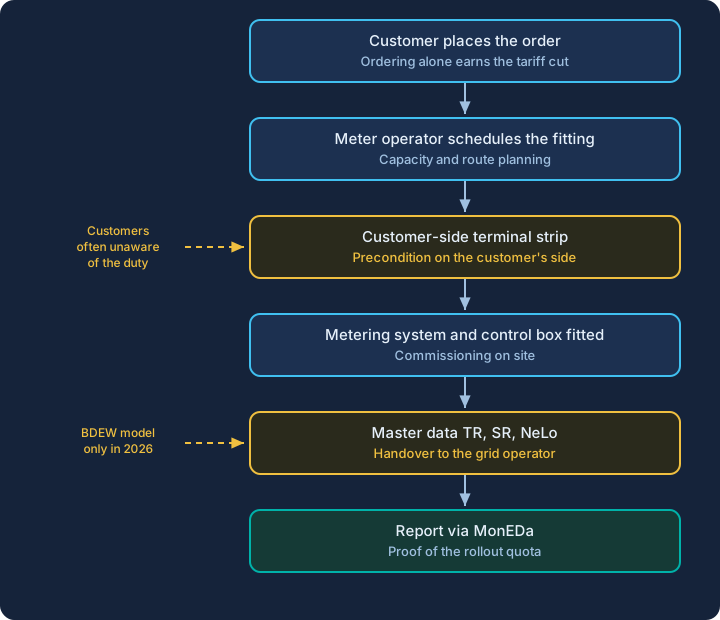
Grid operators need the mapping of technical resource ID, controllable resource ID and network location, otherwise targeted switching is impossible. BDEW will only present that master data model in 2026. Until then the processes between grid operator and metering point operator run provisionally, because the nationwide specification does not exist.
In parallel, many utilities lack the billing processes and matching data models in their ERP for the new price structure. Fitting the box without being able to bill it is half a job.
Outwardly what counts is the MonEDa report. It knows nothing about provisional arrangements.
Two positions, one deadline
Regulator and industry look at the same deadlines and reach opposite conclusions.
Both sides are right, and that is the uncomfortable part. Hardware is certified and available, the process chain behind it is not. A deadline that looks at certified devices measures the wrong bottleneck.
Where it really jams
Four bottlenecks, all of which want solving at once. None of them is certification.
Availability
A general shortage of available, good-quality control boxes persists, and many devices show field problems after a few months.
Digital control
Most certified boxes switch through analogue relay interfaces. Boxes combining analogue and digital control over EEBus only reached the field in early 2026.
Fitting
Capacity, space in the meter cabinet, customer cooperation. Three reasons a scheduled appointment does not become a fitted installation.
Data
Missing master data model, provisional processes between the market roles, ERP without matching billing.
The control box itself is the best-solved part of this chain. Which is remarkable, given that the debate circled around it for years. Anyone wanting the control chain in technical detail will find it in the analysis of control boxes and section 14a grid control ; anyone asking who actually operates the channel should read the piece on CLS management and the aEMT role .
What utilities should do now
This rollout stopped being a procurement topic. It is an order and data topic.

Four steps for the coming months
-
Measure the order backlog
How many control box orders are open, how many of those are fitted, how old is the oldest open order? Most utilities do not have these three numbers, and without them the fitting schedule is planned blind.
-
Move customer communication forward
The control signal terminal strip belongs in the appointment confirmation and in a conversation with the local electrical trade, not on a leaflet in the attachment.
-
Set up the master data chain provisionally but documented
Decide now where technical resource ID, controllable resource ID and network location live in your own systems and how they travel to the grid operator. Then the switch to the BDEW model in 2026 becomes a migration rather than a fresh start.
-
Name your own stage honestly
Pilot, extension of functions, regular operation for new installations, or existing stock: the four-stage grid from the Technische Studie 2.0 works as a shared language toward the supervisory board and the regulator.
Certified hardware exists and the smart meter quota is met. What is missing is three numbers on the order backlog, a master data chain that holds, and the realisation that a terminal strip in a customer's cellar decides the appointment.
Further reading
Frequently asked questions
In two cases. First for renewable generation above 7 kW installed capacity, second for installations covered by an agreement under section 14a EnWG, meaning heat pumps, wallboxes and batteries. The basic metering point operator then fits the control device alongside the intelligent metering system. New installations have a two-year deadline.
The customer commissions the metering point operator, or alternatively the grid operator. For the reduced network charges under module 1 or module 2, simply ordering the intelligent metering system and control box is enough; the actual installation is not yet required. That decoupling creates an order backlog which no installation quota shows.
Eight control box solutions are certified against the technical guideline BSI TR-03109-5. The two most recent come from Theben Smart Energy and VIVAVIS and were certified in June 2025. They are the first to carry a fully integrated EEBus interface, while the older boxes mostly switch through analogue relay interfaces.
The owner has to have a control signal terminal strip fitted, through which the switching command reaches the device. Many customers and many electricians are still unaware of this requirement. In existing buildings the meter cabinet often lacks the space as well, so the customer has to rebuild before the fitting appointment.
Through the regulator's MonEDa platform. The first half-year survey for 2026 ran until 24 July 2026. Operators who miss the statutory quota face supervisory measures, with fines ranging from 1,000 euro to 10 million euro. At the 31 December 2025 cut-off the national quota stood at 23.3 percent of mandatory installation cases.