GPKE and feed-in processes: integrating the MPES processes in 2025
With that step the feed-in point becomes the generating metering point, the reference for supplier switch, registration and master data on the generation side. MPES stands for market processes for feed-in points.
The 6 June 2025 date is the same one that brings the 24-hour supplier switch on the consumption side, and it sits within the wider development of market communication, in which EDIFACT stays and API web services cover MaLo identification and control.
Until June 2025 the German market communication for electricity ran on two separate rulebooks. The GPKE governed the consumption points, with supplier switch, registration, master data and market communication, while the MPES, the market processes for feed-in points, did the same job for generation plants and direct marketing on the basis of BK6-20-160, valid until 5 June 2025. From 6 June 2025, postponed from the original 4 April 2025, the separate MPES rules are repealed and their content moves into the GPKE, so feed-in and consumption processes run within one rulebook. The legal anchor is the LFW24 ruling BK6-22-024 with Notice No. 4 of 6 December 2024, flanked by the parallel proceeding BK6-24-174, which brings the new GPKE reading versions and the metered-load-profile transmission under the MsbG to the same date: two parallel BNetzA proceedings, one effective date. The term feed-in point is replaced by generating metering point, which also captures generation that does not feed directly into a public grid and ties the process to the Market Master Data Register (MaStR) with over 3 million generation plants. The GPKE itself is restructured into four parts: an introduction, the assignment processes, the configurations and control commands, and the master data processes, shared for consumption and generating metering points. For direct marketers and plant operators this is the biggest change in years: direct marketers become a market role in the GPKE, switch, registration and master data follow the GPKE mechanisms, a new MaLo identification process via API and new EDIFACT formats apply from 6 June 2025, and the old MPES master data has to be migrated into the new master-data logic. Whoever maps the case references, inventories and migrates the generation master data, moves the direct-marketer processes into the GPKE role model, tests API and formats, and trains the market-communication teams is on the front foot.
GPKE and MPES: two rulebooks become one
Until June 2025 there were two separate worlds. The GPKE governed the supply of consumers, the MPES governed the processes around generation plants. That split now ends, and the two rulebooks become one.
The GPKE, the business processes for the supply of electricity, has long governed the consumption side. It defines the supplier switch, the registration and deregistration, the master data and the market communication that go with the delivery of electricity to a consumption point. For years it was the central rulebook of the German electricity market communication, but only for consumption points, not for generation.
The MPES, the market processes for feed-in points, were the separate rulebook for the generation side. They covered the same kinds of process, supplier switch, registration and master data, but for generation plants and direct marketing, most recently on the basis of the BK6-20-160 ruling, which was valid until 5 June 2025. So a market participant active on both sides had to operate two parallel sets of rules.
Two rulebooks meant double maintenance. Companies had to keep two process worlds, often two IT setups and two sets of special cases, even though many of the underlying steps were similar. The aim of merging the MPES into the GPKE is harmonisation: one rulebook for both consumption and feed-in, fewer parallel structures and less complexity in the long run.
What happens on 6 June 2025
The effective date is the same one that brings the 24-hour supplier switch. The separate MPES rules are repealed and their content moves into the GPKE, driven by two parallel proceedings at the Federal Network Agency (BNetzA).
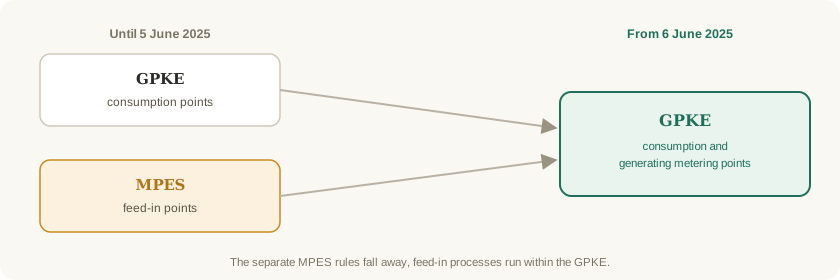
The integration is effective from 6 June 2025, postponed from the original date of 4 April 2025. From that day the separate MPES rules are no longer in force, and the feed-in processes that they used to govern run within the GPKE. The end of the MPES is not a soft transition but a clean cut-off: the old BK6-20-160 ruling runs only until 5 June 2025, and the new GPKE world starts the next day.
The MPES content is transferred under the LFW24 ruling BK6-22-024, which is set out in Notice No. 4 of 6 December 2024. This is the same ruling that anchors the 24-hour supplier switch on the consumption side, so the feed-in integration and the faster switch sit in one rule package with one effective date. That is why the two changes share the same deadline and why companies should plan them together.
Alongside it runs a second, parallel proceeding, BK6-24-174. It brings the new GPKE reading versions and the metered-load-profile transmission under the MsbG, the metering point operation act, to the same 6 June 2025 date. It is worth being clear about this: these are two parallel BNetzA proceedings pointing at one effective date. BK6-22-024 carries the LFW24 logic and the MPES transfer, BK6-24-174 carries the restructured GPKE reading versions and the metering side, and only together do they describe the full picture of what changes on 6 June 2025.
From feed-in point to generating metering point
One term disappears and a new one arrives. The feed-in point becomes the generating metering point, and that is more than a rename.

Under the MPES the unit of process was the feed-in point. In the GPKE this is replaced by the generating metering point, the counterpart on the generation side to the metering point on the consumption side. The shift in term aligns the generation side with the metering-point logic that the GPKE already uses, so both consumption and generation are described in the same vocabulary.
The new term is also broader than the old one. The generating metering point captures generation that does not feed directly into a public grid, for example plants behind a customer connection or in a closed network. Where the feed-in point was tied to the act of feeding into the public grid, the generating metering point is tied to the act of generating, which fits the way modern plants and self-consumption setups actually work.
As a metering point in the GPKE, the generating metering point becomes the reference point for the core processes: the supplier switch, the registration and the master data on the generation side all hang off it. It is tied to the Market Master Data Register (MaStR), which holds over 3 million generation plants, so the register and the process world are anchored to the same identity for each plant.
The new GPKE structure in four parts
The GPKE is recut. Instead of separate process lists for consumption and feed-in, there are now four shared parts that apply to both worlds.
The restructuring is what makes the merger work in practice. Rather than bolting the old MPES processes onto the side of the GPKE, the BNetzA reorganises the GPKE into four parts that each cover a class of process and apply equally to consumption and generating metering points. The four parts are:
- Part 1, introduction: the introductory process description that sets out scope, terms and how the rest of the document is read.
- Part 2, assignment processes: the assignment processes such as supply start, supply end and supplier switch, the core of who supplies a metering point.
- Part 3, configurations and control commands: the configurations and the control commands that describe how a metering point is set up and steered.
- Part 4, master data processes: the master data processes that keep the data of the metering point correct and synchronised between market participants.
Because the four parts are shared, a process such as the supplier switch is now described once and read the same way for a consumption point and a generating metering point. That is the structural pay-off of the merger: the feed-in side stops being a separate annex and becomes part of the same body of rules, which is also why the master data migration in Part 4 matters so much for the generation side.
What changes for direct marketers and plant operators
For the feed-in side this is the biggest change in years. Direct marketers and plant operators have to move their processes and data into the GPKE logic.

The direct marketer becomes a market role within the GPKE processes for generating metering points. Where the MPES described the direct marketer in its own terms, the GPKE now carries the role directly, so the direct marketer takes part in the standard process world rather than a separate one. The supplier switch, the registration and deregistration and the master data all follow the same GPKE mechanisms that already apply at consumption points, which means the generation side inherits a process logic that many teams already know from the supply side.
On the technical side, two things change at once from 6 June 2025. There is a new MaLo identification process via API, the process of identifying the metering point through an interface rather than the older message paths, and there are new EDIFACT formats for the messages themselves. Direct marketers and plant operators therefore have to adapt both the channel and the formats. It is not a move away from EDIFACT: under Bundesnetzagentur notice no. 58, API web services are expected to stay limited to MaLo identification and control, and the switching and master-data processes keep running on EDIFACT.
The largest single task is the master data migration. The master data that used to live under the MPES has to be moved into the new master-data logic in Part 4 of the GPKE. This is not a one-time export but a mapping of the old fields and identities onto the new structure, so that each generating metering point carries correct and complete master data on day one of the new rulebook. Getting this migration right is what decides whether the switch and registration processes run cleanly afterwards or generate clearing effort.
What companies should do now
Whoever moves the feed-in side into the GPKE world early avoids process errors and clearing effort later. The master data migration and the API connection are the largest pieces, and they line up with the format work set out in MaKo 2026 with EDIFACT, AS4 and API web services and with the remote-control duties in the direct marketing and remote control over the smart meter gateway article.
- Clarify the case-reference mapping of the GPKE parts. Map which content sits in BK6-22-024 and which in BK6-24-174, document the four GPKE parts internally, and make sure the teams know which case reference governs which process.
- Inventory and migrate the generation master data. List the existing MPES master data for every generating metering point and migrate it onto the GPKE master-data logic in Part 4, so each plant carries correct data from the start.
- Move direct-marketer processes into the GPKE role model. Take the direct marketer into the GPKE role model for supplier switch, registration and master data, and test the new MaLo identification via API and the new EDIFACT formats before the cut-off. The metering-side shift on consumption is the related change in ZSG quarter-hour balancing.
- Train the market-communication teams. Bring the teams onto the shared consumption and generation rulebook, so the people running the messages understand that feed-in and consumption now follow the same GPKE logic.
Further reading
Frequently asked questions
Until June 2025 the GPKE governed the consumption points and the MPES the feed-in points as two separate rulebooks. From 6 June 2025 the separate MPES rules are repealed and their content moves into the GPKE, so supplier switch, registration and master data run within one rulebook for both consumption and generating metering points. The aim is harmonisation and less double maintenance of processes and IT.
The integration is effective from 6 June 2025, postponed from the original date of 4 April 2025. The MPES are transferred under the LFW24 ruling BK6-22-024, set out in Notice No. 4 of 6 December 2024. This is flanked by the parallel proceeding BK6-24-174, which brings the new GPKE reading versions and the metered-load-profile transmission under the MsbG to the same date.
The generating metering point replaces the term feed-in point in the GPKE. It is the reference point for supplier switch, registration and master data on the generation side, and it also captures generation that does not feed directly into a public grid. It is tied to the Market Master Data Register (MaStR), which holds over 3 million generation plants.
Direct marketers are taken into the GPKE processes as a market role for generating metering points. Supplier switch, registration and master data follow the same GPKE mechanisms as at consumption points. In practice this means a new MaLo identification process via API, new EDIFACT formats from 6 June 2025 and the migration of the old MPES master data into the new master-data logic in Part 4 of the GPKE.
Both changes share the same effective date of 6 June 2025 and the same legal anchor, the LFW24 ruling BK6-22-024. The 24-hour supplier switch under Section 20a(2) EnWG shortens the switch on the consumption side, while the MPES integration brings the feed-in processes into the GPKE. They are parallel parts of the same rule package, which is why companies should plan them together.
Let's collaborate
One contact, a team behind it
Thirty minutes on what you're working on, whether grid, metering, market processes, IT architecture or AI. Afterwards you'll know how we'd approach it and who would sit at the table.
Energy and measurement technology since 2010 · innobu GmbH since 2014 · Based in Schleswig-Holstein, Germany
Whoever pitches also delivers: whoever leads the first call stays your contact right through to the steering committee, with established partners in the project. Direct: info@innobu.com