Competitive metering point operation: the make-or-buy decision 2025-2027
This is an analysis of the market structure and the business-model question in metering point operation, not of contract clauses, price caps or gateway technology. It sets out the two roles, the grid-responsible metering point operator (gMSB) and the competitive metering point operator (wMSB), the customer right of choice under sections 5 and 6 MsbG, and the make-or-buy and outsourcing decision that every municipal utility now faces. The neighbouring topics sit close by: the standard contracts are covered in the article on the metering contracts under BK6-24-125, the price caps in the piece on the MsbG amendment and price caps. Note: gMSB = grundzustaendiger Messstellenbetreiber, the grid-responsible metering point operator; wMSB = wettbewerblicher Messstellenbetreiber, the competitive metering point operator; MsbG = Metering Point Operation Act.
Metering point operation in Germany has two roles. The gMSB, the grid-responsible metering point operator, is by law automatically responsible for a metering point, usually the distribution system operator, until a third party is appointed. Under section 5 MsbG the connection user and under section 6 MsbG the connection owner may pick a competitive metering point operator, the wMSB, at any time. This right of choice is not new, it has existed since the MsbG of 2016. The wMSB is not tied to a grid area, works nationwide and, unlike the gMSB, is not bound by the price caps of the MsbG amendment. By 31 December 2025 the BNetzA had been notified of 3,094,346 smart metering systems, an install quota of 5.5 percent of around 56.5 million metering points, 23.3 percent in the mandatory cases. The quota spreads sharply by operator size: large operators above 500,000 points reached 27.1 percent on average, the smallest below 30,000 only 14.6 percent, which is the economic core of the make-or-buy question. Competitive operators have installed around 110,000 smart metering systems since 2023. Outsourcing is not all or nothing: a spectrum runs from in-house operation through business process outsourcing, full-service white-label, to the assignment model. The decision BK6-24-125 of 20 November 2025 makes standard contracts binding from 1 July 2026 and lowers the barrier to market entry. The window 2025 to 2027 is the strategic decision window for the make-or-buy choice, not a legal deadline, since the mandatory rollout runs to the end of 2032. Utilities should run the make-or-buy maths honestly, examine outsourcing where the meter base is small, and enter as a wMSB only with a clear product idea.
gMSB and wMSB: who is allowed to do what
Metering point operation knows two roles with clearly divided rights. The gMSB, the grid-responsible metering point operator, is the statutory default: it is automatically responsible for a metering point as long as nobody appoints a third party. In practice the gMSB is the distribution system operator. The wMSB, the competitive metering point operator, is the voluntary competitor that a customer can choose instead. The decision lies with the customer, not with the grid operator.
The right of choice rests on two sections of the MsbG, the Metering Point Operation Act. Section 5 MsbG gives the connection user, in practice the tenant or owner-occupier who draws electricity, the right to pick a competitive operator. Section 6 MsbG gives the same right to the connection owner, in practice the property owner. This right is not a novelty of 2025: it has existed since the MsbG came into force in 2016. What has changed is the market structure around it, and that is the real subject of this article.
Two features set the wMSB apart from the gMSB and explain why competition is becoming serious. First, the wMSB is not tied to a grid area: it can win and operate metering points across the whole country, while the gMSB is bound to its own network. Second, and economically more important, the wMSB is not bound by the price caps of the MsbG amendment that limit what the gMSB may charge for a smart metering system. The competitive operator can therefore price differently, bundle metering with other services and agree longer terms, which is the basis of every wMSB business case.
Why the rollout becomes a make-or-buy question
The mandatory install quotas force every gMSB into a decision of principle: build the operation itself or buy it in. The figures the BNetzA published for the end of 2025 show why the answer depends on size more than on anything else. By 31 December 2025 the authority had been notified of 3,094,346 smart metering systems, an install quota of 5.5 percent across around 56.5 million metering points. In the mandatory cases, where installation is legally required, the quota was 23.3 percent.

The headline quota hides a sharp spread by operator size, and that spread is the economic core of the make-or-buy question. Large operators with more than 500,000 metering points reached an average install quota of 27.1 percent. The smallest operators, with fewer than 30,000 points, reached only 14.6 percent. It gets sharper still, because the next quota no longer measures the stock at all: it counts, as a period quota, only the metering points that newly fell due. Small grid-responsible operators run into economic limits on IT, certification and staff that large ones absorb across their volume, which is exactly why a uniform legal duty produces such uneven delivery, and why the route through the fallback metering operator has stopped being theoretical.
Two things sharpen the pressure further. The BNetzA has opened supervisory proceedings against operators that miss their quotas, so under-delivery is no longer cost-free. At the same time the published quota understates reality, because competitive operators have installed around 110,000 smart metering systems since 2023 that are only partly captured in the statistics, so the authority assumes the real total is somewhat higher than reported. For a small gMSB the message is the same either way: meeting the quota from its own resources may simply not be affordable, and that is where buying in comes into play. The supervisory side is set out in the article on the smart meter rollout sanctions.
The three outsourcing models
Outsourcing is not all or nothing. The choices form a spectrum, from full in-house operation at one end to complete external operation at the other, and a gMSB can sit anywhere along it depending on its meter volume and the depth of IT it wants to own.
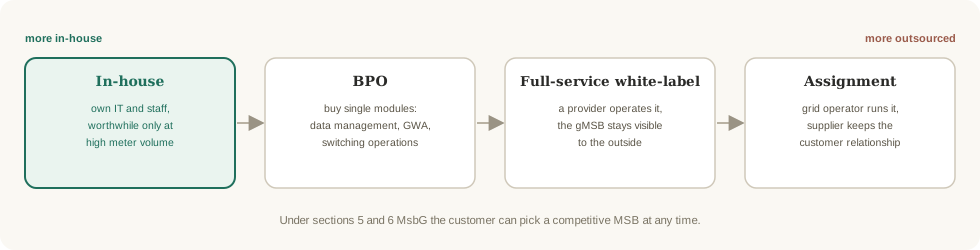

At the in-house end, the gMSB runs everything with its own IT and its own staff. This pays off only at a high meter volume, where the fixed cost of certified systems and trained people is spread across enough points to be worthwhile. One step in is business process outsourcing: instead of building everything, the operator buys single modules precisely where it lacks scale, for example data management, the gateway administration (GWA) or remote switching. Small operators increasingly pick exactly the modules they need rather than the whole stack. The gateway-administration handover during a switch is detailed in the piece on the GWA switch in the mass rollout.
Further along the spectrum sits full-service white-label: a specialist provider operates the whole metering business, while the gMSB stays visible to the outside as the responsible operator. The customer still sees the utility, but the work happens at the provider, including the procurement and logistics of meters and gateways. The fourth option is the assignment model, in German Beistellung, the economically efficient middle road: the grid operator as gMSB takes over the operational delivery, while the supplier keeps the customer relationship without building its own expensive IT. The market is visibly shifting from pure competition toward this kind of division of labour, where specialised providers handle the heavy lifting and operators choose how much to keep.
Entering as a wMSB: opportunities and obligations
Whoever wants to become a competitive operator can earn more than a gMSB, but carries set-up costs and separation duties in return. Entering the market is an investment decision, not a regulatory formality, and it only works when the business case rests on something more than the metering charge alone.
The real drivers are customer retention, bundled products and value-added services. Because the wMSB is not bound by the price caps, it can fold the metering charge into a bundle, agree longer contract terms and market additional services on top of the meter. A supplier that also operates the metering point keeps the customer relationship closer and can build products that a price-capped gMSB cannot offer. The metering charge on its own is rarely enough to justify the entry, which is why a clear product and bundle idea matters more than the meter fee.
The obligations are just as concrete. Where a single company runs both roles, the BNetzA requires an organisational separation of the gMSB and the wMSB, so that the grid-responsible default operator does not favour the company's own competitive arm. Market entry also needs partners across the whole chain: IT, field technicians, gateway administration, logistics and customer service. Few new entrants build all of this themselves, which is why the outsourcing models above and the wMSB question are two sides of the same market: the same specialist providers that let a gMSB buy in also let a new wMSB get started.
What BK6-24-125 changes for the market
Standard contracts cut the friction of a switch and make outsourcing more predictable. From the middle of 2026 a uniform set of contracts applies, and that is what turns the right of choice on paper into a market that actually moves.
The BNetzA decision BK6-24-125, taken on 20 November 2025, makes standard contracts for metering point operation binding from 1 July 2026. The uniform end-customer and supplier contracts lower the barrier to market entry for competitive operators, because a wMSB no longer has to negotiate bespoke terms with every grid operator it wants to work with. The decision references the switching processes in metering, the Wechselprozesse im Messwesen, that govern how a metering point is reassigned and how data is handed over when the operator changes.
For the make-or-buy decision the effect is indirect but important. Standardised contracts improve the negotiating basis for outsourcing agreements with service providers, because both sides build on the same framework instead of inventing one each time. They also make the cost of a switch easier to forecast, which is precisely what a gMSB needs when it weighs in-house operation against buying in. The contracts themselves, including the standard documents and the penalty regime, are set out in detail in the article on the metering contracts under BK6-24-125.
What utilities should decide now
The strategic switch for 2025 to 2027 is being set now, and that window is about the decision, not the end of the rollout, which runs to the end of 2032. Whoever waits loses both quota and customers, so the practical task is to turn the make-or-buy question into a clear, costed plan rather than a postponed worry.
The first step is to run the make-or-buy maths honestly: from what meter volume does in-house operation actually carry its own cost, given certification, IT and staff. Where the meter base is small, business process outsourcing or full-service deserve a serious look before the operator risks missing its mandatory quotas and facing supervisory proceedings. Entering as a wMSB should follow only from a clear product and bundle idea, not as an end in itself, because the metering charge alone rarely repays the set-up cost and the separation duties.
Finally, the process detail belongs in the decision early. The gateway-administration migration and the standard contracts shape which providers are realistic partners, so they should be part of the selection from the start rather than an afterthought once a model is chosen. Taken together, the honest cost comparison, the right outsourcing depth and an early read on the switching processes give a utility a defensible answer to a question that every gMSB and every municipal utility now has to settle.
- Run the make-or-buy maths honestly. Work out from what meter volume in-house operation carries its own cost in IT, certification and staff.
- Check outsourcing where the base is small. Examine BPO or full-service before risking missed quotas and supervisory proceedings.
- Enter as a wMSB only with a clear product. Build the case on bundles and value-added services, not on the metering charge alone.
- Plan the migration and contracts early. Bring the GWA migration and the standard contracts into the choice of provider from the start.
Further reading
Frequently asked questions
The gMSB, the grid-responsible metering point operator, is by law automatically responsible for a metering point, usually the distribution system operator, until someone appoints a third party. The wMSB, the competitive metering point operator, is the voluntary competitor. It is not tied to a grid area, works nationwide and is not bound by the MsbG price caps. The customer decides which of the two operates the metering point.
Yes. Under section 5 MsbG the connection user, in practice the tenant or owner-occupier, and under section 6 MsbG the connection owner, in practice the property owner, may pick a competitive metering point operator at any time. This right of choice is not new, it has existed since the MsbG of 2016. What is new is the market structure around it: mandatory quotas, supervisory proceedings and the standard contracts that make a switch much easier to run.
There is no fixed legal threshold, but the BNetzA figures show that size decides economics. Large operators with more than 500,000 metering points reached an install quota of 27.1 percent by the end of 2025, while the smallest, under 30,000 points, reached only 14.6 percent. In-house operation with its own IT, certification and staff usually pays off only at a high meter volume. Below that, business process outsourcing or full-service is normally the more economical route.
In the assignment model, in German Beistellung, the grid operator as gMSB takes over the operational delivery of metering, while the supplier keeps the customer relationship without building its own expensive IT. It is the economically efficient middle road: the supplier can offer metering as part of a bundle and the grid operator uses the scale it already has. It avoids both the cost of full in-house operation and the loss of the customer relationship to a third party.
The BNetzA decision BK6-24-125 of 20 November 2025 makes standard contracts for metering point operation binding from 1 July 2026. Uniform end-customer and supplier contracts lower the barrier to market entry for competitive operators and make outsourcing more predictable. The decision references the switching processes in metering, the Wechselprozesse im Messwesen, that govern assignment and data handover when the metering point operator changes.