Gateway administrator switch at scale: how SMGW administration is handed over
The gateways stay on the wall, but their administration has to change operator, and that is harder than it sounds. The gateway administrator (GWA) is a function of the metering point operator (MSB), not a separate market role, so on an MSB or concession change the new operator has to take over the installed devices from a distance. This piece is about that handover process: the switchGWA command, the certificate logic, the WAN technology and the mass business of migrating many gateways at once. It is a different question from the security and certification of the GWA itself, which the just-published article on BSI TR-03109-6 covers, namely who may be a GWA and how secure it has to be. Note: GWA is the gateway administrator, MSB is the metering point operator.
When the metering point operator (MSB) changes, the administration of the already installed smart meter gateways must move from the previous gateway administrator (GWA) to the new one, remotely and at scale. The GWA is a function of the MSB, not a separate market role, and today this handover is not yet fully automatable through the market processes. The reference document is a VDE-FNN note from October 2024, a target picture rather than a binding standard, that describes the GWA change as an end-to-end process and understands itself as a complement to the BSI TR-03109-1 Annex VI. The implementation is running across several bodies through 2025 and 2026: the project group GWA system connection in February 2025, BSI TR-03109-6 v2.0 in December 2025, and the WiM data formats via BDEW and EDI@Energy from October 2025 at the earliest. The technical core is the switchGWA on the gateway: the previous GWA triggers it, the gateway connects to the new GWA, and the new GWA confirms and takes over full control, with no private keys copied and the certificate fetched from the smart meter PKI directory. The hurdles sit in the communication technology, the WAN profile, the IP version and the technology mix of LTE, LTE450, powerline and ethernet, and the note only describes the success case. Practice already shows the value of a clean process: the largest GWA change in Germany moved around 21,000 smart meter systems with a loss rate of 2 percent instead of 8 to 10 percent on average. Whoever inventories the WAN technology per gateway, checks the GWA system for switchGWA capability and PKI connection, watches the WiM data flows and builds cluster capability is in a position to reuse devices rather than lose them.
What the GWA change is and why it is hard
When the metering point operator changes, the gateway stays on the wall but its administration has to change hands. That sounds simple, yet today it is not fully automated.
On an MSB change or a concession change, a new GWA takes over the gateways that are already installed in the field. The hardware does not move, only the operator of the administration changes, so the new GWA has to gain control of devices it never rolled out itself. This is the heart of the GWA change, or gateway administrator switch: a remote handover of administration rather than a physical exchange of equipment.
A key point is that the GWA is a function of the metering point operator (MSB), not a separate market role. The MSB either runs the gateway administration in-house or commissions a service provider to do it, but in the market processes there is no independent GWA role that simply moves with the device. That is part of why the change is awkward to map cleanly: it has to be expressed through the MSB change and the device takeover, not as a transfer of a role.
After today's state, a GWA change is not yet fully automatable through the market processes. Without a mass-capable switch, many gateways cannot be reused, which means devices are dismantled or written off rather than handed over, and that hits both resources and the economics of the metering business. As the rollout ramps up, the number of affected devices rises sharply, so the gap between the manual reality and the automated target picture matters more with every year.
The VDE-FNN note and the 2025-2026 implementation
The frame is set, but it is not finished. A VDE-FNN note from 2024 provides the target picture, and the implementation runs in several bodies in parallel.
The VDE-FNN note from October 2024 describes the change as an end-to-end process and understands itself as a complement to the BSI TR-03109-1 Annex VI. It is important to read it for what it is: a target picture, not a binding standard and not a specification document. It sets out how an automated GWA change with device takeover should work under WiM Strom, but it does not by itself oblige anyone to implement it in a particular way. The path from this picture to working systems runs through several committees at once.
Those threads come together over 2025 and 2026. The project group GWA system connection was set up with a renewed mandate in February 2025 to carry the work forward. The security frame was updated with BSI TR-03109-6 v2.0 in December 2025, anchored in TR-03109-1 Annex VI, which is the link between the change process and the gateway administration guideline. The market-process side, the data formats that actually carry a GWA change, is supplied through BDEW and EDI@Energy from October 2025 at the earliest.
- VDE-FNN note, October 2024: the end-to-end process description as a target picture, complementing the BSI TR-03109-1 Annex VI, not a binding standard.
- Project group GWA system connection, February 2025: a renewed mandate to take the system-side implementation forward.
- BSI TR-03109-6 v2.0, December 2025: the updated security guideline for the gateway administration, anchored in TR-03109-1 Annex VI.
- WiM data formats from October 2025 at the earliest: the formats that carry the device takeover, supplied via BDEW and EDI@Energy.
So the GWA change is not a single deliverable but a moving construction site, with the regulatory market processes of WiM on one side and the security guidelines on the other. The note shows where it should arrive, while the data formats and systems decide when it actually does.
How the handover works technically
The technical core is a defined command on the gateway. The previous GWA triggers it, the new GWA catches the device, all without a site visit.
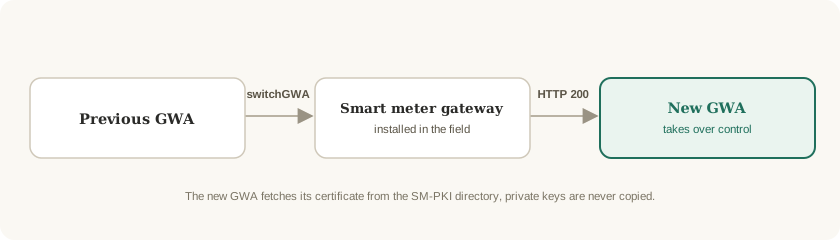
The previous GWA triggers the switchGWA on the installed smart meter gateway. This is the defined command that starts the handover from inside the existing administration, so the change is initiated by the operator that still holds control, not forced from outside. From that point the gateway is told where its new administrator is.
The gateway then connects to the new GWA over its WAN link, and the new GWA confirms and takes over full control of the device. After the confirmation the new operator can configure, update and monitor the gateway exactly as if it had rolled it out itself. The whole sequence runs remotely, which is what makes a mass change feasible at all: no technician has to visit each metering point.
Crucially, no private keys are copied between the two gateway administrators. The new GWA is identified through certificate information, and its certificate is fetched from the public directory of the smart meter PKI. The gateway therefore trusts the new operator on the basis of a verifiable certificate, not on the basis of a shared secret, which keeps the handover secure even though the operator on the other side is changing.
The four technical stumbling blocks
The success case is described, but the snags sit in the communication technology. Whether a gateway can be taken over from a distance depends on several factors.

The note describes a clean success case, but in the field the takeover hangs on how each gateway actually talks to the outside world. Four points decide whether the switch goes through remotely:
- Synchronising the GWA change with the WAN communication profile. The change has to be coordinated with the communication profile of the gateway, so that the device can reach the new GWA at the moment of the switch rather than losing contact in between.
- A matching IP version. The new GWA has to offer the same IP version that the gateway uses, IPv4 or IPv6. If they do not match, the gateway cannot establish the connection to its new administrator.
- The technology mix. The communication path varies widely: LTE with SIM takeover, LTE450 with only one provider, powerline and ethernet each behave differently, and a SIM tied to one operator or a single-provider LTE450 contract can block a clean remote takeover.
- The failure case. The note only describes the success case, so aborts are not standardised. When a switch fails, the operators settle it bilaterally, which is exactly the part that is hardest to scale across thousands of devices.
The lesson is that the command is the easy part. What determines a mass change is the inventory of communication technology behind each gateway, and that is where most of the preparation effort has to go.
What practice shows: migrations and loss rates
Several large changes have already run and deliver hard numbers. They show how much a clean process is worth.

The largest GWA change in Germany so far moved around 21,000 smart meter systems and over 13,000 gateways in eight weeks. According to enercity netz, the loss rate was only 2 percent, against 8 to 10 percent on average. That gap is the whole point: every device that cannot be taken over has to be dismantled or replaced, so cutting the loss rate from 8 to 10 percent down to 2 percent saves thousands of gateways and the cost of touching them in the field.
Other cases point in the same direction. One utility migrated around 4,000 metering systems, and a service provider moved 60 clients in parallel onto a new GWA system, which shows that the process can be clustered rather than run one customer at a time. At the upper end, a single large GWA already manages over 100,000 gateways for several principals, which is the scale at which a mass-capable switch stops being a convenience and becomes a precondition for the business.
Read together, these numbers make the case that the GWA change is worth industrialising. The technology is workable today in good conditions, but the difference between an average and a best-in-class loss rate is large enough to justify serious preparation before a change.
What companies should do now
Whoever prepares the change saves devices and avoids losses. The technology in the installed base decides what can be done from a distance, so the inventory comes first.
- Inventory the WAN technology per gateway. Record the IP version, the SIM type and provider, and any LTE450 framework contracts for each device, because that is what determines whether a remote takeover is possible at all.
- Check GWA systems for switchGWA capability and PKI connection. Make sure the GWA system can trigger and accept the switchGWA and is connected to the smart meter PKI directory, so the certificate logic of the handover actually works.
- Watch the WiM data flows and format updates, and build cluster capability. Follow the WiM data flows and the format updates from BDEW and EDI@Energy, and prepare to process large volumes in clusters rather than device by device.
- Ensure TR-03109-6 v2.0 conformity. Keep the gateway administration in line with TR-03109-6 v2.0 by the next recertification, so the security frame around the change is in order, as set out in the article on the rollout and the smart meter rollout.
Further reading
Frequently asked questions
A GWA change, or gateway administrator switch, is the handover of the administration of already installed smart meter gateways from one gateway administrator (GWA) to another. It happens when the metering point operator (MSB) changes, for example on a concession change, while the gateways stay on the wall in the field. The GWA is a function of the MSB, not a separate market role, so the new operator must take over the devices remotely.
There is no separate binding standard for the automated GWA change. The reference document is a VDE-FNN note from October 2024, a target picture that describes the change as an end-to-end process. It is embedded in WiM Strom, the metering market processes set by the BNetzA, and in the BSI technical guidelines, but it is not itself a mandatory specification. Implementation through the data formats and systems is running over 2025 and 2026.
The technical core is the switchGWA on the gateway. The previous GWA triggers the switchGWA, the gateway then connects to the new GWA, and the new GWA confirms and takes over full control of the device. The whole handover runs remotely over the WAN connection, without a site visit to the metering point.
No private keys are copied between the gateway administrators. The new GWA is identified through certificate information, and its certificate is fetched from the public directory of the smart meter PKI. This keeps the handover secure: the gateway trusts the new GWA on the basis of the certificate, not on the basis of shared secrets.
The hurdles sit in the communication technology, not in the command itself. The GWA change has to be synchronised with the WAN communication profile, the IP version (IPv4 or IPv6) has to match, and the technology mix matters: LTE with SIM takeover, LTE450 with only one provider, powerline or ethernet behave differently. The note only describes the success case, so aborts are settled bilaterally between the operators.