
Smart meter rollout: supervisory proceedings and the BNetzA sanction regime
The focus is Section 76 MsbG, the penalty payment and how the procedure runs. The rollout numbers are only the backdrop, the sanction is the story.
The progress of the rollout is the subject of the smart meter rollout article, which gives the wider picture. The sanction regime described here is also separate from the contract pressure of BK6-24-125, which is a parallel regime with its own contractual penalty that hits the same operators from 1 July 2026. Note: gMSB is the basic metering point operator and MSB is the metering point operator.
On 27 March 2026 the BNetzA opened around 77 supervisory procedures against basic metering point operators (gMSB) that missed the statutory 20 percent smart meter rollout quota by 31 December 2025. By 21 September 2026 the number had grown to proceedings against 434 companies, 150 of which had been closed. The quota is anchored in Section 45 MsbG. The market average reached 23.3 percent of the mandatory installation cases, so the quota was met on average, but with a large spread: each operator is measured individually, the average protects no one. The legal basis of the sanction is Section 76 MsbG, which lets the BNetzA stop unlawful conduct and order all necessary behavioural and structural remedies. Enforcement runs through a penalty payment under Section 94 EnWG, which Section 76(4) MsbG applies, within a range of 1,000 euros to ten million euros. A supervisory procedure runs in three stages: a hearing, then a penalty payment warning with a grace period, then the assessment and, if needed, an increased penalty payment. Around 813 basic metering operators are monitored, and the 77 procedures account for only about one percent of the mandatory rollout. The next statutory stage cited by the BNetzA is 90 percent of mandatory installation cases by the end of 2032. A cited penalty floor of 5,000 euro and a grace period until 30 September 2026 are single-source figures and not confirmed. Companies should determine their quota status per quarter, report on time, evidence any external obstacles robustly, and harden their processes and IT, since the rollout sanction and BK6-24-125 hit at the same time.
The BNetzA rollout monitoring
The 77 cases do not come out of nowhere. They rest on a monitoring machine: the BNetzA measures the smart meter rollout quarterly and per operator, and exactly this data is the basis for the procedures.

The BNetzA collects the rollout data quarterly from all basic metering point operators. This is a continuous reporting duty, not a one-off snapshot, so the regulator always has a current view of how far each operator has come and how fast it is moving.
The decisive point is that each operator is measured individually, not against the market average. An operator cannot hide behind a healthy overall figure: its own quota is what counts, and the next stage, the control box rollout at scale, is still ahead. The BNetzA publishes the quotas and makes the laggards visible, which adds a reputational layer on top of the legal one.
The monitoring also exposes a second problem. Late operators sometimes do not report at all or report late, which on its own raises their risk. A missing or late return signals to the regulator that an operator is not engaged with the rollout, and it is precisely these operators that move to the front of the queue when the procedures begin. The second line of defence is control that actually switches, which needs CLS management and the aEMT role.
The 77 cases: what is behind them
On 27 March 2026 supervision turned serious. The procedures hit first the operators that had not started the rollout at all, the clearest cases of default.
The BNetzA opened around 77 supervisory procedures against basic metering point operators on 27 March 2026. To keep the dates clear: 27 March 2026 is the day the procedures were opened, while 31 December 2025 is only the cut-off date for the quota. The trigger for the procedures is the missed 20 percent quota by that cut-off.
By 21 September 2026 the 77 procedures from March had grown to proceedings against 434 companies. The Bundesnetzagentur closed 150 of them, for instance because the quota had since been met or the default metering responsibility had been transferred (press release of 21 September 2026). It has threatened penalty payments of 5,000 to 500,000 euros. None had been imposed by 11 September 2026, according to the federal government (Bundestag printed paper 21/7996). The regulator really is working through the market.
The first wave targets the non-starters, the operators that had not begun the rollout. A second wave against operators that missed the quota narrowly has been announced, so the 77 are the leading edge rather than the full extent of the supervision. The regulator is working through the market step by step.
- 77 procedures, opened 27 March 2026: against basic metering point operators that are late on the rollout.
- The trigger is the missed quota: the statutory 20 percent quota was not met by the cut-off of 31 December 2025.
- Non-starters first: the first wave targets operators that had not started the rollout at all, with a second wave against narrow missers announced.
- Small share of the rollout: the 77 operators together account for only about one percent of the mandatory rollout.
The scale should be read carefully. The 77 operators together account for only about one percent of the mandatory rollout, so this is not a market-wide failure but a focused move against the slowest operators. The point is the principle, not the volume: the BNetzA is showing that the quota is enforced and that being late carries a real procedure.
Section 76 MsbG: the legal basis of the sanction
The supervision stands on a clear norm. The penalty payment itself comes from the Energy Industry Act, to which the MsbG refers.
Section 76 MsbG is the legal basis. It lets the BNetzA stop unlawful conduct and order all necessary remedies, both behavioural and structural. The regulator is therefore not limited to demanding that an operator catch up: it can shape how the operator has to get there, which gives the supervision real teeth.
Section 76(4) MsbG applies Part 8 of the Energy Industry Act (EnWG), and there Section 94 governs the penalty payment: the regulator enforces its orders under the rules for enforcing administrative measures, and a penalty payment amounts to at least 1,000 euros and at most ten million euros (Section 76 MsbG, Section 94 EnWG). Within that range the amount is set at the regulator's discretion, oriented at the economic capacity of the operator and at proportionality, so a small operator and a large one are not treated identically. The penalty payment is a means of pressure to force compliance, not a fine for past conduct.
So far the Bundesnetzagentur has threatened penalty payments of 5,000 to 500,000 euros, and none had been imposed by 11 September 2026 (Bundestag printed paper 21/7996). The floor of 5,000 euros cited in the trade press is therefore not a legal threshold. It describes the warnings issued so far.
Anatomy of a supervisory procedure
A supervisory procedure is not a single switch but an escalation in stages. An operator that responds and delivers can still avert the assessment.
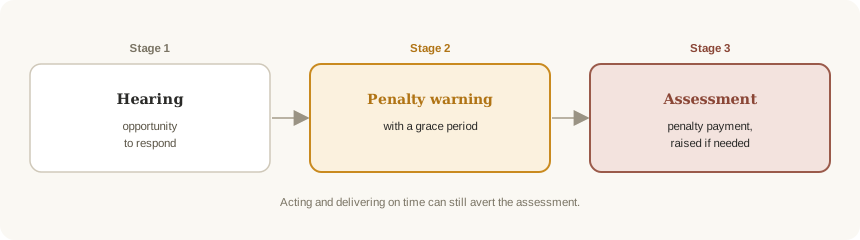
Stage one is the hearing. The operator is given an opportunity to respond and to set out its position, including any reasons why it is behind. This is the moment to engage rather than to stay silent, because a substantive and timely response can shape how the procedure develops.
Stage two is the penalty payment warning. The BNetzA warns that a penalty payment will follow and sets a grace period in which the operator can still come into compliance. A cited grace period until 30 September 2026 is a single-source figure, so it should be treated as an indication and not as a confirmed deadline that applies uniformly to every case.
Stage three is the assessment. If the operator still does not deliver, the BNetzA assesses the penalty payment and can raise it for continued non-performance. External obstacles such as supply shortages can be relevant, but they have to be evidenced: an operator that wants to rely on them must show them robustly, not merely assert them.
Quotas, the spread and what comes next
The average is misleading. Behind the 23.3 percent there is a large gap between big and small operators, and the next stage is much higher.

The spread is wide. Large operators reached around 27 percent, while very small operators sat at around 15 percent, and some large network operators were above 45 percent. The market average of 23.3 percent therefore hides very different realities, which is exactly why the BNetzA measures each operator on its own quota rather than on the average, and why the smallest operators are the ones that could end up notifying under Section 11 (2) MsbG and handing their grid area to the fallback metering operator.
Looking ahead, the next statutory stage per the BNetzA is 90 percent of mandatory installation cases by the end of 2032. This is the firm anchor in Section 45 MsbG. The step from a 20 percent floor to a 90 percent target is large, so the pressure on the slower operators does not ease, it grows.
Secondary figures should be handled with care. Intermediate values such as 50 percent by 2028 circulate in trade media, but they are secondary depictions and not a confirmed statutory anchor. Binding interim targets do exist, though, just not as a share of the stock: section 45 (1) no. 4 MsbG sets a period quota on the newly due metering points for 2026, 2028 and 2030. They should not be presented as a fixed milestone: the reliable reference points remain the 20 percent floor that already passed and the 90 percent target for the end of 2032.
What companies should do now
Whoever knows its own quota status and reports cleanly reduces the procedure risk. In a procedure, the response and the documentation decide the outcome.
- Determine the quota status per quarter and report on time. Establish the exact quota for each quarter and submit the return to the BNetzA on time, since a missing or late return raises the risk on its own.
- If the quota is missed, evidence external obstacles robustly and take grace periods seriously. Document supply shortages and other external obstacles in a way that holds up, and treat any grace period in a procedure as a real chance to come into compliance, not as a formality.
- Consider rollout service providers or bundling. Examine whether a rollout service provider or a bundling of effort with other small basic operators can lift the installation pace, especially where in-house capacity is the bottleneck.
- Harden processes and IT. Strengthen the operational and IT processes around the rollout, because the rollout sanction and BK6-24-125 hit at the same time and both reward clean data and reliable execution.
Deadline, market roles, systems
31 December 2025Smart meter rollout: 20 percent of the mandatory installation casesLaw · date passed
Applicability: The quota counts the mandatory cases under § 30 (1) nos. 2 to 5 and (2) MsbG, meaning final customers between 6,000 and 100,000 kilowatt hours a year plus controllable loads under § 14a EnWG. The basis is the total number of metering points across all grid areas covered by the default responsibility.
If the deadline is missed: Regulator can enforce If the default metering point operator misses the quota, the Federal Network Agency can order measures under Sections 45(2) and 76 MsbG and enforce them with coercive fines of EUR 1,000 to EUR 10 million (Section 76(4) MsbG, Section 94 EnWG); such proceedings have been running since March 2026. If the rollout of control units falls short by at least 25 percent and this contributes significantly to a possible threat to system security, it can withdraw the default responsibility under Section 12(2g) EnWG. Legal basis ↗
- Default metering point operatorrole obligationShows the Bundesnetzagentur that at least 20 percent of mandatory installation cases carry a smart metering system, and works through any open supervisory proceeding.Typically affected: Gateway administration and CLS management, Field service and work orders, SAP IS-U / S/4HANA Utilities
31 December 2026Smart meter rollout: 90 percent of the installation cases since February 2025Law · adopted
If the deadline is missed: Regulator can enforce If the default metering point operator misses the quota, the Federal Network Agency can order measures under Sections 45(2) and 76 MsbG and enforce them with coercive fines of EUR 1,000 to EUR 10 million (Section 76(4) MsbG, Section 94 EnWG). If the rollout of control units falls short by at least 25 percent and this contributes significantly to a possible threat to system security, it can withdraw the default responsibility under Section 12(2g) EnWG. Legal basis ↗
- Default metering point operatorrole obligationFits at least 90 percent of metering points due since 25 February 2025 with smart metering systems by year end.Typically affected: Gateway administration and CLS management, Field service and work orders, SAP IS-U / S/4HANA Utilities
31 December 2028Smart meter rollout: 90 percent of the 2027 to 2028 installation casesLaw · adopted
If the deadline is missed: Regulator can enforce If the default metering point operator misses the quota, the Federal Network Agency can order measures under Sections 45(2) and 76 MsbG and enforce them with coercive fines of EUR 1,000 to EUR 10 million (Section 76(4) MsbG, Section 94 EnWG). If the rollout of control units falls short by at least 25 percent and this contributes significantly to a possible threat to system security, it can withdraw the default responsibility under Section 12(2g) EnWG. Legal basis ↗
- Default metering point operatorrole obligationFits at least 90 percent of metering points due in 2027 and 2028 with smart metering systems.Typically affected: Gateway administration and CLS management, Field service and work orders
31 December 2032Smart meter rollout: 90 percent of all mandatory casesLaw · adopted
If the deadline is missed: Regulator can enforce If the default metering point operator misses the quota, the Federal Network Agency can order measures under Sections 45(2) and 76 MsbG and enforce them with coercive fines of EUR 1,000 to EUR 10 million (Section 76(4) MsbG, Section 94 EnWG). If the rollout of control units falls short by at least 25 percent and this contributes significantly to a possible threat to system security, it can withdraw the default responsibility under Section 12(2g) EnWG. Legal basis ↗
- Default metering point operatorrole obligationHas fitted at least 90 percent of all metering points due with smart metering systems by the end of 2032.Typically affected: Gateway administration and CLS management, Field service and work orders
A classification for typical market roles, not a review of your individual case and not legal advice. Whether an obligation applies to your company (thresholds, exemptions) is for your legal department or counsel to confirm. The calendar doesn't replace your own deadline review. Information as of: 27 October 2026.
Further reading
Frequently asked questions
On 27 March 2026 the BNetzA opened around 77 supervisory procedures against basic metering point operators that missed the statutory 20 percent rollout quota by 31 December 2025. The first wave targets operators that had not started the rollout at all. A second wave against operators that missed the quota narrowly has been announced. Together the 77 operators account for only about one percent of the mandatory rollout.
Under Section 45 MsbG basic metering point operators had to equip 20 percent of their mandatory installation cases by the end of 2025. The market average reached 23.3 percent, but with a large spread between operators. The next statutory stage cited by the BNetzA is 90 percent of mandatory installation cases by the end of 2032.
The legal basis is Section 76 MsbG. It lets the BNetzA stop unlawful conduct and order all necessary behavioural and structural remedies. Enforcement runs through a penalty payment under Section 94 EnWG, which Section 76(4) MsbG applies. The range is 1,000 euros to ten million euros; within it the regulator sets the amount at its discretion based on economic capacity and proportionality.
A supervisory procedure runs in three stages. First a hearing with an opportunity to respond, then a penalty payment warning with a grace period, then the assessment and, if needed, an increased penalty payment for continued non-performance. Operators that act and deliver on time can still avert the assessment, but external obstacles such as supply shortages have to be evidenced.
Late operators face a supervisory procedure under Section 76 MsbG and, if they do not deliver, a penalty payment under Section 94 EnWG of between 1,000 euros and ten million euros; so far the BNetzA has threatened amounts of 5,000 to 500,000 euros. On top of that there is reputational exposure, since the regulator publishes the quotas and makes laggards visible. From 1 July 2026 a second, separate regime adds pressure: the standardised metering contracts under BK6-24-125 with their own contractual penalty.
Let's collaborate
One contact, a team behind it
Thirty minutes on what you're working on, whether grid, metering, market processes, IT architecture or AI. Afterwards you'll know how we'd approach it and who would sit at the table.
Energy and measurement technology since 2010 · innobu GmbH since 2014 · Based in Schleswig-Holstein, Germany
Whoever pitches also delivers: whoever leads the first call stays your contact right through to the steering committee, with established partners in the project. Direct: info@innobu.com