EEBUS and IEC 63380: the common language of energy devices
This is a device interoperability article. It looks at what EEBUS is, what IEC 63380 actually covers, how the two protocols SPINE and SHIP work, where EEBUS sits on the home area network, which use cases it provides for Section 14a and what the certification from 2026 changes. The distinction from the neighbouring topics is part of the picture: the regulation and the hardware are covered in the article on the FNN control box and Section 14a, the generation side over the CLS channel in the piece on direct marketing and remote control via SMGW, and the WAN side in the article on scaling the SMGW backend. EEBUS sits complementary to all of these on the home area network behind the gateway. Note: HEMS = home energy management system, HAN = home area network, SMGW = smart meter gateway.
EEBUS is the vendor-neutral, open communication standard for energy management in the building, carried by the EEBUS Initiative since 2012. It connects the home energy management system (HEMS), controllable consumers and generators with the smart meter gateway. In 2025 EEBUS gains international standardisation via IEC 63380, but with an important caveat: IEC 63380 has an EV-charging focus in technical committee TC 69 and covers mainly the interface between local energy management and the charging station, not the whole home area network path. The EEBUS protocols SPINE and SHIP moved into IEC 63380-2 and -3, while the household-appliance strand for heat pump, storage and white goods runs normatively via IEC 63510 and EN 50631. EEBUS uses two protocols: SHIP is the secure transport layer over TCP/IP with TLS and pairing, SPINE is the device-independent data model on top. On the home area network the smart meter gateway has three interfaces, control signals run over the CLS channel to the FNN control box, which translates and passes them on via EEBUS to the end devices, secured per BSI TR-03109-1 and without the internet on this path. For Section 14a EnWG, EEBUS provides the use cases LPC, LPP, MPC and MGCP, and BNetzA, VDE FNN and ZVEH recommend EEBUS. From early 2026 a three-stage EEBUS certification turns EEBUS-ready into real interoperability, with full certification using SHIP pairing via QR code, and first devices were pilot-qualified in 2025. Companies should implement the EEBUS stack with SHIP and SPINE, aim for the 2026 certification, and reference the right standard: IEC 63380 for charging and IEC 63510 for household appliances.
What EEBUS is and what IEC 63380 actually covers
EEBUS is the common language of energy devices. It is a vendor-neutral, open communication standard for energy management in the building, carried by the EEBUS Initiative since 2012. It connects the HEMS, controllable consumers and generators with the smart meter gateway. Heat pump, wallbox, storage and inverter can speak to a central energy manager regardless of who built them.
The frequent equation of EEBUS with IEC 63380 is too short, because the standard has a narrower focus than the name suggests. IEC 63380 was published in 2025, but its official scope is the charging of electric vehicles in technical committee TC 69: the interface between local energy management and the charging station, not the whole HAN path between the gateway and the HEMS. What did move into the standard are the protocols. The EEBUS protocols SPINE and SHIP were carried over into IEC 63380-2 and -3, so the standardisation covers the EEBUS transport and data model even though its anchor use case is charging.
- EEBUS, since 2012: carried by the EEBUS Initiative, it connects HEMS, consumers, generators and the SMGW.
- IEC 63380 (2025): covers mainly the interface to the charging station (TC 69), not the whole HAN path.
- SPINE and SHIP: the EEBUS protocols moved into IEC 63380-2 and -3.
- Household appliances: the heat pump, storage and white goods strand runs via IEC 63510 and EN 50631.
The clarification matters because it decides which standard to reference. The household-appliance strand for heat pump, storage and white goods runs normatively via IEC 63510 and EN 50631, not via IEC 63380. The HAN path from the SMGW to the HEMS is regulated in Germany through BSI TR-03109, the FNN control box and Section 14a EnWG, where EEBUS is the recommended, voluntary application protocol rather than a binding IEC norm. So EEBUS is the language, IEC 63380 standardises it for charging, and other standards apply to other device classes.
SPINE and SHIP: the two protocols
EEBUS draws a clean line between transport and content. This split into two protocols is what makes the standard device-independent rather than tied to one product class.
SHIP is the secure transport layer. It runs over TCP/IP, uses TLS for encryption and includes the pairing that lets two devices establish a trusted connection. SPINE sits above it as the device-independent data model on the information layer. SPINE runs over SHIP, and both are now part of the IEC standardisation. The data model describes devices in neutral, vendor-spanning terms, so a wallbox or a heat pump appears to the energy manager as a set of standardised capabilities rather than a proprietary interface.
- SHIP: the secure transport layer over TCP/IP, with TLS and pairing.
- SPINE: the device-independent data model on the information layer.
- Stack: SPINE runs over SHIP, both are now part of the IEC standardisation.
- Neutral terms: the data model describes devices in vendor-spanning terms.
The practical payoff is that a device maker implements one stack and can talk to any compliant HEMS, and a HEMS provider can integrate any compliant device without a custom adapter per vendor. That is the whole point of separating the secure transport from the neutral data model.
The HAN path: SMGW, control box and HEMS
EEBUS does not sit on the backend side but in the house. Behind the smart meter gateway, the control box translates the grid signals into the device language, and EEBUS is what carries them onward.
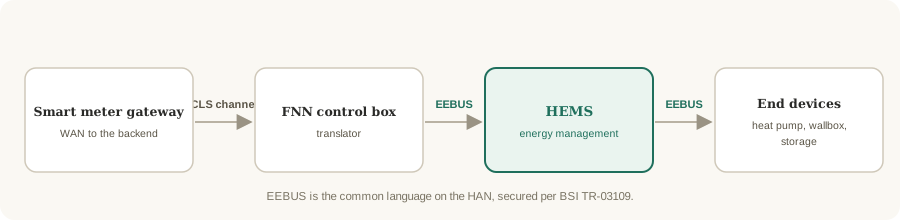
The smart meter gateway has three interfaces: one to the meter, one to the backend over the WAN, and one to the home area network in the building. Control signals from the grid operator run over the CLS channel through the gateway to the FNN control box. The control box acts as a translator: it takes the incoming commands and passes them on via EEBUS to the end devices such as heat pump, wallbox and storage. The security on this path follows BSI TR-03109-1, and the HAN path itself runs without the internet.
- Three interfaces: the SMGW connects to the meter, the backend and the HAN.
- CLS channel: control signals run over it to the FNN control box.
- Control box as translator: it passes the commands on via EEBUS to the end devices.
- Security: per BSI TR-03109-1, on the HAN path without the internet.
The division of labour is clear: the gateway is the secured channel, the control box is the translator, and EEBUS is the language the end devices understand. This is why EEBUS sits complementary to the regulation, which is covered in the article on the FNN control box and Section 14a, and to the WAN side in the piece on scaling the SMGW backend.
The Section 14a use cases: LPC, LPP, MPC and MGCP
For grid-supportive control EEBUS provides ready-made building blocks. They map the requirements of Section 14a precisely, which is why the regulators point to them.

Section 14a EnWG has required the controllability of new consumption devices above 4.2 kW since 1 January 2024. EEBUS delivers the use cases for this. LPC limits the power consumption in a grid-supportive way, for example a wallbox steplessly down to 4.2 kW rather than a hard on or off. LPP limits the feed-in power of generators. MPC and MGCP provide metering data, at the device and at the grid connection point respectively, so the energy manager and the grid operator both see what is happening.
- LPC: limits the power consumption in a grid-supportive way, a wallbox steplessly to 4.2 kW.
- LPP: limits the feed-in power of generators.
- MPC and MGCP: provide metering data at the device and at the grid connection point.
- Recommendation: BNetzA, VDE FNN and ZVEH recommend EEBUS as the preferred interface.
The stepless throttling is the key difference from a simple switch contact: instead of disconnecting a heat pump or a wallbox entirely when the grid is tight, the device keeps running at reduced power. BNetzA, VDE FNN and ZVEH recommend EEBUS as the preferred interface for exactly this kind of grid-supportive control.
Certification and device interoperability from 2026
EEBUS-ready did not automatically mean compatible. That gap is what the new certification is built to close, by turning a claim on a datasheet into tested interoperability.

From early 2026 the EEBUS Initiative introduces a three-stage certification, reaching from EEBUS ready up to full certification. The full certification uses automatic SHIP pairing via QR code, which lowers the installation effort because the technician no longer has to enter pairing credentials by hand. First devices reached pilot qualification in 2025, among them heat pumps, inverters and HEMS. Real interoperability in the field is only assured with the certification, not with an EEBUS-ready label alone.
- Three stages: from EEBUS ready up to full certification, starting early 2026.
- SHIP pairing via QR code: full certification lowers the installation effort.
- Pilot qualification 2025: first heat pumps, inverters and HEMS.
- Field interoperability: only assured with the certification.
For companies this changes the procurement question from does it support EEBUS to is it certified. The neighbouring topics give the wider frame: the regulation behind the control box in the article on the FNN control box and Section 14a, the generation side over the CLS channel in the piece on direct marketing and remote control via SMGW, the WAN side in scaling the SMGW backend, and the gateway administrator role in the article on BSI TR-03109-6 and the gateway administrator.
What companies should do now
Whoever implements EEBUS cleanly and early, and aims for the certification, is prepared for the ramp-up of grid-supportive control. The work differs by role, but the standard to reference is the same.
- Device makers: implement the EEBUS stack. Build the EEBUS stack with SHIP and SPINE, cover the use cases LPC and MPC, and aim for the certification in 2026.
- HEMS providers: seek pilot qualification. Aim for the pilot qualification, integrate the SHIP pairing, and test the connection to the SMGW and the control box.
- Metering operators: plan the control box. Plan the control box procurement with EEBUS-capable components and build a TR-03109-conformant path.
- Everyone: reference the right standard. Reference IEC 63380 for charging and IEC 63510 for household appliances, so the documentation points at the correct norm.
Further reading
Frequently asked questions
Not exactly. IEC 63380 has an EV-charging focus in technical committee TC 69 and covers mainly the interface between local energy management and the charging station. The EEBUS protocols were standardised within IEC 63380, however: SPINE and SHIP moved into IEC 63380-2 and -3. So IEC 63380 carries EEBUS, but it does not cover the whole home area network path on its own.
IEC 63380 was published in 2025 and covers above all the interface between local energy management and the charging station, the EV-charging focus of TC 69. It is a multi-part standard from part 1 to part 4 and is based on EEBUS. Part 2 carries the data model, part 3 specifies the protocols SPINE, SHIP and ECHONET Lite together with cyber security. The household-appliance strand for heat pump, storage and white goods runs via IEC 63510 and EN 50631, not via IEC 63380.
SPINE and SHIP are the two EEBUS protocols. SHIP is the secure transport layer over TCP/IP, with TLS and pairing. SPINE is the device-independent data model that runs on top of SHIP and describes devices in neutral, vendor-spanning terms. The clean split between transport and content is what makes EEBUS device-independent.
The smart meter gateway has three interfaces: to the meter, to the backend and to the home area network. Control signals from the grid operator run over the CLS channel through the gateway to the FNN control box. The control box acts as a translator and passes the commands on via EEBUS to the HEMS and the end devices. On this home area network path there is no internet, and the security follows BSI TR-03109-1.
Section 14a EnWG has required the controllability of new consumption devices above 4.2 kW since 1 January 2024. EEBUS provides the ready-made use cases for this: LPC limits power consumption in a grid-supportive way, LPP limits feed-in power, and MPC and MGCP provide metering data at the device and at the grid connection point. BNetzA, VDE FNN and ZVEH recommend EEBUS as the preferred interface.