
Heating Costs Ordinance: remote reading becomes mandatory by the end of 2026
This is a regulatory and submetering article. It looks at how the Heating Costs Ordinance turns heat and hot-water metering into a remote-readable, monthly-reporting system, and at the firm deadline by the end of 2026 for the stock. Covered are heat meters, heat cost allocators and hot-water meters, not cooling meters: cooling is only relevant as context of the EU Energy Efficiency Directive, not as a duty under the ordinance. The technical bridge to the wider metering world runs through the smart meter gateway, since new devices must be connectable to it. This piece is about the ordinance itself: what it requires, the chain of deadlines, the monthly consumption information, the reduction rights and what companies should do now.
The Heating Costs Ordinance (Heizkostenverordnung) requires remote-readable heat and hot-water metering. New devices have had to be remotely readable since 1 December 2021 and interoperable and smart-meter-gateway-connectable since 1 December 2022, while the existing stock of non-remote-readable heat meters, heat cost allocators and hot-water meters must be retrofitted or replaced by 31 December 2026 under Section 5. An exception applies only where retrofitting is technically impossible or involves disproportionate effort. Since 1 January 2022 users with remote-readable devices must receive monthly consumption information, showing the previous month consumption in kilowatt hours with a comparison to the previous month, to the same month of the previous year and to an average user. Breaches can be met with reduction rights: 15 percent for non-consumption-based billing, 3 percent for missing remote-readable equipment and a further 3 percent for missing or incomplete monthly information, the two 3 percent reductions being cumulative according to the prevailing interpretation. The ordinance covers heat, heat cost allocators and hot water, not cooling, and implements the EU Energy Efficiency Directive 2018/2002 (Articles 9b, 9c, 10a). Around 40 percent of units were not yet converted at the start of 2025 per a VDIV survey, with installation capacity the main bottleneck. Companies should inventory the stock, secure installation capacity before the end of 2026, check the monthly information process and insist on interoperable, smart-meter-gateway-ready devices when buying new.
What the Heating Costs Ordinance requires
The Heating Costs Ordinance governs how heat and hot water are metered and billed in multi-party buildings. The principle is consumption-based billing: the cost is split so that, as a rule, 70 percent follows consumption and 30 percent is base cost. The reform of 2021 turned reading into remote reading, which is the change that now drives the deadlines.
The scope is precise, and one boundary is worth stating clearly. Covered are heat meters, heat cost allocators and hot-water meters. Cooling meters are not covered by the ordinance. Cooling is addressed in the EU context, but it is not a duty under the German Heating Costs Ordinance, so it stays out of scope for the remote-reading and retrofit duties.
The ordinance implements the EU Energy Efficiency Directive 2018/2002, in particular its Articles 9b, 9c and 10a. The aim behind the technical rules is straightforward: more transparency for users and more energy saving in the building stock. Remote reading and monthly feedback are the instruments meant to get there.
The deadlines: everything remotely readable by the end of 2026
There is a chain of cut-off dates, not a single switch. The most important one is the end of 2026, by which the entire stock must be converted. The earlier dates govern new devices and have already passed.
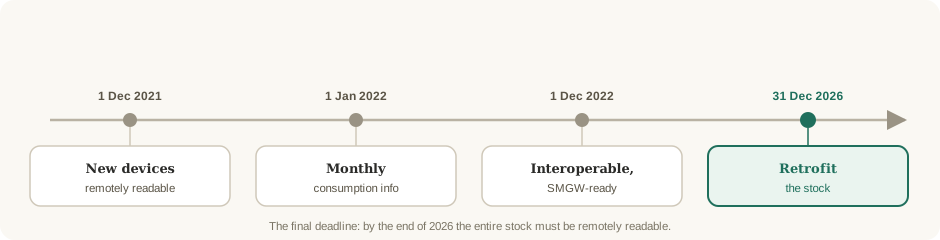
Since 1 December 2021 newly installed devices must be remotely readable. From 1 December 2022 a second requirement was added: new devices must also be interoperable and connectable to a smart meter gateway. So a device bought today already has to meet both conditions, not just the bare remote-reading function.
- Since 1 December 2021: new devices must be remotely readable.
- Since 1 December 2022: new devices must also be interoperable and connectable to a smart meter gateway.
- By 31 December 2026: non-remote-readable stock must be retrofitted or replaced.
- Exception: only where retrofitting is technically impossible or involves disproportionate effort.
The decisive date is 31 December 2026. By then every non-remote-readable device in the stock must be retrofitted or replaced. An exception exists only where this is technically impossible or where the effort would be disproportionate, and that has to be evidenced rather than merely asserted. For most buildings the realistic path is to plan and book the installation work well before the end of 2026.
The monthly consumption information
Remote reading does not mean once a year. Since 2022 users must be informed about their consumption every month wherever remote-readable devices are installed, and this is exactly where practice still falls short.

The duty to inform users monthly has applied since 1 January 2022, in every case where remote-readable devices exist. It is not optional and not tied to the annual bill: it runs through the year, month by month, and it sits on the party responsible for the metering and billing.
The content is defined. The information shows the previous month consumption in kilowatt hours, set against several reference points: a comparison to the previous month, to the same month of the previous year and to an average user. The point of the comparison is to make a change in heating behaviour visible quickly rather than only at the end of the year.
In practice the duty is widely unmet. According to the VDIV survey the majority of users do not yet receive the monthly information, with regular delivery reported for only around a third of users. That gap matters, because the missing information is one of the breaches that triggers a reduction right, so the risk is already running today.
Reduction rights for breaches
The ordinance has teeth. Where a building owner does not bill by consumption, does not install the remote-readable equipment or does not send the monthly information, users may reduce the bill by a flat percentage. The reduction is a lever in the hands of the user, not a fine imposed by an authority.
- 15 percent reduction for non-consumption-based billing.
- 3 percent reduction for missing remote-readable equipment.
- 3 percent reduction for missing or incomplete monthly information.
- Cumulative reading: the two 3 percent reductions can add up according to the prevailing interpretation, although the wording does not say so explicitly.
The 15 percent reduction is the headline figure and applies where the heating cost is not billed by consumption at all. The two 3 percent reductions attach to the newer duties: one for the absence of remote-readable equipment, one for the absence or incompleteness of the monthly information. The cumulative reading of the two 3 percent reductions is the prevailing interpretation in the commentary, but it should be marked as an interpretation: the wording of the ordinance does not state the cumulation explicitly, so the safest course for a building owner is to assume it can apply and to remove the breaches.
Interoperability, market power and data protection
Behind the technical rules sits a market question. The interoperability duty is meant to open up the provider switch that the Bundeskartellamt criticised for years as too hard, and it ties the new devices into the wider metering infrastructure.

New devices must be readable across manufacturers and connectable to a smart meter gateway. That is the same gateway infrastructure that carries the wider electricity metering world, where the smart meter rollout and grid-control duties such as the control box under Section 14a meet. Tying heat and hot-water metering into that infrastructure is what makes cross-provider reading and a later switch realistic.
The market is concentrated. Three large metering service providers hold most of the market between them, and despite the interoperability duty the lock-in effects in the legacy stock persist. Older devices were often not designed for cross-provider reading, so the switch barrier remains real for the existing fleet even where new purchases meet the open standard.
Data protection is the third strand. Monthly consumption data is personal data, since it allows conclusions about the behaviour of a household. Data security to the state of the art is therefore mandatory, which is a further reason to channel the data through the secured gateway infrastructure rather than through ad hoc routes.
What companies should do now
Whoever knows the stock and schedules the rollout ahead of the capacity bottleneck avoids both reductions and deadline stress. The monthly information is already a duty today, so the process should be checked first.
- Inventory the stock. Record the devices and their calibration and contract terms, so the volume and timing of retrofits and replacements is clear before the end of 2026.
- Secure installation capacity early. Book the metering service provider capacity for the exchange well before the end of 2026, since the lack of installation capacity is the main bottleneck in the market.
- Check the monthly information process. Make sure the monthly consumption information is actually being sent where remote-readable devices exist, because the reduction risk for missing information is already running.
- Buy interoperable, gateway-ready devices. When buying new, insist on interoperable, smart-meter-gateway-ready devices and keep the option of a provider switch open.
Further reading
Frequently asked questions
The Heating Costs Ordinance requires that heat and hot-water metering be remotely readable. New devices have had to be remotely readable since 1 December 2021 and interoperable and smart-meter-gateway-connectable since 1 December 2022. The existing stock of non-remote-readable heat meters, heat cost allocators and hot-water meters must be retrofitted or replaced by 31 December 2026.
New devices have had to be remotely readable since 1 December 2021. The non-remote-readable stock must be retrofitted or replaced by 31 December 2026 under Section 5 of the Heating Costs Ordinance. An exception applies only where retrofitting is technically impossible or involves disproportionate effort, and that has to be evidenced.
No. The ordinance covers heat, heat cost allocators and hot water, not cooling. Cooling meters are addressed in the EU Energy Efficiency Directive context, but they are not a duty under the German Heating Costs Ordinance, so cooling metering is out of scope for the remote-reading and retrofit duties described here.
Where remote-readable devices are installed, users must be informed about their consumption every month, a duty in force since 1 January 2022. The information shows the previous month consumption in kilowatt hours, with a comparison to the previous month, to the same month of the previous year and to an average user. The aim is more transparency and energy saving.
Tenants may reduce the bill by 15 percent for non-consumption-based billing, by 3 percent for missing remote-readable equipment and by a further 3 percent for missing or incomplete monthly information. According to the prevailing interpretation the two 3 percent reductions are cumulative, although the wording does not say so explicitly.