
Standardised metering contracts from 2026: what BK6-24-125 means for the basic metering operator
What was once a set of voluntary association templates has become mandatory law of the market.
The ruling turns the central contracts of electricity metering into fixed standard documents: the framework contract between network operator and metering point operator, plus two new contracts with connected users and with suppliers. This is a different matter from the standard balancing group contract, which is its own contract on the balancing group side, and it is not the same as the technical gateway administrator switch, which is about handing over devices rather than standardising contracts. Note: gMSB is the basic metering point operator, wMSB is the competitive metering point operator and MSB is the metering point operator.
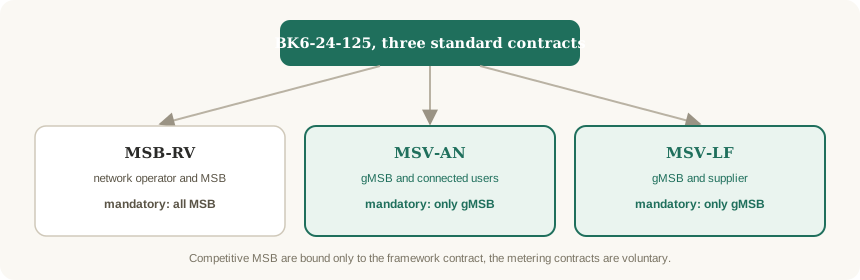
With the ruling BK6-24-125, decided on 20 November 2025 and effective since 1 July 2026, the BNetzA has set three standard contracts in electricity metering: the revised framework contract MSB-RV between network operator and metering point operator (MSB), the new metering contract with connected users MSV-AN and the new metering contract with suppliers MSV-LF, plus a form under Section 54 MsbG for the data communication. The scope is electricity only, gas continues to run through the cooperation agreement. Network operators and basic metering point operators (gMSB) are bound. Every MSB must conclude the framework contract with the network operator, but the metering contracts MSV-AN and MSV-LF are mandatory only for the gMSB, while a competitive metering point operator (wMSB) may use the templates voluntarily. New is a symmetric contractual penalty of 10 cents gross per day and metering point for a culpable breach of material process or data obligations, owed by both the network operator and the MSB, only for material breaches and after a chance to remedy. New too is an automatic amendment regime: ruling-driven changes become part of the contract without a fresh explicit amendment, after information at least two months in advance and online publication, and for the first time a metering-point-specific termination of single metering points is possible. The legal basis is Section 9, Section 34(1) and Section 54 MsbG, and only standard services are in scope. Importantly, non-discrimination stays statutory under Section 8(2) MsbG, an explicit contract clause was deliberately dropped, so it is not newly created by BK6-24-125. The ruling amends Annex 3 of the WiM ruling and refers dynamically to WiM and GPKE, while the MSB change still runs under WiM. Basic metering point operators had to convert their entire portfolio by 1 July 2026; the previous contracts applied only until 30 June 2026. The tasks are to choose the changeover variant, set up acceptance channels and harden their master-data and WiM and GPKE processes against the penalty.
What BK6-24-125 sets: three standard contracts
The BNetzA decision-making chamber 6 adopted the ruling BK6-24-125 on 20 November 2025, with the contracts binding since 1 July 2026. What used to be a set of non-binding association templates becomes a fixed standard: for the first time the regulator sets how the central contracts in electricity metering have to look.
Three contract sets are set, all for electricity. The first is the revised framework contract, the MSB-RV, between the network operator and the metering point operator (MSB). The second is the new metering contract with connected users, the MSV-AN. The third is the new metering contract with suppliers, the MSV-LF. The two metering contracts are genuinely new, while the framework contract is a reworked version of the document the market already knew.
Alongside the three contracts the ruling adds a form under Section 54 MsbG, which governs the data communication that goes with the contracts. Taken together, these documents make the previously non-binding templates of the associations into mandatory standard contracts, so the parties no longer negotiate the core text but use a set framework.
The scope is deliberately limited. BK6-24-125 covers electricity only. For gas the corresponding ground is still held by the cooperation agreement, so the standardisation set out here does not reach into the gas sector. That keeps the change focused on the electricity metering market, where the rollout volume and the contract count are highest.
Who is bound: gMSB, network operators and wMSB
The obligation is graded. This is the point that is most often misread, because not every market participant is bound in the same way.
Network operators and basic metering point operators (gMSB) are fully bound. They have to use the standard contracts as set, which is where the weight of the changeover falls, since the basic operator carries the bulk of the installed base and of the end-customer relationships in its area, a weight that moves in full to the fallback metering operator if a grid area ever ends up there.
The framework contract and the metering contracts do not bind the same circle. Every metering point operator (MSB) must conclude the framework contract MSB-RV with the network operator, whether it is a basic or a competitive operator, because that contract governs the relationship with the network. The metering contracts MSV-AN and MSV-LF, by contrast, are mandatory only for the gMSB.
A competitive metering point operator (wMSB) is therefore in a lighter position. It is bound to the framework contract like everyone else, but it is not obliged to use the standard metering contracts with connected users and suppliers. It may adopt the templates voluntarily, which can still be useful for a clean and recognisable contract base, but it is free to shape those relationships differently.
The new penalty and the amendment regime
Two changes alter contract practice the most: a flat contractual penalty and an automatic amendment regime that reaches into the running contract.

The new contractual penalty is a flat 10 cents gross per day and metering point. It applies for a culpable breach of material process or data obligations, and it is symmetric, so it is owed by both the network operator and the MSB. The penalty does not trigger on every slip: the claim arises only for material breaches, and only after the party at fault has been given a chance to remedy the problem first.
The second change is the amendment regime. Future ruling-driven changes become part of the contract automatically, without a fresh explicit amendment agreement between the parties. The safeguard is procedural rather than negotiated: the parties have to be informed at least two months in advance, and the changed contract is published online. This keeps the standard contracts current across the market without each pair of parties having to renegotiate every time the regulator moves.
Finally, the contracts introduce a metering-point-specific termination for the first time. Instead of having to terminate the whole contract, a party can now end the arrangement for single metering points. That gives both sides a much finer instrument and changes how disputes and migrations can be handled in practice.
The changeover by 1 July 2026
For basic metering point operators this is a mammoth task. With the end-customer contracts it can reach into potentially millions of contracts per operator, and the deadline was fixed.

Existing contracts had to be converted by 1 July 2026 and the contracts have to be published online. Under the ruling, the previous versions could be used only until the end of 30 June 2026. For the gMSB this meant moving the entire portfolio onto the new standard documents within a tight window, while keeping the contractual relationships intact throughout.
The form requirements are kept light to make the volume manageable. Conclusion in text form suffices, and acceptance can run by email, through a portal or via a QR code. An implied conclusion under Section 9(3) MsbG is also possible, with a confirmation in text form, so the operator does not depend on an active signature from every connected user to put the new contract in place.
- Deadline 1 July 2026: existing contracts had to move onto the standard documents by then and have to be published online.
- Text form is enough: conclusion in text form suffices, with acceptance by email, portal or QR code.
- Implied conclusion is possible: an implied conclusion under Section 9(3) MsbG works, with a confirmation in text form.
- Mind the termination variant: the amendment-and-termination route carries a risk of contract-less periods, so the deadlines have to be planned carefully.
The biggest operational risk is the changeover variant. If an operator chooses to terminate the old contract and conclude a new one, a gap can open between the two, a contract-less period that has to be avoided. Planning the deadlines so that the new contract is in force before the old one ends is therefore central to a clean changeover.
Legal basis, the WiM link and non-discrimination
The ruling does not stand alone. It fills out the MsbG and meshes with the market change processes, while leaving one point deliberately to the statute.
The legal basis is Section 9, Section 34(1) and Section 54 MsbG, and the subject of the contracts is restricted to standard services. The standard contracts cover the standardised core of metering, not the individually agreed special services, so the regulated text and the freely negotiated part stay separate.
One point is easy to get wrong: non-discrimination is statutory. It is anchored in Section 8(2) MsbG, and an explicit contract clause for non-discrimination was deliberately dropped from the standard contracts. The effect is that non-discrimination is not newly created by BK6-24-125. It continues to apply by force of the statute, and leaving it out of the contract text avoids duplicating what the law already secures.
On the process side, the ruling amends Annex 3 of the WiM ruling, while the MSB change itself still runs under WiM. The standard contracts refer dynamically to WiM and to GPKE in their respective applicable versions, so the contracts stay aligned with the market processes as those evolve. The contract standardisation here is therefore best read together with the wider WiM and metering changes and the ongoing smart meter rollout, which together set the operational backdrop against which these contracts now run.
What companies should do now
Whoever sorts the contract portfolio early and hardens the processes avoids the penalty and contract-less periods. The transition period ended on 30 June 2026. Since 1 July 2026 the standard contracts apply uniformly, including to old contracts. Anyone still holding contracts in the old version has catch-up work to do, starting with the inventory and the changeover decision.
- Inventory the contract portfolio and choose the changeover variant. Take stock of the existing contracts and decide between a fresh conclusion and an amendment-and-termination route, so the path to the new standard documents is clear before the work starts.
- Set up acceptance channels and check publication. Put the acceptance routes in place, by email, portal and QR code, and check that the contracts are published online, because that is mandatory.
- Harden master-data and WiM and GPKE processes against the penalty. Tighten the master-data quality and the WiM and GPKE process steps, since material process or data breaches are exactly what triggers the symmetric 10-cent penalty.
- Prepare for the automatic amendment regime and metering-point-specific termination. Set up the internal handling so that ruling-driven changes flow into the contracts automatically and so that single metering points can be terminated cleanly when needed.
Deadline, market roles, systems
1 July 2026Standard metering contracts for default metering operatorsRegulatory ruling · in force
If the deadline is missed: Regulator can enforce Ruling BK6-24-125 sets no penalty of its own. Under Section 76(1) MsbG the Federal Network Agency can order conduct contrary to the ruling to stop and enforce this with coercive fines of EUR 1,000 to EUR 10 million (Section 76(4) MsbG, Section 94 EnWG). Legal basis ↗
- Electricity grid operatorrole obligationConcludes new metering operator framework contracts on the amended MSB-RV, adapts existing ones and publishes the MSB-RV on its website so it can be concluded in text form.Typically affected: Customer and grid connection portal, SAP IS-U / S/4HANA Utilities
- Default metering point operatorrole obligationConcludes metering contracts with connection users and suppliers on the standard MSV-AN and MSV-LF templates, adapts existing metering contracts to them and publishes both templates on its website so they can be concluded in text form.Typically affected: SAP IS-U / S/4HANA Utilities, Customer and grid connection portal
- Competitive metering point operatorrole obligationSigns the metering operator framework contract with the grid operator on the amended template or adapts the existing one.Typically affected: SAP IS-U / S/4HANA Utilities
- SupplieraffectedSigns the standard MSV-LF metering contract with the default metering operator.Typically affected: SAP IS-U / S/4HANA Utilities
A classification for typical market roles, not a review of your individual case and not legal advice. Whether an obligation applies to your company (thresholds, exemptions) is for your legal department or counsel to confirm. The calendar doesn't replace your own deadline review. Information as of: 27 October 2026.
Further reading
Frequently asked questions
With BK6-24-125, decided on 20 November 2025, the BNetzA sets three standard contracts in electricity metering and revises the framework contract between network operator and metering point operator. The contracts have been binding since 1 July 2026. They replace the previously non-binding association templates and turn them into mandatory standard contracts for network operators and basic metering point operators.
Three contract sets for electricity are set: the revised framework contract MSB-RV between network operator and metering point operator, the new metering contract with connected users MSV-AN and the new metering contract with suppliers MSV-LF. A form under Section 54 MsbG for the data communication is added. The scope is electricity only, gas runs through the cooperation agreement.
Network operators and basic metering point operators (gMSB) are fully bound. Every metering point operator must conclude the framework contract MSB-RV with the network operator. The metering contracts MSV-AN and MSV-LF are mandatory only for the basic metering point operator, while a competitive metering point operator (wMSB) may use the templates voluntarily.
The contracts introduce a flat contractual penalty of 10 cents gross per day and metering point for a culpable breach of material process or data obligations. It is symmetric, so it applies to both the network operator and the metering point operator. The claim arises only for material breaches and after a chance to remedy has been given.
The deadline was 1 July 2026. The previous contracts could be used only until the end of 30 June 2026; since then the standard contracts apply uniformly to existing and new contracts and have to be published online. Conclusion in text form suffices, with acceptance by email, portal or QR code, and an implied conclusion under Section 9(3) MsbG is possible with confirmation in text form.
Let's collaborate
One contact, a team behind it
Thirty minutes on what you're working on, whether grid, metering, market processes, IT architecture or AI. Afterwards you'll know how we'd approach it and who would sit at the table.
Energy and measurement technology since 2010 · innobu GmbH since 2014 · Based in Schleswig-Holstein, Germany
Whoever pitches also delivers: whoever leads the first call stays your contact right through to the steering committee, with established partners in the project. Direct: info@innobu.com