The Control Box and Section 14a: The Last Mile of Grid Control
Between the grid signal and the heat pump in the basement lies a chain of metering point operator, smart meter gateway, CLS channel and control box. This actuation layer is certified and partly installed in 2026, yet distribution grid operators still send almost no control commands. Instead of true grid-oriented control, a crude time-window solution often stands in.
Grid-oriented control under section 14a EnWG needs an actuator that turns a grid signal into a real intervention at the device: the control box. It sits on the CLS interface of the smart meter gateway and steers a heat pump, wallbox or storage through protocols like EEBus or Modbus. In 2026 this hardware is advanced, but its application is not. By mid-2025 around eight BSI-certified control boxes were on the market, four further providers were added on 18 June 2025, and no device for control directly from the gateway had been certified by 14 October 2026. Even so, distribution grid operators still send almost no control commands in daily operation, so preventive control with fixed time windows often stands in instead of demand-based grid-oriented control. That stopgap is only allowed until the end of 2028. The real gap is not a hardware problem but a forecasting and decision problem: which of the thousands of controllable loads is throttled, when and by how much. This is exactly where AI comes in, and exactly where it is still missing today.
The hardware is here, the action is missing
Grid-oriented control under section 14a should briefly throttle heat pumps, wallboxes and storage during a grid bottleneck instead of expanding the grid or switching off entirely. In 2026 the required hardware is certified and partly installed, which turns the control box rollout at scale into a question of fitting and proof, yet distribution grid operators still send almost no control commands in daily operation. The energy transition hangs on the last mile between grid signal and device.
The link to metering is tight. innobu set out where the metering and data infrastructure stands in its article on the stalled smart meter rollout. There the input for the AI is missing; here the executed intervention at the device is missing. Both belong to the same control loop.
The control chain: from grid signal to control box
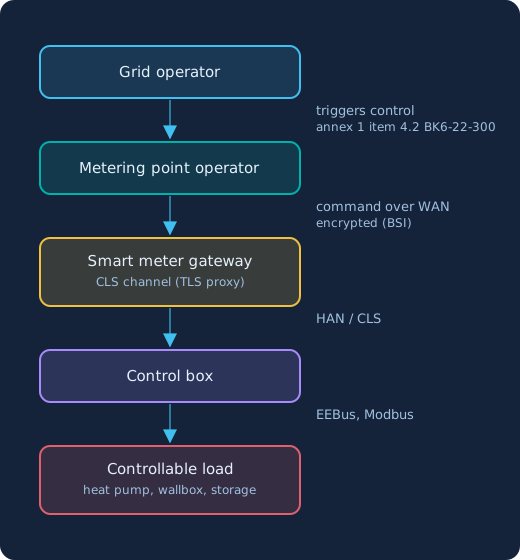
A control command follows a fixed path. The grid operator detects a bottleneck from its grid state assessment and triggers control without delay at the metering point operator, as item 4.2 of annex 1 to determination BK6-22-300 requires. The metering point operator sends the command over the wide area network and the encrypted CLS channel of the smart meter gateway to the attached control box. The gateway only secures the channel and does not evaluate the command itself. The control box translates the signal into a command for the heat pump, wallbox or storage. The handbook chapter on grid-oriented control under § 14a follows the full chain, with both Bundesnetzagentur determinations and the grid charge modules.

The control box is meant to be integrated directly into the smart meter gateway. Protection profile PP-0073 has described that integrated control function since version 2.0 of December 2024, as the functional package “Power Limitation”. It saves hardware and communication steps. No such gateway had been certified by 14 October 2026, though: every certificate of the five gateway manufacturers is based on version 1.3 of the protection profile and version 1.1 of TR-03109-1.
Preventive or grid-oriented: two ways to steer
There are two control logics, and the difference matters. Preventive control works with fixed time windows, regardless of the actual grid state. Grid-oriented or dynamic control only acts during a real bottleneck. Today the preventive variant is the transitional solution. Under item 10.5 of annex 1 to BK6-22-300 it is allowed only until 31 December 2028, for at most 24 months per grid area from its first use and for at most two hours a day.
In both cases a minimum power of 4.2 kilowatts remains available, and special rules apply from 11 kilowatts. So throttling may never become a full shut-off. Who accepts, executes and evidences that command inside the utility is settled by CLS management and the aEMT role.
Direct control or EMS: who executes the command
There are two ways for the intervention, and the operator of each installation chooses which one applies (annex 1, item 4.4). With direct control the grid operator's setpoint applies to each individual device. With control through an energy management system the grid operator only names the permitted total power, and the system in the home distributes it across the devices itself.
The grid operator gives each installation its own setpoint. Simple in principle, but rigid, because each installation is regulated separately and the household has no room to manoeuvre.
The grid operator sets a power ceiling, and the home energy management distributes it across the devices. A simultaneity factor of roughly 0.8 to 0.45 applies, depending on the number of devices.
Why the EMS is often the better choice: A home energy management system already optimises for electricity price and self-consumption. During a bottleneck the control box may override it, yet combined with on-site photovoltaics the household often barely notices. The throttling stays a short intervention rather than a hard shut-off.
Status 2026: certified, installed, but unused
The technology is further along than its application. Certified control boxes and first integrated solutions are ready, yet in daily operation almost no control command flows. The following milestones show how close the actuation layer is to market readiness and how far the application still lags.
First integrable control box
The SwiSBox by Swistec is certified as one of the first control boxes that can be integrated into the smart meter gateway, with an EEBus connection.
Four further providers certified
The BSI certifies control boxes from eBZ, EFR, Robotron and Power Plus Communications. They can be used in intelligent metering systems immediately.
Gateway control still open, first pilot control
No gateway allowed to control directly under version 2.0 of the protection profile had been certified by 14 October 2026. A Viessmann pilot with grid operators integrates household devices into congestion management for the first time under real conditions, still without regular operation.

Without sent commands the control box stays an actuator without a task. As long as distribution grid operators do not steer dynamically through a DERMS, fixed time windows bridge the gap and give away part of the available flexibility.
Where AI comes in
Grid-oriented control at scale is a forecasting and decision problem, not a pure hardware problem. A grid operator must decide in real time which of thousands of controllable loads to throttle and by how much, without intervening more than necessary. This is exactly where AI comes in, and exactly where it is still missing today.
Forecast
AI combines load forecasting, grid state estimation and congestion prediction into a picture of the coming grid state, often hours ahead.
Decision
From the forecast follows the control decision: which load is throttled, when and by how much, so the intervention stays minimal and the bottleneck still disappears.
Actuator
The control box executes the decision. Only actuator and decision system together produce true dynamic control instead of crude time windows.
The control box is the actuator, the AI is the decision system. Without automation operators fall back on crude preventive control. How AI keeps the power grid stable in an emergency is shown in the article on AI-driven blackout prevention. Data protection and IT security remain mandatory, because the control reaches deep into the household and falls under the GDPR.
Challenges and risks
Control stands or falls with interoperability and trust. If boxes, gateways and devices do not work together cleanly, the control stays theoretical. At the same time an intervention must not noticeably reduce comfort.
Beware the permanent stopgap: Preventive control with fixed time windows is meant as a transition and ends on 31 December 2028 at the latest. If it becomes the normal case until then, the grid gives away part of its flexibility, and households are throttled even when there is no bottleneck at all. The incentive to switch to grid-oriented control must be preserved.
What companies should do now
Grid operators, municipal utilities, installers and larger consumers should treat the control chain as a project, not a device purchase. Whoever connects actuation and automation early can move from crude time-window control to true grid-oriented control.
-
Build forecasting and decisioning
Grid operators should not stop at fixed time windows but build load forecasting and automated control decisions, so the intervention becomes demand-based.
-
Test the control chain for interoperability
Municipal utilities and metering operators should test control box, gateway and processes as one continuous chain, not as separate components. The weakest link sets the pace.
-
Plan the control box for new installations
Installers should plan the section 14a-compliant control box from the start for every new controllable load from 4.2 kilowatts, rather than retrofitting it later.
-
Check EMS and modules
Businesses with a heat pump, wallbox or storage should check control through an energy management system and the right grid fee modules, to cushion interventions and cut costs.
The actuation side of grid-oriented control is almost ready in 2026, its application is not. Whoever thinks the control chain and automation together now turns the duty into usable flexibility. How AI agents in energy utilities take over grid control is explored in the article on Agentic AI in energy utilities.
Deadline, market roles, systems
1 January 2029§ 14a EnWG: end of the transition periodRegulatory ruling · adopted
Applicability: Controllable consumption devices at low voltage above 4.2 kW: non-public charging points, heat pumps, air conditioning and battery storage. Pre-2024 installations without a § 14a reduction stay outside but may switch voluntarily.
If the deadline is missed: Regulator can enforce From 1 January 2029 ruling BK6-22-300 no longer permits preventive control (Annex 1 item 10.5), and the new rules apply to legacy installations above 4.2 kW with the old § 14a reduction (item 10.2). The Federal Network Agency can order a breach to stop under Section 65 EnWG and enforce this with coercive fines under Section 94 EnWG. Legal basis ↗
- Electricity grid operatorrole obligationReplaces preventive control with grid-oriented control by 31 December 2028 at the latest, announces the switch to device operators and suppliers in advance, and moves legacy installations above 4.2 kW with the old § 14a reduction into the new rules on 1 January 2029.Typically affected: Grid control system / SCADA
- Default metering point operatoraffectedProvides control units and gateway connections for legacy installations that move into grid-oriented control on 1 January 2029.Typically affected: Gateway administration and CLS management, Field service and work orders
A classification for typical market roles, not a review of your individual case and not legal advice. Whether an obligation applies to your company (thresholds, exemptions) is for your legal department or counsel to confirm. The calendar doesn't replace your own deadline review. Information as of: 23 October 2026.
Further reading
Frequently asked questions
A control box is the hardware that lets a grid operator briefly throttle controllable loads such as heat pumps, wallboxes or storage during a grid bottleneck. It sits on the CLS interface of the smart meter gateway, receives the signal from there and translates it through protocols like EEBus, Modbus or IEC 61850 into a command for the device. The duty applies to controllable loads from 4.2 kilowatts, new installations since 2024.
The command follows a fixed path. The grid operator triggers control at the metering point operator. The metering point operator sends the command over the wide area network and the encrypted CLS channel of the smart meter gateway to the attached control box. The control box translates the signal into a command for the heat pump, wallbox or storage. As a communication adapter, the box meets the BSI guideline TR-03109-5.
Preventive control works with fixed time windows of up to two hours per day, regardless of the actual grid state. Grid-oriented or dynamic control only acts during a real bottleneck. The preventive variant is the transitional solution today because the data base and the automation for true dynamic control are often still missing. It is allowed until 31 December 2028 at the latest, for at most 24 months per grid area. In both cases a minimum power of 4.2 kilowatts remains available.
Yes, but the application lags the technology. By mid-2025 around eight BSI-certified control boxes were on the market, and on 18 June 2025 four further providers were added. Control directly from the smart meter gateway is described in version 2.0 of protection profile PP-0073, but no gateway certified under it existed by 14 October 2026. First boxes are installed and operational, yet distribution grid operators still send almost no control commands in daily operation.
New controllable loads from 4.2 kilowatts have had to be connectable for grid-oriented control since 2024. In return grid fees fall through the section 14a modules, for example a flat reduction or, since April 2025, time-variable grid charges. Anyone using an energy management system can distribute a power ceiling across the devices themselves instead of having each device throttled individually.
Let's collaborate
One contact, a team behind it
Thirty minutes on what you're working on, whether grid, metering, market processes, IT architecture or AI. Afterwards you'll know how we'd approach it and who would sit at the table.
Energy and measurement technology since 2010 · innobu GmbH since 2014 · Based in Schleswig-Holstein, Germany
Whoever pitches also delivers: whoever leads the first call stays your contact right through to the steering committee, with established partners in the project. Direct: info@innobu.com