The next-generation smart meter gateway: tariff use cases and WAN technology
This is an analysis of what the device itself can do: the tariff use cases as a framework, and the WAN communication technologies at the gateway, from LTE to LTE-450 to powerline. The distinction from the neighbouring topics is part of the picture. The backend side, with metering data and WAN concentration, is covered in the article on scaling the SMGW backend, and the home area network side, where the device language EEBUS lives, in the piece on EEBUS and IEC 63380. This article sits between them, on the device and its radio link to the world. Note: TAF = tariff use case (Tarifanwendungsfall), SMGW = smart meter gateway.
The next-generation smart meter gateway is an industry term, not an official BSI standard. It describes devices that, through extended re-certification, support more tariff use cases (TAF) and additional radio technologies such as LTE-450. The basis remains BSI TR-03109-1, with version 1.1 valid until the end of 2027 and version 2.0 for the communication unit. The technical richtlinie defines 14 tariff use cases from TAF 1 to TAF 14, of which seven are currently normative: TAF 1, 2, 6, 7, 9, 10 and 14. The first generation could do TAF 1, 2, 6 and 7, and the grid-supportive TAF 9 and 10 plus the high-frequency TAF 14 were added later, often by firmware. Dynamic electricity tariffs run technically on TAF 7, the metered load profile with 15-minute values, together with TAF 2, not on TAF 14 or TAF 9. Since 1 January 2025 every electricity supplier must offer at least one dynamic tariff under Section 41a EnWG, and the customer needs a smart metering system. On the WAN side the gateway uses the mobile network (LTE, GPRS), broadband powerline per IEEE 1901 and ethernet or fibre, while the dedicated 450 MHz network LTE-450 adds better building penetration and 72 hours of backup power for critical infrastructure. LTE-450 coverage rose from 34 to around 90 percent in 2025, more than 10,000 gateways are already active in the network and three SMGW are certified. The event-based TAF 5 and 16 are the next stage, and the rollout reached around 3.09 million smart metering systems by the end of 2025. Companies should set the WAN strategy per site, plan LTE-450 for hard-to-reach locations, upgrade existing devices by firmware, and base dynamic tariffs on TAF 7 values.
What defines the new SMGW generation
New generation is an industry term, not a standard. There is no official SMGW 2.0 norm. What people mean are devices that can do more than the first smart meter gateways, both on the tariff side and on the radio link. The step up comes from extended re-certification rather than from a new specification, so much of it lands on existing hardware as a firmware update rather than as a replacement.
Two shifts mark the difference. On the tariff side the number of normatively available tariff use cases (TAF) grew from four to seven. The first generation could do TAF 1, 2, 6 and 7, and the grid-supportive TAF 9 and 10 plus the high-frequency TAF 14 were added later. On the radio side additional WAN technologies arrived, above all the dedicated 450 MHz network LTE-450 for critical infrastructure. Both are about the device reaching more use cases and more sites.
- Not a standard: there is no official SMGW 2.0, only extended re-certification.
- From four to seven TAF: the normatively available tariff use cases grew.
- Additional WAN technologies: above all LTE-450 for critical infrastructure.
- Basis stays the same: BSI TR-03109-1, with v1.1 until the end of 2027 plus v2.0.
The basis remains the BSI technical richtlinie TR-03109-1. Version 1.1 is valid until 31 December 2027, and version 2.0 adds interoperability of the communication unit. So the new generation is not a clean break but an expanded capability set on the same regulatory foundation, which is exactly why so much of it can reach the field by re-certification rather than by new hardware.
The tariff use cases: the framework
Tariff use cases are the building blocks with which the smart meter gateway records and provides metered values. They decide which tariffs and which services are possible, so the framework is worth knowing before any single tariff.
BSI TR-03109-1 defines 14 of them. TAF 1 to 8 cover tariffing and balancing, TAF 9 covers controllable and generation plants, TAF 10 to 13 cover grid state data, and TAF 14 covers high-frequency values. Of these, seven are currently normative and certified: TAF 1, 2, 6, 7, 9, 10 and 14. TAF 6 delivers values on demand, and TAF 7 delivers the metered load profile, the basis on which more advanced tariffs are built.
| TAF | Purpose |
|---|---|
| TAF 1 | Data-minimal tariffs, annual consumption |
| TAF 2 | Time-variable tariffs |
| TAF 6 | On-demand meter reading |
| TAF 7 | Metered load profile with 15-minute values, basis of dynamic tariffs |
| TAF 9 | Actual feed-in and controllable plants |
| TAF 10 | Grid state data |
| TAF 14 | High-frequency values, minute level, for visualisation |
Source: BSI TR-03109-1.
The framing matters because it sets expectations: not every advanced service needs an exotic TAF. The high-frequency TAF 14 is striking but specialised, while the everyday workhorses for tariffing remain TAF 2 and TAF 7. That distinction becomes concrete in the next section, where dynamic tariffs turn out to rest on the metered load profile.
How dynamic tariffs run via the SMGW
Dynamic tariffs have been mandatory since 2025. Technically they do not need the most exotic TAF but the metered load profile, and getting that right avoids a common misconception.

Since 1 January 2025 every electricity supplier must offer at least one dynamic tariff under Section 41a EnWG. The technical basis is TAF 7 with its 15-minute values, complemented by TAF 2 for time-variable models. TAF 14, the high-frequency use case, serves visualisation and value-added services, not billing. And the precondition on the customer side is a smart metering system, not a simple modern meter. For the price logic and the market mechanics behind these contracts, the article on dynamic tariffs goes deeper.
- Mandatory since 1 Jan 2025: all suppliers, under Section 41a EnWG.
- Technical basis: TAF 7 with 15-minute values, complemented by TAF 2.
- TAF 14: for visualisation and value-added services, not for billing.
- Precondition: a smart metering system at the customer.
The practical upshot is that a supplier does not need every TAF to launch a dynamic tariff. It needs TAF 7 and TAF 2 in the gateway and a smart metering system at the meter point. The high-frequency reading is a nice add-on for an app, but the bill is built on the 15-minute metered load profile.
WAN technologies: LTE, LTE-450 and powerline
The biggest practical hurdle is reachability. Around a quarter of meter points sit where radio is difficult, so the right WAN choice often decides whether a gateway works at all.
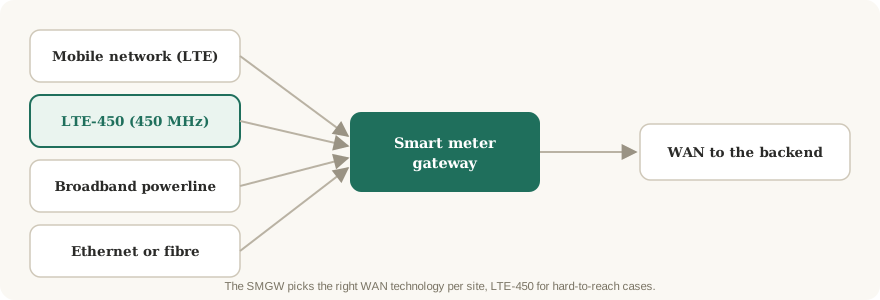
At the WAN side the gateway can use several technologies. The mobile network covers most sites via LTE or GPRS. Broadband powerline per IEEE 1901 carries data over the power line itself, and ethernet or fibre serves sites with a fixed line. New in the ramp-up is LTE-450, a dedicated 450 MHz network for critical infrastructure. Its advantages are physical: better building penetration than ordinary mobile bands and 72 hours of backup power at all network elements, which keeps it reachable in a power outage. For radio-less basement locations, powerline and hybrid solutions bridge the gap where no signal reaches.
- Mobile network: LTE and GPRS for the majority of sites.
- Broadband powerline: per IEEE 1901, over the power line itself.
- Ethernet or fibre: for sites with a fixed connection.
- LTE-450: the dedicated 450 MHz network, better building penetration, 72 hours of backup power.
The point is that there is no single best radio. The gateway picks the technology that fits the site, and LTE-450 is the answer where ordinary mobile fails, above all in basements and at critical infrastructure that must stay reachable through an outage. Powerline closes the remaining gaps so that the radio-less quarter of meter points still reports back.
Outlook: TAF 5 and 16 and the ramp-up
The development goes on. Event-based tariff use cases and the LTE-450 build-out shape the next stage, while the rollout itself still has a long way to run.

The next stage on the tariff side is the event-based TAF 5 and TAF 16, set out in a BSI implementation note in 2025. On the radio side the LTE-450 coverage rose from 34 to around 90 percent across 2025, and more than 10,000 gateways are already active in the 450 MHz network. The rollout overall remains early: by the end of 2025 only around 3.09 million smart metering systems were installed. The neighbouring articles set the wider frame, on the backend side in the piece on scaling the SMGW backend and on the home area network side in EEBUS and IEC 63380.
- Event-based TAF 5 and 16: the next stage, with a BSI implementation note in 2025.
- LTE-450 coverage: up from 34 to around 90 percent across 2025.
- In the 450 MHz network: more than 10,000 gateways already active.
- Rollout status: around 3.09 million smart metering systems by the end of 2025.
The picture is one of capability racing ahead of installed base. The framework can already do far more than most meter points use, and the gap between what the device supports and what is in the field is where the next years of work sit. Whoever plans for TAF 5 and 16 now buys headroom for later.
What companies should do now
Whoever plans the WAN strategy per site and lifts existing devices by firmware gets the maximum out of the technology already in place. Dynamic tariffs build on TAF 7.
- Set the WAN strategy per site. Decide between LTE, LTE-450, powerline and ethernet per location rather than rolling out one technology everywhere.
- Plan LTE-450 for hard-to-reach sites. Reserve the dedicated 450 MHz link for basements and critical infrastructure that must stay reachable in an outage.
- Upgrade existing devices by firmware. Lift the installed base to TAF 9, 10 and 14 by re-certification instead of replacing hardware.
- Base dynamic tariffs on TAF 7. Build the tariff logic on the 15-minute metered load profile and prepare for the event-based TAF 5 and 16.
Further reading
Frequently asked questions
The new generation is an industry term, not an official BSI standard. It describes smart meter gateways that, through extended re-certification, can do more than the first devices: more tariff use cases such as TAF 9, 10 and 14, and additional WAN technologies, above all the dedicated 450 MHz network LTE-450. The basis remains BSI TR-03109-1, with version 1.1 valid until the end of 2027 and version 2.0 for the communication unit.
Tariff use cases (TAF) are the building blocks with which the smart meter gateway records and provides metered values. BSI TR-03109-1 defines 14 of them, from TAF 1 to TAF 14. TAF 1 to 8 cover tariffing and balancing, TAF 9 covers controllable and generation plants, TAF 10 to 13 cover grid state data, and TAF 14 covers high-frequency values. Currently seven are normative: TAF 1, 2, 6, 7, 9, 10 and 14.
Dynamic electricity tariffs run technically on TAF 7, the metered load profile with 15-minute values, together with TAF 2 for time-variable models. They do not run on TAF 14, which only provides high-frequency values for visualisation and value-added services, and not on TAF 9, which concerns feed-in and controllable plants. The customer needs a smart metering system for it to work.
On the WAN side the smart meter gateway uses the mobile network (LTE, GPRS), broadband powerline per IEEE 1901 and ethernet or fibre. New in the ramp-up is the dedicated 450 MHz network LTE-450 for critical infrastructure. The gateway picks the right technology per site, and powerline or hybrid solutions bridge radio-less basement locations, which make up about a quarter of meter points.
LTE-450 is a dedicated 450 MHz radio network for critical infrastructure. It offers better building penetration than ordinary mobile networks and 72 hours of backup power at all network elements, so it stays reachable even in a power outage. Its coverage rose from 34 to around 90 percent in 2025, more than 10,000 smart meter gateways are already active in the network, and three SMGW from PPC, Theben and EMH are certified for it.