Direct Marketing: Remote Control of Renewable Plants via the Smart Meter Gateway from 2028
Section 10b EEG requires two functions from renewable energy plants over 25 kW in direct marketing, the retrieval of the actual feed-in and the remote-controlled reduction of the feed-in capacity by the direct marketer. From 1 January 2028 or upon installation of a smart metering system, whichever comes first, this remote control runs via the CLS channel of the certified smart meter gateway and an FNN control box. The transition technology such as the radio ripple-control receiver expires at the end of 2027. This article explains what Section 10b EEG requires, how the obligation is distinguished from Section 9 EEG and Section 14a EnWG, what changes technically, which deadline and which penalty under Section 52 EEG apply, what risks exist and what companies should do now.
Section 10b EEG makes renewable plants in direct marketing remote-controllable. Plants over 25 kW must be equipped so that the direct marketer can retrieve the actual feed-in at any time and reduce the feed-in capacity by remote control. This is the precondition for market-based marketing. From 1 January 2028 or upon installation of a smart metering system, whichever comes first, this remote control runs mandatorily via the smart meter gateway. Until then the transition technology such as the radio ripple-control receiver is permitted, and it expires at the end of 2027. Technically, the control will in future run via the CLS channel of the certified smart meter gateway and an FNN control box, the same architecture as for Section 14a EnWG, but for the generation side. The distinction matters: Section 9 EEG governs the grid-related control of generators by the grid operator, Section 14a EnWG that of consumers, Section 10b EEG the market-based control by the direct marketer. Same hardware, different direction. Whoever fails to meet the obligation pays 10 euro per kW and month under Section 52 EEG, reduced to 2 euro per kW and month. As of April 2025, around 119 GW of capacity was directly marketed, of which around 92 GW in the market premium segment. The bottleneck is the rollout: at the end of 2025, the penetration with smart metering systems stood at only around 5.5 percent, and certified control boxes have only been available for a short time. Whoever maps the plant fleet, schedules the installation with the metering point operator early, clarifies the CLS connection with the direct marketer and prices the penalty risk is prepared for the deadline.
What Section 10b EEG requires
Section 10b EEG makes renewable plants in direct marketing remote-controllable. Plants over 25 kW must be equipped so that the direct marketer can retrieve the actual feed-in at any time and reduce the capacity by remote control. This is the precondition for market-based marketing.
At its core, Section 10b EEG requires two functions from plants over 25 kW in direct marketing. First, the direct marketer must be able to retrieve the actual feed-in in real time at any time. Second, it must be able to reduce the feed-in capacity by remote control. Together, the two make up the market-based remote controllability needed to market the plant and respond to price signals. With the 2025 reform, the reference point for proving this remote controllability was moved from commissioning to the first feed-in. From 1 January 2028 or upon installation of a smart metering system, whichever comes first, the remote control runs mandatorily via the smart meter gateway. Until then, the transition technology such as the radio ripple-control receiver remains permitted, and it expires at the end of 2027. How large the affected area is can be seen in the market figures: as of April 2025, around 119 GW of capacity was directly marketed, of which around 92 GW in the market premium segment. The central bottleneck is the rollout, because at the end of 2025 the penetration with smart metering systems stood at only around 5.5 percent.
Section 9, 14a or 10b? Who steers what
Three steering obligations are often confused but use the same hardware for different purposes. Section 9 EEG and Section 14a EnWG serve grid safety, Section 10b EEG market-based marketing. Whoever separates them places their own obligation correctly.
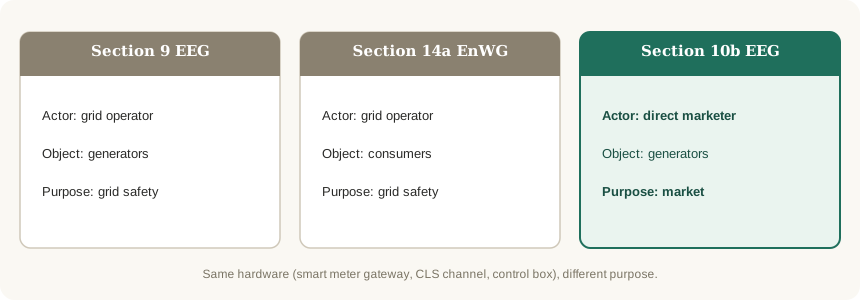
In detail, the three obligations differ in actor, object and purpose. Section 9 EEG governs the grid-related control of generators by the grid operator for grid safety, with the capacity threshold under the Solarspitzengesetz starting at 7 kWp. Section 14a EnWG governs the grid-oriented control of controllable consumption devices such as heat pumps and wallboxes, likewise by the grid operator for grid safety. Section 10b EEG governs the market-based control of generators by the direct marketer, with the purpose of marketing on the market. The common basis is the same: the smart meter gateway, the CLS channel and the control box. It is therefore the same hardware, but a different direction. Whoever separates these three strands cleanly recognises that the remote-control obligation in direct marketing is a stand-alone obligation on the generation side and must not be confused with grid control.
From ripple-control receiver to smart meter gateway
The technical change is at the heart of it. The previous transition technology is replaced by the certified gateway infrastructure. This unifies the control and ties it to the regulated metering system.

In detail, the new world differs clearly from the old. So far the transition technology ran via the radio ripple-control receiver with a return channel, which was proprietary and non-uniform. In future, the control runs via the smart meter gateway with a CLS channel and an FNN control box. The metering values are transmitted via the tariff application cases, TAF for short, while the control itself runs via the IEC 61850 standard. This architecture is the same as for Section 14a EnWG, but it is used here for the generation side. The installation and operation of the smart meter gateway and the control box lie with the metering point operator, MPO for short. For the plant operator, this means that meeting its own obligation depends on a third party, with whom the scheduling and the technical connection have to be clarified early. The advantage of the new architecture is the unification and the connection to the certified, regulated metering system.
The 2028 deadline and the Section 52 penalty
The reference date is clear but depends on the rollout. The SMGW obligation takes effect from 1 January 2028 or upon installation of a smart metering system, whichever comes first. Whoever fails to meet the obligation pays.
For practice, the reference-date logic means above all one thing: what counts is whichever comes first. Remote control via the smart meter gateway becomes mandatory from 1 January 2028 or upon installation of a smart metering system, whichever comes first. So if the smart metering system is installed before 2028, the SMGW control takes effect earlier. Up to that point, the transition technology such as the radio ripple-control receiver remains permitted, and it expires at the end of 2027. The ongoing obligation also includes an annual function test of the control, for plants under 100 kW from 2026. Whoever does not meet the remote controllability pays a penalty under Section 52 EEG of 10 euro per kW and month, reduced to 2 euro per kW and month. With the EEG 2023, this penalty system replaced the earlier reduction of the remuneration.
Watch the penalty under Section 52 EEG: The penalty of 10 euro per kW and month scales directly with the plant size. For a plant of 1 MW that is around 10,000 euro per month, as long as the remote controllability is not met. Whoever schedules the gateway installation too late or relies on the transition technology beyond the end of 2027 risks exactly this ongoing burden. What counts is the deadline from 1 January 2028 or upon installation of a smart metering system, whichever comes first.
Challenges and risks
The tight deadline meets a slow rollout. Without an installed gateway the obligation runs empty, and certified control boxes have only been available for a short time. An honest view has to name this, rather than painting the obligation only as orderly progress.

In detail, the risks lie on several levels. First, the rollout backlog is the central problem, because at the end of 2025 the penetration with smart metering systems stood at only around 5.5 percent. Without an installed gateway the SMGW control simply cannot take effect, so that the obligation is in practice tied to the electricity rollout, which is only a precondition. Second, the availability of certified control boxes is a bottleneck, as these have only been on the market for a short time. Third, a structural imbalance arises: the obligation hits the plant operator, but the technical implementation depends on the metering point operator, who installs and operates the gateway and the control box. Fourth, the penalty hits large plants hard, at 1 MW it is around 10,000 euro per month. A balanced view therefore recognises both the value of a uniform, market-based control infrastructure and the real gaps from the rollout backlog, the device availability and the shared responsibility.
The remote-control obligation in direct marketing is a sensible step towards a uniform control infrastructure and at the same time still a work in progress. The rollout backlog with around 5.5 percent penetration at the end of 2025, the still tight availability of certified control boxes and the fact that the obligation hits the operator while the implementation depends on the metering point operator belong honestly on the table. Whoever sees both, the value of uniform control and the real bottlenecks, can do the groundwork in a targeted way and limit the penalty risk.
What companies should do now
The obligation is an asset and data task with lead time. Whoever maps the plant fleet and schedules the gateway installation early avoids penalties. This turns a deadline into a concrete plan.
-
Map the plant fleet
Map the plant fleet over 25 kW and document the migration status per plant. Whoever knows which plants still run on transition technology and where a smart metering system is already installed can prioritise the need for action. This inventory is the basis for all further planning up to the deadline from 1 January 2028 or upon installation of a smart metering system, whichever comes first.
-
Schedule the install with the MPO
Schedule the installation of the smart meter gateway and the control box with the metering point operator early. Since installation and operation lie with the metering point operator and the rollout runs slowly, an early appointment is the most effective lever against time pressure at the reference date. Whoever waits here risks the deadline passing without an installed gateway.
-
Clarify the CLS connection
Clarify the CLS connection and the test windows with the direct marketer. The retrieval of the actual feed-in and the remote-controlled reduction run via the CLS channel of the smart meter gateway, that is exactly the two functions required by Section 10b EEG. Whoever aligns the connection and the test dates early ensures that the control actually works at the reference date and passes the annual function test.
-
Price the penalty risk
Price the penalty risk and factor it into the investment decision. The penalty under Section 52 EEG of 10 euro per kW and month scales with the plant size, at 1 MW that is around 10,000 euro per month. Whoever sets this burden against the cost of the gateway and control box quickly recognises that timely installation is the economically clearly cheaper option.
Further reading
Frequently asked questions
Section 10b EEG requires two functions from plants over 25 kW in direct marketing. The direct marketer must be able to retrieve the actual feed-in at any time and reduce the feed-in capacity by remote control. This is the precondition for market-based marketing. With the 2025 reform, the reference point for the proof was moved from commissioning to the first feed-in.
Remote control via the smart meter gateway becomes mandatory from 1 January 2028 or upon installation of a smart metering system, whichever comes first. Until then the transition technology such as the radio ripple-control receiver is permitted, and it expires at the end of 2027. The obligation requires that a smart metering system is installed, without which the SMGW control cannot take effect. The legal basis is Section 10b paragraph 2 EEG.
Affected are plants with more than 25 kW of installed capacity in direct marketing. In total, around 119 GW of directly marketed capacity was in the market as of April 2025, of which around 92 GW in the market premium segment. With the 2025 reform, the reference point for proving remote controllability was moved from commissioning to the first feed-in.
Section 14a EnWG governs the grid-oriented control of controllable consumption devices by the grid operator, such as heat pumps and wallboxes. Section 10b EEG, by contrast, governs the market-based control of generators by the direct marketer. Both use the same hardware, the smart meter gateway with CLS channel and control box, but with a different actor, object and purpose. Same hardware, different direction.
Whoever does not meet the remote controllability pays a penalty under Section 52 EEG of 10 euro per kW and month, reduced to 2 euro per kW and month. The EEG 2023 thereby replaced the earlier reduction of the remuneration. The penalty hits large plants hard, at 1 MW that is around 10,000 euro per month. In addition, an annual function test of the control is required, for plants under 100 kW from 2026.