Rollout quota 2026: why your equipment rate proves nothing on the deadline
This article sets out what section 45 (1) no. 4 (b) MsbG actually requires by 31 December 2026, why stock quotas and period quotas measure different things, and how a default metering point operator adjusts its tracking accordingly.
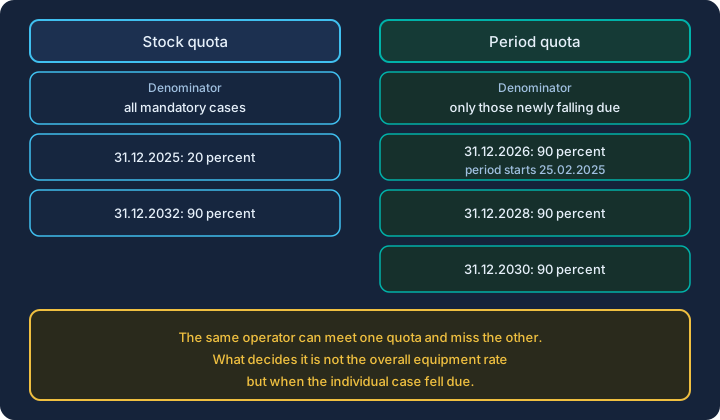
A period quota is an equipment obligation whose denominator is not the stock of all mandatory installation cases but only the metering points that fell due within a defined window; it binds the default metering point operator, and the next one closes on 31 December 2026. Section 45 (1) no. 4 (b) MsbG then requires at least 90 percent of the metering points that newly fell due since 25 February 2025. The provision names five deadlines: 20 percent of all mandatory installation cases on 31 December 2025, 90 percent of the newly due cohort on 31 December 2026, 2028 and 2030 respectively, and 90 percent of all mandatory installation cases on 31 December 2032. Two stock quotas frame three period quotas. The Bundesnetzagentur's monitoring puts the equipment rate at 23.3 percent of mandatory installation cases for the fourth quarter of 2025, drawn from 813 default metering point operators; on 27 March 2026 it opened 77 supervisory proceedings against companies that had missed the 20 percent quota. That figure is a stock figure. It does not count towards the 2026 deadline, and no public interim figure for the cohort itself exists.
Two kinds of quota
Sounds like bookkeeping. It decides whether an operator complies on the deadline or not.
Addressed is the default metering point operator, and it covers final consumers under section 30 (1) nos. 2 to 5 and section 30 (2). Equipping had to begin by 1 January 2025 at the latest.
What counts on 31 December 2026
Narrow wording, and it asks for 90 percent of the metering points that newly fell due in the window from 25 February 2025 to the end of 31 December 2026.
Three things are packed into that. The window opens on a date in the middle of a year, not at a year boundary. The denominator covers only cases that fell due inside it, so neither the legacy cases before it nor those arriving in 2027. And the numerator counts how many of those were actually equipped.

Exactly when a metering point newly fell due for the purposes of this provision follows from section 29 in conjunction with section 30 MsbG. That allocation is case work and belongs in your own legal review, not in an article.
Why the overall rate misleads
23.3 percent, reported for the fourth quarter of 2025 by 813 default metering point operators. Above the 20 percent mark, and the Bundesnetzagentur still opened supervisory proceedings against 77 companies on 27 March 2026. An average says nothing about the individual operator.
For the next deadline that holds twice over, because there the quantity being measured is not even the same.
Picture two operators. One lifted its equipment rate early by clearing planable legacy cases in large batches, while the cases arriving after February 2025 were left sitting. The overall rate looks good, the cohort does not. The other stands worse on the overall rate but served every newly due case as it came. On 31 December 2026 the second complies and the first does not.
Those figures are not a measurement. They describe a mechanism, and the risk lies exactly there: track your position only as an overall quota and the cohort stays invisible.
No public interim figure for compliance with the period quota exists. The monitoring reports the stock rate. What an operator has reached for the 2026 deadline is, for now, known only to that operator.
Two readings of the interim targets
Whether binding interim targets exist at all between 2025 and 2032 gets two different answers, and there is something to both.
The contradiction does not resolve, because the two sides are talking about different things. The circulating percentages of the stock remain unsupported. The period quotas are in the statute book.
What it means for planning
A cohort quota calls for tracking by due date. An equipment rate on its own no longer works as a steering figure.

In practice: every mandatory installation case needs a due date in the system, and the reporting has to be able to filter on it. Without that you cannot calculate your position on the deadline, let alone steer towards it.
Then comes the regulator's half-yearly survey, which sets the rhythm at which your status becomes visible from outside, and it comes round once more before the deadline.
What happens if the quota is missed is not in section 45 but in section 76 MsbG. How a supervisory proceeding runs and what the regulator examines is covered in the article on the Bundesnetzagentur's sanctions in the smart meter rollout .
What to do now
A little over three months remain. Most of the work is analysis, not installation.
Four steps before year end
-
Build the cohort in the first place
Filter out every mandatory installation case that newly fell due since 25 February 2025. If your system carries no due date per case, that is the real task, and it is more urgent than any installation. Without that filter you do not know your position on the deadline, and you cannot evidence it either.
-
Work out the distance to 90 percent
Numerator over denominator, honestly, once. The number that comes out is the only one that counts on 31 December.
-
Prioritise route planning by due date
While the period quota is open, a case from the cohort outranks a legacy case, even where the legacy case sits more conveniently on the route. That is an uncomfortable change for dispatch, because it makes routes less dense.
-
Use the next half-yearly report as a dry run
Calculate the cohort quota for the coming survey too, even though it is not asked for there. Then the analysis exists before it is needed.
Further reading
Frequently asked questions
What does the rollout quota require by 31 December 2026?
Section 45 (1) no. 4 (b) MsbG requires the default metering point operator to have equipped at least 90 percent of the metering points that newly fell due between 25 February 2025 and the end of 31 December 2026. The denominator is therefore not the whole stock of mandatory installation cases but only that cohort.
How does a period quota differ from a stock quota?
A stock quota measures the share of all mandatory installation cases that are equipped. That is how the 20 percent on 31 December 2025 and the 90 percent on 31 December 2032 work. A period quota counts only the metering points that newly fell due within a defined window. That is how the 2026, 2028 and 2030 deadlines work. The two can point the same way, but they need not.
Is a good equipment rate enough to meet the 2026 quota?
Not necessarily. An operator that lifted its equipment rate early by working through legacy cases, while doing little of the cohort that fell due after February 2025, can miss the period quota and still look healthy. Conversely an operator with a low overall rate can meet it, provided it consistently served the cases that newly fell due.
Where does the rollout stand?
According to the Bundesnetzagentur's monitoring, around 23.3 percent of mandatory installation cases carried a smart metering system in the fourth quarter of 2025. The survey draws on figures from 813 default metering point operators. On 27 March 2026 the regulator opened 77 supervisory proceedings against companies that had missed the 20 percent quota. That figure is a stock figure and says nothing about compliance with the period quota.
Which quotas follow after 2026?
Section 45 (1) no. 4 MsbG names five deadlines. On 31 December 2025 it is 20 percent of all mandatory installation cases; on 31 December 2026, 2028 and 2030 it is 90 percent of the metering points that newly fell due in the respective period; and on 31 December 2032 it is 90 percent of all mandatory installation cases again. Two stock quotas frame three period quotas.