Service · Prototype and AI
AI for utilities: from pilot to regular operation, with prototype and governance
Working code in days, AI in grid operations and customer service with governance that plans for the EU AI Act and BNetzA supervision from day one.
30 minutes on the project that's pressing for you right now. No sales loop.
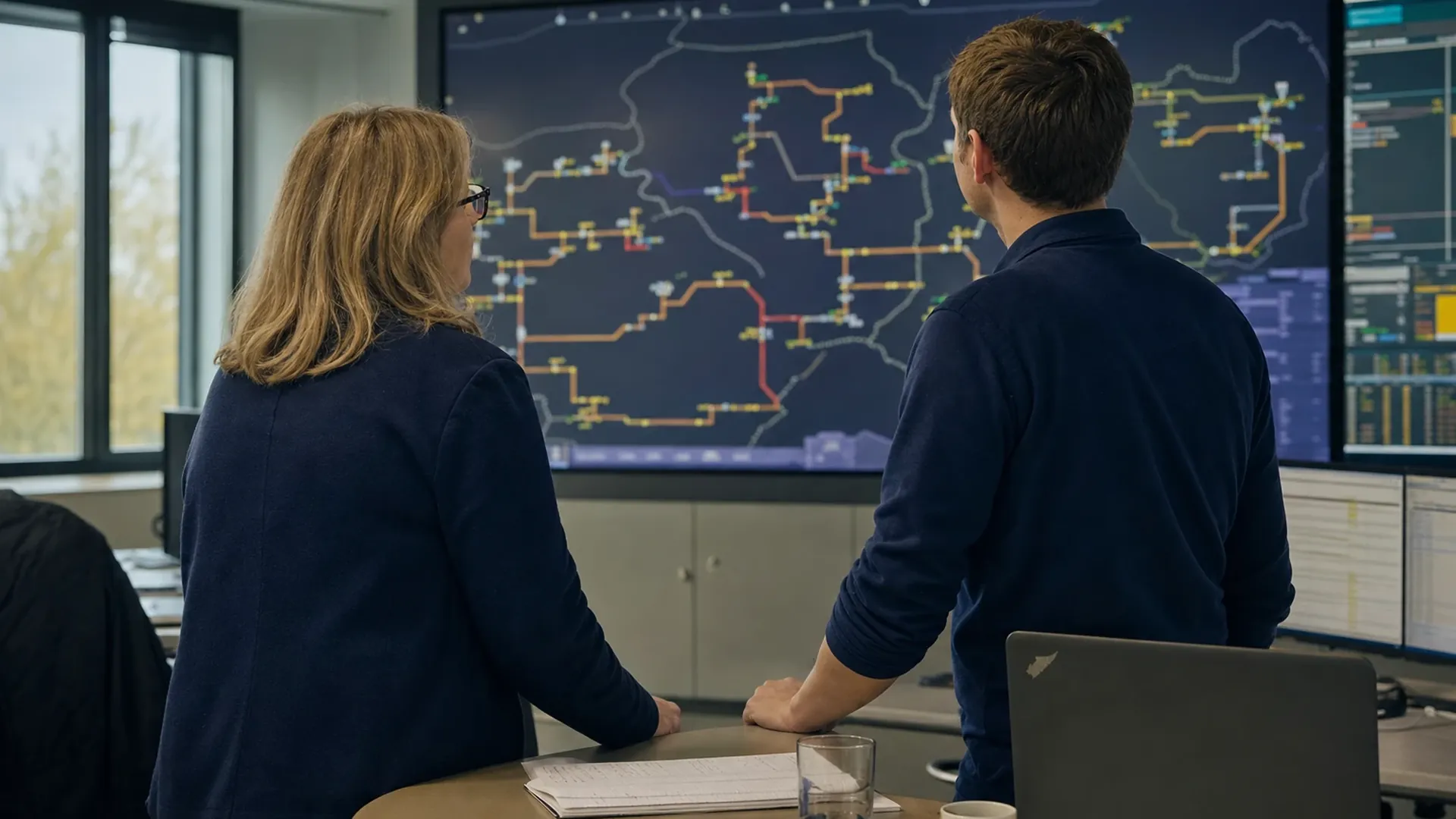
79 percent of German energy utilities have introduced AI, 61 percent are stuck in the pilot stage, none calls itself advanced. The bottleneck is rarely the model. It is the data behind it and the rules for using it. innobu builds the prototype that proves it holds, and the framework that lets it into regular operation.
Summary
AI for utilities at innobu means: a working prototype in days instead of a feasibility study in months, built on your data and in your process, plus the governance that allows the path into regular operation. Typical cases are load forecasting and grid state, clarification automation in market communication, customer service and document processes. The EU AI Act's high-risk duties apply from December 2027. Under the Commission's draft guidelines, AI in grid operations only falls under them if it physically protects the installations as a safety component and the operator is designated a critical entity. Whether that applies to your cases is for your legal advisers to assess. Governance puts that assessment into practice, so it is part of the work from the start.
Who this service is for
- Head of grid operations and planningYou want to improve grid state, load forecasting or congestion analysis with AI and need proof before you set up a programme.
- Head of market communication and billingClarification cases, master data errors and documents eat capacity, and a pilot with a vendor changed nothing.
- Head of IT and digitalisationBusiness units experiment with AI tools, and nobody keeps the inventory and risk classification the EU AI Act requires: Art. 50 since 08/2026, Annex III from 12/2027.
- International AI vendorsYou want to sell into German utilities and need to know what the EU AI Act, KRITIS and the market roles demand of your product.
Service
What you get
Prototype in days
A working prototype on your data and in your process, built with AI-assisted development, so you see whether the idea holds before budgets flow.
Use cases with a business case
Load forecasting, grid state, clarification automation, customer service, document processes: assessed by benefit, data situation, risk and effort.
Path into regular operation
Data connection, operating model, responsibilities, monitoring and handover to IT or vendors, so the prototype does not stay a pilot.
AI governance under the EU AI Act
Inventory, classification, documentation and approval paths, so you can answer the Federal Network Agency as market surveillance authority. Our AI governance for utilities page describes the approach; deadlines and articles are collected in the topic field AI in the energy industry.
Sovereign tool choice
Cloud or own infrastructure, European or American models: assessed by data protection, KRITIS requirements and cost, without vendor lock-in.
Process
How it works
Four stages, a tangible result after each.
Select cases
We review your candidates, assess benefit, data situation and risk and pick one to three cases with the biggest lever.
Build the prototype
In a few days a working prototype on real data emerges that business and IT check together.
Set up governance
In parallel we set up the inventory, the classification procedure and the approval path, so that your legal advisers' assessment is in place as a requirement before go-live and translated into the process.
Transfer into operation
We plan data connection, operating model and monitoring and hand over to your IT or your vendor.
Evidence
Backed by
You can read how we assess AI cases at utilities before we talk, every statement with a source. The AI regulatory matrix sets out EU AI Act duties, deadlines and penalties by role. Our piece on Annex III at a utility checks the electricity examples against the Commission's draft guidelines. For scale and cover there is a curated partner network, softstack for development, Horizonte for strategy and organisation, SmartOptimo for metering and rollout. Full background.
Classification for typical roles, not an assessment of your individual case and not legal advice. Whether a duty applies to your company is for your legal advisers to assess. Information as of 17 October 2026.
Questions
Frequently asked questions
The PwC study on 2025 (ZfK, 13 April 2026) shows: 79 percent have introduced AI, 61 percent are stuck in the pilot. The reasons are rarely the model but missing data connection, no operating model, no responsibilities and no governance. A prototype on real data with a path into operation addresses exactly these points.
A working piece of software on your data and in your process, built with AI-assisted development, that proves or disproves an idea before a programme is set up. Not a click dummy and not a feasibility study.
Most often: load and feed-in forecasting in the distribution grid, grid state estimation, clarification automation in market communication, customer service with a knowledge base and document processes in grid connection and billing. Which case comes first depends on your data.
Since February 2025 providers and deployers must take measures for AI literacy, and since 2 August 2026 the transparency duties under Article 50 apply. From 2 December 2027 the high-risk requirements under Annex III point 2 follow. Under the Commission's draft guidelines of May 2026, AI in grid operations only falls under them if it protects the physical integrity of the installations as a safety component and the operator is designated a critical entity. The draft explicitly lists load forecasting for grid optimisation as not high-risk. Since the KI-MIG the Federal Network Agency is the market surveillance authority. Inventory, classification, documentation and approval paths should be in place by December 2027.
It depends on data, KRITIS requirements and cost. innobu assesses both paths and European as well as American models without vendor lock-in. For many cases in grid operations a sovereign variant is the better choice.
With role-based AI orchestration in development; the human remains the decision maker. The method is described as Agentic Harness Engineering on innobu.com, with the reliability questions that also apply to your cases.
Further reading
- AI Agents in Market Communication: 4 Levels
- AI in grid control: human oversight, Art. 14
- AI Customer Service and Churn Prevention at Utilities
- AI studies 2026: what utilities and municipal utilities report on AI
- AI for exception cases: from pilot to operations
- Can the grid model go to sales? Meter data, AI and unbundling in the multi-utility
Let's collaborate
Next step
One AI case in mind, or twenty on a slide? In a first conversation we sort by benefit and data situation and say which case is feasible as a prototype in days.
Energy and measurement technology since 2010 · innobu GmbH since 2014 · Based in Schleswig-Holstein, Germany
Whoever pitches also delivers: whoever leads the first call stays your contact right through to the steering committee, with established partners in the project. Direct: info@innobu.com