The fallback metering operator under section 11 MsbG: what the 2026 list means
This article sets out the fallback regime in German metering law: who is named for which federal state in 2026, the three routes into it, what happens during the six months of emergency operation, and why the collapse of a competitive metering operator is first of all your own problem.
The fallback metering operator is the default metering point operator named for each German federal state that, under section 11 (2) MsbG, keeps metering running in emergency mode when another default operator can no longer meet its installation duties or guarantee reliable technical operation, loses its certificates under section 25 MsbG or ends up without the licence required by section 4 MsbG. Six months later the default responsibility for the entire grid area passes to it by operation of law, with every right and obligation, and without compensation. The German regulator's 2026 publication names Westnetz GmbH in 13 of 16 federal states, determined under section 11 (3) number 3 MsbG, which is the route that applies when nobody has declared readiness. For municipal utilities this is no longer a footnote: at the end of 2025 the 599 smallest of the 813 default metering operators reached an average of 14.6 percent on the mandatory installation quota, and on 27 March 2026 the Bundesnetzagentur opened its first 77 supervisory proceedings.
What the fallback operator is
The provision entered German metering law in 2023 and has drawn little attention since. No surprise there. It describes a case nobody plans for themselves.
Section 11 (2) MsbG knows three triggers. The default operator notifies the regulator that it can no longer meet its installation obligations under sections 29, 30, 32 and 45 MsbG, or guarantee the reliable technical operation of intelligent metering systems. Its certificates under section 25 MsbG are gone. Or the licence under section 4 MsbG is no longer in place. As soon as one of those happens, the fallback operator is on, with no procedure, no tender, no consent.
Who that is follows from subsection 3, in three tiers. First, the operator that runs the most intelligent metering systems in the given federal state, at least 10,000 of them, and has told the regulator it is ready to step in. Failing such a declaration, the largest operator nationwide that has declared readiness for that particular state. And if nobody does either, simply the largest operator nationwide, willing or not. The Bundesnetzagentur publishes name, address and website at the start of every calendar year, based on the data it holds for its monitoring report under section 35 EnWG.
That third tier is the actual mechanism. It guarantees somebody is always responsible, whether or not anyone signed up.
The 2026 list and its footnotes
The 2026 publication says more than an address table usually does. Westnetz GmbH of Dortmund appears in 13 federal states, and not because the company put its hand up. Because nobody else did. The regulator marks those entries with an asterisk and cites section 11 (3) number 3 MsbG, the tier that works without any declaration of readiness.
| Federal state | Fallback metering operator | Determined under |
|---|---|---|
| Bremen | wesernetz Bremen GmbH | section 11 (3) no. 2 MsbG |
| Saxony | DIGImeto GmbH & Co. KG | section 11 (3) no. 2 MsbG |
| Thuringia | TEN Thüringer Energienetze GmbH & Co. KG | section 11 (3) no. 2 MsbG |
| The other 13 states | Westnetz GmbH | section 11 (3) no. 3 MsbG |
What the table leaves out is the more telling part: not a single entry under number 1. In no federal state is there a regional leader with at least 10,000 intelligent metering systems that told the regulator it would step in if needed. Readiness was collected through the monitoring survey. Almost nobody declared it.
Which is understandable. An operator still pushing its own rollout quota ahead of itself does not volunteer for somebody else's grid area. It changes nothing about the legal consequence, though, and it explains why fallback responsibility now sits with a single group subsidiary.
The 2027 edition will rest on the next round of the same survey. The form for the first half of 2026 was due back through the MonEDa portal by 24 July 2026. Report incompletely there and you still shape next year's list, just without noticing.
Three routes into the fallback regime
A grid area reaches the fallback operator by three routes, and only one of them looks like a crisis. The other two are a self-notification and a tender that drew no bids.
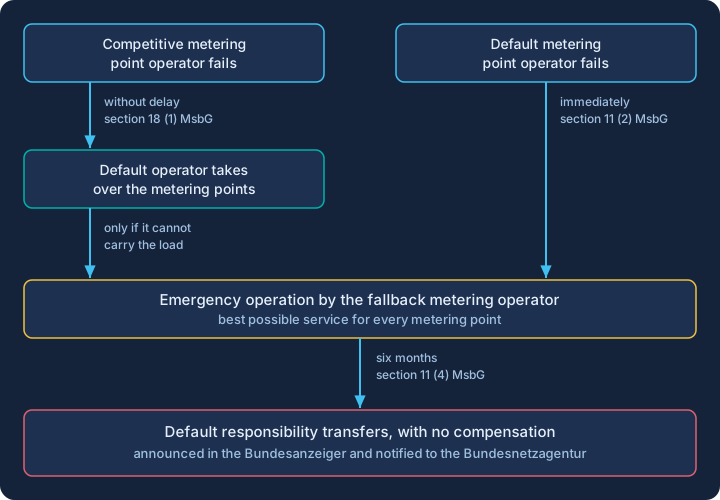
Route one is the notification under section 11 (2) number 1 MsbG. It reads like a technical filing and is in fact a switch: writing to the regulator that you cannot meet the installation duties permanently starts the clock in subsection 4.
Route two is losing the preconditions. No certificates under section 25 MsbG means no operation of intelligent metering systems, and no licence under section 4 MsbG means no default responsibility. Grid operators licensed under section 4 EnWG are exempt from that second licence, but never from the certificates. How much work keeping them costs at scale shows in the handover of gateway administration .
Route three appears in no subsection at all. It sits on the regulator's page about transferring default responsibility: if no bid is submitted in the transfer procedure, responsibility passes to the fallback operator. That hits precisely the utilities that weighed things up, decided to outsource, and then found no bidder. Anyone preparing that make-or-buy decision should therefore test bidder interest before opening a procedure under section 41 MsbG.
A transfer procedure has to close with an award within six months at the latest. With no bid it closes anyway, just in the fallback regime instead of with your preferred partner.
When a competitor fails, you are up first
This is where the common misreading sits. When a competitive metering operator fails, the fallback operator is not the first address. The default metering point operator is.
Section 18 (1) MsbG puts it in one sentence: if a third party's metering operation ends or the third party fails, and no other third party takes over at that point, the default operator is entitled and obliged to take over without delay. The connection user may not be charged anything beyond the fees under section 7 MsbG. Without delay does not mean at the next billing cycle.

A fair amount hangs on that sentence in practice. Under section 16 (1) MsbG the failed operator's devices must be offered to you for purchase or use, individually or as a whole, against reasonable payment. Decline, and the outgoing operator together with the grid operator must remove the equipment free of charge at a date you choose, or tolerate you removing it. Where metering data is missing for the period, section 71 (3) MsbG lets you determine consumption. And the metering change processes keep running while you sort all this out.
There is a second fall-back path, which the regulator describes in its rollout guidance. If a competitive operator fails to install the mandatory intelligent metering system under section 29 MsbG at a metering point, its contract with the customer ends automatically, the metering point falls back, and your installation obligation revives. Those cases arrive one at a time and unannounced, not as a batch.
Only when you cannot carry that load does section 11 come in. Subsection 2 names the default operator obliged to take over under section 18 (1) sentence 1 as an explicit trigger for emergency operation. The chain is longer than it usually gets described in meetings.
Six months, then the responsibility is gone
Section 11 (4) MsbG is not a review period. Six months after emergency operation begins, the default responsibility for the grid area passes to the fallback operator with every right and obligation, in particular those under sections 29 to 32 MsbG. Nobody has to sign anything. The transfer happens by operation of law, and the statute provides no compensation.
Two provisions apply accordingly. Section 16 (1) and (2) MsbG covers the devices, so the same purchase, use or removal logic as in an ordinary switch. Section 43 (4) MsbG requires the incoming operator to announce the change in the Bundesanzeiger without delay and notify the Bundesnetzagentur. The scheme of section 43 also shows what stays with the outgoing utility: responsibility for metering points without a modern metering device and without an intelligent metering system. The old Ferraris meters, in other words, and that population shrinks every year.
A notification under section 11 (2) MsbG is not a technical filing. It is a management decision with a six-month deadline and an outcome that cannot be taken back.
Which leaves the money. Section 11 (6) MsbG allows the Bundesnetzagentur to recognise special financial burdens connected with fallback operation in determinations under section 33 (1) number 2 MsbG and section 21 (3) EnWG. Allows, not requires. How that plays out in the first real case, nobody yet knows.
Why this touches more utilities in 2026
The fallback rule sat in the statute as paper law for three years. The rollout monitoring figures explain why it will not stay that way.
As at 31 December 2025, section 45 (1) number 4 MsbG required 20 percent of mandatory installation cases between 6,000 and 100,000 kilowatt hours, including controllable devices under section 14a EnWG. Across all 813 default metering operators the figure came to 23.3 percent of 4,709,487 quota-relevant cases. That reads like a target met.
The average hides the spread. The 19 operators with more than 500,000 metering points reach 27.1 percent, the 66 mid-sized ones 19.7 percent, the 129 smaller ones 17.5 percent. And the 599 operators below 30,000 metering points manage 14.6 percent on average. In total the regulator recorded 3,094,346 installed intelligent metering systems, a mere 5.5 percent of all 56,464,984 metering points, against 30,393,141 modern metering devices.
On 27 March 2026 the Bundesnetzagentur drew a conclusion from that and opened 77 proceedings against companies that had not started the rollout at all.
We see that many companies are not meeting the statutory rollout targets. As a first step we are today opening proceedings against the companies that have not started the rollout.
The penalty range under section 76 (4) MsbG together with section 94 sentence 3 EnWG runs from 1,000 euros to ten million, and the regulator has announced further proceedings. That creates a situation small utilities did not face before: a penalty payment on one side, the notification under section 11 (2) number 1 MsbG on the other. The link between the period quota and fallback responsibility has stopped being theory. In 2026 it is a trade-off sitting on supervisory board tables.
Where it pinches on both sides
The rule is uncomfortable for everyone involved, for different reasons.
In between stand connection users and suppliers. Billing and market communication carry on through emergency operation, master data moves twice within six months, and from the outside the whole thing is hard to tell apart from an ordinary switch. Anyone who has run a migration to standardised metering contracts knows how quickly clarification cases pile up.
And then there is the point the 2026 list raises about itself. A fallback rule that funnels 13 of 16 federal states to the same group subsidiary does not spread the risk. It concentrates it. For one small grid area at a time, that holds. For several at once, the mechanism was visibly not built.
What utilities and grid operators should do now
None of this takes long. The value lies in having written it down once, before somebody has to work it out under time pressure.
Six steps that are possible this week
-
Note your own fallback operator
One look at the regulator's publication, one entry in the emergency documentation. Check it annually, because the designation is republished every calendar year.
-
Work through the fall-back under section 18 MsbG
How many metering points does the largest competitive operator serve in your grid area, and what happens if they all come back tomorrow? The question targets three capacities: fitters, meters in stock, and slots in gateway administration. If one of them falls short, you now know which.
-
Prepare the device decision
Section 16 (1) MsbG gives you the choice between purchase, use and removal. Settle in advance which meter and gateway types you would take on and which you would not, price ceiling included. In the real case there is no time for it.
-
Treat the section 11 (2) notification as a board matter
It does not belong in the metering department's in-tray. Whoever sends it gives away the grid area in six months.
-
Test bidder interest before a transfer procedure
A procedure under section 41 MsbG without bidders still ends, just not where you planned. Two preliminary conversations spare you that outcome.
-
Report completely in the monitoring survey
The half-yearly data decides next year's publication, your published quota, and whether you end up in a supervisory proceeding. One filing, three effects.

Ticking off all six points does not make a utility safer than it was. It only means knowing where it stands, which for a provision with this legal consequence is already something.
Further reading
Frequently asked questions
What is a fallback metering operator?
The fallback metering operator is the default metering point operator named for each German federal state under section 11 (3) MsbG. It keeps metering running as well as possible when another default operator fails. German law calls that state emergency operation. The Bundesnetzagentur publishes the name at the start of every calendar year.
Who is the fallback metering operator in 2026?
For 2026 the Bundesnetzagentur published Westnetz GmbH of Dortmund for 13 of the 16 federal states, determined under section 11 (3) number 3 MsbG. Bremen has wesernetz Bremen GmbH, Saxony has DIGImeto GmbH und Co. KG and Thuringia has TEN Thüringer Energienetze GmbH und Co. KG, each under number 2. The basis is the survey for the 2025 monitoring report.
What happens after six months of emergency operation?
Under section 11 (4) MsbG the default responsibility for the grid area passes to the fallback operator six months after emergency operation began, with every right and obligation, in particular those under sections 29 to 32 MsbG. Section 16 (1) and (2) and section 43 (4) MsbG also apply, which means the change has to be announced in the Bundesanzeiger and notified to the Bundesnetzagentur.
What applies when a competitive metering operator fails?
Section 18 (1) MsbG applies first, not the fallback regime. The default metering point operator is entitled and obliged to take over metering without delay, and may not charge the connection user anything beyond the fees under section 7 MsbG. Only when it cannot carry that load does section 11 (2) MsbG name exactly this case as a trigger for emergency operation.
How does a grid area end up in the fallback regime?
Three ways. The default operator notifies the Bundesnetzagentur that it can no longer meet the installation duties or run intelligent metering systems reliably. Or it loses the certificates under section 25 MsbG or the licence under section 4 MsbG. Or a transfer procedure under section 41 MsbG attracts no bid, in which case the regulator states that responsibility also passes to the fallback operator.
Does the outgoing operator receive compensation?
The statute provides none. Section 11 (4) MsbG transfers the default responsibility by operation of law. For the devices, section 16 (1) MsbG applies accordingly: the outgoing operator offers them for purchase or use against reasonable payment, and if the new operator declines, they have to be removed. Section 11 (6) MsbG only allows the Bundesnetzagentur to take special burdens of fallback operation into account in its determinations.