
AI-Accelerated Grid Simulation: Congestion Analysis for the Section 14d Plan
The first grid expansion plan under section 14d EnWG is due at the regulator on 31 October 2026. It requires scenario-based congestion analyses to 2045, across high, medium and low voltage. That overwhelms the half-manual power flow of the past. This article shows why the classic calculation reaches its limits, what a digital twin plus ML-accelerated simulation actually delivers, how German regulation sets the pace, and what distribution grid operators should do now.
Grid expansion planning is becoming a duty with a date. Section 14d EnWG requires larger distribution grid operators to submit a formal grid expansion plan for the first time by 31 October 2026, and every two years after that. It builds on a regional scenario, which for the 2026 plans was due by 31 December 2025 and which itself orients on scenario path B of the network development plan; the assumptions the 2027 draft scenario framework sets for it are open for comment until 28 September 2026. The plan works through the target years 2028, 2033 and 2045, across high and medium voltage down to the transformation into low voltage. This computational load overwhelms the classic, half-manual power flow. The exact Newton-Raphson method is accurate but slow, and the plan needs thousands of scenario and outage calculations. Two building blocks solve it. A digital twin as a current image of the grid, and on top of it an ML surrogate, a trained model that approximates the power flow and runs up to 145 times faster depending on grid size. Critical cases are checked by the exact AC calculation. The driver behind the congestion sits in basements and driveways: controllable consumption devices under section 14a EnWG, mandatory since 2024 for new heat pumps, wallboxes and storage. Around 866 distribution grid operators share Germany, and the investment need in the distribution grid to 2045 is estimated at between over 180 and around 320 billion euros. AI speeds up the calculation, but it replaces neither data quality nor engineering judgment. Operators without a solid digital twin should close the data gaps first, above all in low voltage, before a low-voltage control system can act on them.
Grid planning gets a deadline
Distribution grid expansion was long an internal engineering task, half-manual, with no fixed date. That is over. Section 14d EnWG turns it into a regulated duty. Larger distribution grid operators must submit a grid expansion plan to the regulator for the first time by 31 October 2026, and update it every two years after that.
The plan is not a form. It is a scenario-based analysis of which congestion will arise in the target years 2028, 2033 and 2045, and which measures resolve it. It builds on a regional scenario that has to be ready at least around ten months earlier. For the 2026 plans that deadline was 31 December 2025. The Bundesnetzagentur can set the form, content and method, and demand adjustments.
The relevant grid levels run from high and medium voltage down to the transformation into low voltage. And that is the point where the whole thing tips over, computationally.
Why the classic power flow reaches its limits
A congestion analysis stands or falls with the power flow calculation. It simulates how current flows through the grid, where voltages deviate and where equipment overloads. How much an asset actually ages in the process is what transformer online monitoring shows at the asset itself. The established Newton-Raphson method solves these nonlinear equations exactly. For a handful of sample cases, that works well.

But the section 14d plan does not want a handful of cases. It wants thousands. Every combination of generation, load and outage, across three target years and many grid areas, plus the automatic N-1 analysis for resilience. Run that with an exact method and minutes turn into weeks. The combinatorial explosion is the real problem, not the physics.
And there is an uncomfortable truth. Many operators have not modelled their low-voltage grid in full. Exactly where digital secondary substations and smart meters deliver new data, the biggest gaps remain. Unlike the operational relief of acute congestion through redispatch or short-term load and generation forecasting, this is planning years ahead. Errors multiply over time.
What AI-accelerated grid simulation means
The approach has two building blocks, no more. First a digital twin, a current, data-driven image of the real grid. On top of it an ML surrogate, a trained model that approximates the power flow instead of solving it exactly every time. For the mass of scenarios the surrogate returns approximations in milliseconds. The critical cases are checked by the exact AC calculation. Weeks of work turn into an overnight run.
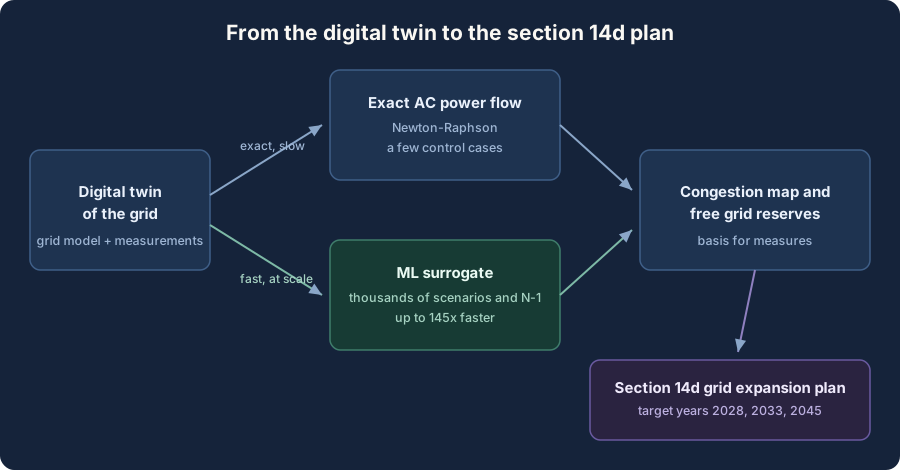
The surrogate is the heart of it. Usually a graph neural network that learns from many computed power flows to predict the result directly. In research grids such a model runs up to 145 times faster than Newton-Raphson, depending on grid size. Physics-informed variants keep the physical plausibility and cut constraint violations by one to two orders of magnitude compared with pure ML. That is the difference between a fast number and a fast, usable number.
| Criterion | Exact AC power flow | ML surrogate |
|---|---|---|
| Method | Newton-Raphson, physically exact | trained graph network that approximates the power flow |
| Speed | accurate, but slow per case | approximation in milliseconds, up to 145x faster |
| Strength | reference for critical control cases | mass of scenarios and N-1 runs |
| Limit | scales poorly across thousands of runs | accuracy depends on model and training data |
German and regulatory perspective
The duty hits a very uneven set of operators. Germany has around 866 distribution grid operators, from a few very large ones to many small municipal utilities. Anyone with fewer than 100,000 connected customers is exempt from the planning duty, unless they had to curtail more than three percent of possible wind or solar generation due to congestion recently. So a large share of operators drops out, but the ones with a duty cover the bulk of the customers.
The real driver of the congestion sits in basements and driveways. Since 2024, new heat pumps, wallboxes and storage have to be controllable as controllable consumption devices under section 14a EnWG. In return, the operator cannot refuse the connection. That raises the planning complexity, because it is not the single load that decides on expansion, but its simultaneity. How many charge at the same time in the evening? Exactly this distribution is what the surrogate maps across thousands of runs.
There is a lot of money at stake. The investment need in the distribution grid to 2045 is estimated, depending on the study, at between over 180 and around 320 billion euros, and roughly 245,000 kilometres of low-voltage and 218,000 kilometres of medium-voltage lines have to be built or reinforced. Good simulation decides whether these billions flow precisely or are built on suspicion, and it feeds the network capacity that the regulation will assess in future. That is the real lever, not the compute time.
Challenges and risks
AI speeds up the calculation. It replaces neither data quality nor engineering judgment. A surrogate is only as good as the grid model it trains on. Anyone who ignores the limits is selling a fast number as certainty.
In low voltage especially, many operators lack solid grid models. Without the data basis, even the best surrogate returns wrong results. Closing the gap comes before the AI, not after it.
A surrogate hits the average well and can underestimate rare, critical outage cases. That is why the exact AC calculation stays a control instance, not optional. For the N-1 edge cases it is the final check.
An ML result without a traceable derivation does not hold up in a formal plan. The Bundesnetzagentur has to accept the method. So assumptions, training data and validation belong documented, from the start.
What distribution grid operators should do now
The course is clear: close the data basis first, then scale the simulation. The section 14d schedule sets the pace, the regional scenario is the basis, the plan is the result. AI-accelerated simulation pays off where many scenarios and N-1 cases have to be computed, with the exact calculation as a safety net. Four steps, roughly in this order.

The roadmap for the section 14d congestion analysis
-
Close the data gaps in the grid model
First check how complete your own grid model is, with low voltage as the priority. A digital twin is worth only as much as the data behind it. Measurements from secondary substations and smart meters belong integrated before the surrogate is trained.
-
Set the section 14d schedule as the frame
The regional scenario comes first, the grid expansion plan comes last. Plan backwards from 31 October and factor in the internal sign-offs. Anyone who only starts in the summer of 2026 computes under pressure instead of cleanly.
-
Pilot ML surrogates deliberately
Not the whole grid at once. Pick a pilot area, calibrate the surrogate against the exact calculation, and only then let it loose on the scenario mass. The exact AC calculation stays the reference for the edge cases.
-
Document method and assumptions
Every assumption, every training dataset, every validation belongs on record. Not as bureaucracy, but so the plan holds up to a reviewer. A result no one can trace is worthless in regulation.
AI-accelerated grid simulation is not an end in itself. It makes a legal duty feasible in the time available that otherwise would not be. The gain is not the faster calculation alone, but that precise planning saves billions. The rest, data quality and a traceable method, stays homework.
Further reading
Frequently Asked Questions
AI-accelerated grid simulation uses a digital twin of the grid and a trained ML surrogate model that approximates the physical power flow instead of solving it exactly for every scenario. Such surrogates return approximations in milliseconds and run up to 145 times faster than the classic Newton-Raphson method, depending on grid size. Critical cases are still verified with the exact AC calculation.
Section 14d EnWG obliges larger distribution grid operators to submit a grid expansion plan to the regulator, for the first time by 31 October 2026 and every two years thereafter. The plan contains scenario-based congestion analyses for the target years 2028, 2033 and 2045 across high and medium voltage down to the transformation into low voltage. It builds on a regional scenario, which for the 2026 plans was due by 31 December 2025.
The established Newton-Raphson method solves the power flow equations exactly, but slowly. The section 14d plan requires thousands of combinations of generation, load and outages across three target years and many grid areas, plus automatic N-1 analyses. That number of repetitions turns the exact calculation into a bottleneck, especially in the low-voltage grid, which many operators have not yet modelled in full.
A digital twin is a current, data-driven image of the real grid that continuously reconciles measurements with the grid model. It serves as a shared basis for planning, grid connection and operation. On it, platforms run power flow simulations over a full year at quarter-hour resolution and perform automated N-1 simulations to reveal congestion and free grid reserves.
No. An ML surrogate is only as good as the grid model and the training data, and it can underestimate rare but critical outage cases. The exact AC power flow remains necessary as a reference for the control cases. For a formal section 14d plan the method also has to be auditable, a pure ML result without a traceable derivation does not hold up in regulation.