Low-voltage control system with CLS-management: real-time control under §14a EnWG
On 5 February 2026 Westfalen Weser Netz coupled a low-voltage control system (LV-SCADA) directly with CLS-management for the first time, together with envelio and GWAdriga. This creates a complete chain from the measurement in the grid to the dimming command at the device. This article explains the control loop, why a classic control system does not fit the low-voltage grid and what real-time control means for putting §14a EnWG into practice.
A low-voltage control system is the software a distribution grid operator uses to monitor and control the low-voltage grid. On 5 February 2026 Westfalen Weser Netz coupled it with CLS-management for the first time, together with envelio and GWAdriga, and built a working process chain for control in the low-voltage grid. The loop runs automatically: grid state data flows via tariff application case TAF10 into a digital twin, the control system detects congestion and sends the control command precisely through CLS-management to the affected connections. There the control box dims the power to at least 4.2 kW. For security reasons the system runs on-premises inside the process data network, not in the cloud. The pilot starts as a friendly-user operation in 20 low-voltage grids across two operating stations. For grid operators the complete controllability is what counts: since 1 January 2024 new controllable consumption devices above 4.2 kW must be controllable under §14a EnWG, yet in practice many grid operators still send hardly any real control commands. A working control-system chain closes exactly this gap.
The first coupled low-voltage control system
On 5 February 2026 Westfalen Weser Netz, together with envelio and GWAdriga, connected a low-voltage control system with CLS-management for the first time. This created a complete chain from the measurement in the grid to the control command at the device. That is the real progress, not a new box, but the closed process chain.
The roles are clearly split. envelio provides the control system on top of its Intelligent Grid Platform, GWAdriga operates the CLS-management as gateway administrator, and Westfalen Weser Netz brings both together in its own grid. GWAdriga's CEO Michal Sobótka calls it the first comprehensive and working process chain for control in the low-voltage grid. envelio's CEO Simon Koopmann speaks of a working chain between all project partners. The pilot runs first as a friendly-user operation in 20 low-voltage grids across two operating stations.
Why is this a topic in its own right? Because until now mostly the individual parts existed. The measurement layer has delivered data for years, for example through digital secondary substations in the low-voltage grid . At the other end the control box dims the device. In between the software was missing that turns a measurement into a justified control command. The control system is that missing piece.
The control loop: from measurement to dimming command
Control follows a closed loop. Grid state data from smart metering systems flows via tariff application case TAF10 into a digital twin of the low-voltage grid. When the control system detects looming congestion, it calculates the required measure and sends the control command precisely through CLS-management to the affected connections. Selective, not blanket. Who runs that function and what certification it demands is covered in CLS management and the aEMT role.
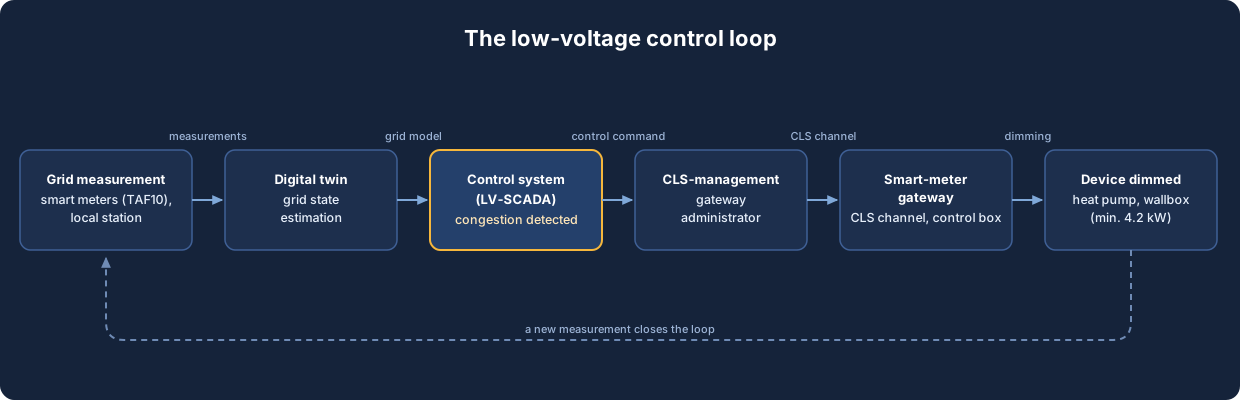
Four building blocks carry the loop. The measurement delivers smart-meter data via TAF10, plus feeder measurements and sensors in the local network station. The digital twin turns this into a grid state estimation , the basis for automated congestion management . The control system decides. And the CLS channel of the smart-meter gateway carries the command to the control box, which dims to at least 4.2 kW. How the grid state can be calculated at every point without a measurement there is shown in the article on AI-based grid simulation and congestion analysis in the distribution grid .
Why a classic control system is not enough
A high-voltage control system cannot simply be transferred to the low-voltage grid. In high voltage every single measure is highly critical, but the data volume is small and slow. In the low-voltage grid it is the other way round. Many thousands of local network stations, huge data volumes, high dynamics from heat pumps, wallboxes and PV. Manual monitoring does not scale here.

| Characteristic | High voltage | Low voltage |
|---|---|---|
| Criticality per measure | high | low |
| Data volume | small | very large |
| Data dynamics | slow | high |
| Number of stations | manageable | several thousand per grid |
The core problem is the data situation. Different systems, inconsistent formats, missing measurements. So everything stands or falls with a reliable grid state estimation that delivers a dependable grid model even with fragmented data. The approach brings planning and operation together in one model instead of maintaining two separate worlds. That saves double work and keeps the model current.
The control box is the hand, the local station the eye. The control system is the brain. Without that estimation in the background every control command stays a guess.
What this means for §14a EnWG
The pilot is the practical answer to §14a EnWG . Since 1 January 2024 new controllable consumption devices above 4.2 kW in the low-voltage grid must be controllable, in return grid fees drop. In practice many grid operators still send hardly any real control commands, and a rough time-window solution often kicks in instead. A working control-system chain closes exactly this gap.
The brakes are coming off. By the end of 2026 90 percent of connected capacity should be controllable, and new standard interfaces such as the edna REST API for low-voltage control systems and the SAP S/4HANA link to CLS-management speed up the rollout. How the control command takes the last mile to the device is shown in the article on the control box and grid control under §14a . For security reasons the control system runs on-premises inside the process data network, not in the cloud. Dennis Hunting of Westfalen Weser Netz calls that a particular challenge of the project.
Challenges and risks
The technology is largely certified. The path into full operation stays demanding anyway. The real hurdles are not in the control box, but in data quality, IT security, staff and integration into existing processes.
One point is often underrated. A control system is only as good as the data that feeds it. Without measurement the model estimates on sand. And the control itself is round-the-clock operation, critical infrastructure, not a side project. On the next grid level up the same principle applies with Redispatch 3.0 and congestion management with flexibility . The low-voltage grid is now catching up.
What grid operators should do now
The pilot delivers a blueprint that other distribution grid operators can reuse. Whoever brings the measurement layer, the grid model and the CLS chain together now reaches full operation faster. Four steps help.

-
Build out the measurement layer
Instrument local network stations and feeders with sensors and smart metering systems. Without dense measurement the grid state estimation stays vague, and the control system decides on a thin basis.
-
Maintain the grid model
Build the digital twin with a clean GIS link and keep it current. One model for planning and operation saves double work and keeps the state estimation reliable.
-
Close the process chain
Integrate control system, CLS-management and ERP system so the command runs through from measurement to control box. Standard interfaces such as the edna REST API cut the effort.
-
Start small, then scale
Begin with a friendly-user operation in a few grids, run the control loop with real hardware and only then extend it across the whole grid area. That shows early whether the dimming command arrives cleanly.
Further reading
Frequently asked questions
A low-voltage control system, also called LV-SCADA, is the software a distribution grid operator uses to monitor and control the low-voltage grid. It collects measurements, builds the grid as a digital twin, detects congestion and triggers control commands. Unlike a high-voltage control system it has to process thousands of local network stations and very large, fast-changing volumes of data.
CLS-management is the administration of the CLS channel (Controllable Local Systems) inside the smart-meter gateway. A control command reaches the control box at the connection point through this channel. The gateway administrator, in the Westfalen Weser Netz pilot GWAdriga, operates the CLS-management and forwards the control system's commands securely to the affected connections.
Control follows a closed loop. Grid state data from smart metering systems flows via tariff application case TAF10 into a digital twin. When the control system detects congestion, it sends the control command through the CLS-management to the affected connections. There the control box dims the power to at least 4.2 kW. A new measurement closes the loop.
A high-voltage control system is built for a few highly critical switching operations with small, slow-moving data volumes. The low-voltage grid is the opposite: many thousands of local network stations, huge data volumes and high dynamics from heat pumps, wallboxes and PV. Manual monitoring does not scale there. It needs a reliable grid state estimation and a continuously updated grid model, even with fragmented data.
On 5 February 2026 Westfalen Weser Netz coupled a low-voltage control system directly with CLS-management for the first time, together with envelio and GWAdriga. This created a complete process chain from measurement to control command at the device. The pilot runs first as a friendly-user operation in 20 low-voltage grids across two operating stations. For security reasons the control system runs on-premises.