
Redispatch 3.0: When the Car in the Driveway Relieves the Grid
Redispatch 3.0 is the industry and roadmap label for market-based congestion management that, for the first time, treats millions of small distributed assets in the low-voltage grid as flexibility. It is not a legal term. Today's cost-based Redispatch 2.0 applies to plants from 100 kilowatts. The next stage adds a market on top, in which aggregators bundle thousands of electric cars, heat pumps and home batteries and offer them to grid operators. Since October 2025 the BMWE-funded DataFleX project has tested this in the field with more than 5,000 assets.
Redispatch 3.0 is the industry and roadmap framing for the next stage of congestion management, in which small distributed assets such as electric cars, heat pumps and home batteries become grid flexibility for the first time. It is not a legally defined term. Today's Redispatch 2.0, in force since 1 October 2021 for plants from 100 kilowatts, is cost-based: grid operators (Netzbetreiber) ramp plants up or down at regulated cost. The next stage describes a hybrid model that adds a market-based dispatch of distributed flexibility, which a grid-side DERMS aggregates, selected through a shared merit order, on top of the cost-based redispatch for large generators. Article 13 of the EU Electricity Regulation (EU) 2019/943 requires market-based procurement as the rule but allows exceptions, which Germany uses; a government-commissioned study warned that a full switch could cause market distortions and more congestion. Congestion management cost around 2.8 billion euros in 2024. Since October 2025 the BMWE-funded DataFleX project has tested the model with more than 5,000 assets, and its harder problem is the cross-sector data space rather than the hardware. The economically sensible step for grid operators and flexibility marketers is to build the data and integration foundation now.
What Redispatch 3.0 is and why the term needs caution
Redispatch 3.0 is the industry and roadmap label for the next stage of congestion management, in which small distributed flexibility from the low-voltage grid is used systematically for the first time. It is not a legally defined term, and that should be said plainly. Today's Redispatch 2.0 has ramped plants from 100 kilowatts up or down at regulated cost since October 2021, and what distribution grid operators pay for redispatch without balancing is being reset by the Bundesnetzagentur right now. The next stage aims to open up electric cars, heat pumps and home batteries as flexibility that already exists, without grid expansion and without loss of comfort.

The direction of travel is the already-there potential of the low-voltage grid: millions of small assets that today run past congestion management entirely, and that a low-voltage control system can address selectively. Redispatch 3.0 is framing from research projects and transmission grid operator roadmaps, not the wording of any statute. Treating it as a fixed legal category would overstate where the rules actually stand in 2026.
Cost-based versus market-based: the regulatory dispute
The core of the debate is whether grid operators should instruct flexibility at regulated cost or buy it on a market, and Europe and Germany pull in different directions here. Article 13 of the EU Electricity Regulation (EU) 2019/943 requires market-based congestion management (Engpassmanagement) as the rule but allows exceptions, which Germany uses with its cost-based model. A change is contested because a purely market-based redispatch could, according to a government-commissioned study, trigger market distortions and more congestion.
Article 13 (EU) 2019/943 demands market-based procurement, with exceptions in paragraph 3 where competition is lacking or strategic behaviour is likely. Germany runs redispatch cost-based, and the government-commissioned study warned of market distortions in a full switch. Separately, the discussed redispatch reservation for renewables is a distinct and contested debate, which Agora Energiewende criticises as a brake on investment in renewables.
How EVs, heat pumps and home batteries become grid flexibility
A small asset can be dispatched in a grid-friendly way only if it is controllable, measured and bundled. Section 14a EnWG makes heat pumps, non-public wallboxes and battery storage controllable from 2024 and so creates the regulatory base. Market-based congestion management goes beyond that: the asset owner offers flexibility voluntarily and for payment, which an aggregator bundles into marketable packages.

Section 14a EnWG requires controllable consumption devices from 2024 to be dimmable, to at least 4.2 kilowatts, in return for a reduced grid fee. Market-based flexibility is voluntary and paid, typically with a capacity price for availability plus an energy price for the dispatch. The precondition is intelligent metering: without the smart meter rollout and secure data paths, the potential stays theoretical.
The interplay of aggregators and grid operators
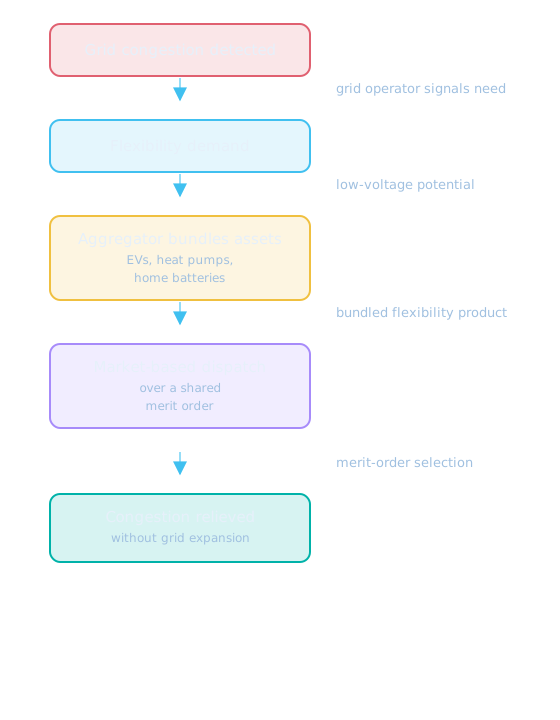
The market-based model redistributes the roles: the aggregator bundles thousands of small assets into a tradable flexibility product, the distribution grid operator reports the local congestion and its restrictions, and the transmission grid operator coordinates across regions. A shared merit order then selects the cheapest suitable measure, whether a large power plant or a cluster of heat pumps. This produces a hybrid model of cost-based redispatch for large generators and market-based dispatch of distributed flexibility. This finer congestion management is what the German action plan favours over a German bidding zone split.
The aggregator is the bundler: it aggregates individual assets, guarantees availability and takes on the market interface. The distribution grid operator supplies the congestion location and the network restriction, in the DataFleX test as a so-called flex band for staying within distribution-grid limits. Transmission and distribution operators share the coordination so that local flexibility does not create new congestion elsewhere.
This division of labour is what turns a wish to use small assets into a workable mechanism. It also explains why the interplay with the control box and Section 14a grid control matters: the same controllable devices that can be throttled in an emergency are the ones a market can later call on for paid, voluntary flexibility.
DataFleX and the data and IT architecture
DataFleX is currently the largest German field project for distributed flexibility, and it shows that the real hurdle is not the hardware but the data space. The project couples the data ecosystems of energy, transport and heat for the first time, among others through Energy Data-X and Catena-X, to provide flexibility data in a standardised, secure and near real-time way. This cross-sector data and market integration is the actual task for grid operators and aggregators.
The partners include the distribution grid operator Avacon Netz and aggregators such as Octopus Energy, OLI Systems and MVV/Beegy. The architecture lives on standardised, secure interfaces and real-time data rather than on new physical equipment. That is the same lesson as in the stalled smart meter rollout: the data base, not the device, is the part that decides whether distributed flexibility can be settled at all.
What grid operators and flexibility marketers should prepare now
Build the data and integration capability before the regulatory framework for Redispatch 3.0 is settled, rather than retrofitting later under time pressure. Whoever treats the smart meter rollout, the Section 14a processes and the market communication as one connected data foundation can later connect distributed flexibility without a break. That turns a regulatory waiting state into a stable basis for market-based congestion management.
-
Prioritise the data foundation
Treat metering, secure data paths and standardised interfaces as the part that decides connection readiness, and build them in parallel with the smart meter rollout rather than after it.
-
Read Section 14a as an entry, not only an emergency
Design the Section 14a processes so that today's emergency throttling can later become controllable and marketable flexibility, instead of treating the two as separate systems.
-
Plan the aggregator and grid operator interfaces
Define how distribution and transmission operators exchange congestion locations and restrictions with aggregators, so that a shared merit order can select measures without manual workarounds.
-
Watch the regulation actively
Track the EU Article 13 requirement, the redispatch reservation debate and the DataFleX results, because together they set the frame within which any market-based dispatch will operate.
Redispatch 3.0 will only work on a data foundation that exists before it is needed. Whoever builds the metering, the Section 14a processes and the market interfaces now turns a regulatory waiting state into a usable basis. How new tariff models make the electricity market steerable and how virtual power plants bundle battery storage show the same shift toward distributed, market-coordinated flexibility.
Further reading
Frequently asked questions
Redispatch 3.0 is the industry and roadmap label for the next stage of congestion management, in which small distributed assets such as electric cars, heat pumps and home batteries are used as grid flexibility for the first time. It is not a legally defined term. The current rules, Redispatch 2.0, apply to assets from 100 kilowatts and work cost-based. Redispatch 3.0 describes a hybrid model that adds a market-based dispatch of distributed flexibility on top of the existing cost-based redispatch for large generators.
In cost-based redispatch the grid operators (Netzbetreiber) instruct assets to ramp up or down at regulated cost. In market-based congestion management (Engpassmanagement) operators buy flexibility on a market, where asset owners offer their flexibility voluntarily and for payment. Article 13 of the EU Electricity Regulation (EU) 2019/943 requires market-based procurement as the rule but allows exceptions, which Germany uses with its cost-based model. A full switch is contested because a purely market-based redispatch could, according to one government-commissioned study, cause market distortions and more congestion.
A small asset can be dispatched in a grid-friendly way only if it is controllable, measured and bundled. Section 14a EnWG makes heat pumps, non-public wallboxes and battery storage controllable from 2024 in return for a reduced grid fee, which creates the regulatory base. Market-based congestion management goes further: the asset owner offers flexibility voluntarily and for payment, typically a capacity price for availability plus an energy price for the dispatch, and an aggregator bundles many assets into a marketable product.
DataFleX is a research project funded by the German Federal Ministry for Economic Affairs and Energy (BMWE). It started in October 2025, runs for 16 months and receives more than 7 million euros in EU funding. It tests market-based congestion management with more than 5,000 distributed assets and over one megawatt of capacity in the control zones of TenneT and TransnetBW, together with the distribution grid operator Avacon Netz and aggregators such as Octopus Energy, OLI Systems and MVV/Beegy. It is currently the largest German field test for distributed flexibility.
The economically sensible step is to build data and integration capability before the regulatory framework for Redispatch 3.0 is settled, rather than retrofitting later under time pressure. Whoever treats the smart meter rollout, the Section 14a processes and the market communication as one connected data foundation can later connect distributed flexibility without a break. Section 14a should be read not only as an emergency throttle but as the entry into controllable and later marketable flexibility.
Let's collaborate
One contact, a team behind it
Thirty minutes on what you're working on, whether grid, metering, market processes, IT architecture or AI. Afterwards you'll know how we'd approach it and who would sit at the table.
Energy and measurement technology since 2010 · innobu GmbH since 2014 · Based in Schleswig-Holstein, Germany
Whoever pitches also delivers: whoever leads the first call stays your contact right through to the steering committee, with established partners in the project. Direct: info@innobu.com