Digital Secondary Substations: Area Rollout and Low-Voltage Monitoring
This article covers the digitalization of the secondary substation: why the rollout is picking up speed now, what a digital station measures and how it transmits its data, how it relates to section 14a EnWG, why the industry is leaving the selective approach behind, where the risks lie and what energy providers should do now.
A digital secondary substation is a local distribution station between medium and low voltage that is retrofitted with measurement and communication technology and captures current and load on the low-voltage side. This makes the low-voltage grid visible, which used to be largely unobserved. The area rollout has begun: E.ON put its 10,000th digital secondary substation into operation in mid-July 2025, installs up to 500 stations per month and plans to connect around 28,000 stations via the resilient 450 MHz radio network by the end of 2026. Around 2 million measured values per minute arrive at the central data platform. Netze BW is equipping 550 stations with current sensors, creating around 18,000 digital measurement points that deliver data every 15 minutes. The driver is section 14a EnWG: since 2024 all distribution system operators must be able to curtail controllable loads such as heat pumps, wallboxes and storage during congestion, which is impossible to do precisely without grid observability. The industry is leaving behind the selective approach of digitalizing only 20 to 30 percent of stations and simulating the rest, moving toward the view that every secondary substation will eventually be digital. The real bottleneck is not the hardware but handling the data volume, recognizing the cost in the regulatory framework and IT security. For energy providers this means aligning the rollout with a data strategy, planning the data platform before the hardware and building in analysis and forecasting from the start.
The area rollout has begun
The secondary substation is becoming the measurement point of the distribution grid. E.ON put its 10,000th digital secondary substation into operation in Germany in mid-July 2025 and now builds up to 500 stations per month. That ends the phase of single pilot projects, and the actual area rollout begins.
For you as a lead at a distribution system operator or municipal utility, the task shifts. The question is no longer the single pilot station but how you store, quality-check and analyse the data from tens of thousands of stations.
- E.ON: 10,000th digital secondary substation mid-July 2025, up to 500 per month, target around 28,000 via the 450 MHz radio network by the end of 2026.
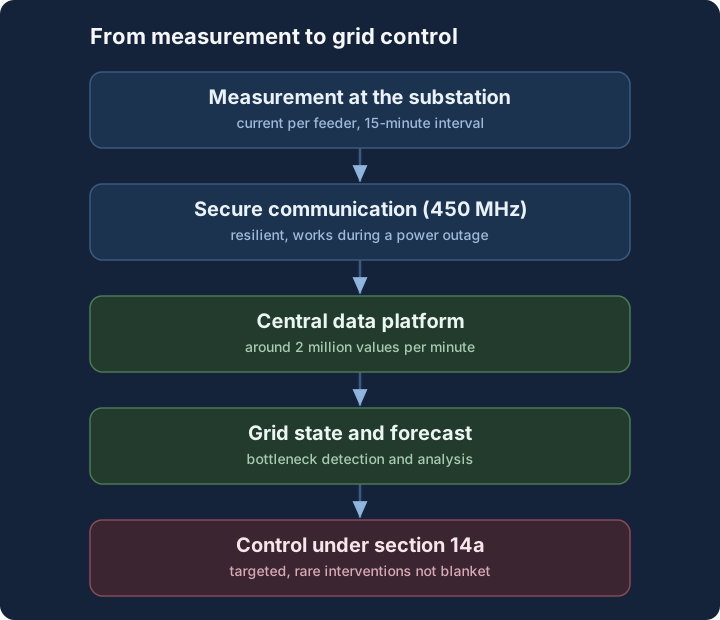
- Around 2 million measured values per minute arrive at the central data platform and are processed automatically.
- Netze BW is equipping 550 stations with current sensors from the EnBW start-up SMIGHT, creating around 18,000 measurement points with a 15-minute data interval.
- WEMAG Netz has the first digital secondary substation with low-voltage feeder measurement in its network area in operation and plans to build every new station to this standard.
What a digital secondary substation measures and reports
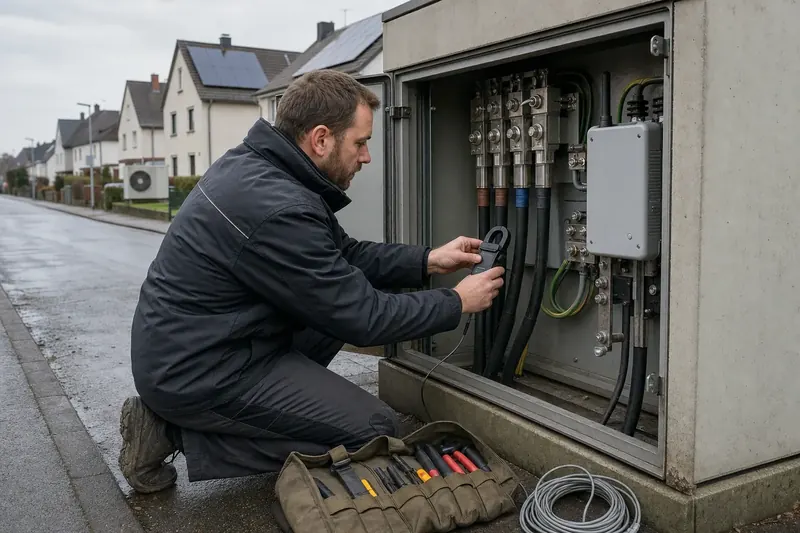
A digital secondary substation captures current, voltage and load on the low-voltage side, where the households are connected. The retrofit today usually happens as an upgrade: existing stations and cable distribution cabinets get measurement and communication technology. Only this feeder measurement makes the low-voltage grid visible to the operator. The medium-voltage cables feeding these stations are assessed separately through medium-voltage cable diagnostics , and their permissible rating through underground cable monitoring with DTS and RTTR.

The data path is similar across suppliers. Clip-on current sensors on the individual feeders measure the current per line and send it encrypted to an IoT platform. Communication increasingly runs over the resilient 450 MHz radio network, which keeps working during a power outage, and already carries more than 3 million smart meters. Around 1,600 radio sites are enough for nationwide coverage in Germany.
One practical finding from the rollout is worth noting: real measured values often deliver more useful conclusions than the calculation models assumed so far. Where operators long worked with assumptions and samples, the measurement at the station shows the true picture of the load.
The driver: section 14a EnWG and observability
The digitalization of the secondary substation is not an end in itself but the prerequisite for section 14a EnWG . Since 2024 all distribution system operators must be able to curtail controllable loads such as heat pumps, wallboxes and storage during grid congestion. Without observability of the low-voltage grid, a bottleneck can neither be detected early nor resolved in a targeted way.
Observability is the exception in the low-voltage grid today, not the rule. According to BDEW it is currently not possible in most cases because measurement and communication technology is missing. The association therefore calls for the cost of digitalization to be fully recognized in the regulatory framework, the same framework that the new quality regulation extends with reliability and capacity metrics.
Many grid operators would actually prefer to avoid having to intervene actively under section 14a.
This is exactly where the connection lies. An operator who measures its stations sees bottlenecks coming and can respond with targeted, rare interventions instead of blanket curtailment. The same grid-serving control is described in the article on section 14a EnWG and the control box from the perspective of the controllable load at the house connection.
From the selective approach to area-wide monitoring
For a long time a selective approach was considered sufficient: digitalize 20 to 30 percent of the stations and model the rest via simulations and digital twins . That approach is giving way to the realization that in the long run every secondary substation will be digital. Equipment rates of 50 to 60 percent are now discussed as an intermediate step.
- The shift moves from sample plus model toward broad measurement at the station.
- Digital twins remain important but are fed with real measured values instead of assumptions. How such models work at municipal utilities is shown in the article on digital twins in district heating .
- Several hundred thousand secondary substations in Germany, estimates put them around 570,000, make full coverage a task for more than a decade.
The switch from model to measurement is not purely technical. It moves the effort from the calculation assumption into the operation of the data platform. Whoever equips stations today without planning the data processing collects measured values that no one analyses.
Challenges and risks
The area rollout is not a pure hardware topic. The biggest hurdle is handling the data volume and the question of who bears the cost. And digitalization does not replace physical grid expansion, it only makes it more plannable, because the measurements provide the data basis for the AI grid simulation and congestion analysis behind the grid expansion plan.
Around 2 million measured values per minute at a single operator show the order of magnitude. Without a stable data platform and automated, partly AI-assisted analysis, this data stays unused. On top of that comes regulation: without full recognition of the cost in the regulatory framework, the investment incentive is missing. And with every connected station the attack surface grows, which raises the requirements from NIS2 and the German BSI rules.
- Data volume: millions of measured values per minute need a stable data platform and automated analysis, otherwise no benefit emerges.
- Cost and regulation: the investment must be recognized in the regulatory framework, otherwise financing slows the rollout.
- Cybersecurity: more connected stations enlarge the attack surface, NIS2 and BSI rules raise the demands on IT security.
- Physics: the installation space in existing stations is limited, and measurement does not resolve a structural bottleneck. Physical grid expansion remains necessary for that.
What energy providers should do now
Distribution system operators should treat the secondary substation as a data source and align the rollout with a data strategy, not just with unit counts. The value comes from the analysis, not the sensor. Four steps are pressing.

Four priority steps
-
Prioritize the rollout by load
Equip the network areas with high feed-in and many controllable loads first. That is where the benefit of measurement appears fastest and where the first bottlenecks threaten.
-
Plan the data platform before the hardware
Decide early how the 15-minute values are stored, quality-checked and analysed. The platform is the bottleneck, not the sensor.
-
Choose the communication path deliberately
Weigh 450 MHz radio, cellular or fibre by availability and resilience. The resilient 450 MHz network keeps working during a power outage, an advantage precisely in fault situations.
-
Automate analysis and forecasting
Automate load and feed-in forecasts and bottleneck detection with data analytics, so that interventions under section 14a stay rare and targeted instead of blanket.
The digital secondary substation does not stand alone. It feeds into the same digitalization as the smart meter rollout at the customer and the remote control via the smart meter gateway . Only together do the grid side and the customer side give a complete picture of the low-voltage grid.
Further reading
Frequently asked questions
A digital secondary substation is a local distribution station between medium and low voltage that is fitted with measurement and communication technology. Current sensors on the low-voltage feeders capture current and load, usually every 15 minutes, and send the values encrypted to a central data platform. This makes the low-voltage grid, which used to be largely unobserved, visible to the grid operator.
The low-voltage grid has a very large number of assets but almost no measurement technology so far. According to the German utility association BDEW, observability in the low-voltage grid is currently not possible in most cases because measurement and communication technology is missing. Operators have long worked with calculation models and samples instead of real measured values. Only the area rollout of digital secondary substations closes this gap.
Section 14a of the German Energy Industry Act (EnWG) has required all distribution system operators since 2024 to be able to curtail controllable loads such as heat pumps, wallboxes and storage during grid congestion. Without observability, a bottleneck can neither be detected early nor resolved precisely. The digital secondary substation supplies the grid state data that keeps an intervention rare and targeted rather than blanket.
Communication increasingly runs over the resilient 450 MHz radio network, which keeps working during a power outage. More than 3 million smart meters are already connected to it, and around 1,600 radio sites are enough for nationwide coverage in Germany. E.ON plans to connect around 28,000 digital secondary substations via 450 MHz by the end of 2026. Cellular or fibre are used as alternatives, depending on availability and resilience.
The previous approach was selective: digitalize 20 to 30 percent of stations and model the rest via simulations and digital twins. That approach is giving way to the view that in the long run every secondary substation will be digital. Equipment rates of 50 to 60 percent are discussed as an intermediate step. With several hundred thousand secondary substations in Germany, full coverage remains a task for more than a decade.
Let's collaborate
One contact, a team behind it
Thirty minutes on what you're working on, whether grid, metering, market processes, IT architecture or AI. Afterwards you'll know how we'd approach it and who would sit at the table.
Energy and measurement technology since 2010 · innobu GmbH since 2014 · Based in Schleswig-Holstein, Germany
Whoever pitches also delivers: whoever leads the first call stays your contact right through to the steering committee, with established partners in the project. Direct: info@innobu.com