Handbook · The handbook in twelve pictures
Digitalising the energy transition, explained
Smart meters, the gateway, §14a and market communication in twelve pictures: the short version of the handbook, each picture linked to its chapter.
The handbook “Digitalising the Energy Transition” has eight chapters, and nearly every figure in it carries a footnote. This page tells the same story in twelve pictures, for readers who need the big picture rather than every exception. Anything missing here is in the book. Under each picture, a link takes you to the matching chapter. Neither page is legal advice.
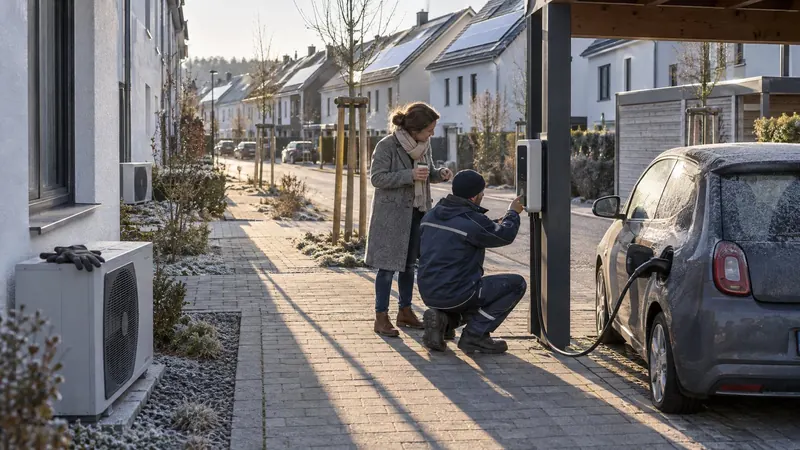
Picture 1New devices on the street
Heat pumps, wallboxes and solar panels are moving into the low-voltage grid, where grid operators long saw very little.
The low-voltage grid is the network on your doorstep, from the local substation at the end of the street to each house. Heat pumps, wallboxes and home batteries now hang off it, and solar modules cover many roofs. How heavily a cable was loaded, the grid operator usually didn't know. Hardly anything was measured here. In November 2023 Germany's Federal Network Agency called the observability of the low-voltage grid lamentably inadequate1.
Strong words from a regulator.
Picture 2The law sets the pace
Since 2023 the dates for the smart meter rollout have been written into the law. Before that, everything hinged on a BSI determination.
Under the 2016 act2, the duty to install only began once the Federal Office for Information Security (BSI) found that three manufacturers offered suitable devices. It did so in February 20203. A year later the Higher Administrative Court of North Rhine-Westphalia held that finding obviously unlawful in urgent proceedings4. That didn't halt installations: the court ruled on one company's lawsuit. In May 2022 the BSI withdrew the finding5.
Since 27 May 2023 the dates have been in the act itself6,7. The quotas were reworded in February 20258. The next deadline is 31 December 2026, when 90 percent of the mandatory cases due since February 2025 must be equipped9.
Picture 3Two devices, one metering system
A modern digital electricity meter on its own sends nothing. Only with a smart meter gateway does it become an intelligent metering system.
The old meter with its spinning disc counted kilowatt hours. When the power flowed, it had no idea. Its successor, a modern metering device in legal terms, is digital and records the time too. It still sends nothing anywhere.
That's the gateway's job: a small computer with its own security module. Only meter and gateway together form what the Metering Point Operation Act calls an intelligent metering system10. Far from the norm: in mid-2026, 5.9 percent of metering locations had one11.
Picture 4Three networks, one firewall
The gateway sits between the meters, the home network and the outside world, and lets through only what's allowed.
Think of a gatekeeper with three doors. Through the first come the meter readings: electricity and, under the BSI's guideline, gas, water and heat too. Behind the second lies the home network with the customer display, the service technician and controllable devices like the heat pump. The third leads out to the companies allowed to receive data.
Only the gateway administrator may configure it. Yet the BSI states plainly that the administrator has no insight into the readings12. Where does the comparison limp? A gatekeeper makes their own calls; the gateway follows rules others load into it.
Picture 5Checked twice
No gateway goes into a meter cabinet without two BSI certificates: one for security, one for interoperability.
The first certifies under an international standard, the Common Criteria, that the device withstands attacks, above all from outside. A single one of those could hit a great many devices. The second confirms that the gateway meets the BSI's technical guideline and works with the other companies' systems. The law requires both13. Every new function goes through this testing again before an update brings it into the field.
Then there's a chain of trust: everyone involved identifies with certificates whose root the BSI itself holds14.
Picture 6Functions to switch on
What a gateway measures, how often and for whom is set by tariff use cases. Only the gateway administrator can switch them on.
Tariff use case, or TAF after the German term, is a clunky name for a gateway function. TAF 1 sends single meter readings, monthly under the latest guideline of December 202415. TAF 7 records the reading every quarter hour and delivers the values daily. Quarter-hour balancing, where companies settle their energy volumes, depends on it, and so, as a rule, does the dynamic tariff. It's the workhorse. TAF 10 reports voltage and current at the connection to the grid operator, by default as quarter-hour values once a day. Minute values cost extra and cover a quarter of connections at most16.
Plenty of slide decks still list TAF 1 to 14. That's the state of play before 202117.
Picture 7Dimming, not switching off
Once current measurements show a threat to the grid, the grid operator may turn down a heat pump or wallbox. Never below 4.2 kW.
Since 2024 new rules under §14a of the Energy Industry Act have applied1. They cover almost every new heat pump, air conditioner, non-public wallbox and battery over 4.2 kW in the low-voltage grid18. Throttling comes only after a threat has been detected; experts call this curative. Nothing gets switched off: directly controlled devices keep 4.2 kW, heat pumps and air conditioners over 11 kW more. Operators who can't yet measure in real time may throttle based on planning data for now. The limits: 24 months per grid area, the end of 2028 at the latest, two hours a day18.
And the owner? The grid operator may not refuse or delay the device's connection for lack of capacity. Plus money, see picture 9.
Picture 8How a control command travels
The grid operator decides, the metering point operator sends the command, and the gateway just passes it on.
Once the grid operator detects a threat, the regulator's rule gives it five minutes at most to instruct the metering point operator18. That operator sends the command through a secured channel in the gateway to the control box in the house. The box hands it to the heat pump, or to an energy management system serving several devices.
The gateway administrator sets up the channel but doesn't send commands. Often several of these roles sit in one company. And with no box at all? The BSI has described control from the gateway itself. By mid-October 2026 it listed no certificate under the new rules for this19. Even so, manufacturers say gateways with a built-in control module are already in the field20.
Picture 9What device owners get in return
Being controllable earns owners lower grid charges. Two of the three modules don't need an intelligent metering system.
Module 1 is a flat-rate cut of 80 euros gross a year. On top comes a stability bonus that depends on the local grid operator's energy rate21. Choose nothing and you get this one. Module 2 cuts the energy rate to 40 percent and drops the standing charge, but needs a separate meter21. Module 3 adds three price bands across the day, only on top of Module 1 and only with an intelligent metering system.
By mid-October 2026 the Federal Network Agency had threatened four distribution system operators with penalty payments, mainly over Module 322.
Picture 10A price that follows the exchange
On a dynamic tariff the price follows the exchange, which trades quarter hours. It only meets the consumption on the bill.
Since January 2025 every German electricity supplier has had to offer a dynamic tariff, though only to customers with an intelligent metering system23. The price follows the exchange, whose day-ahead auction has traded quarter hours since October 202524. That's normally 96 prices a day. Whether a tariff that still passes on hourly prices meets the law, no authority has explicitly said.
The bill needs as many consumption values. The gateway usually records them via TAF 7, the metering point operator forwards them daily, and both series meet only in the supplier's billing. That's 35,040 values per supply point a year, where one annual reading used to do. A leap for any billing system that thinks in years.
Picture 11How companies talk to each other
Grid operators, suppliers and metering point operators exchange almost everything as standardised messages. Web services exist for just two purposes.
A customer switches supplier. For them it's a form. For the companies it's a chain of standardised EDIFACT messages over a secured transport channel called AS4. Since January 2026 the switch has had to work technically within 24 hours25.
Web services query one system directly from another. They exist for two tasks only. With one, a supplier looks up the ID of a market location, the point it supplies. With the other, grid operators and suppliers place control commands with the metering point operator. In July 2026 a consultation proposed expanding them26. On 1 October the Federal Network Agency dropped the idea: the UTILTS message stays, and web services stay at two uses for now27. The real bottleneck is elsewhere anyway: master data that's wrong.
Picture 12Two numbers, two denominators
26.1 or 5.9 percent: both numbers describe the same rollout on the same day. They just count different things.
On 30 June 2026, 26.1 percent of mandatory cases had an intelligent metering system11. This quota counts customers using 6,000 to 100,000 kWh a year plus controllable devices under §14a, about 4.8 million. Across all 54.1 million reported metering locations it was 5.9 percent that day. The real figure is probably higher, the agency says, because competitive metering operators report voluntarily. By how much, it doesn't say.
Quote only one and you paint a skewed picture. The first quota, 20 percent of mandatory cases by the end of 2025, applied to each company separately. Since March 2026 the Federal Network Agency has opened supervisory proceedings against 434 companies for missing it; 150 have since been closed28.
The whole journey
Twelve pictures take apart what belongs together in the grid. The interactive model follows a quarter-hour reading from the basement to the bill, step by step. A control command travels almost the same route back, over a different channel. Click a node to see what happens there, which chapter covers it and which deadline comes next.
What nobody knows yet
Some things can't be simplified because nobody collects them. Do the installed gateways actually deliver quarter-hour values, do they operate a control box? Nobody publishes a figure. For dynamic tariffs the Federal Network Agency counts providers, 412 in 202429, but publishes no customer count. And the time from installation to the first quarter-hour bill? Nobody measures it so far.
The book collects such gaps under Open questions and negative findings, along with the points where sources contradict each other.
The next deadlines
Live from the deadline calendar, data as of 14 October 2026. When a deadline changes, this list changes with it.
Sources
Primary sources first. Uncertain statements are marked as uncertain in the text rather than left out.
- Federal Network Agency, Ruling Chamber 6: ruling BK6-22-300 of 27 November 2023 on integrating controllable consumer devices and controllable grid connections under §14a EnWG, operative part and reasons, in particular pp. 3, 14 f., 20 f., 22, 25 f., 28 f., 32, 36 f., 40 f., 66 to 70 and 85 (German; quotations are our translation). bundesnetzagentur.de, retrieved 14 October 2026.
- Metering Point Operation Act (MsbG), header data: signed 29 August 2016, BGBl. Part I p. 2034, in force under Article 16 GDEW on 2 September 2016, last amended by Article 17 of the act of 18 December 2025 (BGBl. 2025 Part I No. 347) (German). gesetze-im-internet.de, retrieved 14 October 2026.
- Federal Office for Information Security (BSI): general ruling on the technical possibility of installing intelligent metering systems, ref. 610 01 04/2019_001, decided 31 January 2020, signed 7 February 2020, deemed notified 24 February 2020 (German). bsi.bund.de, retrieved 14 October 2026.
- Higher Administrative Court of North Rhine-Westphalia, order of 4 March 2021, case 21 B 1162/20, operative part and paragraphs 2, 3, 5, 8, 10, 23, 34, 121, 124 and 126 (German). nrwe.justiz.nrw.de, retrieved 14 October 2026.
- BSI: general ruling withdrawing the general ruling on technical possibility, ref. 610 01 04/2022_01, of 20 May 2022, with reasons (German). bsi.bund.de, retrieved 14 October 2026.
- Federal Law Gazette 2023 Part I No. 133 of 26 May 2023, Act on Restarting the Digitalisation of the Energy Transition of 22 May 2023 (German). recht.bund.de, retrieved 14 October 2026.
- Act on Restarting the Digitalisation of the Energy Transition (GNDEW), Article 2 (amendments to the MsbG), nos. 20, 21, 30 and 37, Bundestag enactment as Bundesrat printed paper 161/23; entry into force on 27 May 2023 per the footnote to sections 31 to 34 MsbG (German). bundesrat.de and gesetze-im-internet.de, retrieved 14 October 2026.
- Federal Law Gazette 2025 Part I No. 51 of 24 February 2025, Act amending energy law to avoid temporary generation surpluses of 21 February 2025, Article 1 no. 2, Article 2 nos. 8, 9 and 14, Article 9 (German). recht.bund.de, retrieved 14 October 2026.
- Section 45 MsbG, equipment duties of the default metering point operator, paragraphs 1 to 4 (German). gesetze-im-internet.de, retrieved 14 October 2026.
- Section 2 Metering Point Operation Act (MsbG), definitions, nos. 7, 10, 13, 15, 19, 20 (German). gesetze-im-internet.de, retrieved 14 October 2026.
- Federal Network Agency: iMSys rollout, results of the first half-yearly survey 2026 with FAQ, page as of 21 September 2026 (German). bundesnetzagentur.de, retrieved 14 October 2026.
- Federal Office for Information Security (BSI): BSI TR-03109-1, interoperability requirements for the communication unit of an intelligent metering system, version 2.0 of 13 December 2024, sections 1.1, 2.2, 2.3, 3.3.5, 3.3.6, 3.7, 3.8 and 3.21 (German). bsi.bund.de, retrieved 14 October 2026.
- Section 24 MsbG, certification of the smart meter gateway, paragraphs 1 and 4 (German). gesetze-im-internet.de, retrieved 14 October 2026.
- Section 28 Metering Point Operation Act (MsbG), holder of the root certificates (German). gesetze-im-internet.de, retrieved 14 October 2026.
- BSI: TR-03109-1, version 2.0 of 13 December 2024, sections 1.6 (MUSS+) and 2.3.3 (the administrator's evaluation profiles), tables 3.2 and 3.11 (overview of TAF), sections 3.2.8 (TAF 1), 3.2.11 (TAF 7), 3.2.12 (TAF 8) and 3.2.13 (TAF 15), table 3.43 (measurands) and annex E (changes MWV7 to MWV9) (German). bsi.bund.de, retrieved 14 October 2026.
- Section 34 Metering Point Operation Act (MsbG), standard and additional services of the metering point operator, paragraph 1 nos. 4 to 7 and paragraph 2 sentence 2 no. 6 (German). gesetze-im-internet.de, retrieved 14 October 2026.
- BSI: TR-03109-1, version 1.1 of 17 September 2021, table 4.1 (use cases TAF 1, 2, 6, 7, 9, 10 and 14) and changelog for chapter 4 ("Optionale TAF entfernt", optional TAF removed) (German). bsi.bund.de, retrieved 14 October 2026.
- Federal Network Agency, Ruling Chamber 6: Annex 1 to ruling BK6-22-300 of 27 November 2023, clauses 2.4, 2.6, 3, 4.1 to 4.8, 5, 7.3, 8.3, 8.4 and 10.1 to 10.7 (German). bundesnetzagentur.de, retrieved 14 October 2026.
- BSI: Certified products under section 24 MsbG, smart meter gateway (German). bsi.bund.de, retrieved 14 October 2026.
- Zeitung für kommunale Wirtschaft: digitalisation ticker, two items of 1 July 2026 on gateways with an integrated CLS module and on control directly from the gateway (German). zfk.de, retrieved 14 October 2026. Trade press, company statements.
- Federal Network Agency, Ruling Chamber 8: ruling BK8-22/010-A of 23 November 2023, grid charges for controllable connections and consumer devices (NSAVER), operative clauses 1 to 7 and paragraphs 117, 120 and 135 (German; quotations are our translation). bundesnetzagentur.de, retrieved 14 October 2026.
- Federal Network Agency, Ruling Chamber 8: publication of administrative enforcement measures to enforce the obligations under ruling BK8-22/010-A, as of 13 October 2026 (German). bundesnetzagentur.de, retrieved 14 October 2026.
- Section 41a Energy Industry Act (EnWG), load-variable, time-of-day or dynamic and other electricity tariffs and fixed-price contracts, paragraphs 2 to 7 (German; quotations are our translation). gesetze-im-internet.de, retrieved 14 October 2026.
- EPEX Spot: 15-minute products live on EPEX SPOT Day-Ahead markets, announcement of 30 September 2025. epexspot.com, retrieved 14 October 2026.
- Section 20a Energy Industry Act (EnWG), paragraph 2 sentences 1 and 4 (German). gesetze-im-internet.de, retrieved 14 October 2026.
- Federal Network Agency, ruling chambers 6 and 7: notice no. 57 on the data formats of 31 July 2026, consultation for the 1 April 2027 implementation date, section with the notes published at EDI@Energy's request (German). bundesnetzagentur.de, retrieved 14 October 2026.
- Federal Network Agency, ruling chamber 6: notice no. 58 on the data formats of 1 October 2026, section on entry into force on 1 April 2027 and, among the notes published at EDI@Energy's request, sections on API web services and further results (German). bundesnetzagentur.de, retrieved 14 October 2026, rechecked 15 October 2026 (no later notice).
- Federal Network Agency: press release "Bundesnetzagentur veröffentlicht halbjährliche Erhebung im Messwesen" (half-yearly metering survey published), 21 September 2026 (German). bundesnetzagentur.de, retrieved 14 October 2026.
- Federal Network Agency and Federal Cartel Office: Monitoring Report 2025, published 26 November 2025, PDF version as of 26 January 2026, p. 5 and p. 163, figure 93; on 14 October 2026 the overview page lists no newer report (German). data.bundesnetzagentur.de, retrieved 14 October 2026.