
Grid expansion plan under section 14d EnWG: what has to be filed by 31 October
The deadline has been in the law since the EnWG amendment. It now falls on a Monday four weeks out. Any operator with 100,000 customers or more files its grid expansion plan on 31 October 2026, built on a scenario that was not written in its own house.
The grid expansion plan under section 14d EnWG sets out how a German electricity distribution system operator intends to develop its network up to 2045; it is filed with the Federal Network Agency for the first time on 31 October 2026 and every two years on that date afterwards. The obligation attaches to the role of operators with 100,000 or more connected customers, and to smaller ones only where more than 3 percent of wind or solar output was curtailed in each of the two previous years. The basis is not the in-house forecast but the planning region's joint regional scenario, published for all six regions on VNBdigital on 28 January 2026, which projects roughly 425 gigawatts of photovoltaics, 175 gigawatts of onshore wind and over 364 gigawatts of connection capacity for charging infrastructure by 2045. The plan carries grid maps of congestion regions, the development of the distribution task, measures for five and ten years, the congestion analysis, the flexibility need and the expected costs. It then goes to consultation with medium and high voltage grid users, and onto VNBdigital no later than four weeks after completion. The 2024 round covered 82 operators and around 227 billion euros of investment, but the FfE found it barely comparable.
Who has to file
Two numbers decide whether a utility delivers on 31 October: 100,000 and 3 percent.
Section 14d(8) EnWG exempts operators whose networks have fewer than 100,000 customers connected directly or indirectly. That exemption falls away if the technically possible generation from wind or solar was curtailed by more than 3 percent in each of the two previous years. A small operator with a lot of wind in its territory can therefore land in the obligation without ever approaching the customer threshold.
Staying under the threshold does not mean staying out. Smaller operators feed their network data to the upstream operator so that its planning does not stop at the territory boundary. That is not a side note: according to the BDEW, the 2025 regional scenarios involved every distribution operator with fewer than 100,000 customers for the first time.
There was already a round in 2024. The Federal Network Agency records the NAP 2024 as covering the 82 largest operators, who submitted plans for the coming five and ten year periods. What is new is the fixed two year rhythm and, more to the point, the shared data basis.
The regional scenario is the basis
The plan is not calculated from your own sales forecast. Section 14d(3) EnWG requires the operators of a planning region to draw up a joint regional scenario with development paths to 2045, and to finish it ten months before the grid expansion plan is due. For this round that lead time has run out.
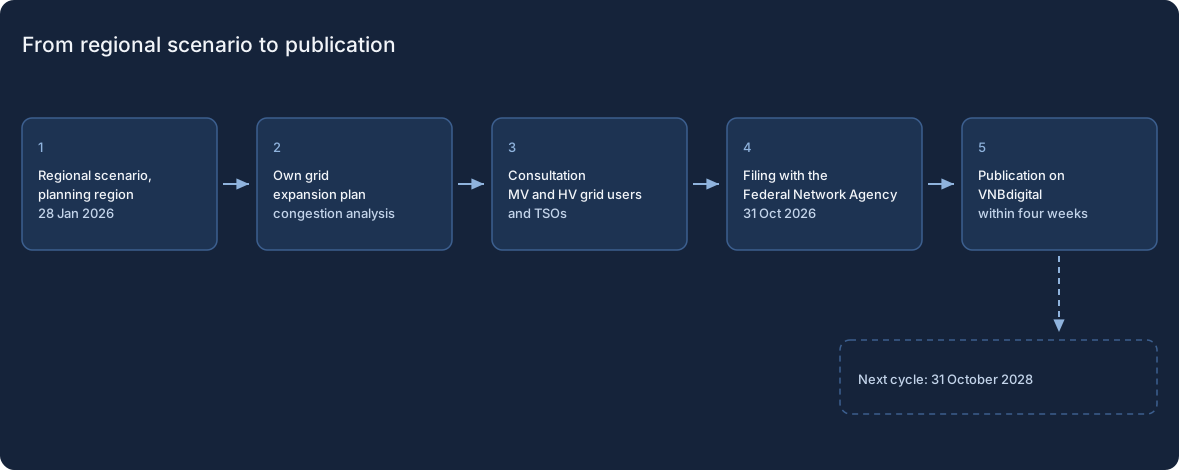
All six 2025 regional scenarios appeared on VNBdigital, the joint internet platform under section 14e EnWG, on 28 January 2026. The planning regions are Nord, Mitte, West, Ost, Südwest and Bayern; every distribution operator belongs to one of them, in a few cases to two.
Inside those documents sit the magnitudes that are the actual assignment. By 2045 the scenarios expect roughly 425 gigawatts of photovoltaics, four times today's installed capacity, around 175 gigawatts of onshore wind, 68 gigawatts of large battery storage in the distribution grid alone against roughly 2 today, 78 gigawatts of heat pumps, over 364 gigawatts for charging infrastructure and just under 37 gigawatts of data centres.
Break those numbers down to your own territory and the result is rarely comfortable.
Where the assumptions come from, and how the transmission level scenario framework feeds into them, we covered in our piece on the 2027 scenario framework and the regional scenarios .
What belongs in the plan
Section 14d(4) EnWG lists the mandatory content. The list works as an outline for the document and as a checklist against the draft that is already on the table.
| Content | What sits behind it |
|---|---|
| Grid maps | congestion regions in high and medium voltage, shown cartographically |
| Input data | the values of your own planning region's regional scenario |
| Distribution task to 2045 | expected development of feed-in, offtake and connection capacity |
| Measures for 5 and 10 years | optimisation, reinforcement, renewal, expansion, with timing |
| Congestion analysis | where it gets tight and how the operator intends to solve it |
| System services and flexibility | need and planned coverage, plus the extent of peak shaving |
| Costs | the expected cost of the measures set out |
| Energy efficiency and demand-side management | to be taken into account under subsection 7, so not only copper |
That last point is easy to skip. A plan that lists only assets leaves open why a measure is needed at all when load management or grid-serving flexibility could avoid it. How market and grid compete for the same flexibility in the local network is set out in our piece on grid-serving flexibility under section 14c .
And the congestion analysis? It is the part most utilities spend longest on. Which methods hold up there we took apart in the pieces on AI grid simulation for congestion analysis and on underground cable monitoring with DTS and RTTR .
The data behind the document
In the end the grid expansion plan is a PDF. Before it sit five data stocks that in many utilities are kept by different departments and rarely tell the same story.

Your geographic information system supplies topology, assets and station data. If the switching state there does not match the field, the load flow calculation runs cleanly on the wrong network.
Load flow itself has to handle target years, not just today. A model that represents 2026 answers nothing about 2035.
Then the connection requests. Planned charging parks, heat pumps, large storage and data centres belong in the forecast even where no contract is signed. Treat the queue as a list of cases rather than a capacity forecast and you give away precisely the information that scales the regional scenario down to your territory.
Fourth, measures and investment planning. The plan states costs. If they diverge from the medium-term financial plan, you end up with two sets of numbers that contradict each other at the next supervisory board meeting.
And finally the documentation of assumptions. In two years the plan gets updated, not recalculated. Fail to record today why you departed from the regional scenario and 2028 starts from scratch. That is the point where a deadline turns into a process.
Consultation and publication
This plan leaves the building twice.
Before filing comes consultation. Section 14d(6) EnWG requires that at least the grid users of the medium and high voltage levels and the transmission system operators get an opportunity to comment on the plans that concern them. VNBdigital is the route provided for it.

After completion comes publication. Section 14e(4) EnWG requires the grid expansion plan on the joint internet platform no later than four weeks after completion, and operators have to notify the regulator of that publication in text form. The same applies to the regional scenario.
That changes what the document has to be. From publication onwards, a congestion region on the map is a statement about a location that a business park, a municipality or a project developer will read and quote. Map quality and wording are not cosmetics here.
Under section 14d(5) EnWG the Federal Network Agency can set out details on form, content and transmission, and require adjustments. That power is why the argument about comparability is not settled.
The argument about comparability
On one point the assessments diverge, and we are not settling it here.
The Forschungsstelle für Energiewirtschaft analysed the 2024 round and published on 6 February 2025. Its finding: the documents showed
differences and inconsistencies in methodology
and, because format and quality varied, were
barely usable for science and industry
Its analysis names different units for electric mobility with no stated conversion, shifting regional resolution between planning region, network territory and federal state, and commercial vehicle traffic that was only partly accounted for. Of more than 800 network operators in Germany, 81 were required to publish; the investment volume they set out came to around 227 billion euros, and possibly up to 240 billion once incomplete data is allowed for.
Industry describes the same process differently. On 28 January 2026 the BDEW wrote about the 2025 regional scenarios:
The BDEW developed a practical procedure together with representatives of distribution system operators at every level and from every planning region, with the VKU, and in coordination with the Federal Network Agency
and notes that the six planning regions coordinate with each other and with the regulator through the association. On that reading, comparability comes from the shared scenario and the agreed procedure, not from a prescribed format.
The two sides are talking about different things. The FfE measures what came out as a document; the BDEW describes how the input data is produced. Whether the procedure is enough shows on 31 October, and the power under subsection 5 sits with the Federal Network Agency.
Where it can go wrong
Last round, the biggest problems were not in the arithmetic.
The grid expansion plan rarely fails on the load flow calculation. It fails on data that does not line up, on costs that age faster than the document, and on measures nobody has the crews to build.
BET Consulting points to distribution transformers in its review: some operators plan for more transformers by 2028 than they operate today. Prices for transformers and cable have risen sharply, with an uncertain path ahead. A cost estimate in the plan is a snapshot from the day it is published.
Peak shaving and flexibility barely feature so far, according to the same review, partly because the regulatory framework is unclear. That is awkward, because section 14d(7) EnWG expressly requires energy efficiency and demand-side management to be taken into account.
The quiet bottleneck is people. A plan setting out measures for which neither in-house crews nor contractor capacity exist reads well in October and becomes a burden of explanation in 2028.
What operators should do now
Four weeks out, this is no longer about methodology. It is about completeness and coordination. And about making the next cycle easier than this one.
The next four weeks
-
Put the coverage question in writing
Document customer numbers and the curtailment share for both previous years. Especially if the utility stays under the threshold. Whether the obligation applies in a specific case is the operator's own assessment, usually with its legal department or outside counsel.
-
Hold the mandatory content against the draft
Eight points from subsections 4 and 7, one at a time. Name the gaps instead of smoothing them over.
-
Justify departures from the regional scenario
Where your own forecast diverges from the joint scenario, the reasoning belongs in a section of its own, with source and date. It is the section consultation asks about first, and the one that saves the most work in 2028.
-
Schedule the consultation
Bring in medium and high voltage grid users and the upstream operator early enough that responses arrive before filing, not after.
-
Prepare the publication
Maps, legibility, how you handle sensitive detail, and the notice to the regulator in text form. The four week clock in section 14e(4) EnWG runs from completion, not from filing.
-
Wire the data path for 2028
Connect GIS, load flow calculation and connection requests once, properly, instead of running the plan as a project all over again.
In the grid portfolio of a multi-utility in northern Germany that we have been running since 2024, this order shows up in almost every regulatory programme: work out which data the role's obligation actually requires, then the system, then the document. Do it the other way round and you get a handsome PDF and a data estate that looks the same at the next deadline as it did at the last one.
Further reading
Frequently asked questions
Operators of electricity distribution networks with 100,000 or more customers connected directly or indirectly. Operators below that threshold are covered under section 14d(8) EnWG only if the technically possible generation from wind or solar was curtailed by more than 3 percent in each of the two previous years. Whether a given utility falls under it is decided by its own customer and curtailment figures.
On 31 October 2026, and every two years on 31 October after that. Section 14d(1) EnWG sets the rhythm. Section 14e(4) EnWG adds publication: the plan goes onto the joint internet platform VNBdigital no later than four weeks after completion, and the regulator has to be notified in text form.
Section 14d(4) EnWG lists grid maps showing congestion regions in high and medium voltage, the input data from the regional scenario, the expected development of the distribution task up to 2045, planned measures for the next five and ten years, the congestion analysis with intended solutions, the need for system services and flexibility, and the expected costs. Section 14d(7) adds energy efficiency and demand-side management.
The regional scenario is a planning region's joint forecast for generation, consumption and connection capacity up to 2045. It has to be completed ten months before the grid expansion plan is filed and forms its basis under section 14d(3) EnWG. The six 2025 regional scenarios were published on VNBdigital on 28 January 2026.
Under section 14d(6) EnWG, at least the grid users of the medium and high voltage levels and the transmission system operators get an opportunity to comment on the plans that concern them. In practice that means industrial customers, large generators and the upstream operator read along.
Yes. Section 14d(5) EnWG lets the Federal Network Agency set out details on form, content and the way the plan is transmitted, and it can require adjustments to both the regional scenario and the plan. That power is exactly where the criticism of the 2024 round's comparability lands.