Transformer Online Monitoring: Condition, Not Calendar
Expensive, long-lived, and right now hard to replace at short notice. That is exactly why a transformer's condition and remaining life move to the centre. This article shows how online monitoring shifts maintenance from time-based to condition-based, what gets measured at the tank, where the market is heading and where the limits sit.
Online monitoring watches power transformers continuously, not just once a year at the inspection. Sensors measure the gases dissolved in the insulating oil (online DGA), partial discharge, bushings, tap changers and the hot-spot temperature all the time. So maintenance follows the actual condition instead of the calendar. The market for transformer online monitoring grows from around 2.93 billion dollars in 2025 to roughly 3.2 billion dollars in 2026, continuous online monitoring already held about 65 percent of installations in 2024, and DGA holds around 48 percent. The driver is scarcity. Lead times for high-voltage power transformers run 18 to 36 months according to Siemens Energy, and up to six years for some grid components, while much of the roughly 40-year-old fleet reaches its replacement window. If you cannot replace quickly, you have to run the existing assets safely for longer. IEEE C57.143 (updated on 27 August 2025) and IEC 60599 set the frame. Predictive maintenance typically pays off for grid operators in 12 to 18 months and cuts maintenance costs by around 30 percent. The limits sit with false alarms, retrofit costs and the cybersecurity of the connected sensors.
Why the transformer becomes the bottleneck
The condition of the transformer already standing there decides how long the grid can get by with it. Sounds trivial. It is the core of the whole debate, ever since a new unit stopped being something you simply order.
A new high-voltage transformer takes 18 to 36 months, Siemens Energy says, and some grid components up to six years. Meanwhile the fleet ages. Typical technical life is around 40 years, and much of it has now arrived exactly there. Add data centres, the renewables build-out and regular replacement demand, all at once, all reaching into the same empty warehouses. If you cannot replace in months, you need to know how healthy the asset is.
So monitoring is not a technical luxury. It is an answer to the scarcity, and it pulls extra safe operating years out of an asset you cannot replace. That is the real reason the topic is surfacing now. The grid itself became measurable much the same way recently, for example through LiDAR corridor inspection for vegetation management.
From time-based to condition-based
Condition-based maintenance schedules the work by the measured value, not by the calendar. The difference is bigger than it sounds. Classic maintenance runs fixed intervals no matter how the asset is doing, so it swaps sometimes too early, sometimes too late. Online monitoring supplies the data for the better way. The next step goes further still.
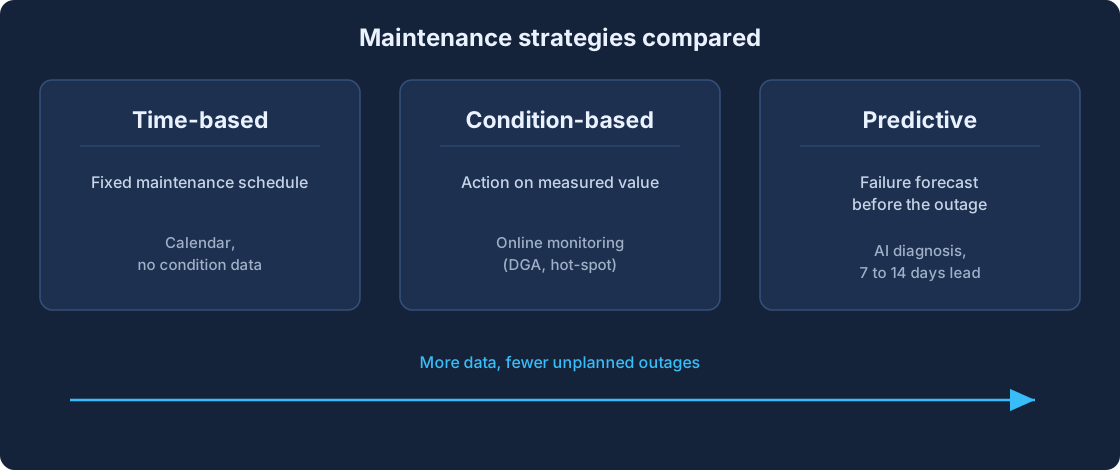
The benefit is concrete. In 2024 about 65 percent of all installations were already continuous online monitoring, and the share grows around 10 percent a year as utilities switch over. On critical components the forecast lands in over 90 percent of cases, 7 to 14 days ahead. And the business? Maintenance costs down 30 percent, unplanned downtime down as much as 50 percent, payback in a typical 12 to 18 months. Not a lab figure. The reason to invest.
What gets measured at the transformer
A single measurement lies easily. So modern monitoring combines several paths: oil, electrical quantities, heat, mechanics. Together they say more than any single reading. What gets measured, and how it is read, comes from the standards IEEE C57.143 and IEC 60599.

Four measurement paths carry most of the diagnosis:
- Online DGA: analysing the gases dissolved in the insulating oil detects hotspots and partial discharge early and holds around 48 percent of the market. It is the proven core of any condition assessment.
- Partial discharge: UHF, acoustic or HFCT sensors pick up discharge signals that often appear weeks before dielectric breakdown. That lead time is what makes a planned shutdown possible in the first place. On buried cables the same measurement handles fault location in medium-voltage cable diagnostics .
- Fibre-optic hot-spot sensing: sensors in the winding measure to about plus/minus 1 degree Celsius across minus 40 to plus 260 degrees Celsius, calibration-free for 15 to 25 years and immune to electromagnetic interference, and the same fibre technique carries the whole-route temperature profile in underground cable monitoring with DTS and RTTR.
- Bushings and tap changers: monitoring of bushings and the on-load tap changer (OLTC), plus oil moisture and top-oil temperature, rounds the package out into a full picture.
The combination is what counts. A single DGA value can mislead. But a gas rise, plus a partial discharge signal, plus a rising hot-spot temperature, that is a diagnosis solid enough to plan a shutdown on. Ideally the raw data flows through a standardised interface into the control system, as the digital substation under IEC 61850 provides.
Grid expansion meets asset scarcity
Across Europe, record grid expansion runs into a global transformer shortage. That makes monitoring more than an efficiency question here. It pulls the operating years out of the existing fleet that the build-out is short of.

How tight it is shows in a real case. The German utility Stadtwerke Oranienburg had to turn down new grid connections for a while, a grid bottleneck stalled the growing town. The transformers it needed came from Ljubljana in the end, after a long wait. Siemens Energy is putting around 220 million euros into expanding its Nuremberg plant, but relief comes at best in the medium term. Until then, every asset that keeps running safely is money saved and time won.
The regulatory picture fits. Incentive regulation rewards efficient maintenance. And the digitalisation of protection and control in the substation lays the data paths that make condition data usable at all. A sensor on the tank is not an island device, then, but a building block in digital grid operation.
False alarms, retrofit, cybersecurity
Online monitoring is not a self-runner. Roll out sensors without a data strategy and you harvest alarms instead of decisions. Three points slow the practice down.
First, false alarms. The sheer volume of DGA and partial discharge alerts overwhelms the teams, and the false positives are exactly what then delays the urgent action. Without defined thresholds, more sensors mainly mean one thing: more noise.
Second, retrofit. Older transformers have no standardised mounting points. That drives installation cost and extends downtime. Roughly 10,000 to 50,000 dollars per asset, well above that for large high-voltage units, and running operating costs rise by around 30 percent on a retrofit. It does not undo the business case. But it forces prioritisation.
Third, cybersecurity. Every cloud-connected sensor enlarges the attack surface. Fewer than 40 percent of utilities report full implementation of their security measures, and around 30 percent report cyber threats. So OT security under IEC 62443 and the NIS2 obligations belong in the plan from the start, not in an afterthought. And then data integration. Legacy SCADA systems with tight bandwidth and inconsistent protocols struggle with the new measurement data.
What grid operators should do now
The entry works through prioritisation, not a fleet-wide roll-out in one go. Fit the critical and old assets first, set up the interpretation cleanly, then scale. Four steps put a project in shape.
-
Sort the fleet by criticality and age
Fit the transformers whose failure would be most expensive first, and those close to the end of their life. A fleet-wide roll-out in one go burns budget where the risk is small. In practice the payback sets in from around 500 monitored assets.
-
Select the sensors by standard
Choose the measurement paths by IEEE C57.143 and interpret the gases by IEC 60599. Combine online DGA, partial discharge and hot-spot rather than relying on a single value. Only the combination carries a solid diagnosis.
-
Define alarm thresholds and interpretation
Set thresholds and escalation paths before the first alert arrives. An AI-assisted diagnosis only helps with a clean data base, otherwise it amplifies the noise. The goal is the decision, not the alarm.
-
Build in cybersecurity and integration
Plan network segmentation, encryption and the requirements from IEC 62443 and NIS2 from the start. Bring the measurement data into the existing control system over a standardised interface instead of creating a data island.
As long as a new transformer takes 18 to 36 months, the cheapest path to more grid reliability is the asset already running. Online monitoring makes its condition visible, extends safe use and moves maintenance from the calendar to the measured value. Prioritise by criticality, interpret cleanly and build in security from the start, and you get the most out of it.
Further reading
Frequently asked questions
Online monitoring is the continuous sensor-based observation of a transformer while it runs. Sensors measure oil gases, partial discharge, bushings and hot-spot temperature all the time, not just at the annual inspection. The condition stays visible at any moment, and maintenance follows the measured value instead of the calendar.
Time-based maintenance follows fixed intervals, regardless of the asset's condition. Condition-based maintenance schedules work by real measured values from online monitoring. The next step, predictive maintenance, forecasts a fault before it happens, on critical components with roughly 7 to 14 days of lead time.
DGA stands for dissolved gas analysis, the analysis of gases dissolved in the insulating oil. Online DGA measures these gases continuously at the transformer and detects thermal faults and partial discharge often weeks before a breakdown. DGA holds around 48 percent of the monitoring market, and the interpretation follows the IEC 60599 standard.
That is exactly the reason. Lead times for high-voltage power transformers run 18 to 36 months according to Siemens Energy. If you cannot replace an asset quickly, you need to know its remaining life and avoid unplanned outages. Monitoring extends safe use and flags problems while there is still time to act.
IEEE C57.143 covers the selection and application of monitoring equipment for liquid-immersed transformers and was published in an updated edition on 27 August 2025. IEC 60599 is the reference for interpreting dissolved gas analysis. For the cybersecurity of the sensors, IEC 62443 and the NIS2 requirements apply.
Let's collaborate
One contact, a team behind it
Thirty minutes on what you're working on, whether grid, metering, market processes, IT architecture or AI. Afterwards you'll know how we'd approach it and who would sit at the table.
Energy and measurement technology since 2010 · innobu GmbH since 2014 · Based in Schleswig-Holstein, Germany
Whoever pitches also delivers: whoever leads the first call stays your contact right through to the steering committee, with established partners in the project. Direct: info@innobu.com