
Grid development scenarios 2027: why the assumptions sit in the distribution grid
This article reads the 2027 draft scenario framework from a distribution planner's desk: which assumptions path B carries, why that path matters most to a municipal utility, what the transmission operators have taken from the regional scenarios for the first time, and where an objection is worth making before 28 September 2026.
The scenario framework is the set of assumptions about generation, demand and flexibility that Germany's four transmission system operators submit to the Bundesnetzagentur and which, once approved, becomes the calculation basis for the electricity network development plan; for distribution operators and municipal utilities it applies indirectly, through their own regional scenario, and comments are open until 28 September 2026. The 2027 draft sets out three paths for each target year, 2040 and 2045, and was for the first time coordinated with the gas transmission and hydrogen network operators before submission. Path B for 2040 carries 12.5 million heat pumps, 39.5 million electric vehicles, 400 GW of solar and 79.5 GW of small battery storage, alongside net electricity demand of 1,051.3 TWh against 466.0 TWh in the 2025 reference. Path B is at once the joint scenario with the gas side and the reference point for regional scenarios, on the basis of which section 14d EnWG requires a grid expansion plan, first due on 31 October 2026. What is new is that the transmission operators have taken distribution operators' regional renewable forecasts on board for the first time; flexibility stays out for now because of its complexity. Two points remain open and are explicitly put out for comment: the single nationwide curtailment factor of 3 percent for overbuilding, and whether it should be differentiated by region.
What the 2027 draft says
On 31 August 2026 the Bundesnetzagentur opened the electricity and the gas and hydrogen drafts for consultation. What is new is less the cycle than the coordination: the electricity and gas sides merged their assumptions before submitting them. Klaus Mueller, president of the regulator, singled that out in the announcement.

Two movements stand out. Electrolyser capacity comes in well below the last scenario framework, which is why every path assumes substantial import dependency for hydrogen. Data centres and large battery storage go the other way: electricity demand from new data centres jumps from 4.2 TWh in the reference to 141.8 TWh in path B for 2040.
On the gas side, biomethane carries real weight for the first time. For a gas network operator that is the more interesting line than any hydrogen figure.
Why this is a distribution grid topic
Work through the draft's table of key figures and ask, line by line, which voltage level the asset actually connects to. The answer contradicts the title on the cover.
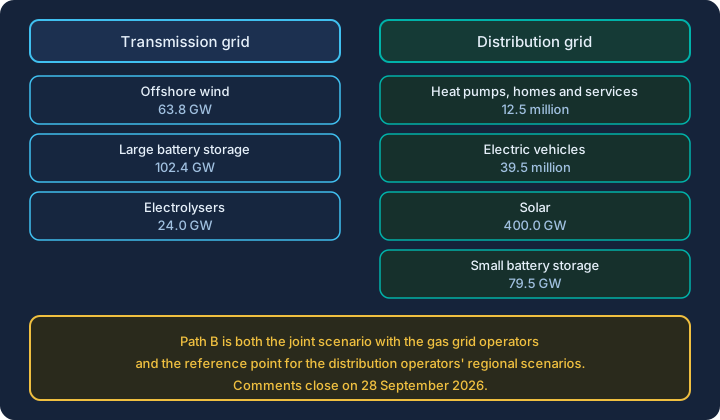
Offshore wind, large battery storage and electrolysers sit at transmission level. The rest does not. 12.5 million heat pumps in homes and commercial premises, 39.5 million electric vehicles, 400 GW of solar and 79.5 GW of small battery storage spread across house connections, local network stations and medium-voltage feeders. Across your grid, in other words.
Net electricity demand in the same path rises from 466.0 to 1,051.3 TWh. More than a doubling, and the larger part of the increase comes from consumers nobody plans individually.
That is why the document is worth reading, even with network development plan printed on the front.
Path B is the one that matters
Three paths per target year sounds like three equally weighted possibilities. They are not.
Path B carries two roles at once. It is the joint scenario the electricity and gas sides agreed on, and for it the transmission operators, together with the gas transmission and hydrogen network operators, derived consistent electricity, hydrogen and methane demand for industry, households, commerce and transport for the first time. It is also the path that distribution operators' regional scenarios orient on.
That closes the circle back to your own building. Under section 14d EnWG every distribution grid operator draws up a grid expansion plan every two years, first due on 31 October 2026, and does so on the basis of the regional scenario. Skip the check on path B and you carry someone else's assumptions unread into your own planning.
What the expansion plan itself demands in form and content is a separate subject. Here only one thing counts: where its numbers come from.
What the transmission operators take on board
Chapter 1.3 of the draft is where a distribution operator finds itself described. The transmission operators write there that the legislator, with section 14d EnWG, implicitly suggested interlocking regional scenarios with their own, and they draw a consequence from it.
Distribution operators' regional forecasts for renewable energy development go into the draft scenario framework. For the first time.
In the previous round that was not possible. Many regional scenarios then rested heavily on the modelling results of the network development plan, and feeding forecasts that came out of the plan back into the plan is circular. With the second package of regional scenarios in December 2025 the distribution operators delivered largely independent forecasts. Only that made the integration defensible.
Regional flexibility was deliberately left out. Too complex for this round, the transmission operators say, and they name it as potential for future development. So if you plan flexibility in your own grid, you still plan it alone.
Alongside this the network operator survey continues, collecting project-level connection data on planned battery storage and large consumers. The draft names one problem plainly: reporting standards between grid operators still differ. Better than in the last round, but not the same.
Two readings of the same interlock
The convergence between the levels is described positively throughout the draft. It has a second side, and it stands in the same chapter.
Both statements sit side by side, and both are true. The interlock is real. The method behind it is not yet.
Three percent for the whole country
One detail in the renewables chapter deserves more attention than it gets, because the transmission operators explicitly ask for input on it.

Overbuilding means more generation capacity sits at a grid connection point than the connection can carry away. Because wind and solar profiles largely complement each other, that usually works out. Where the combined feed-in exceeds the connection, the surplus does not reach the grid.
Its cap holds the annual energy reduction across both technologies stays at or below 3 percent of the annual energy volume, taking its cue from the planning benchmark used for peak shaving. Nationwide and uniform, one factor for every region.
That is a simplification, and the transmission operators say so themselves. They write themselves that the affected regions shift across the target years, because bottlenecks move as soon as capacity is built somewhere. And they ask two things in the consultation: whether the parameter is appropriate, and whether regional differentiation would make sense.
For a distribution operator in a bottleneck region that is not an academic question. A uniform factor fails to represent exactly those grids where overbuilding is already routine. Anyone holding solid figures of their own has an address for them until 28 September.
What to do now
Two weeks, and most of the work is holding your own asset base up against someone else's assumptions.
Five steps before 28 September
-
Hold path B against your own grid area
Take the four distribution-heavy lines, heat pumps, electric vehicles, solar and small battery storage, and scale the national increase down to your share. If your own connection application pipeline says something different, that is exactly the input the consultation is asking for. This needs no external study, just the numbers already in the building.
-
Check what was taken from your regional scenario
The renewable forecasts went in for the first time. Verify that what stands in chapter 4 matches what your planning region delivered in December 2025.
-
Comment on overbuilding
Here the invitation is explicit, and this is where a comment changes most. If you run connection points with overbuilding, you know the actual energy reduction. Whether it lands above or below 3 percent belongs in the response, together with the question of regional differentiation.
-
Bring your own reporting into line
Divergent reporting standards are named in the draft as an open problem of the network operator survey. Reporting at project level and in a consistent format improves the assumptions your own grid is later modelled with.
-
Plan around 31 October
The first grid expansion plan under section 14d EnWG falls due a few weeks after the consultation closes. Both pieces of work draw on the same assumptions, so schedule them together rather than one after the other.
Further reading
Frequently asked questions
What is the scenario framework for the network development plan?
The scenario framework is the set of assumptions about generation, demand and flexibility that Germany's four transmission system operators submit to the Bundesnetzagentur, and which, once approved, becomes the calculation basis for the electricity network development plan. The 2027 draft sets out three scenario paths for each target year, 2040 and 2045. The regulator opened it for consultation on 31 August 2026 and comments are accepted until 28 September 2026.
Why does the scenario framework concern distribution grid operators?
A large share of the assumed assets sits in the distribution grid: in path B for 2040 that is 12.5 million heat pumps in homes and the service sector, 39.5 million electric vehicles, 400 GW of solar and 79.5 GW of small battery storage. On top of that comes the link through section 14d EnWG: a distribution operator's grid expansion plan is drawn up on the basis of the regional scenario, and regional scenarios orient on scenario path B.
What is new in the cooperation with distribution grid operators?
For the first time, distribution operators' regional forecasts for renewable energy development feed into the scenario framework. The basis is the second package of regional scenarios from December 2025. In the previous round the transmission operators left them out, because many regional scenarios were themselves built on network development plan results, which would have produced circular reasoning. Regional flexibility is still left out for now.
What does overbuilding mean in the 2027 scenario framework?
Overbuilding means connecting more generation capacity at a shared grid connection point than the connection can carry away. The draft models this with a single nationwide curtailment factor: feed-in is limited so that the annual energy reduction across wind and solar together stays at or below 3 percent of the annual energy volume. The transmission operators explicitly ask for input on whether that parameter is appropriate and whether it should be differentiated by region.
Until when can a utility submit comments?
Until 28 September 2026. The Bundesnetzagentur published the draft electricity and gas/hydrogen scenario frameworks on 31 August 2026 and held an online information session on 10 September 2026. After the deadline the regulator reviews and approves the framework, and the approved assumptions become the calculation basis for the network development plan.