Meter access: what section 38 MsbG actually requires
This article sets out how access works at a meter exchange in Germany: which two notice periods run before every installation, why the alternative date is not a courtesy, when a notice posted in the building is enough, how the escalation up to a written demand has to be built, and what every locked door costs against the quota due on 31 December 2026.
The access right under section 38 MsbG is the claim of the default metering point operator to enter the property and rooms of the connection user, as far as that is necessary to carry out its tasks, and it exists only after prior written notice. That notice has to be given at least two weeks before the appointment and has to offer at least one alternative date. Ahead of it sits the information duty under section 37(2) MsbG, at the latest three months before a smart metering system is installed. If either one is missing, the duty to allow access falls away for that appointment. The Regional Court of Münster enforced the three-month period with a contractual penalty of 6,500 euros and extended it expressly to the contracted service provider. The locked door gets expensive through the quota: section 45(1) no. 4 (b) MsbG requires 90 percent of the metering points that became newly due since 25 February 2025 to be equipped by 31 December 2026, and the Bundesnetzagentur reports only 26.1 percent of mandatory installation cases as equipped as at 30 June 2026.
What the access right requires
The provision is short. Four sentences, and the first carries the duty: plant operators, connection users and connection customers have to grant access to the default metering point operator and to its representative carrying an identity card.
The half sentence before that gets skipped over. After prior written notice. The duty to allow access hangs on it, not on the purpose of the law and not on the quota. No notice, no duty.
Sentence 4 turns the view around and asks the same people to make sure the metering point is accessible. A cluttered basement room and a locked meter cabinet are therefore not the fitter's legal problem. The fitter still stands in front of a door that stays shut, and the legal position does not repair his day.
One detail with consequences: for third parties commissioned under sections 5 or 6 MsbG the statutory claim does not apply, and the contractual arrangements govern instead. A competitive metering point operator cannot invoke section 38 MsbG. The default operator can.
It has to be given at least two weeks before the date of entry; at least one alternative date is to be offered.
Two deadlines, one alternative date
Two periods run before every installation, and they get mixed up regularly. One announces the rollout, the other the appointment. Running only one of them leaves access unsecured.
| Feature | Section 37(2) MsbG | Section 38 sentences 2 and 3 MsbG |
|---|---|---|
| Subject | the planned installation of a smart metering system | the specific date of entry |
| Lead time | at the latest three months | at least two weeks |
| Mandatory content | reference to the free choice of metering point operator under sections 5 and 6 MsbG | at least one alternative date, offered |
| Delivery route | information to the affected connection users, connection customers and plant operators | notice to the connection users or a notice posted on or in the building |
The posted notice is the underrated option. Section 38 sentence 2 MsbG allows it expressly, and in a multi-occupancy building it is often the only route that reaches everyone: the default metering point operator knows the supplier, not necessarily every connection user behind every flat door. Bundling saves visits and postage at the same time.
The alternative date is where announcement letters fail most often. A line such as "if you cannot make the appointment, please get in touch" does not satisfy the duty. The law asks for an offer with a date, not for a call-back request.
How seriously the courts take the notice periods shows in a decision of the Regional Court of Münster. It ordered a metering technology company to pay a contractual penalty of 6,500 euros for breaching a cease-and-desist undertaking on the three-month period (024 O 36/21), and made clear that the duty also binds the contracted service provider.
Outsourcing the rollout does not outsource the deadline.
Why access decides the quota
The quota counts installed systems. Not procured, not scheduled, not driven to. An installation case where the door stays shut has cost a device, a fitter and travel time, and on the reporting date it still sits in the denominator.

Section 45(1) no. 4 (b) MsbG requires at least 90 percent of the metering points that became newly due since 25 February 2025 to be equipped by 31 December 2026. That is not a stock quota but a cohort, and why the overall equipment rate says nothing about it is set out in the piece on the period quota under section 45 MsbG .
The gap is considerable. 3,172,579 smart metering systems is what the Bundesnetzagentur counts as at 30 June 2026, reported by 803 default metering point operators. That is 5.9 percent of all metering locations. For the mandatory installation cases between 6,000 and 100,000 kilowatt hours the rate sits at 26.1 percent. Roughly 765,000 devices were added in the first half of the year, 1.5 percentage points in six months.
In that arithmetic a failed visit is not a soft metric. It is the difference between an installation case that counts and one that is paid for twice and counts for nothing. An operator who does not know how many visits come back empty is steering past the one lever still available in the closing weeks of the year.
Escalation up to the written demand
Enforcement is a staircase, and each step rests on clean documentation of the one below. Skip one and the step above it goes too.
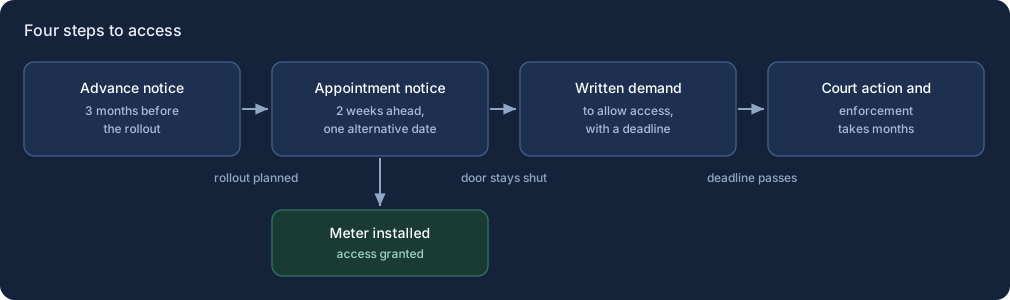
Step one is the first appointment with the two-week notice and a named alternative date. Step two is documented non-access: a card left on site, date, time, a fresh proposal and a reply channel that is more than a service number staffed during office hours.
Step three is the written demand to allow access, citing section 38 MsbG, with a deadline and with the note that the cost of another failed visit can be passed on under the general terms for metering contracts. Most cases resolve here.
Step four is enforcement through the courts. In a tenancy it usually does not run through the metering operator but through the owner or the community of apartment owners, which can sue for toleration under section 27(1) WEG and then enforce the judgment.
Data protection concerns alone do not lift the duty to allow access. A defective or late notice does, and it hands the connection user two arguments at once: a justified refusal today and a weaker position for the metering operator in court later.
Where the pincer closes
The default metering point operator sits between two forces pulling in opposite directions, and both of them are right.
From one side comes the regulator. On 27 March 2026 the Bundesnetzagentur opened the first 77 supervisory proceedings against default metering point operators that had missed the 20 percent quota due on 31 December 2025, and announced more, mainly against small and mid-sized operators. Periodic penalty payments range from 1,000 euros to 10 million euros. How that sanctions regime of the Bundesnetzagentur is built decides how much time an operator still has.
From the other side comes consumer protection, and it keeps winning. The Regional Court of Münster enforced the three-month period against a service provider. The Regional Court of Halle, in a judgment of 21 August 2025, barred Mitnetz Strom from charging up to 884 euros for a smart meter installed at the customer's request, and the case continues before the Higher Regional Court of Naumburg.
For daily work that means speed excuses no formal error, and the formal error costs more than the two weeks it saves. Uncomfortable, and still the clearer of the two messages.
Digital scheduling instead of a second visit
The most expensive part of the rollout is the second visit, and it almost never comes from a technical problem. It comes from a scheduling problem.

The most expensive thing about the rollout is the second visit, and that is exactly what we avoid.
Ron Melz and Martin Stötzel, managing directors of Spine, speaking to ZfK, 24 October 2025A fixed date in the letter is the variant with the highest failure rate, because it leaves control of the calendar with the sender. A time slot that the connection user picks moves the effort off the street and back into planning. As a by-product, digital scheduling produces exactly the evidence the escalation needs later.
Four things matter more here than the choice of software. The reminder 48 hours before the appointment, because a large share of failed visits are simply forgotten ones. A reply channel for cancellations, otherwise the alternative date becomes the second wasted visit. The bundled visit in a multi-occupancy building, backed by the notice under section 38 sentence 2 MsbG and a word with the property manager. And the record in the system: date sent, delivery route, alternative date offered, result on site, photo of the card left behind.
A portal without a telephone alternative shuts out precisely the group that is least often at home. That is not an edge case but a noticeable share of the stock.
The same dispatch work carries the control box rollout , where a second device has to be mounted and documented at the same address. Solving both in one visit halves the access problem.
What metering operators should do now
Until the end of the year the work sits in documentation, not in a courtroom. A toleration action will not save 31 December 2026.
What is possible this week
-
Split open installation cases by cause
Never reached, missed once, actively refused. Three buckets, three different measures, and only the first one is solved with a letter. Without that split the whole remainder walks into the same dunning loop, which then also hits the people who merely missed an appointment.
-
Check every announcement letter for the alternative date
Is there a second date on it, or only an invitation to get in touch? In the second case the template needs changing before the next batch goes out.
-
Keep proof of dispatch and delivery route per case
Date, route, addressee, and for posted notices a photo with a date on it. This is the part the escalation hangs on months later, and at the moment of dispatch it costs close to nothing.
-
Introduce self-booking and a reminder
Even if it starts as a link in the letter and a text message 48 hours ahead. The telephone alternative stays.
-
Move refusal cases into the written demand now
With a deadline and a note on the cost of a further visit. Anyone waiting for December has already lost step four.
-
Report the cohort separately
The overall equipment rate does not answer the question posed by section 45(1) no. 4 (b) MsbG. What is needed is the status of the metering points that became newly due since 25 February 2025, and within that the share that hangs on access.
Six points, and not one of them needs a new system. Five of them only need someone to fill in fields that already exist.
Further reading
Frequently asked questions
What does section 38 MsbG require at a meter exchange?
Section 38 sentence 1 MsbG obliges plant operators, connection users and connection customers to grant the default metering point operator and its representative carrying an identity card access to their property and rooms after prior written notice, as far as this is necessary to carry out its tasks. Sentence 4 adds the duty to keep the metering point accessible. For third parties commissioned under sections 5 or 6 MsbG the contractual arrangements apply instead.
How far in advance does a meter exchange have to be announced?
The notice of the date of entry has to be given at least two weeks in advance under section 38 sentence 3 MsbG. Separately, section 37(2) MsbG requires information about the planned installation of a smart metering system at the latest three months before the installation, with a reference to the free choice of metering point operator under sections 5 and 6 MsbG.
Does the metering operator have to offer an alternative date?
Yes. Section 38 sentence 3 MsbG requires at least one alternative date to be offered. A general invitation to get in touch if the appointment does not suit does not meet the duty. The alternative date belongs in the same letter as the first one.
Is a notice posted in the building enough?
Section 38 sentence 2 MsbG allows notice either by communication to the individual connection users or by a notice posted on or in the building. The posted notice is therefore an equivalent delivery route and in a multi-occupancy building often the only one that reaches every user. The two-week period and the alternative date apply unchanged.
What happens if the connection user refuses access?
The metering operator documents the failed visit, offers the alternative date and then issues a written demand to allow access, with a deadline. If that also fails, enforcement through the courts remains, in a tenancy usually through the owner or the community of apartment owners, which can sue for toleration under section 27(1) WEG. Data protection concerns alone do not lift the duty, while a defective notice does.
Who pays for a second visit?
If the connection user refuses or obstructs access without justification, the general terms for metering contracts provide for the resulting costs to be passed on. The meter exchange itself carries no separate charge for the connection user; the charges for metering operations follow section 7 MsbG and the price caps of the MsbG.