Does section 14a control still need a box of its own?
E.ON wants the separate control box dropped from new installations. Technically that has been possible since late 2024. The question is what it means for next year's procurement.
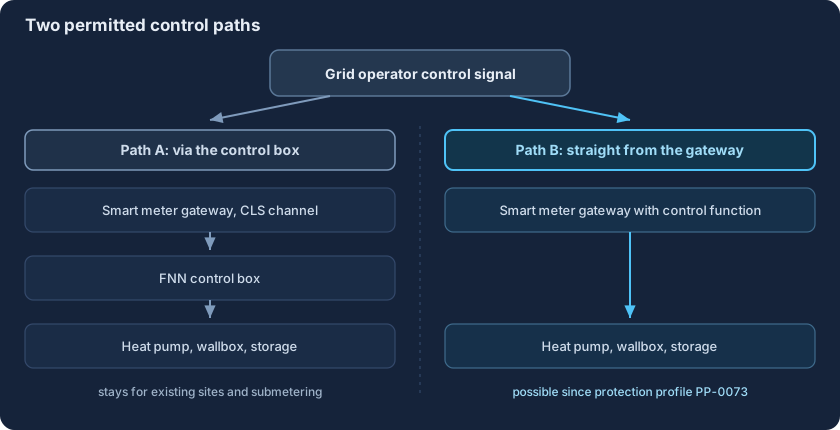
The integrated control function lets the smart meter gateway accept a control command itself and pass it on locally to a heat pump, wallbox or storage unit, instead of routing it over the CLS channel to a separate FNN control box. This became possible through BSI protection profile PP-0073 version 2.0 from late 2024. On 17 September 2026 E.ON called for the box to be dropped from new installations, and backed it with a finding of its own: in roughly half of all installation visits the device can be fitted, but the site is not prepared for the communication. For submetering and the existing base the control box stays, in the BDEW's reading, and no end date exists. Metering point operators are therefore planning for two control paths rather than one.
What E.ON wants and why now
On 17 September 2026 E.ON called for the smart meter rollout and the control rollout to be merged, with the control function anchored directly in the smart meter gateway. In new installations the separate box would then go.
The trigger is not enthusiasm for technology but a number from its own installation business. In about half of all visits the device can be fitted in the meter cabinet, yet the site is not prepared for communication with the controllable equipment.
99.63 %
of control commands arrived straight from the gateway in the field test
1,100
control commands Bayernwerk sent in autumn 2025 to show it
PP-0073
protection profile opened the second path at the end of 2024
50 %
of installation visits meet a site that is not prepared
2
control paths CLS management will have to handle from now on
77
supervisory proceedings the Bundesnetzagentur opened in March
The typical case sits in every second terraced house: meter in the cellar, internet connection in the flat, heat pump in the utility room or outside against the gable wall. Three places, no cable between them. A second device in the cabinet does not solve that, it only makes it dearer.
E.ON expects less hardware in the field, lower costs and faster processes across the whole chain from the meter through the IT systems to the building installation. At E.ON Grid Solutions the installation rate is above the mandatory quota, by the company's own account. So this is not a laggard asking for room to breathe.
Two paths, one control chain
Since the end of 2024 there have been two permitted ways to reach a controllable device. The familiar one runs over the gateway's CLS channel to an FNN control box, the new one straight out of the gateway. The Federal Office for Information Security made the second path possible in the first place with protection profile PP-0073 version 2.0.
How the control chain works in detail, from grid signal to relay, we set out in the control box and section 14a EnWG. What is new here is only that the middle box can go.
One point matters for planning: this is not a replacement. The CLS path stays as a fallback. For the metering point operator that means more work at first rather than less, because CLS management has to handle both paths for as long as both are in the field.
What the field test shows
Bayernwerk Netz and Power Plus Communications tested the second path in the field in September and October 2025. Roughly 1,100 control commands, a success rate of 99.63 percent, controlling generation units, storage and consumption devices. Communication ran over EEBus, the same interface the newer FNN control boxes serve.

Bayernwerk has been pursuing the approach since 2019, by its own account. The field test is the end of a long run-up, not a sudden idea. Joachim Kabs, managing director of Bayernwerk Netz GmbH, puts the case in terms of less hardware and fewer interfaces in the household, which he says makes the energy transition simpler, safer and more efficient.
For the investment case a different point weighs more: gateways already installed need only a software update, not a swap, according to the parties involved. Certification of the software stack at the manufacturers began in early 2026, and broad use is expected from mid-2026.
99.63 percent is a very good result for one grid operator's field test with one gateway manufacturer. It is not evidence of interoperability across several manufacturers, and not proof of routine operation at scale. Both are still outstanding.
Where the control box stays
The box is not going away, and anyone striking it from the plan now is planning wrong. The BDEW names two cases where it stays: submetering constellations and sites already fitted out. No end date for the first path is written down anywhere.
On top of that sits an unresolved dispute, and it is no detail. In its impulse paper the BSI provides for the controllable unit to be certified under TR-03109-5. The BDEW considers that commercially unviable and unnecessary in security terms, arguing that both control variants can reach the same security level at the digital interface.
Whether manufacturers of heat pumps and wallboxes offer their devices for the direct path at all hangs on that question. If the certification requirement stands, the lean path becomes unattractive again for many device classes, and the box comes back through the side door.
The BDEW therefore wants an identical interface to the customer installation for both solutions. Without it, two process landscapes grow up for the same task, and the metering point operator pays for them.
VDE FNN is already drawing the organisational conclusion: the control box administrator (STB-A) becomes control administration (ST-A), because control actions now run over both paths. Anyone who has documented roles and processes corrects the label there before the first transaction takes the new path.
The argument over Smart Meter Light
A second argument is running alongside, and it pulls the other way. On 1 July 2026 the coalition committee decided to introduce a Smart Meter Light for households with no installation obligation, and at the same time moved the rollout target to more than 90 percent of relevant metering points by the end of 2030.
The idea comes from the Smart Meter Initiative around Octopus Energy, Tibber, Ostrom and Rabot Energy, which has been arguing for a simplified device since 2023. Their case: households outside the mandatory scope should be able to use dynamic tariffs without waiting for the full rollout.
VDE FNN and DKE rejected it in a joint position paper on 13 July 2026. A parallel system ties up standardisation resources that the ongoing rollout is short of. And customers who receive a Light device would have to swap it again when they add solar, a heat pump or a wallbox. Their core sentence: without uniform standards we end in chaos. As an alternative they name the existing 1:n gateway technology, where several meters hang off one gateway, at roughly 30 euros per meter per year.
On this point E.ON stands on the same side as the standards bodies, out of a different interest. A simplified variant would have to use the same technology and the same IT processes, it argues, or it creates new investment, longer procedures and security risks.
So two promises of simplification face each other. One takes a device out of the meter cabinet, the other puts a new one beside it. Both sell speed, and neither has been settled. For a municipal utility that has to procure for 2027, that is the most uncomfortable part of the situation.
Challenges and risks
Integrated control solves a hardware problem and creates a process problem. Look only at the bill of materials and you underestimate the second half.
| Point | Effect of the direct path |
|---|---|
| Hardware in the meter cabinet | One device fewer in new installations, space problem eased |
| Gateways already installed | Software update instead of a device swap |
| Missing cable in the building | Unchanged, and it is the main problem in the E.ON finding |
| CLS management and service | Two control paths, two failure patterns, two skill sets for years |
| Existing base and submetering | Control box stays, with no end date |
| Certification under TR-03109-5 | Open, and it decides what devices the market will offer |
Dependence on the gateway manufacturer grows. If certification of the software stack slips at one supplier, the whole procurement plan hangs on it, and a second supplier is not brought in within a quarter.
The pressure from the quota sits alongside all of this. On 27 March 2026 the Bundesnetzagentur opened 77 supervisory proceedings against metering point operators that missed the 20 percent mark. Small operators below 30,000 metering points averaged 14.6 percent. Anyone in that position does not get to decide the device question at leisure.
What utilities have to decide now
The decision is not made in principle but in the procurement round for 2027. Four points are worth the time before the next framework contract.

Four points before the next procurement round
-
Get the certification date in writing
Ask your gateway supplier when its software stack for the integrated control function is certified and whether devices already installed follow by update. A verbal assurance in the annual review will not carry this plan.
-
Check CLS management against both paths
Can your system handle both control paths? If not, that belongs in the same procurement round, not the one after it.
-
Follow the role change through
STB-A becomes ST-A. That is one line in the process documentation and one question to whoever runs the administration for you.
-
Take the preparation problem into the site survey
Where are the meter, the internet connection and the controllable unit, and what does the cable between them cost? That question survives whatever ends up in the cabinet. It is also the only item on this list that no supplier takes off your hands.
What you do not have to decide today: the existing base. The control box runs on there, and no end date exists. The question arises for new installations, and from mid-2026 it arises in practice.
Further reading
Frequently asked questions
The integrated control function lets the smart meter gateway accept a control command itself and pass it on locally to the controllable unit. The established path runs from the gateway over the CLS channel to a separate FNN control box. The direct path became possible through protection profile PP-0073 version 2.0, published by the Federal Office for Information Security at the end of 2024.
No. The BDEW names two cases where the control box stays: submetering constellations and sites already fitted out. The CLS path also remains as a fallback. E.ON asks for the box to go in new installations, not in the existing base. There is no end date for the first path.
Bayernwerk Netz and Power Plus Communications sent roughly 1,100 control commands straight from the gateway in September and October 2025 and reached a success rate of 99.63 percent. Generation units, storage and consumption devices were controlled, and communication ran over EEBus. This is one grid operator's field test, not nationwide routine operation.
Certification of the necessary software stack at the gateway manufacturers began in early 2026, and broad use is expected from mid-2026. Gateways already installed need only a software update rather than a device swap, according to the parties involved. Only your gateway supplier can give you the actual date.
VDE FNN is taking the role of control box administrator (STB-A) forward into control administration (ST-A), because control actions can now run over both paths, via the FNN control box and straight from the gateway. The existing application guidance had to be adjusted accordingly. Process documentation and role descriptions in house follow from that.
On 1 July 2026 the coalition committee decided to introduce a Smart Meter Light for households with no installation obligation and moved the rollout target to more than 90 percent of relevant metering points by the end of 2030. VDE FNN and DKE rejected it in a position paper on 13 July 2026: a parallel system ties up standardisation resources, and customers would have to swap the device again when they add solar, a heat pump or a wallbox. As an alternative they name the existing 1:n gateway technology at roughly 30 euros per meter per year.