AI in grid state determination: what measurement has to deliver
Vendors promise that machine learning can fill the missing measuring points in the low-voltage grid. The German VDE FNN guidance on grid state determination explicitly allows neural networks. It also asks for an accuracy you have to prove, and in one place it rules out exactly what models like to do most.
Grid state determination (Netzzustandsermittlung) is, under the German regulator's decision BK6-22-300, the loading of a low-voltage grid area derived from current measurements and grid models; every distribution system operator needs it as proof before it curtails heat pumps or wallboxes under §14a EnWG, and preventive control as a stopgap ends on 31 December 2028 at the latest. The VDE FNN guidance on Tenorziffer 2e accepts any calculation method, neural networks included, provided it determines voltage within 2.0 percent and current within 10 percent at the 99th percentile. Without a site-specific proof, that counts as met in a radial grid when 15, 30 or 70 percent of connections deliver smart meter data via TAF 10, depending on whether the substation measures each feeder, only the transformer total or nothing. Operators relying on direct measurement may act from 80 percent loading, but may not draw conclusions about unmeasured assets. That gives machine learning a clear place: forecasting, substitute values during outages, PV estimation, plausibility checks and deciding when to fetch data, each backed by reference measurements.
Why the question is on the table now
A German distribution system operator may only curtail a heat pump to 4.2 kilowatts under §14a EnWG if it can prove a congestion. The Bundesnetzagentur calls that proof grid state determination. Until it is in place, the rules allow a workaround.
The workaround is called preventive control. An operator whose planning data points to a congestion, but who cannot yet control based on the actual grid state, may curtail in advance under section 10.5: two hours a day at most, for up to 24 months per grid area from the first use, and never beyond 31 December 2028. After that, only the measured or calculated grid state counts.
Plenty of utilities are some way off. In May 2026 the Berlin-based 1000 GW Institute found that only 14 of 169 distribution system operators it examined actually let customers switch to the time-variable network tariff under Module 3. That's a different construction site. It still shows how long the chain from measured value to billing to control command remains in practice.
Software vendors step into the gap with a promise: whatever isn't measured, a model will calculate. Partly true. But where exactly?
What the VDE FNN guidance asks of measurement
The bar is set by the VDE FNN guidance on Tenorziffer 2e, written by the grid operators under VDE FNN's coordination. It went to the regulator in December 2024 and came out as version 1.0 in April 2025, after consultation. The ruling chamber recommends that all market participants take it into account. It knows two ways to prove a congestion.
One is a calculation method based on measured values. It has to determine voltage with a deviation of no more than 2.0 percent of nominal voltage and current with no more than 10 percent of the continuous current rating, both at the 99th percentile. Inputs are one-minute values or rolling ten-minute averages. The operator either proves that accuracy for each grid area, with spot-check reference measurements, or sticks to the default equipment levels.
| Measurement in the secondary substation | Radial grid | Meshed grid, one transformer | Meshed grid, two or more transformers |
|---|---|---|---|
| Every low-voltage feeder measured | 15 % | 5 % | 0 % |
| Transformer total only | 30 % | 10 % | 0 % |
| No measurement in the substation | 70 % | 40 % | 25 % |
The table explains why the debate turns to the secondary substation so quickly. Without any measurement there, a radial grid needs more than twice the share of smart meters it would need with a transformer total. And it comes with a footnote that's easy to miss: the values assume every measured value can be ordered at any time and no communication fails. Otherwise, the guidance says, safety margins or fail-over strategies should be considered.

The second way is direct measurement at a single asset: the transformer, a cable distribution cabinet or a smart meter. Control may start at 80 percent of the temperature-dependent rating or at 80 percent of the permissible voltage drop, which means minus 8 percent. That value must be measured directly. The sentence that follows matters more than any other for the AI debate (our translation):
Taking into account further safety factors, and the conclusions about assets that are not directly measured that go with them, is not permitted.
Two things the guidance takes for granted and calls upstream processes: the current switching state of the grid and the current output of the PV systems, for example via a reference installation. Both drive accuracy. Neither is reliably available in many grid areas today. For the measurement side in the substation, see our piece on digital secondary substations.
Where a model may help
The VDE FNN guidance prescribes no method. It leaves it to vendor and operator whether to use statistical, analytical, heuristic methods or "neural networks". A neural network isn't a special case that needs an exception. It just has to prove the same accuracy as a classic estimator.
Sounds generous. The reasoning behind it is less so. The guidance states that the grid equation system at low voltage is and will stay "underdetermined" because there are so few measuring points. A model can't conjure up missing equations. It can extrapolate patterns from the past, and that's something else.
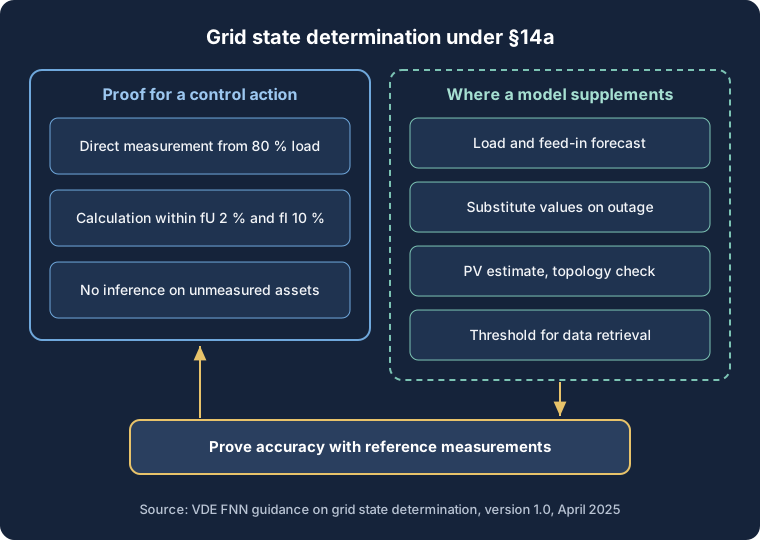
Where that works can be pinned down fairly precisely.
Forecasting is the clearest case. A load and feed-in forecast for the next hours or days answers a question grid state determination never asks: where will it get tight tomorrow? For setting thresholds, planning crews and prioritising grid expansion, that's the biggest lever. Our article on AI load and generation forecasting in the distribution grid goes deeper.
If a gateway drops out for ten minutes, operations still have to carry on. A model that fills the gap plausibly is precisely the fail-over strategy the guidance suggests for communication failures. As proof for a control command, though, a substitute value won't do.
Then there are the tasks the guidance calls upstream. Estimating PV output, finding unregistered systems, checking a switching state that differs between GIS and field: these are classification and estimation problems where machine learning is at its best.
The underrated case is data retrieval itself. In the accompanying study, smart meter data was only requested once the transformer exceeded 50 percent of its permissible apparent power. The number of time steps with a data request fell by 42 to 98 percent, with no loss in sensitivity or specificity. That's money, because every request through the gateway costs transmission and backend processing. When a threshold is well chosen can be learned from load curves. A model that decides when to measure is worth far more than one that pretends a measurement happened.
The dispute over unmeasured feeders
At one point the guidance and the product pitch rub against each other, and we won't settle it here.
SMIGHT markets its grid management system NeMS with the claim that load and feed-in profiles are forecast from historical data and machine learning, "also for feeders without measurement" (our translation). An Adaptive Dynamic Twin is meant to combine measured data, grid topology, weather data and satellite images. On the forecast horizon, SMIGHT's own product page says 24 hours; the trade magazine stadt+werk reported at least 48 to 72 hours on 15 September 2026.
MITNETZ Strom fitted around 20 secondary substations with measurement technology together with Robotron back in 2021, using algorithms that carry findings from measured to unmeasured stations, according to ZfK in March 2021. Project lead Steve Bahn described the goal as forecasts for the coming days, for instance how many EV charging sessions a local grid can handle at the same time.
VDE FNN, April 2025, on the direct measurement path: conclusions about assets that are not directly measured are "not permitted".
A contradiction? Not necessarily. The vendors talk about forecasting and observability, the guidance about proving a specific control command. The guidance itself says its requirements apply to peak-load situations in critical grid areas and do not carry over to general observability. The line blurs exactly where a system turns a forecast into a control command automatically. Whether a model estimating an unmeasured feeder counts as a "calculation method" with an accuracy proof, or as an inadmissible conclusion, is settled by the evidence in each case, not by the product page.
How operators approach it today
Three examples show the range. We stick to what's publicly documented.
MITNETZ Strom
After its 2021 monitoring project, MITNETZ has offered the Smart Energy Cloud together with exceeding solutions since February 2024, aimed at small and mid-sized municipal utilities. The platform includes CLS management, substitute value formation and grid visualisation, and 66 utilities sit in its user community.
SMIGHT NeMS
Substation and cabinet measurement plus forecasting and §14a control via the metering operator, with audit-proof logging. Named customers include the municipal utilities of Ludwigsburg-Kornwestheim and Fellbach and Stuttgart Netze.
DIGITECHNETZ
A research project led by TU Dresden with SachsenNetze, Robotron, F&S, DIgSILENT and emsys: a digital twin fed by smart meter and substation data, algorithmic state detection and load forecasting. 4.7 million euros in total, 2.5 million in public funding.
With DIGITECHNETZ, one detail beats the platform. Three SachsenNetze substations were fitted with measurement technology during the project, and the operator now installs it as standard in new substations. So the first lasting result of an AI project was a decision about measurement hardware.
What it costs, SMIGHT and the Horizonte-Group calculated in summer 2026 for a model grid of 1,000 secondary substations over eight years. In a radial grid, substation measurement comes to around 13 million euros, a pure smart meter approach to around 49 million. It's a study by a vendor of substation measurement, and it should be read that way. The direction still matches table 1 of the guidance. Measure in the substation and you need fewer gateways out in the street, and less model.
For the control chain behind the measurement, see our pieces on low-voltage SCADA with CLS management and on DERMS in the distribution grid.
§ 66 MsbG and the EU AI Act: what the law allows a model
Two sets of rules decide how far a model can go. One is about the data, the other about the system.
§ 66(1) of the German Metering Point Operation Act (MsbG) lets the grid operator process measured values where strictly necessary, among other things for secure operation, planning and load and feed-in forecasts (no. 3) and for §14a measures with dynamic control based on actual and forecast loading (no. 4). Forecasting models are explicitly covered. The catch is in paragraph 3: personal measured values used under no. 3 are deemed no longer necessary one year after the end of the year they were collected and must be deleted or anonymised; for no. 4 the period is three years. Anyone planning to train a model on multi-year household time series needs an anonymisation concept before collecting data, not afterwards. Whether a grid forecasting model in a multi-utility may also serve retail or aggregation is a separate question touching §6a EnWG on unbundling, and only a case-by-case review can answer it.
On the EU AI Act, the European Commission published draft guidelines on classifying high-risk systems on 19 May 2026, with consultation until 23 July. They aren't final. For electricity supply they draw a narrow line, sorted in detail in our piece on which AI at a utility is high-risk under Annex III: a system is high-risk under Annex III point 2 only if it acts as a safety component and is used by an operator designated as a critical entity under the CER Directive.
Anomaly detection shows up on both sides. As a tool a human checks, it enriches the decision and has no direct safety function. As support for decisions on load distribution and shutdowns, it is high-risk. The line is thin, and the draft draws it by purpose, not by technology.
What the draft leaves open is the case closest to §14a: a model that estimates the grid state and triggers a curtailment without human review and without an independent protection layer. Our reading is cautious. The more directly the model controls, and the less a measured threshold sits in between, the closer it moves to a safety component. Under the Digital Omnibus, the requirements for Annex III high-risk systems apply from 2 December 2027. The full classification is in our article on high-risk AI in energy infrastructure.
Where it can go wrong
Table 1 assumes every value can be ordered. A radial grid without substation measurement that plans on 70 percent smart meters and then has dead spots in the basements hits the quota on paper and misses it in operation.
TAF 10 today delivers minute-by-minute instantaneous values, snapshots with a measuring interval of up to one second. A motor starting up distorts such a value. VDE FNN considers one-minute averages more suitable and wants TAF 10 developed accordingly. A model trained on instantaneous values learns their noise along with everything else.
And grids change faster than models. Every new wallbox shifts the load along the feeder, and an accuracy proof from 2026 says little about 2028. The rules require operators to prove quality on request, and the guidance itself is to be reviewed at least every three years.
A model nobody in-house can explain makes a poor witness when a curtailment is disputed. The burden of proof sits with the grid operator, not the software supplier.
What grid operators should do now
There's time until the end of 2028, but not for every grid area separately. Once you start preventive control somewhere, the 24 months run from that day. In compressed-air metering, where innobu started in 2010, we learned to fix the measuring points first and talk about analytics second. The same applies here.
Five steps to a grid state determination that holds up
-
Classify your grid areas
Assign every critical grid area to a basic topology, radial or meshed, and note what its substation measures today. Only then do you know which row of table 1 applies to you.
-
Weigh substation against gateway
Put substation measurement and smart meter share side by side per grid area, using your own rollout figures rather than somebody else's study.
-
Pin down the model's role
Decide for each use case whether the model justifies a control command, bridges an outage or only forecasts. It's an architecture decision with consequences for proof, data retention and your AI inventory. Write it down before a vendor makes it for you.
-
Plan the proof from day one
If you use a calculation method, plan the spot-check reference measurements and their documentation right away. Temporary measurement in a cable cabinet is often enough.
-
Settle data and classification
A deletion concept under § 66(3) MsbG, anonymisation for training data, and an AI inventory entry stating the system's purpose.

At a multi-utility in northern Germany we have been supporting a §14a programme with five sub-projects since 2024. Whenever we raise the question of the model, we end up at the measurement concept first. How the control command then reaches the customer is covered in our article on the §14a control box, and why market and grid compete for the same flexibility in the local grid in our piece on grid-serving flexibility under §14c.
Further reading
Frequently asked questions
Grid state determination is, under the German regulator's decision BK6-22-300, the loading of a low-voltage grid area derived from current measurements and grid models. It is the proof that controlling heat pumps, wallboxes or batteries in that area is objectively necessary, and it must follow the current state of the art. The state of the art is described in the VDE FNN guidance on Tenorziffer 2e, version 1.0 from April 2025.
Yes. The VDE FNN guidance leaves the choice of calculation method to vendor and operator and names neural networks explicitly. The method must, however, determine voltage within 2.0 percent and current within 10 percent at the 99th percentile, and the operator has to be able to prove it, for example with spot-check reference measurements.
It depends on topology and on what the substation measures. In a radial grid, the guidance assumes sufficient accuracy without a site-specific proof when 15 percent of connections deliver smart meter data via TAF 10 and every feeder is measured in the substation, 30 percent with only a transformer total and 70 percent with no substation measurement. Meshed grids need less, down to zero with two or more transformers and feeder-level measurement.
For forecasting, planning and substitute values during outages, yes. As proof for a control command it depends on the route: operators relying on direct measurement may not draw conclusions about assets that are not directly measured, according to VDE FNN. Operators using a calculation method must prove its accuracy for the grid area.
Until 31 December 2028 at the latest. Within that period, an operator may control preventively in a given grid area for no more than 24 months from the first use, and only for two hours a day. After that, every control action needs a grid state determination.
Under the European Commission's draft guidelines of 19 May 2026, usually not, as long as it forecasts or warns and a human decides. High-risk requires a direct safety function and an operator designated as a critical entity under the CER Directive. The draft is not final, and this general assessment does not replace a review of the individual case.