Market or grid: who controls flexibility in the local grid
Tibber reports more than two gigawatts of controllable capacity, Heartbeat AI 600 megawatts. The batteries, heat pumps and wallboxes behind those numbers sit on local grids whose load hardly anyone measures. Who decides when a feeder runs full is settled in law. In practice it is open.
Grid-serving flexibility means shifting consumption or feed-in according to the state of the local network, while market-driven flexibility follows the electricity price. Section 14c of the German Energy Industry Act (EnWG) has required distribution system operators since July 2022 to procure flexibility services through market-based procedures, but under Section 118(28) EnWG that duty is suspended until the Bundesnetzagentur approves or sets specifications, and it has not done so. In the local grid, operators therefore work with Section 14a: time-variable network charges as an incentive and dimming of controllable devices to 4.2 kilowatts as an emergency brake. Because price-optimising aggregators create new simultaneity in low-voltage networks as they grow, the distribution system operator becomes more important, not redundant, and its precondition is visibility, which is still largely missing with smart metering systems at 5.9 percent of metering points on 30 June 2026.
Grid-serving versus market-driven
A device is controlled in a grid-serving way when it reacts to the state of the local network. It is market-driven when it reacts to the exchange price. Most of the time both signals point the same way. In a bottleneck they don't.
Geography explains it. Germany is a single bidding zone, so the day-ahead price is identical from Flensburg to Passau. A bottleneck sits at one transformer serving an estate of 80 house connections. The price knows nothing about it.
Responsibility for running that transformer safely stays with the distribution system operator, no matter who optimises the heat pumps behind it. That gives us the line we take on the subject: in a bottleneck, grid first, market second. Outside the bottleneck, let the market do what it does best.
Why one shared price builds a new peak
Optimise a thousand home batteries and wallboxes towards the same cheap quarter hour and you have built a new load peak. Low-voltage networks have too few connections to smooth each other out.
This is not a claim from grid operators defending their turf. Guidehouse wrote it down in October 2023, commissioned by the German economics ministry for its climate-neutral power system platform.
At low-voltage level, the effects of dynamic tariffs can become visible sooner in the form of local grid congestion, because balancing effects are smaller. (our translation)
At system level the same paper sees no risk to stability. That is the point. What smooths the curve nationally can concentrate load on a single feeder. According to Guidehouse, voltage problems usually come first, so the voltage band is breached before a cable reaches its thermal limit.

How fast it tips was calculated by the Forschungsstelle für Energiewirtschaft (FfE) for bidirectionally charging electric cars across 1,206 low-voltage networks of Bayernwerk Netz. At ten percent price-optimised vehicles, expansion costs were lowest, 13.7 percent below the uncontrolled case. Above 30 percent, transformer overload from feed-back rises sharply. Same technology, different share, and relief turns into a reason to build.
A field test shows the reverse. In the Grids & Benefits project led by UnternehmerTUM with RWTH Aachen, dynamic network charges ran from March to December 2025. For home charging, more than 70 percent of sessions and around 20 percent of the energy moved into grid-friendly time windows.
So aggregators are not the problem. A price signal with no sense of place is.
Who pools the flexibility today
Aggregators are market participants with a sound business model. They cut their customers' energy bills and give the power system flexibility it needs. Treating them as a nuisance misreads the situation.
2 GW
of controllable capacity is what Tibber reports across Germany, Norway, Sweden and the Netherlands
600 MW
are steered by Heartbeat AI according to ZfK, offered to municipal utilities since April 2026
400 MW
sit in Enpal's virtual power plant, by the company's own account
70 %
of home charging sessions moved into grid-friendly windows with dynamic network charges
30 %
price-optimised electric cars, and the maths at the transformer turns
5.9 %
of metering points had a smart metering system at the end of June 2026
Things are moving quickly. On 11 September 2026 Tibber launched Grid Rewards, which shifts EV charging at short notice according to intraday prices and credits the customer. 1Komma5° has opened its Heartbeat AI platform to municipal utilities since April 2026 and pitches it as the operating system for the decentralised energy world: HEMS, smart meter integration, dynamic tariff and market access, for around 15 euros per household per month.
For a municipal utility that is an offer and a competitor at once. In May 2026 the trade paper ZfK put the question bluntly: who owns the HEMS? Whoever runs it holds customer access, data and the revenue from flexibility. We cover that side of the market in our pieces on virtual power plants and battery storage and on white-label prosumer platforms.
None of these providers replaces the grid operator. None of them knows the load on the feeder their customers are connected to.
What the grid operator has in hand today
In the local grid, the distribution system operator's tool is Section 14a EnWG. Since 1 January 2024 it may dim the consumption of controllable devices to a minimum of 4.2 kilowatts during a bottleneck, and in return their owners pay lower network charges.
| Module | What the customer gets | What the grid gets |
|---|---|---|
| Module 1 | Flat reduction of the network charge, no extra meter | Controllability, but no reason to shift |
| Module 2 | 60 percent off the energy rate, in exchange for a separate meter | The same, cleanly metered |
| Module 3 | Time-variable network charge with high, standard and low tariff, only together with module 1 and a smart metering system | The only price signal tied to the grid, though in fixed windows rather than in real time |
Since 1 April 2025, operators must offer module 3. Many haven't delivered. In May 2026 the Berlin-based 1000-GW-Institut found only 14 of 169 distribution system operators where customers could actually switch to it. The Bundesnetzagentur has threatened two operators with coercive fines and set a deadline of 30 September 2026.
You can read that as negligence. We also read it as a finding about IT: many billing systems only allow one unambiguous meter reading time per market location, and parallel time models are not provided for. How the control chain works technically is covered in our piece on the Section 14a control box.
And dimming? It is the emergency brake. If you pull it regularly, you missed a signal earlier.
Section 14c EnWG: in force since 2022, suspended ever since
Section 14c EnWG requires operators of electricity distribution networks to procure flexibility services for their network in a transparent, non-discriminatory and market-based procedure. It has applied since 29 July 2022. It has never had any effect.
The reason is in the transitional provisions. Under Section 118(28) EnWG the duty is suspended for each flexibility service until the Bundesnetzagentur first approves specifications under Section 14c(2) or sets them under Section 14c(3). As of today neither has happened, and no consultation on it is running.
The procedure is meant to work in two ways. Distribution system operators draft specifications and standardised market products themselves and have them approved, or the regulator sets them directly. Every market participant must be able to take part effectively and without discrimination, aggregators included.
There is also a way out. If market-based procurement is not economically efficient, would seriously distort markets or would worsen congestion, the regulator can define exemptions.
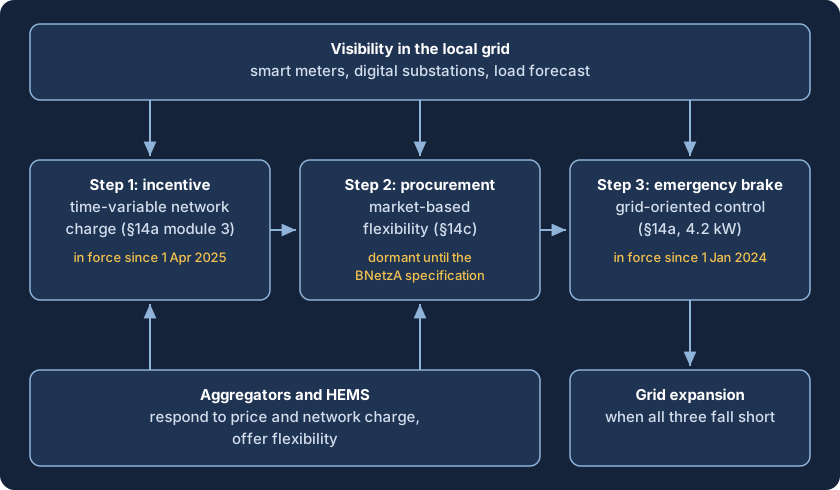
Operators may already procure flexibility voluntarily, in pilot projects for instance. There is no obligation and no common product. For a mid-sized municipal utility this means: if you wait for the specification before you know your own flexibility needs, you will start empty-handed.
The dispute over Section 14c: does a bottleneck need a market?
Whether Section 14c covers congestion management in distribution grids at all has been contested since 2023. The Bundesnetzagentur and parts of the legal profession read it in opposite ways.
At the time, the regulator said it had "no indications of specific flexibility services within the scope of Section 14c EnWG" for which binding uniform specifications would be suitable and efficient. That is how the trade journal Energie & Management reported it on 16 February 2023 (our translation).
In the same report, lawyer Sebastian Schnurre of the firm Assmann Peiffer called that "legally incorrect". His argument: Article 32 of the EU Electricity Directive 2019/944, which Section 14c transposes, explicitly names flexibility services including congestion management.
Aggregators argue economics. A Roland Berger study from the orbit of the New Energy Alliance, whose members include 1Komma5°, Enpal, Lichtblick and Octopus Energy, puts the benefit of decentralised solutions at 185 to 255 billion euros by 2045, including up to 1.4 billion euros a year in avoidable grid investment. It is a commissioned study, and it does not say where in any given local grid those savings would fall.
We leave the dispute open because it is open. Both camps tend to skip one thing, though. A market for local flexibility needs a product tied to a location. That requires the grid operator to know its bottleneck before it tenders for it.
What is still coming from Brussels and Bonn
Three procedures will shift the distribution system operator's role over the next few years, and all three need data from the local grid.
National flexibility needs assessment
Article 19e of the Electricity Market Regulation requires a report on flexibility needs, with transmission and distribution system operators supplying the data. ACER adopted the methodology on 25 July 2025, and the first national assessments were due by July 2026.
Network Code on Demand Response
ACER submitted its proposal to the Commission on 7 March 2025. Among other things it is meant to set out how system operators procure local services such as congestion management transparently. The Commission consulted until 12 September 2025 and published the responses in January 2026. It has not been adopted.
AgNes and the end of preventive control
The Bundesnetzagentur published the full draft ruling on the new network charge system on 6 August 2026 and consulted until 18 September. Dynamic network charges apply first to storage, from 2030 at the earliest, and not to household customers for now. Also from 2029, preventive control of legacy devices under the old Section 14a ends, and control is then based on grid state data.
The details of the charge reform are in our piece on the AgNes network tariff reform. For this article one conclusion matters: 2029 is when an operator without grid state data and a sound grid state determination can neither control properly nor bill properly.
No measurement, no control
What isn't measured can't be controlled. We learned that sentence in compressed-air metering, and in the local grid it holds without exception.
On 30 June 2026 the Bundesnetzagentur counted 3,172,579 smart metering systems against 54,135,202 reported metering points. That is 5.9 percent. Metering operators that missed the 20 percent mark for mandatory cases face 434 supervisory proceedings, 150 of which have since been closed. Period quotas apply from the end of 2026, with 90 percent of mandatory cases to be equipped by 2032. More in our piece on the 2026 rollout quota.

The meter at the house connection is only part of it. Add measurement points in the digital secondary substation and a load forecast that infers the state of whole feeders from a few real readings. How that works without full rollout is covered in our piece on load and generation forecasting in the distribution grid.
With that view, an operator can base module 3 on real load curves, describe a bottleneck before tendering it under Section 14c, and justify a dimming event. Without it, you negotiate with aggregators about something you cannot see yourself.
Where it can go wrong
Coordination between market and grid has not been solved, only postponed. Right now we see trouble in three places most often.
Two signals with no ranking. An aggregator optimises for the intraday price, the module 3 network charge says something else, and the control box may receive a third command. Which signal wins has to be settled technically and contractually, not in the middle of an incident.
Rebound after dimming. Dim a group of heat pumps for an hour and they catch up all at once afterwards. Without a forecast you only move the bottleneck by an hour.
Then there's dependency. Anyone buying a platform for HEMS, tariff and marketing should settle first who owns the data, whether the grid operator's control commands keep priority and what switching providers would look like. That is not a criticism of any particular provider, it is procurement hygiene. Whether a specific contract covers these points can only be judged case by case.
Staff are the underrated bottleneck. Congestion management in low voltage, documentation of dimming events and coordination with the metering operator and aggregators are permanent tasks, not project tasks.
What grid, metering and IT leads should do now
Don't wait for Section 14c to be specified. The work it will need is the work Section 14a and AgNes already demand.
Four steps for the next twelve months
-
Grid: know your critical feeders
Identify the local grids where heat pumps, wallboxes and storage are growing fastest and put measurement points there. Derive the module 3 time windows from measured load curves, not standard load profiles. Put a number on the flexibility need for those grids, in kilowatts and hours. You will need it for the flexibility needs assessment, for any future Section 14c tender and for grid planning.
-
Metering: controllable devices first
Prioritise connections with controllable devices in the rollout and test the chain from gateway through control box to device once, end to end.
-
IT: flexibility as a data object
Decide where control commands, grid state and flexibility commitments live in your systems and how they are logged. Define an interface through which aggregators can receive grid restrictions. A DERMS for the distribution grid is one option, not a must.
-
Management: decide the role
Partner, platform operator or both? A municipal utility can market flexibility itself, have a third party market it, or focus on running the grid. The only uncomfortable option is not deciding.
Since 2024 we have been supporting a Section 14a programme with five sub-projects at a multi-utility in northern Germany. The lesson is plain: control itself was rarely the problem. The data in front of it almost always was.
Further reading
Frequently asked questions
Section 14c of the German Energy Industry Act requires operators of electricity distribution networks to procure flexibility services for their network in a transparent, non-discriminatory and market-based procedure. The operators draft the specifications and the Bundesnetzagentur approves them, or the Bundesnetzagentur sets them itself. The provision has applied since 29 July 2022.
No. Under Section 118(28) EnWG the obligation is suspended until the Bundesnetzagentur first approves or sets specifications. That had not happened by the end of September 2026. Voluntary procurement, for example in pilot projects, remains possible.
Section 14a is a mandatory instrument: the grid operator may dim controllable devices to 4.2 kilowatts during a bottleneck, and their owners get reduced network charges under module 1, 2 or 3. Section 14c is a market instrument: the grid operator buys flexibility from providers, aggregators among them. Section 14a has applied since 2024, Section 14c is dormant.
Because they optimise many devices against the same exchange price, and that price is the same across Germany. If many batteries, wallboxes and heat pumps in one local grid charge at the same time in the cheapest quarter hour, a new peak appears there. Guidehouse noted in 2023 for the German economics ministry that such local congestion becomes visible sooner in low-voltage networks because balancing effects are smaller. The behaviour is rational for the market, the signal simply has no sense of place.
On 1 January 2029 the new AgNes network charge system is due to take effect, and preventive control of legacy devices under the old Section 14a ends. Control then becomes grid-oriented and is based on grid state data. An operator that does not collect that data by then cannot justify a dimming event.
That depends on the role the utility wants to play. Cooperation can make sense if the contract settles who owns the data, that the grid operator's control commands take priority and how switching providers works. This general assessment does not replace a review of the individual case.