
Section 14a EnWG: publishing control actions on VNBdigital and the end of the exemption for non-controllable devices
Both duties sit in Annex 1 to ruling BK6-22-300 of the Federal Network Agency (BNetzA) of 27 November 2023 and fall on the electricity distribution system operator whose low-voltage grid the device is connected to. Publication under item 8.4 is a monthly routine fed by the grid control system, control logs and the way network areas are cut. For devices commissioned after Thursday, 31 December 2026, the transitional rule in item 10.6 no longer helps.
The publication duty under Section 14a EnWG requires electricity distribution system operators, for every month in which they controlled consumption devices in a grid-oriented or preventive way, to publish on the joint platform VNBdigital by the 15th calendar day of the following month, per network area and postcode, the type of control, the number of devices affected, the average power cut and the total duration, together with the planned remedy and its expected completion; it has applied since 1 March 2025 (ruling BK6-22-300, Annex 1 items 8.4 and 10.7). The second deadline concerns the exemption in item 10.6: a controllable consumption device that demonstrably cannot be controlled and cannot be made controllable at reasonable cost only falls outside the participation duty and the connection guarantee if it is commissioned by 31 December 2026. From 1 January 2027 every new controllable consumption device subject to participation takes part in control without this exemption, and the network operator may not delay or refuse its connection by pointing to a lack of grid capacity. The ruling sets no sanction of its own; the regulator can order compliance under Section 65 EnWG, enforce it with coercive fines and pursue a breach as abuse under Section 30 EnWG, with fines of up to EUR 1 million.
Two deadlines from BK6-22-300, both with the DSO
Most people know ruling BK6-22-300 for two dates: grid-oriented control started on 1 January 2024, and preventive control ends when 31 December 2028 runs out. Two dates in between hit a distribution system operator's daily work sooner. Since Saturday, 1 March 2025, it has had to publish, by the 15th of the following month, where and how hard it controlled devices in any month it did so. On Thursday, 31 December 2026, the transitional rule for devices that technically cannot be controlled comes to an end.
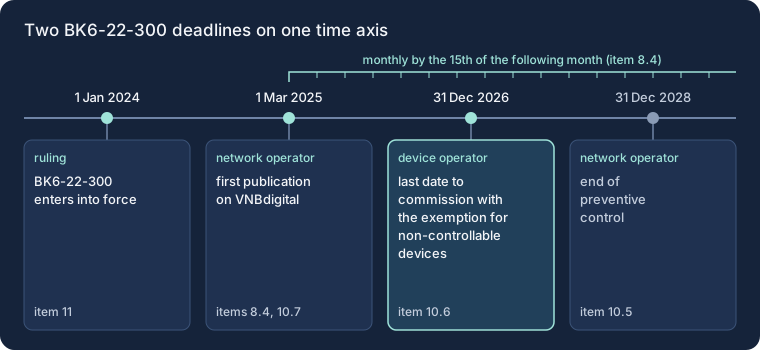
| Date | Who | What | Source | If missed |
|---|---|---|---|---|
| since 1 Mar 2025 (Sat), every month by the 15th of the following month | electricity DSOs that controlled devices in the month, grid-oriented or preventively | show the network areas; per network area and postcode the type of control, number of devices, average power cut, total duration, remedy and its expected completion | BK6-22-300 Annex 1 items 8.4, 10.7 | order under Section 65(2) EnWG, coercive fine under Section 94; abuse under Section 30, fine of up to EUR 1 million under Section 95 |
| commissioning by 31 Dec 2026 (Thu); from 1 Jan 2027 (Fri) no exemption | electricity DSOs; the device operator has to set out and prove the case | items 3 to 5 do not apply to demonstrably non-controllable devices; afterwards participation and the connection duty apply to every new controllable device subject to participation | BK6-22-300 Annex 1 item 10.6 | as above |
In both cases the obligated party is the operator of the electricity distribution network whose low-voltage grid the device is connected to (item 2.2); closed distribution systems under Section 110 EnWG are exempt (item 3.1 a). Controllable consumption devices are non-public charging points, heat pumps including auxiliary and emergency heaters, space cooling and battery storage when charging, each with more than 4.2 kW of connection capacity at grid level 6 or 7 (item 2.4.1). How a control command travels from the network operator via the metering point operator to the device, and why preventive control ends in 2028, is covered in our piece on the control box under Section 14a EnWG.
Since March 2025: every month by the 15th on VNBdigital
The duty only arises in months with control, and only for the network areas where it happened. In that case the network operator shows the network area on a joint web platform in a way that lets every device operator see which network area their device belongs to, and posts a machine-readable list (item 8.4). It gives the type of control, grid-oriented under item 4 or preventive under item 10.5, the number of controllable devices affected, the average power they were instructed to cut and the total duration of the measures, with the postcode of the network area based on the transformer station, in monthly resolution and "by the 15th calendar day of the following month". On top of that it states whether and which measures the operator is taking to reduce control, and when they will be complete.
The platform is VNBdigital, the joint portal of electricity distribution system operators under Section 14e EnWG, run by the BDEW, where network operators also publish their grid expansion plans under Section 14d EnWG. In its reasoning the ruling chamber had named exactly this portal as an example, since operators had to build a joint portal anyway. As for the format, it comes from the BDEW: its recommendation, version 1.0 of 30 January 2025, followed two BNetzA workshops and two consultations, and in notice no. 4 of 5 February 2025 the ruling chamber told all network operators to take the BDEW's format rules and guidance into account.
| Field | What it shows | Note from the recommendation |
|---|---|---|
| Network area ID | unique identifier of the network area | issued via the central code allocation body, Energie Codes und Services GmbH; each device sits in exactly one network area |
| Postcode | location for public comparison | one network area can span several postcodes, one postcode several network areas |
| Type of control | grid-oriented (item 4) or preventive (item 10.5) | as in the ruling |
| Number of devices affected | every controlled device in the network area | devices grouped under item 2.4.2 count as one |
| Intervention time | hours in the calendar month in which control took place in the network area | independent of the number of devices and interventions; two hours on 31 days give 62 hours |
| Intervention intensity | share of installed capacity not available because of control, weighted by duration per day | 11 kW capped at 4.2 kW for two hours gives 5.2 percent |
| Measure to reduce control | grid digitalisation, grid expansion, grid optimisation or no measure | "no measure" only for grid-oriented control caused by a short-term bottleneck |
| Expected completion | half-year, H1 or H2 | may be updated if construction or permits are delayed |
Intervention time and intensity are coarser than the decimal point suggests. Intervention time counts the hours in which any intervention ran in the network area; whether a given heat pump drew power at all during that time doesn't matter, which is why the BDEW calls the figure a maximum. Intensity is an average over every day of the month, including days without intervention, so three evenings of heavy capping show up as a small percentage. What the platform shows is an overview. Each individual case is documented under item 7.1, with grid state assessments, recipients, intensity and duration of each measure, which the operator keeps for at least two years (item 7.3) and hands to the BNetzA on request (item 7.4).

The monthly list hangs on a chain: grid state assessment in the control system, the command to the metering point operator, feedback from the control unit and the assignment of every device to exactly one network area. For intensity the operator also needs the installed capacity of each controlled device and the maximum power it was allowed. If any of that is missing from the systems, someone rebuilds the figure by hand every month. How the trigger for control is evidenced is covered in our piece on grid state assessment under Section 14a.
No map is required. At consultation stage the ruling chamber had proposed a mandatory map and then dropped it to protect critical infrastructure, after objections that it would reveal the grid structure. On VNBdigital, device operators therefore search by postcode or network operator, narrow down the period and download the result as a CSV or XLS file; the BDEW recommendation also provides for a complete file covering all distribution system operators.
Until 31 December 2026: the exemption for non-controllable devices
Item 10.6 is a hardship rule with three conditions that must all be met. The controllable consumption device demonstrably cannot be controlled, its controllability cannot be established at reasonable technical cost either, and it is commissioned by the end of 31 December 2026. Items 3 to 5 then do not apply to it: no participation duty, no grid-oriented control, and no guaranteed grid connection under item 5. This covers devices commissioned from 1 January 2024, which would otherwise fall under the ruling; older ones follow the transitional rules in items 10.1 to 10.3.
In its reasoning the chamber sets a high bar. It wanted to catch individual hardship cases in which a device could otherwise not be connected at all, and it puts the burden of setting out, and if necessary proving, impossibility on the device operator, vis-à-vis the network operator. A device without a digital interface is therefore not automatically uncontrollable. A large share of the heat pumps controlled under the old Section 14a are switched by a contactor in front of the unit, which cuts power during the blocking period on a command from, say, a ripple control receiver. For this kind of control the chamber presumes technical feasibility and considers it usable in principle for every device category covered. Nor does a device that can only be switched off entirely, rather than dimmed in steps, establish impossibility; item 4.6 sentence 2 then requires a cut to the next lower value that is technically possible.

For the device operator, the exemption comes at a price. They don't have to take part, but they also can't rely on any advantage that presupposes participation, item 5 in particular: a network operator may not delay or refuse the connection of a participating device by pointing to a lack of grid capacity, and that bar does not apply to an exempted device. Two things follow for the network operator. For every case it treats as exempt it needs the device operator's case and the date of commissioning, which it has to be notified of in advance anyway under Section 19(2) NAV and item 8.1. And its network planning should know each of these cases, because the device cannot be capped in a bottleneck.
From 1 January 2027: no more impossibility plea
Controllable consumption devices commissioned from Friday, 1 January 2027, can no longer be exempted on the grounds that control is technically impossible. They take part in grid-oriented control, their operator must fit them with the necessary technical equipment including a control unit and keep them controllable at all times (item 4.6), and the network operator must connect them without citing a lack of grid capacity under Section 17(2) or Section 18(1) no. 1 EnWG (item 5). How metering point operators install control units in volume is covered in our piece on the control box rollout in the mass market.
Not everything falls under control from 2027. What remains are the exemptions in item 3.1 b: charging points of institutions with special rights under Section 35(1) and (5a) of the German road traffic regulations (StVO), such as police, fire brigades and ambulance services, and heat pumps and air conditioning that do not heat or cool living, office or common rooms, in particular those used for commercial operations or critical infrastructure. These exemptions depend on the purpose and operator of the device, not on its technology and not on a date. Devices from before 2024 also continue to follow their own transitional rules.
According to the Bundesverband Wärmepumpe, the German heat pump association, 299,000 heating heat pumps were sold in Germany in 2025, about 55 percent more than in 2024. Not every one of them has more than 4.2 kW of connection capacity, and we have found no public figure on how many devices have claimed technical impossibility. What matters to the network operator is something else: from January 2027 the registration process has no route left by which a new device subject to participation gets through without a control unit.
What the EnWG provides if a deadline is missed
BK6-22-300 sets no sanction of its own for either duty. But the ruling was issued under Section 29(1) EnWG, so the general toolkit applies: the regulator can order the measures needed for compliance under Section 65(2) EnWG and enforce the order with coercive fines under Section 94 EnWG. For network operators, breaching the conditions set under Section 29(1) is also an abuse of their market position (Section 30(1) sentence 2 no. 1 EnWG); the authority can require it to stop (Section 30(2)) and can also establish it after the fact (Section 30(3)).
For distribution system operators with fewer than 100,000 connected customers whose network does not extend beyond one federal state, the state regulatory authority is responsible (Section 54(2) no. 8). Section 95(1) no. 4 and no. 3(b) EnWG provide for fines of up to EUR 1 million for the abuse and for breaching an order to stop it (Section 95(2) no. 3). Those affected can apply for abuse proceedings (Section 31) and claim removal, injunctive relief or, where there is fault, damages (Section 32 EnWG). This describes the framework the law provides; whether it applies in a particular case depends on the facts of that case.
Where transparency meets grid security
The publication duty is a compromise, and the reasoning of the ruling of 27 November 2023 shows which positions it sits between. For the exemption, one term stays open.
More data demanded
In the consultation the Bundesverband Wärmepumpe asked for assumptions and data on grid load, and measures for grid reinforcement and expansion, to be made public. The ruling chamber countered that this went beyond the review item 7 is meant to allow, and pointed to item 8.4 for public transparency.
Effort of the monthly list
Building and maintaining the platform takes effort, as the chamber itself concedes. Even so, it did not consider monthly resolution disproportionate, because the data, "as critical voices also admit, can largely be mapped electronically" (our translation).
Map versus critical infrastructure
The mandatory map the chamber first consulted on was dropped after concerns that it would reveal the grid structure. Device operators therefore find their network area through postcode and network area ID, not on a plan.
Reasonable technical cost
Neither the ruling nor its reasoning sets a threshold beyond which a retrofit is no longer reasonable. It is the network operator that assesses the plea first; the device operator can take a dispute to the regulator, for example with an application under Section 31 EnWG.
Part of the heat pump association's demand has made it onto VNBdigital: remedy and half-year are in the list, load data for the network area are not. From 2029 every reported hour of intervention has to come from a grid state assessment, because preventive control ends when 31 December 2028 runs out (item 10.5).
What to do now
The monthly routine has been running for a year and a half and should by now work without manual steps; for the exemption, just over nine weeks remain.
Every month by the 15th
-
Evaluate control actions per network area
Pull the type, number of devices, duration and intensity per network area from the grid control system and control logs, with network area ID and postcode.
-
Check and upload
Check the values with the BDEW Excel template, which sits under Support in the internal area of VNBdigital and is open only to the company's registered DSO admins, add the remedy and half-year, and post the list before the 15th.
-
Record months without control
Without control there is nothing to publish. An internal note for each month shows, if anyone asks, that the missing list is not an omission.
By 31 December 2026
Log every registration in which a device operator claims technical impossibility, with the case made, evidence and commissioning date, and decide on each before the turn of the year; the contactor in front of the unit is the standard case against which every plea is measured. Accepted exemptions belong in the network planning of the relevant network area as non-controllable load.
From January 2027
The exemption route for new devices disappears from the grid connection portal and from the standard texts for device operators; the control unit becomes a condition before commissioning. Item 3.1 b exemptions stay as a separate check, with the purpose of the device as the criterion.
Deadline, market roles, systems
1 March 2025Section 14a: publish control measures monthly by the 15thRegulatory ruling · in force
Applicability: Network operators are obliged for network areas in which control measures under para. 4 or 10.5 took place in the month.
If the deadline is missed: Fine possible BK6-22-300 sets no specific sanction. The regulator can order publication under Section 65(2) EnWG and enforce it with coercive fines under Section 94 EnWG. For network operators a breach is also an abuse of their market position (Section 30(1) sentence 2 no. 1 EnWG). The regulator can require it to stop (Section 30(2)) and can also establish it after the fact (Section 30(3)); for distribution system operators with fewer than 100,000 customers whose network does not extend beyond one federal state, the state regulatory authority is responsible (Section 54(2) no. 8). Section 95(1) nos. 4 and 3(b) EnWG threaten fines of up to EUR 1 million for the abuse and for breaching an order to stop it (Section 95(2) no. 3). Those affected can apply for abuse proceedings (Section 31) and claim removal, injunctive relief or, where there is fault, damages (Section 32 EnWG). Legal basis ↗
- Electricity grid operatorrole obligationEvaluates control actions per network area every month and posts them machine-readable on the joint platform by the 15th of the following month.Typically affected: Grid control system / SCADA, Customer and grid connection portal, Regulatory management, controlling
1 January 2027Section 14a: exemption for non-controllable devices ends with 2026 commissioningRegulatory ruling · adopted
If the deadline is missed: Fine possible BK6-22-300 sets no specific sanction. The regulator can order compliance under Section 65(2) EnWG and enforce it with coercive fines under Section 94 EnWG. For network operators a breach is also an abuse of their market position (Section 30(1) sentence 2 no. 1 EnWG). The regulator can require it to stop (Section 30(2)) and can also establish it after the fact (Section 30(3)); for distribution system operators with fewer than 100,000 customers whose network does not extend beyond one federal state, the state regulatory authority is responsible (Section 54(2) no. 8). Section 95(1) nos. 4 and 3(b) EnWG threaten fines of up to EUR 1 million for the abuse and for breaching an order to stop it (Section 95(2) no. 3). Those affected can apply for abuse proceedings (Section 31) and claim removal, injunctive relief or, where there is fault, damages (Section 32 EnWG). Legal basis ↗
- Electricity grid operatorrole obligationChecks for registrations from 2027 that every new controllable device is connected as controllable and keeps cases under para. 10.6 separately.Typically affected: Customer and grid connection portal, SAP IS-U / S/4HANA Utilities, Regulatory management, controlling
A classification for typical market roles, not a review of your individual case and not legal advice. Whether an obligation applies to your company (thresholds, exemptions) is for your legal department or counsel to confirm. The calendar doesn't replace your own deadline review. Information as of: 27 October 2026.
Further Reading
Frequently Asked Questions
Electricity distribution system operators that have controlled consumption devices in a grid-oriented or preventive way must show the affected network areas on a joint web platform and publish a machine-readable list: per network area and postcode, the type of control, the number of devices affected, the average power they were instructed to cut and the total duration, plus the planned remedy and when it will be complete. The legal basis is item 8.4 of Annex 1 to ruling BK6-22-300; the duty has applied since 1 March 2025 (item 10.7).
In monthly resolution, each time by the 15th calendar day of the following month. The duty only arises for months and network areas in which control under item 4 or item 10.5 of ruling BK6-22-300 took place; for a month without control there is nothing to publish.
On VNBdigital, the joint web platform of electricity distribution system operators under Section 14e EnWG, run by the BDEW. The format follows the BDEW recommendation, version 1.0 of 30 January 2025, which the Federal Network Agency called on all network operators to take into account in its notice no. 4 of 5 February 2025. Device operators search by postcode or network operator and can download the data as a CSV or XLS file.
A controllable consumption device, such as a heat pump or wallbox above 4.2 kW, that demonstrably cannot be controlled and cannot be made controllable at reasonable technical cost either. If it is commissioned by 31 December 2026, items 3 to 5 of ruling BK6-22-300 do not apply to it. The device operator has to set this out, and prove it if necessary, to the network operator. According to the reasoning of the ruling, a contactor that cuts power to the device on a control signal counts as a technical means of control.
Controllable consumption devices commissioned from 1 January 2027 can no longer be exempted on grounds of technical impossibility. They take part in grid-oriented control, and the network operator may not delay or refuse their connection by pointing to a lack of grid capacity (item 5). The exemptions in item 3.1 b, for instance for charging points of police, fire brigades and ambulance services or for heat pumps used for commercial operations rather than space heating, still apply.
Ruling BK6-22-300 sets no sanction of its own. The regulator can order compliance under Section 65(2) EnWG and enforce it with coercive fines under Section 94 EnWG. For network operators a breach is also an abuse of their market position under Section 30(1) sentence 2 no. 1 EnWG; Section 95 EnWG provides for fines of up to EUR 1 million for the abuse and for breaching an order to stop it.
Let's collaborate
One contact, a team behind it
Thirty minutes on what you're working on, whether grid, metering, market processes, IT architecture or AI. Afterwards you'll know how we'd approach it and who would sit at the table.
Energy and measurement technology since 2010 · innobu GmbH since 2014 · Based in Schleswig-Holstein, Germany
Whoever pitches also delivers: whoever leads the first call stays your contact right through to the steering committee, with established partners in the project. Direct: info@innobu.com