DERMS in the distribution grid: the control layer for grid-oriented control
Once heat pumps, charging points, PV and storage pull and feed into the low-voltage grid at the same time, one fixed rule per connection is no longer enough to keep voltage and loading in check. This is where a DERMS comes in, and from 2029 the law demands almost word for word what such a platform can do.
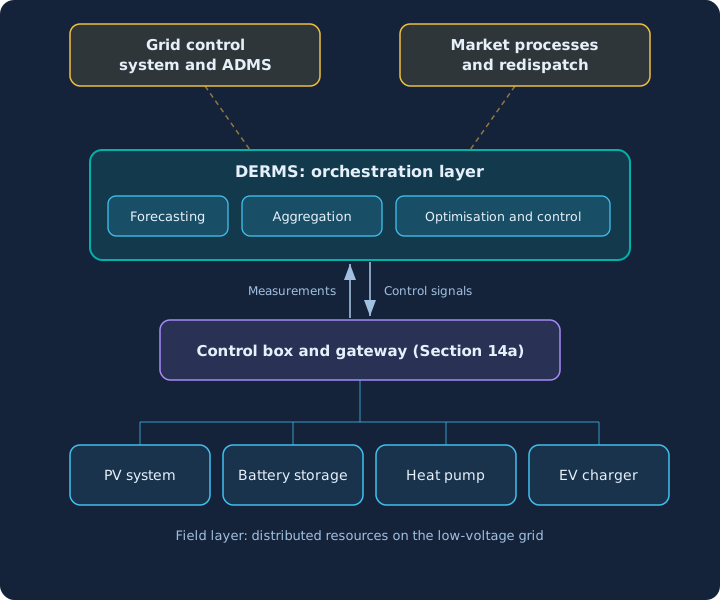
A DERMS (Distributed Energy Resource Management System) is a software platform a distribution system operator uses to forecast, aggregate and control distributed resources such as PV, battery storage, heat pumps and EV chargers. It matters now for utilities and grid operators because grid-oriented control under Section 14a of the German Energy Industry Act must be dynamic and measurement-based from 1 January 2029. Preventive blanket dimming ends then, allowed only until the end of 2028 and, per grid area, for at most 24 months. The global DERMS market stood at roughly 1.8 billion US dollars in 2026 and grows at about 18 percent a year. The real decision is not a product choice but a question of architecture: a standalone DERMS, an extension of the grid control system, or a rule-based start via the control box.
Why a DERMS is on the agenda now
A DERMS is the software layer that turns individual controllable assets into a controllable grid. The trigger is simply volume. As long as only a handful of heat pumps hang off one feeder, an operator gets by with fixed limits and the occasional shut-off. When twenty EV chargers on the same line all charge in the evening while the PV systems feed back at noon, the rule of thumb becomes a guessing game.
The numbers behind this are not a forecast for the distant future. The German regulator, the Bundesnetzagentur, expects around 12 million heat pumps and 19 to 25 million electric cars by 2037. Every asset above 4.2 kilowatts has had to connect to grid-oriented control since 1 January 2024. And that hits not a dozen large operators but around 890 distribution system operators, many of them municipal utilities with small teams. That is the real shift: control used to be the exception, now it becomes routine. The handbook chapter on grid-oriented control under § 14a sets out what the Bundesnetzagentur's determinations require, from the control chain to the minimum power.
DERMS, ADMS and virtual power plant: the distinction
Before an operator goes to tender, it has to keep three system categories apart. Otherwise it buys twice, or the wrong thing. The three terms sound alike but mean different things, and the difference decides the procurement.
An ADMS, an Advanced Distribution Management System, controls the grid itself: switching states, assets, outage management. A virtual power plant, by contrast, bundles assets for marketing on the market, regardless of where in the grid they sit. One looks after the line, the other after the revenue. A DERMS sits between them and talks to both.
| Feature | DERMS | ADMS | Virtual power plant |
|---|---|---|---|
| Control object | distributed resources (PV, storage, heat pump, EV charger) | the distribution grid (switching states, assets) | an asset portfolio |
| Purpose | grid services, keeping assets within grid limits | grid operation and outage management | selling flexibility on the market |
| Location | location-specific (voltage, actual feeder) | grid-wide (topology) | location-agnostic |
| Role in the house | grid operations and control room | control room | sales or aggregator |
In practice the line blurs. Many vendors bundle ADMS, DERMS and flexibility management into one piece of software, Siemens for example in Gridscale X. For the operator that is convenient and risky at once: one platform less to integrate, but one dependency more. Which field layer the whole thing docks onto is shown in the piece on the LV control system and CLS management under Section 14a.
From blanket dimming to measurement-based control
The core of the Section 14a reform is the move from the blanket to the measurement. Until the end of 2028 an operator may dim preventively when it lacks the measurement data. But transitionally only, and per grid area for at most 24 months after the first intervention. From 1 January 2029, only dynamic control is allowed.

Dynamic means the operator may throttle an asset only when it monitors the grid section with measurements and a critical state actually exists. No suspicion, no blanket intervention, but a proven reading. And even then 4.2 kilowatts per device stay guaranteed, so the heat pump stays warm and the car stays ready to drive.
This is where a DERMS is needed. It pulls the readings from the secondary substations, combines them with a forecast of the coming hours and decides which asset is throttled, when and how far, instead of shutting down in turn. How precise that forecast is depends on the data basis that, for instance, AI-based load and generation forecasting in the distribution grid provides. Without grid-state monitoring across the network, every optimisation stays a guess, and the deadline slips in practice.
The market and the vendors
The market is young, growing fast and well covered by European names. Worldwide it stood at roughly 1.8 billion US dollars in 2026, with annual growth of about 18 to 19 percent that carries it to around 4 billion by 2031. North America holds the largest share, driven by aggressive build-out and heavy regulation. For European grid operators, though, the world figure matters less than the question of who speaks their language.
And there the choice is wider than many assume. Alongside the control-technology houses Siemens, Schneider Electric, PSI and KISTERS there are specialised platforms such as envelio, which by its own account counts more than 90 distribution operators as customers, plus cloud-based vendors like gridX and international names such as Oracle and GE Vernova. The trend runs towards consolidation: ADMS plus DERMS plus flexibility in one environment. Convenient to buy, expensive to leave.
Build, buy or extend
The key question is not which product but which layer. An operator has three paths, and none of them is right for everyone. They hang on the data situation, the number of assets and the time left until 2029.
Three paths to the control layer
Start rule-based
Control box and grid traffic light, fixed limits. It carries you short-term and is quick to deploy, but scales poorly to high penetration. A good entry point, not a lasting answer.
Buy a DERMS
A standalone platform with forecasting and optimisation. This fits the 2029 logic, but demands clean interfaces to SCADA, ADMS and market processes. The most demanding path, and the most durable one.
Extend the ADMS
Bolt DERMS functions onto the existing grid control system. Less integration, but a tie to one vendor. Sensible when the ADMS is due anyway.
What comes first in every case is a target picture. Control box, forecasting and Redispatch 3.0 have to fit into one architecture as modules, rather than growing side by side as three islands. Whoever reverses that order and buys the product first ends up building the architecture around the product. That bites at the next system change.
Where it gets stuck
A DERMS solves control, but not the data question. Without reliable readings and clean master data, every optimisation stays a guess. This is the point where most projects slow down more than the schedule can take.
Four sticking points show up almost every time. Data quality, because grid-state monitoring needs measurement technology across the network and its roll-out ties up time and budget. Integration, because the DERMS has to dock onto SCADA, ADMS, the control box and market processes, or the next island appears. Vendor lock-in, because consolidated platforms raise the dependency. And cybersecurity, because every new control interface widens the attack surface and falls under the IT security catalogue.
None of these is a reason to postpone the topic. But they explain why a DERMS project rarely fails on the product and often on the data basis beneath it. Whoever does not have the digital secondary substations under control has no viable DERMS either.
What grid operators should do now
The sensible entry point is not the tender but the target picture. Whoever settles the architecture in 2026 has until 2029 to migrate cleanly, rather than buying a product under deadline pressure and patching the holes later.

The next steps
-
Assess the data situation honestly
How much of your grid is realistically measurement-based controllable by 2029? That single number decides more about the schedule than any product question. Start there, not with the vendor list.
-
Define the target architecture
Set where the grid control system ends, where the DERMS begins and where the market role sits. Draw the interfaces to SCADA, the control box and market processes before a vendor draws them for you.
-
Test vendors on real grid data
A proof of concept with your own measurement series says more than any slide deck. Check whether the forecast holds on your grid, not on the vendor's reference network.
-
Fix interfaces and standards in the contract
Nail down open interfaces contractually, so a later system change does not fail on the data model. It is the only effective insurance against the lock-in a consolidated platform brings with it.
Further reading
Frequently asked questions
A DERMS (Distributed Energy Resource Management System) is a software platform a distribution system operator uses to forecast, aggregate and control distributed resources such as PV, battery storage, heat pumps and EV chargers. It keeps those assets within the voltage and loading limits of the actual feeder and is the software basis for grid-oriented control under Section 14a of the German Energy Industry Act.
An ADMS (Advanced Distribution Management System) controls the distribution grid itself, meaning switching states, assets and outage management. A DERMS controls the distributed resources connected to that grid and optimises them, location by location, for grid services such as voltage support and load flow. Many vendors bundle both functions into one platform, for example Siemens with Gridscale X.
Grid-oriented control under Section 14a of the German Energy Industry Act must be dynamic and measurement-based from 1 January 2029. Preventive blanket dimming is only allowed until the end of 2028 and, per grid area, for at most 24 months after the first intervention. Dynamic control requires full grid-state monitoring, and a DERMS is the layer that brings forecasting, measurements and control together for it.
The global DERMS market stood at roughly 1.8 billion US dollars in 2026 and grows at about 18 to 19 percent a year, reaching around 4 billion by 2031. The cost of a single project depends on the number of assets, the data situation and whether an operator buys a standalone DERMS, extends its ADMS or starts rule-based via the control box.
Most distribution operators buy, because forecasting and optimisation across thousands of assets call for a specialised product. The real decision is not the product but the layer: a standalone DERMS, an extension of the existing ADMS or grid control system, or a rule-based start via control box and grid traffic light. What decides is the data situation, the number of assets and the time left until the 2029 deadline.
Let's collaborate
One contact, a team behind it
Thirty minutes on what you're working on, whether grid, metering, market processes, IT architecture or AI. Afterwards you'll know how we'd approach it and who would sit at the table.
Energy and measurement technology since 2010 · innobu GmbH since 2014 · Based in Schleswig-Holstein, Germany
Whoever pitches also delivers: whoever leads the first call stays your contact right through to the steering committee, with established partners in the project. Direct: info@innobu.com