Chapter 2 · Part II: Technology
Devices and architecture: what an intelligent metering system is
From the Ferraris meter to the intelligent metering system: LMN, HAN, WAN and CLS, the control box, the WAN question and how multi-utility metering works.
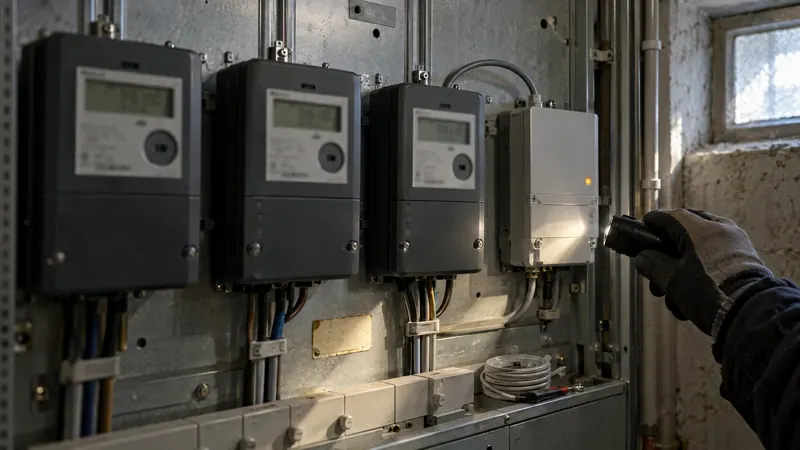
Two devices make an intelligent metering system. A digital electricity meter, called the modern metering device. And beside it the smart meter gateway, a communication computer with a security module inside. Germany's Metering Point Operation Act only speaks of an intelligent metering system when both are there.
Three networks meet at the gateway. Meters on the local metrological network. Customer, service technician and controllable devices on the home area network. Out on the wide area network, the gateway administrator and the market participants. Between them it acts as a firewall, and the channel later used for control runs through the home network.
No guideline says which medium carries the gateway's traffic to the outside world. And the heat meters in the basement?
From spinning disc to metering system
77 words, section signs not counted. One sentence, section 2 no. 7 of the Metering Point Operation Act (MsbG), and it defines the intelligent metering system1. For practical purposes a single line will do: modern metering device plus smart meter gateway.
First came the Ferraris meter. An aluminium disc turns in a magnetic field, a mechanical register adds up the turns as kilowatt-hours. How much power flowed, the device knows. When? No idea.
Electronics replaced the disc in the modern metering device (mME after its German name). By law it has to reflect consumption and time of use, generation where needed, and to be capable of being linked in through a smart meter gateway1. That one word carries the definition. Without a gateway an mME sends nothing at all. It still has to show the connection user consumption and time of use, plus daily, weekly, monthly and yearly values for the past 24 months2.
Only the gateway turns the modern metering device into an intelligent metering system1. The act also knows a plain metering system: any meter "linked into a communication network", such as a meter with its own modem. Since the start of 2026, one that doesn't meet the requirements of sections 21 and 22 may only be installed and used under narrow conditions. For consumption above 100,000 kilowatt-hours and plants above 100 kilowatts, that cut-off comes in 20293. Besides meters, the gateway can link in other technical equipment. A PV system, for instance.
Section 29 decides who gets what. Final consumers above 6,000 kilowatt-hours a year must have an iMSys. Consumers with a §14a agreement and plants above 7 kilowatts get one with a control unit, and the government's EEG 2027 bill would lower that plant threshold to 2 kilowatts4. Every other metering point gets at least an mME, where economically reasonable by the end of 2032, new buildings by completion5. Quotas and exceptions are in chapter 1.
And how far has the rollout got? On 30 June 2026, 3.17 million of 54.1 million reported metering locations had an iMSys. That's 5.9 percent6. So the typical meter cabinet still holds a meter without a gateway.
A further stage has been announced, politically. For customers outside the mandatory rollout, the coalition wants a "Smart Meter Light" that lets them optimise their electricity bills "at low cost and in a cyber-secure way"7. What that would be technically, no bill has defined yet.

One gateway, three networks
The BSI's technical guideline TR-03109-1 describes the gateway through its neighbours. Version 2.0, dated 13 December 2024, knows three communication areas: LMN, HAN, WAN8.
Version 2.0 applies, version 1.1 is in the field
The BSI published version 2.0 of the guideline on 27 February 2025, and it didn't retire its predecessor overnight. Gateways built to version 1.1 and protection profile 1.3 may still be installed until 31 December 2027, and migration by software update is possible. From 2027, certifications under version 2.0 must also cover the MUSS+ requirements, among them the WAN API and interval metering over the LMN9,10. New in version 2.0 are, among other things, a mandatory HAN API and multi-utility metering, submetering included, over the LMN8. Which of these a given gateway in the field can do depends on its certification.
| Network | Who is on it | How it connects | Who sets the rules |
|---|---|---|---|
| LMN, local metrological network | meters for electricity, gas, water, heat | wired over RS-485, two-way; wireless over Wireless M-Bus, one-way only | the gateway administrator, who registers each meter with a profile |
| HAN, home area network | connection user (role CON), service technician (SRV), controllable devices and adapters (CLS) | TLS, with a certificate or, for end customers, also with user name and password | the gateway administrator, who assigns each participant a role |
| WAN, wide area network | gateway administrator, external market participants such as metering point operator, grid operator, supplier | IP connections secured through the smart metering PKI; the physical medium is left open | the PKI certificates and the administrator's profiles |
The table draws on sections 2.3 and 4 of the guideline8,11.
Between the three networks the gateway is a firewall that keeps them apart8. Most of the time it does unglamorous work. Readings come in from the LMN, get a time stamp, are processed by the rules loaded into the device and go out to authorised recipients in the WAN. Time stamps and billing-relevant values put it under German weights and measures law8.
Configuration belongs to one party only, the gateway administrator, GWA for short12. It loads profiles and firmware and monitors the device. If needed, it wakes the gateway with a signed data packet. The readings? Out of its reach. The guideline puts it bluntly: "The GWA has no insight into the meter readings."8
Configure everything, read nothing. An odd division of labour for a box in the basement, and a consistent one.

LMN: where the meters connect
How do readings get in? Two physical interfaces, and the gateway must have both11.
Wired means RS-485. On top of it the guideline stacks HDLC as transport protocol and TLS above that, and the gateway polls the meter actively11. The wireless one runs Wireless M-Bus under EN 13757-4, in one direction only. The meter transmits. The gateway listens, and it ignores packets from any meter the administrator hasn't set up a profile for11.
Several customers can share one device. In an apartment block the gateway has to keep the meters of different connection users apart8. German law goes a step further: several metering points in one property may hang off one gateway, even metering points on different grid connections, provided they sit on the same grid node at the same voltage level12.
So one device can serve a whole building. Possibly several buildings on one node.
HAN: customer, technician, control channel
Three roles meet on the home network. Connection users (CON) check meter readings and their personal log, on a display, a PC or through an energy management system. Then there's the service technician (SRV), who works for the gateway administrator. On site the technician reads the system log and may adjust the device within narrow limits, using rights the administrator has set up in the gateway beforehand8.
The third role is the interesting one. CLS, Controllable Local System, covers anything in the building that is to be controlled or read without belonging to the metering system. A heat pump or a wallbox. A battery, an inverter. Even a data concentrator for heat cost allocators8.
For these devices the gateway acts as a TLS proxy. One encrypted channel arrives from the WAN, another leads into the home network. Both end inside the gateway, which hands the data across without processing it8. Who may use the proxy? Only an active external market participant, aEMT. A passive one just receives data.
Two home networks are a recommendation
Word for word, the guideline says: "To increase the protection of the CLS, splitting the HAN into two networks, HAN-CON and HAN-CLS, is recommended."8 Not mandatory, then, though the IP address ranges should be separate. In future the guideline will require the split, with separate MAC and IP addresses; it announces as much itself11. Whether display and control box share a segment in a given house comes down to the device and the installation.
And from outside? Direct access from the internet to the gateway's services, say via the customer's router, is not provided for11.
This proxy channel is where control happens. For control under §14a the act names data communication "via the smart meter gateway and a control unit connected to it"13. How a command gets from grid operator to heat pump, and why TAF 11 has nothing to do with it, is for chapters 4 and 5.
Treat the CLS channel as a network of its own, with its own role and its own certificate. Put the customer display and the control box in one segment and you give away the protection the guideline recommends.
Hardware in the field
In the field, more equipment joins the gateway. At least one piece of it changes its name depending on who you ask.
Inside the gateway sits a security module. Keys and random numbers come from it; it signs, checks signatures and keeps the key material8. Physically it's part of the gateway. Yet the protection profile treats it as a product of its own, certified separately14. How that fits together is chapter 3.
Next, the control unit. That's the act's term. Installing and running it, the link to the gateway and to an energy management system included, is a standard service of the metering point operator13. The industry says control box, Steuerbox. VDE FNN writes its specification, currently version 1.5 of August 202515.
For the CLS adapter, BSI TR-03109-5 has applied since 1 January 2024. It covers communication adapters in the home network that use the gateway's TLS proxy channel and terminate it on their side16. Inside that channel, back end and adapter speak whatever protocol the application needs; IEC 61850, EEBUS and OpenADR are the guideline's examples16. The BSI list now holds 26 certificates17.
Last comes the customer's energy management system. Not part of the metering system. On the home network it shows up as CON when it displays consumption and as CLS when it controls something8.
Why the confusion over names? Because the component comes in several designs. Germany's energy agency dena lists four labels in use for it: CLS unit, CLS communication adapter, HAN communication adapter and (FNN) control box. According to dena, the terms reflect the range of implementations, and the FNN control box is the standardised variant. It has digital interfaces via EEBUS and analogue ones via relay contacts, and passes the signal either straight to the device or to an energy management system18.
Four names, several designs. In a tender, only the guideline number makes it unambiguous.
The WAN question
"The protocols below the network layer are not specified by this technical guideline."11 One sentence, in a note on figure 4.2. With it, the WAN becomes the operator's problem. LTE, a 450 MHz network, powerline over the power cable, fibre? The guideline doesn't choose.
Legally, the bar is low. Besides the route in use, the gateway has to be open to one more kind of remote communication, arranged by the administrator12. A second medium as an option. No more.
In the other direction, the state can draw lines, and has been able to since December 2025. Section 19(2) authorises the economics ministry to set requirements by ordinance for the own wide area connections of controllable consumption devices, storage and renewable plants, and in certain cases to ban connections that bypass the gateway outright or allow them only through it3. No such ordinance could be found by mid-October 2026.
That one medium falls short was known early. In mid-2020 the Barometer for Digitalising the Energy Transition counted around 14 percent of households with fibre; at the end of 2020, 96.5 percent of the land area had LTE. Its conclusion: "With only one of the communication technologies available to date, sufficient coverage and availability cannot be guaranteed. Hybrid solutions would be needed."19 And land area isn't a basement.
No help from the protection profile either, by design. Its subjects are confidentiality, integrity and authenticity, and it says plainly: "The availability of the SMGW is not addressed by the PP."14 Availability is an operations question.
And in a blackout? Public telecom networks aren't blackout-proof across all their components, notes an expert report by BET and WIK-Consult for the federal economics ministry, dated 28 June 2024. For the customer installation, blackout robustness is enough: an orderly restart once the voltage returns. To connect the iMSys, the report recommends the 450 MHz radio network20. German law does list an "uninterruptible, blackout-proof, dedicated wide area communication connection" as an additional service. It ties that service to a statutory ordinance13, and none had turned up by mid-October 2026.
How far the 450 MHz network has got
450connect, which runs the network, reported 90 percent land coverage on 8 October 2025, along with its 1,000th radio site and 72 hours of blackout resilience. Full coverage was announced for the end of 202521. By 27 August 2026 the company was talking about 100,000 active SIM cards and a nationwide network. A percentage? None given. Smart meter gateways appear there as a device category, without a number of their own22.
No figure for the WAN mix
No published figure could be found for how many gateways connect via LTE, 450 MHz, powerline or fibre. The Federal Network Agency's half-yearly survey doesn't report the transmission technology6.
How often does the connection fail in the field? There are only indirect signs. A PwC study, reported by the trade press in October 2026, gives a first-visit success rate of 74 percent and names a missing WAN connection among the reasons appointments fail. Sample and method aren't stated23.
By now the Federal Network Agency treats this as a compliance question. Installing an iMSys alone is not enough, it says; the devices must reliably record quarter-hourly values and transmit them to the authorised parties6. Without a working WAN connection, that can't happen.
Which leaves this. For the LMN the guideline prescribes cable and radio standard. For the WAN, nothing. It does describe a network diagnostics service, through which the gateway reports its modem's signal quality and connection data to the administrator or a market participant. Optional, though. The manufacturer merely declares whether a device implements it8. With the right device the problem can be measured. Solved it isn't.
Gas, water, heat: two ways into the gateway
On paper the route is clear. On the LMN, the guideline explicitly lists meters for gas, water, thermal energy and electricity8. And the act requires the iMSys to receive readings securely from meters of all four utilities, heat metering devices included12.
Publicly described projects take another route. Submetering, the consumption metering inside multi-occupancy buildings, enters the gateway there through the home network. A data concentrator or adapter collects the values of heat meters and heat cost allocators and talks to the gateway as a CLS, through the TLS proxy. As early as 2023 a metering point operator was rolling out 500 such "CLS adapters for submetering", close to 200 of them already running24. The BSI list now includes a "CLS Adapter Submetering 2" certified under TR-03109-517.
The BDEW sees it the same way. For submetering and existing installations, the association wrote in October 2024, the route via CLS channel and control unit "will continue to be necessary"25.
A contradiction of the specification? No. The same guideline that puts heat meters on the LMN counts data concentrators for heat cost allocators among the CLS on the home network8. Both routes are specified, although the LMN route for submetering only arrived with version 2.0 of the guideline8. So far, publicly described projects build the second.
And what does the law demand? Less than many slide decks claim.
| Utility | What the law requires | Basis |
|---|---|---|
| Electricity | mandatory iMSys in the cases of section 29(1) MsbG, at least an mME by the end of 2032 | section 29 MsbG5 |
| Gas | new gas meters must be connectable; new meters with registering power measurement must be connected to an existing gateway from 1 July 2028 at the latest, the rest once it's technically possible and costs the connection user nothing extra; since 1 July 2026 an iMSys at a gas metering point can be ordered as an additional service, to be installed within four months | sections 20, 34, 40 MsbG26,13,27 |
| Heat and hot water in multi-occupancy buildings | since 1 December 2022 only devices that can be securely connected to a gateway; non-remote-readable legacy devices to be retrofitted or replaced by 31 December 2026 | section 5 HeizkostenV28 |
| District heating | meters installed after 5 October 2021 must be remotely readable, older ones by 31 December 2026; a gateway is allowed but not required | section 3 FFVAV29 |
Connectable isn't connected
Since 1 December 2022 the Heating Costs Ordinance has only required new remotely readable devices to be capable of connecting to a smart meter gateway. Remotely readable devices installed up to that date must meet this requirement after 31 December 203128. A real duty to connect arises only when the building owner picks a bundled offer under section 6 MsbG for space heating: electricity plus at least one other utility over one gateway, at no extra cost compared with separate metering30. Mandatory iMSys installation under section 29 MsbG is about electricity only5. Gas has its own conditional connection duty in section 40, and it covers only new meters at existing gateways27.
How connectable is the field, really? A consultancy source from June 2026 keeps it short: the systems are meant to be interoperable and connectable, but "in practice they often aren't". CLS connections work in pilot projects, it says. Productive rollout is still to come31. A named multi-utility project over the gateway with published production figures for 2026 could not be found.
Open ground, then, even though two services already sit on the act's list of what metering point operators must offer: transmitting submetering data via the gateway, and connecting the main meter of another utility13.
Where the data goes
Readings leave the gateway in one of two ways. Directly, in a star pattern, to each authorised recipient in the WAN. Or indirectly via a market actor8. If the route runs through the administrator, the gateway encrypts the content with the recipient's key11. The administrator carries the data but can't read it.
For processing, the act has a target picture. Plausibility checks and substitute values happen inside the gateway, and the values go straight to authorised parties, once the BSI deems that technically feasible and the Federal Network Agency sets it out in a determination. Until then, the Federal Network Agency's determinations let processing and sending run fully or partly outside the gateway: at the metering point operator, and for gas permanently and at other authorised parties too32. The target is in the statute book. For now, the work stays in the back end.
Meter data management lives there, and so does dispatch in the formats of market communication. That's chapter 7.
And the grid operator? It also receives the actual feed-in from TAF 9 and grid status data from TAF 108, the subject of chapter 4. Without a control system for the low-voltage grid, all of that just fills an archive. The BET and WIK-Consult report reaches the same point from another direction: for control in system-critical situations, distribution system operators' control systems would have to be extended so they observe the grid state, detect congestion automatically and send control commands to very large numbers of devices at once20.
Four checks are worth running on your own installed base:
Document the home network topology per device type
Find out, for every gateway model you use, whether HAN-CON and HAN-CLS are separated physically or logically. Then write the separation into new tenders, because the guideline only recommends it.
Set a WAN strategy per site class
Basement location, metal cabinet, mobile coverage, distance to the local substation: group your meter sites by features like these and set a primary and a fallback medium for each class. Openness to a second medium is required by law anyway. Where your gateway model offers the network diagnostics service, use it to check your assumptions in operation.
Tie component names to guidelines
Write "CLS communication adapter under TR-03109-5" or "control box under the FNN specification" into your specifications, not just "control box".
Plan multi-utility metering via CLS
Reading heat or water through the gateway? For now, expect the CLS route with a certified adapter, and look at the bundled offer under section 6 MsbG as a business model.
Open deadlines for this chapter
Live from the deadline calendar, data as of 14 October 2026. When a deadline changes, this list changes with it.
Sources
Primary sources first. Uncertain statements are marked as uncertain in the text rather than left out.
- Section 2 Metering Point Operation Act (MsbG), definitions, nos. 7, 10, 13, 15, 19, 20 (German). gesetze-im-internet.de, retrieved 14 October 2026.
- Section 61 MsbG, consumption information for the connection user with intelligent metering systems and modern metering devices, paragraph 3 (German). gesetze-im-internet.de, retrieved 14 October 2026.
- Section 19 MsbG, general requirements for metering systems; power to issue ordinances and sub-delegation, paragraph 2 sentences 3 and 4 and paragraph 5, paragraph 2 as amended by Article 17 no. 7 of the act of 18 December 2025 (BGBl. 2025 Part I No. 347) (German). gesetze-im-internet.de, retrieved 14 October 2026.
- German Bundestag, printed paper 21/7867 of 7 September 2026, government bill on a plannable, cost-efficient, grid-compatible and market-oriented expansion of renewable energy in the power sector, Article 3 (amendment of the MsbG), p. 77, Article 7 (entry into force), p. 87, and reasons for Article 3 (German). dserver.bundestag.de, retrieved 14 October 2026.
- Section 29 MsbG, equipping metering points, paragraphs 1 and 3 (German). gesetze-im-internet.de, retrieved 14 October 2026.
- Federal Network Agency (BNetzA): press release on its half-yearly metering survey, 21 September 2026, reference date 30 June 2026, first paragraph and section on reliable data transmission (German). bundesnetzagentur.de, retrieved 14 October 2026.
- Federal Government: Ein Programm für Aufschwung und Beschäftigung, results of the coalition committee of 2 July 2026, p. 7 (German). bundesregierung.de, retrieved 14 October 2026.
- Federal Office for Information Security (BSI): BSI TR-03109-1, interoperability requirements for the communication unit of an intelligent metering system, version 2.0 of 13 December 2024, sections 1.1, 2.2, 2.3, 3.3.5, 3.3.6, 3.8 and 3.21 (German). bsi.bund.de, retrieved 14 October 2026.
- BSI: transitional rules and deadlines for PP-0073 and TR-03109-1, overview with publication of PP and TR v2.0 on 27 February 2025, installation under TR v1.1 and PP v1.3 until 31 December 2027, and MUSS+ requirements from 1 January 2027 (German). bsi.bund.de, retrieved 14 October 2026.
- BSI: protection profiles and technical guidelines for smart metering, overview of current and still valid versions (German). bsi.bund.de, retrieved 14 October 2026.
- BSI: BSI TR-03109-1, version 2.0 of 13 December 2024, chapter 4, requirements for communication links, sections 4.2.3, 4.2 on the INFO-REPORT scenario, 4.3 and 4.4.1 (German). bsi.bund.de, retrieved 14 October 2026.
- Section 21 MsbG, minimum requirements for intelligent metering systems, paragraph 1 nos. 3 and 4 and paragraph 3 (German). gesetze-im-internet.de, retrieved 14 October 2026.
- Section 34 MsbG on standard and additional services, paragraph 1 nos. 5 and 6, paragraph 2 sentence 2 nos. 1, 3, 4, 8 as well as paragraph 4 (German). gesetze-im-internet.de, retrieved 14 October 2026.
- BSI: Certification Report BSI-CC-PP-0073-V2-2024, Protection Profile for a Smart Meter Gateway, version 2.0, section on the target of evaluation. commoncriteriaportal.org, retrieved 14 October 2026.
- VDE FNN: document overview for metering, entry "Lastenheft Steuerbox 1.5", status 08/2025 (German). vde.com, retrieved 14 October 2026.
- BSI: BSI TR-03109-5, communication adapters, version 1.0 of 24 November 2023, sections 1.5 to 2 (German). bsi.bund.de, retrieved 14 October 2026.
- BSI: certificates under TR-03109-5, list of certified communication adapters, including BSI-K-TR-0814-2025 and BSI-K-TR-0665-2025 (German). bsi.bund.de, retrieved 14 October 2026.
- German Energy Agency (dena): an overview of the "CLS unit", implementations and terminology, status 10/2025, pp. 1 f. (German). dena.de, retrieved 14 October 2026. Secondary source.
- EY for the Federal Ministry for Economic Affairs and Energy: Barometer for Digitalising the Energy Transition, reporting year 2020, section 2.7, p. 16 (German). bundeswirtschaftsministerium.de, retrieved 14 October 2026. Study.
- BET Büro für Energiewirtschaft und technische Planung and WIK-Consult: blackout-proof communication links under section 34 MsbG for decentralised flexibilities, expert report for the BMWK of 28 June 2024, executive summary, pp. 6 to 10 (German). bmwk.de, retrieved 14 October 2026. Expert report.
- 450connect: 90 percent land coverage as the backbone of resilience in Germany, press release of 8 October 2025 (German). 450connect.de, retrieved 14 October 2026. Company statement.
- 450connect: 450 MHz in practice, 100,000 active SIM cards, press release of 27 August 2026 (German). 450connect.de, retrieved 14 October 2026. Company statement.
- ElektroWirtschaft: PwC study 2026, smart meter rollout, 6 October 2026 (German). elektrowirtschaft.de, retrieved 14 October 2026. Trade press, study method not disclosed.
- Zeitung für kommunale Wirtschaft: submetering via smart meter gateway ready for practice, 26 November 2023 (German). zfk.de, retrieved 14 October 2026. Trade press.
- BDEW German Association of Energy and Water Industries: integrated control function in the SMGW, 4 October 2024 (German). bdew.de, retrieved 14 October 2026. Association position.
- Section 20 MsbG, connectability of gas meters to the smart meter gateway (German). gesetze-im-internet.de, retrieved 14 October 2026.
- Section 40 MsbG, obligation to connect gas meters (German). gesetze-im-internet.de, retrieved 14 October 2026.
- Section 5 Heating Costs Ordinance (HeizkostenV), equipment for recording consumption, paragraphs 2 to 4 and 6 (German). gesetze-im-internet.de, retrieved 14 October 2026.
- Section 3 District Heating and Cooling Consumption Metering and Billing Ordinance (FFVAV), measuring consumption, paragraphs 3 to 5 (German). gesetze-im-internet.de, retrieved 14 October 2026.
- Section 6 MsbG, the connection owner's right to choose, paragraph 1 no. 2 (German). gesetze-im-internet.de, retrieved 14 October 2026.
- Utility Partners: the submetering rollout is nearly complete and ahead of the smart meter rollout thanks to simpler processes, 18 June 2026 (German). utility-partners.de, retrieved 14 October 2026. Secondary source.
- Section 60 MsbG, data transmission, star-shaped communication, paragraphs 1 and 2 (German). gesetze-im-internet.de, retrieved 14 October 2026.