Section 23c EnWG: the network data electricity and gas operators publish by 1 April
Until July 2021 the duty sat in Section 27 of the electricity and gas network charges ordinances (StromNEV, GasNEV); today it is Section 23c of the Energy Industry Act (EnWG). Since the December 2023 amendment it asks electricity networks for four additional figures that no single system holds: smart metering systems, the withdrawal points connected to them, agreements under Section 14a, and grid connections left open for more than three and more than six months.
The publication duty under Section 23c EnWG requires every operator of an electricity or gas supply network in Germany to publish the structural data of its network on its own website by 1 April each year, mostly as of 31 December of the previous year: for electricity, among other things, circuit lengths, transformer capacity, energy withdrawn, withdrawal points, areas, the default metering point operator and a contact for network access; for gas, line lengths per pressure level, energy withdrawn, exit points, annual peak load and network access terms. Since the act of 22 December 2023, electricity network operators also report the number of smart metering systems at low-voltage connections, the withdrawal points connected to them, the agreements under Section 14a EnWG and the grid connections that, in the previous year, remained uncompleted for more than three and more than six months after the request. The next date is 1 April 2027, with a cut-off of 31 December 2026; according to the Monitoring Report 2025, 851 electricity distribution system operators, 4 transmission system operators with control area responsibility, 699 gas distribution and 15 gas transmission system operators were registered with the Bundesnetzagentur. Section 95 EnWG does not mention Section 23c, but a breach is also an abuse of market position under Section 30 EnWG, which Section 95(1) no. 4 threatens with a fine of up to EUR 1 million, and the Bundesnetzagentur can order publication under Section 65(2) EnWG and enforce it with coercive fines.
What has to be online by 1 April
Ten items for electricity, extended by nos. 4a to 4d since 2023, and seven for gas: that is what Section 23c of the Energy Industry Act (EnWG) asks for by 1 April every year, from every network operator regardless of size. Most figures are as of 31 December of the previous year; energy withdrawn covers the whole previous year. For the 2027 publication, the network as it stood at the turn of 2026/27 is what counts. Anyone who only runs the queries in March has to reconstruct that state after the fact, because GIS and billing systems hold no year-end snapshot unless someone takes one.
| Item | Electricity network (subs. 1) | Gas network (subs. 4, no. 6 repealed in 2023) |
|---|---|---|
| Lines | circuit length of cables and overhead lines per voltage level (no. 1) | line length per pressure level, high pressure also by diameter class (nos. 1, 2) |
| Capacity and load | installed capacity of the transformation levels (no. 2) | coincident annual peak load and when it occurred (no. 5) |
| Energy withdrawn | annual energy in kilowatt hours per network and transformation level (no. 3) | annual energy in kilowatt hours or cubic metres (no. 3) |
| Connections | withdrawal points per network and transformation level (no. 4); withdrawal points with quarter-hourly interval metering or meter-reading series, and all other withdrawal points (no. 8) | exit points per pressure level (no. 4) |
| Area | population in the network area (low-voltage operators only), supplied and geographic area (nos. 5 to 7) | not required |
| Since 2023 | smart metering systems, delayed grid connections, Section 14a agreements (nos. 4a to 4d) | not required |
| Other | name of the default metering point operator, contact for network access (nos. 9, 10) | terms and conditions and cooperation agreement, connection conditions for biogas and LNG plants with network utilisation (nos. 7, 8) |
Subsection 7 sets the format in one phrase: "a common format". Whether a scanned PDF qualifies, the act doesn't say; a table on the page or a CSV file never raises the question. The gas items under subsection 4 nos. 7 and 8 must also be updated without delay whenever they change, at least monthly or, where short-term services require it, daily. Gas transmission system operators also publish the data in English (subsection 7 sentence 3).
The duty also covers closed distribution systems that supply a geographically confined industrial or commercial site or an area of shared services (Section 110(2) EnWG): Section 110(1) EnWG does not exempt them from Section 23c, and anyone applying for that classification has to include the data under Section 23c(1) or (4) nos. 1 to 5 (Section 110(3) no. 2 EnWG). Section 110(1) does exempt them from Section 14a, so no. 4d has nothing to count there. Operators of customer installations under Section 3 nos. 65 and 66 EnWG have no duty, because customer installations are not energy supply networks (Section 3 no. 37).
On 1 April, electricity network operators also publish the previous year's average losses and loss energy procurement costs under Section 10(2) StromNEV; Section 23c(2) no. 7 (transmission) and (3) no. 7 (distribution system operators) additionally require the same data on an ongoing basis, plus the loss energy volumes. On 31 March, the number of connected customers has to be reported to the Bundesnetzagentur and the competent state regulatory authority under Section 28 sentence 2 ARegV. All three dates draw on the same year-end close of the network data.
The four figures added in 2023
Since the act of 22 December 2023 (Federal Law Gazette 2023 I No. 405), Section 23c(1) asks electricity networks for four more figures. 1 April 2024 was the first date on which they were due; 2027 is the fourth. The government's explanatory memorandum explains the four items in a single sentence:
"The provision adds a publication duty for information relevant to grid connections and thereby serves to increase transparency for market participants." (our translation)
Smart metering systems
Number of smart metering systems at low-voltage grid connections as of 31 December, insofar as the network operator knows them.
Connected withdrawal points
Number of withdrawal points connected to a smart metering system via a low-voltage connection, with the same "insofar as known" limit.
Delayed grid connections
Two figures per voltage level: grid connections that, in the previous year, remained uncompleted for more than three months, and for more than six months, after receipt of the connection request.
Section 14a agreements
Number of agreements on grid-oriented control under Section 14a(1) sentence 1 EnWG concluded as of 31 December.
We consider 4c the hardest of the four. It assumes that for every request there is a fixed date of receipt, and the act doesn't say whether that is the first enquiry, the complete application or some other event. Nor does it say whether delays caused by the connecting party count; the wording provides no exception for them. An operator that takes connection requests by email, paper form and grid connection portal runs three clocks that don't agree. And the figure is public: anyone planning a connection can put neighbouring operators side by side; the explanatory memorandum speaks generally of transparency for market participants.

For 4a and 4b the act sets its own limit ("insofar as known to them") but does not say what counts as known. Our reading: where the network operator is also the default metering point operator, its own devices from the metering business count. Metering locations equipped by a competitive metering point operator it only sees through the master data exchanged in market communication; whatever is recorded there as a smart metering system it should treat as known. The Federal Network Agency (Bundesnetzagentur) provides a benchmark: as of 30 June 2026, 3,172,579 of 54,135,202 reported metering locations had a smart metering system, 5.9 percent. That ratio covers all metering locations reported by metering point operators, not just low-voltage connections, so it is only a rough benchmark. A large gap can reflect the actual rollout status or missing master data from other metering point operators; which of the two should be clear before publication. How the agency enforces the rollout quotas is covered in our piece on supervision of the smart meter rollout.
For 4d the basis is the stock of agreements under Section 14a(1) sentence 1 on 31 December. Billing of the reduced network charges is only good for a plausibility check: it bills per market location and module, also includes agreements under the old rules (Section 14a(2)) and may not yet show agreements from December. The wording leaves open whether agreements from before the determination count (Section 14a(4) sentence 4 allows separate legacy and transition rules for them), whether "concluded" means the stock on the cut-off date or every agreement ever signed, and whether the unit is the controllable device or the market location. We recommend counting the agreements under the determination in force on 31 December and stating that reading next to the figure. How far the installation of the Section 14a control box has progressed makes no difference to this figure.
Where the data comes from
The structural data sits in at least four systems, and none of them knows 31 December as a cut-off on its own. GIS holds line lengths, transformer capacity and areas; grid usage billing holds energy withdrawn, withdrawal points and Section 14a agreements; metering and market communication hold the smart metering systems; the portal or work order system holds how long connections took.
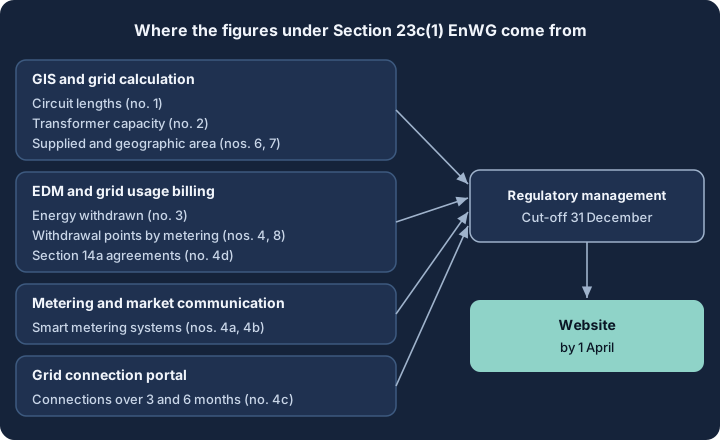
That creates a division of labour the act doesn't mention: regulatory management needs one value per source as of the cut-off date and one person who signs it off. The Bundesnetzagentur also collects many of these figures in its annual monitoring, such as circuit lengths per voltage level and the number of market locations. The data collection for the efficiency benchmarking asks for structural data as well. If the website shows different values from the reports to the Bundesnetzagentur, there are two numbers for the same item, and someone in-house has to be able to explain the gap. Part of it can come from the terms: the monitoring counts market locations, Section 23c counts withdrawal points.

For small operators the effort is modest, but the date is the same. By the Monitoring Report's size classes, 643 of the 851 electricity distribution system operators have fewer than 30,000 customers, and in gas 670 of 699 have fewer than 100,000. Where GIS and billing run at a service provider, the cut-off query has to be ordered before Christmas, not in March.
What Section 23c requires besides 1 April
1 April is only the fixed part of the provision. Section 23c also requires ongoing publications. For most of them, subsection 7 says they must be updated without delay whenever they change, at least monthly or, where short-term services require it, daily; the data under subsection 2a has to be updated at least hourly. Which ones apply depends on the role:
| Role | What stays online | Subsection |
|---|---|---|
| Electricity distribution | annual peak load and load profile per network and transformation level, aggregate loads, schedule forecasts for standard load profile customers, supply from the upstream level, feed-in per voltage level, network losses in volume, percent and cents per kilowatt hour | subs. 3 |
| Electricity distribution | anonymised, aggregated data on load control options and on renewable feed-in from self-generation and from energy sharing installations under Section 42c, insofar as technically available | subs. 2b, since 23 Dec 2025 |
| Transmission | vertical grid load, control area balance, cross-border flows, outages and maintenance planning, wind and solar forecasts, network losses, available for two years | subs. 2 |
| Transmission with control area | renewable share and CO2 content in the bidding zone, at least hourly, on a joint website with an API | subs. 2a, since 23 Dec 2025 |
| Gas distribution | calorific value, billing calorific value on the tenth working day of the following month, connection rules, standard load profiles, map of connected areas | subs. 6 |
| Gas transmission and market area | gas transmission operators: capacity auctions, load flow simulation, readable automatically under subsection 7 and also in English; market area managers: balancing and control energy charges | subs. 5, 5a, 7 |
Subsections 2a and 2b came with the act of 18 December 2025 (Federal Law Gazette 2025 I No. 347). For electricity distribution system operators, 2b is the change with the most room for interpretation, because it only applies "insofar as these data are technically available to it". That room shrinks the more control and feed-in data an operator already collects for running its network. Whatever is technically available has had to go on the website in anonymised and aggregated form since 23 December 2025; preparing it is part of the duty.
From Section 27 StromNEV to Section 23c EnWG
A publication page that still cites Section 27 StromNEV names a legal basis that has not applied to this data since July 2021. The act of 16 July 2021 (Federal Law Gazette I p. 3026) moved the duties into the EnWG as Section 23c, struck Section 27(1) and (2) from the StromNEV, the electricity network charges ordinance, and repealed Section 27 GasNEV; the rest of Section 27 StromNEV went on 29 December 2023. gesetze-im-internet.de now lists both as repealed.
The ordinances themselves have an expiry date: the GasNEV ceases to apply at the end of 31 December 2027, the StromNEV and the ARegV at the end of 31 December 2028 (Article 15(2), (3) and (5) of the act of 22 December 2023), and the Bundesnetzagentur's NEST determinations take their place. With the StromNEV, Section 10(2) disappears as the basis for publishing network losses on 1 April, and with the ARegV the customer count under Section 28; whether the determinations bring successor rules is open. Section 23c stays, because it sits in the act itself, and with it the ongoing loss data duty under subsections 2 no. 7 and 3 no. 7. The price sheets follow a different route and a different date: the publication of network charges by 15 October under Section 20(1) and Section 21(4) EnWG.
What applies if the publication is missing
Section 95 EnWG does not mention Section 23c, but a fine is still possible. Section 23c sits in Part 3, Division 3 of the EnWG, and a network operator that fails to comply with provisions of that division abuses its market position under Section 30(1) sentence 2 no. 1. Section 95(1) no. 4 threatens that abuse with a fine of up to EUR 1 million (Section 95(2) no. 3). The regulator can require the breach to stop (Section 30(2)), and where there is a legitimate interest it can still establish the breach after the publication has been made (Section 30(3)). The Bundesnetzagentur can also order publication under Section 65(2) EnWG and enforce it with coercive fines under Section 94 EnWG; failing to comply with an enforceable order under Section 65(1) or (2) or Section 30(2) is an administrative offence under Section 95(1) no. 3 EnWG.
The competent authority is not always the same. The order under Section 65 comes from the Bundesnetzagentur, because Section 54(2) EnWG does not assign Section 23c to the states (Section 54(3)). Abuse supervision under Sections 30 and 31 lies with the state regulatory authority for distribution system operators with fewer than 100,000 customers whose network does not extend beyond one state (Section 54(2) no. 8). Third parties can act too: anyone whose interests are significantly affected by the missing publication, for instance a connecting party under no. 4c, can apply for abuse proceedings (Section 31), and those affected can claim removal, injunctive relief and, where there is fault, damages (Section 32 EnWG).
What to do before 1 April 2027
Four steps to 1 April
-
Name a lead system for every figure
By mid-December, name one system and one owner for every item in subsection 1, including 4a to 4d. Gas operators go through the seven items in subsection 4.
-
Freeze the values as of 31 December
Schedule queries for the turn of the year, above all for smart metering systems and Section 14a agreements, which change all the time. A February snapshot is not a 31 December snapshot.
-
Define when a connection request is received
By year-end, agree with the legal department which event counts as "receipt of the connection request", document that reading and from then on record the date for every connection, whatever channel the request came through. Section 8(5) EEG, which refers to the "receipt of a grid connection request", is a useful anchor. For the 2027 publication, every connection that was open for more than three or six months during 2026 counts, including those requested in 2025 or earlier. Without receipt data no. 4c can only be estimated, and the estimate then sits on the public website.
-
Reconcile and publish
In March, put the values next to the latest report to the Bundesnetzagentur and, for electricity, next to the network losses publication, explain and document any gaps without forcing the definitions to match, then publish them as a table or CSV and cite Section 23c EnWG as the basis.
Deadline, market roles, systems
1 April 2027Section 23c EnWG: publish network structural data by 1 AprilLaw · adopted
Applicability: Applies to all electricity and gas network operators, including transmission system operators for gas and closed distribution systems in industrial or commercial areas or areas with shared services (Section 110(1) and (2) EnWG; Section 110(1) does not exempt Section 23c but does exempt Section 14a, so no. 4d has nothing to count there). Customer installations under Section 3 nos. 65 and 66 EnWG are not networks. The number of inhabitants in the network area (subsection 1 no. 5) is required only from operators of low-voltage networks, and the smart metering figures (nos. 4a and 4b) only insofar as the network operator knows them. Gas transmission system operators also publish the data in English (subsection 7 sentence 3). Section 23c also requires ongoing publications without a fixed date, such as load profiles, feed-in and network losses for electricity networks (subsections 2 and 3) and calorific values for gas distribution networks (subsection 6); these must be updated without delay when they change, at least monthly or, where short-term services require it, daily (subsection 7).
If the deadline is missed: Fine possible Section 95 EnWG does not mention Section 23c expressly. The Federal Network Agency can order publication under Section 65(2) EnWG and enforce it with coercive fines under Section 94 EnWG; failing to comply with an enforceable order under Section 65(1) or (2) is an administrative offence under Section 95(1) no. 3(a) EnWG. For network operators a breach is also an abuse of their market position (Section 30(1) sentence 2 no. 1 EnWG). The regulator can require it to stop (Section 30(2)) and can also establish it after the fact (Section 30(3)); for distribution system operators with fewer than 100,000 customers whose network does not extend beyond one federal state, the state regulatory authority is responsible (Section 54(2) no. 8). Section 95(1) nos. 4 and 3(b) EnWG threaten fines of up to EUR 1 million for the abuse and for breaching an order to stop it (Section 95(2) no. 3). Those affected can apply for abuse proceedings (Section 31) and claim removal, injunctive relief or, where there is fault, damages (Section 32 EnWG). Legal basis ↗
- Electricity grid operatorrole obligationCompiles line lengths, transformer capacity, energy withdrawn, withdrawal points, smart metering systems, Section 14a agreements and delayed grid connections, mostly as of 31 December 2026 or for calendar year 2026, and publishes them by 1 April.Typically affected: Grid planning, GIS, load flow, EDM / MDM, Customer and grid connection portal, Regulatory management, controlling
- Gas grid operatorrole obligationGas distribution and transmission system operators publish line lengths per pressure level, energy withdrawn, exit points, the coincident annual peak load and network access terms by 1 April; transmission system operators also in English (subsection 7 sentence 3).Typically affected: Grid planning, GIS, load flow, EDM / MDM, Regulatory management, controlling
- Transmission system operatorrole obligationPublishes the structural data under subsection 1 by 1 April, including delayed grid connections under no. 4c; the ongoing network data under subsection 2 come on top, and for operators with control area responsibility also those under subsection 2a.Typically affected: Regulatory management, controlling, Grid control system / SCADA
A classification for typical market roles, not a review of your individual case and not legal advice. Whether an obligation applies to your company (thresholds, exemptions) is for your legal department or counsel to confirm. The calendar doesn't replace your own deadline review. Information as of: 27 October 2026.
Further reading
Frequently asked questions
Section 23c EnWG requires electricity and gas network operators to publish the structural data of their network on their website by 1 April each year, such as line lengths, energy withdrawn, withdrawal or exit points and, for electricity, the area supplied. It also requires ongoing publications without a fixed date, for example load profiles and network losses for electricity distribution networks.
By Thursday, 1 April 2027. Most figures are as of 31 December 2026; energy withdrawn covers the whole of 2026, and the count of delayed grid connections covers connections not completed in 2026 for more than three or six months after receipt of the request.
The act of 22 December 2023 (Federal Law Gazette 2023 I No. 405) added nos. 4a to 4d to Section 23c(1): the number of smart metering systems at low-voltage connections, the number of withdrawal points connected to them, the number of grid connections not completed within three and within six months of receiving the request, and the number of agreements under Section 14a(1) sentence 1 EnWG.
Yes. Section 23c has no threshold by customer numbers, and Section 110(1) EnWG does not exempt closed distribution systems from it. The data under Section 23c(1) or (4) nos. 1 to 5 is also part of an application to be classified as a closed distribution system (Section 110(3) no. 2 EnWG). Because Section 110(1) exempts these systems from Section 14a, no. 4d has nothing to count there. Customer installations under Section 3 nos. 65 and 66 EnWG are not networks and do not fall under Section 23c.
No. The act of 16 July 2021 (Federal Law Gazette I p. 3026) moved the publication duties into the EnWG as Section 23c and struck subsections 1 and 2 of Section 27 StromNEV. Section 27 StromNEV and Section 27 GasNEV are now repealed; the legal basis is Section 23c EnWG.
Section 95 EnWG does not mention Section 23c, but a fine is still possible: a network operator that fails to comply with Section 23c abuses its market position under Section 30(1) sentence 2 no. 1 EnWG, and Section 95(1) no. 4 threatens that abuse with a fine of up to EUR 1 million. The regulator can require the breach to stop (Section 30(2)), and the Bundesnetzagentur can order publication under Section 65(2) EnWG and enforce it with coercive fines under Section 94 EnWG. Those affected can apply for abuse proceedings (Section 31) and claim removal, injunctive relief or, where there is fault, damages (Section 32 EnWG).
Let's collaborate
One contact, a team behind it
Thirty minutes on what you're working on, whether grid, metering, market processes, IT architecture or AI. Afterwards you'll know how we'd approach it and who would sit at the table.
Energy and measurement technology since 2010 · innobu GmbH since 2014 · Based in Schleswig-Holstein, Germany
Whoever pitches also delivers: whoever leads the first call stays your contact right through to the steering committee, with established partners in the project. Direct: info@innobu.com