Electricity efficiency benchmarking: what the data request asks for and which objections still count before 26 October
On 5 October 2026, Ruling Chamber 8 of the Federal Network Agency (BNetzA) published the draft under which electricity distribution system operators in the standard procedure submit their 2026 data by 30 April 2027. The definitions catalogue lists 129 parameters, among them redispatch, connection requests and flexible connection agreements for the first time. Also new for electricity: the routes of every line as a GIS file.
The electricity efficiency benchmarking (Effizienzvergleich Strom) is the nationwide cost comparison of all electricity distribution system operators in the standard procedure; it sets the efficiency targets of the fifth regulatory period from 1 January 2029, and the consultation on its data collection (BK8-26-04#13) closes on 26 October 2026. Under the draft, operators submit load, structural and sales data for the 2026 financial year by 30 April 2027 using the survey form (Annex V2), whose structure they may not change, in the energy data portal, plus their line routes as at 31 December 2026 as a GIS file accurate to within three metres. Supplied area and population are dropped; redispatch, connection requests, flexible connection agreements and battery storage are added. Which parameters end up in the model is not part of this determination, so objections carry most weight on definitions, cut-off dates and workload.
What the agency is consulting on until 26 October
This consultation is about the raw material of the benchmarking: which data an operator has to supply, under which definitions, in which format and by when. Ruling Chamber 8 opened procedure BK8-26-04#13 on 5 October 2026 and published three documents: the draft determination, the definitions catalogue as Annex V1, and a consultation version of the survey form as Annex V2.
Industry associations have seen most of it already. The agency walked them through the data process in a video call on 11 September and took comments on a first draft of the form until 25 September. This public consultation is the second round, and the first in which every operator can formally comment. Comments go by email to Poststelle.BK8@BNetzA.de and evs@bnetza.de, subject “Festlegung Datenerhebung Effizienzvergleich”. The agency plans to publish them, so anyone citing trade secrets should attach a redacted version; without one, the chamber may assume consent to disclosure under Section 71 sentence 3 EnWG.
Since 8 December 2025 the rules for that comparison have stood in the electricity benchmarking methodology determination, part of the NEST package that replaces the Incentive Regulation Ordinance (ARegV). Gas networks are a year ahead on the same path; our article on RAMEN Gas and the fifth regulatory period covers what changes there.
Who submits, and by when
Under the draft, every operator of an electricity distribution system under Section 3 no. 9 EnWG has to submit unless it is in the simplified procedure. Operators are exempt if they applied for the simplified procedure or micro-operator status by 31 March 2027 and are below the threshold under operative part 16.3 of the RAMEN determination; for operators overseen by a state regulator (except under delegated administration), a different deadline may apply to that application, with the draft's footnote pointing to operative part 19 of RAMEN. Closed distribution systems are excluded anyway. Applying while at or above the threshold buys no time: under the draft, such operators may not benefit from an “abusive application” (our translation).
Data for the 2026 financial year are due by 30 April 2027. The line routes as a GIS file are part of the definitions catalogue and are therefore also due on 30 April. To justify the early date, the chamber cites the fixed start of the period on 1 January 2029 and plausibility checks that need considerable lead time. It says it is aware of “the high burden” in the first half of 2027 and names the cost review data due on 30 June. On top of that, data for the quality element for grid reliability are due on 30 April.
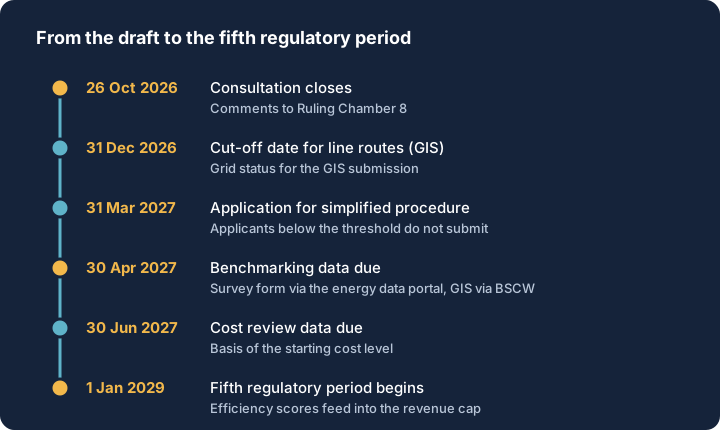
EEG and CHP figures will mostly not be audited by 30 April. The chamber accepts this and allows later corrections once the audited values exist; the draft sets no deadline for them and refers to the correction rules in operative part 4 of the methodology. That is sensible: waiting for audit certificates would push many plausibility checks back considerably, and according to the chamber most data will be in a form good enough for the audit by 30 April.
What is dropped and what is new
In places the form gets shorter, in others considerably longer. For area and population, the chamber cites high effort and little explanatory power in the last round; for the other deletions it gives no separate reason. Added are items that have become part of a distribution operator's job since then.
These new questions follow from a decision already taken. Under operative part 6.2 of the methodology, redispatch costs count as cost inputs in future, so they enter the benchmarking for the first time; how they are smoothed is left to a further determination that is still pending. The chamber wants volumes it can check those costs against. It also asks more about anticipatory grid expansion; the methodology wants to examine how its effect can be reflected in the comparison; the draft does not say which fields serve that purpose. The planning behind it sits in the grid expansion plan under Section 14d EnWG.

For the delivery, the new fields are the hardest part, since no historical values exist for them. On the procedure page, the chamber announces it will send “the majority” of operators a form pre-filled with their own data from the fourth-period benchmarking once the determination is final; operators that were not in the standard procedure back then have no such data. For redispatch measures, flexible connection agreements and the security deposit question, that field stays empty. Connection request figures mean querying the grid connection portal. The catalogue counts installations for which a connection request was “expressed” in 2026; whether that means an informal enquiry or a complete application, it does not define.
GIS data: line routes as a separate delivery
Alongside the form, the draft asks for the routes of the operator's own lines as at 31 December 2026, from extra-high to low voltage, as polylines in Shapefile, File Geodatabase or GeoPackage format with the EPSG code of the reference system. Positional accuracy must be within plus or minus three metres. Attributes such as line type and voltage level should primarily sit in the GIS; anything missing there may, by way of exception, come from other systems in supplementary tables, linked through a shared ID and reflecting the same data status. Manual edits without a “traceable technical basis” are not allowed.
Those files do not go through the energy data portal but through the BSCW server run by ITZBund, the federal IT service centre, a platform for secure file exchange. Each operator gets its own folder, open only to its authorised contact and the responsible unit at the agency; after transfer the data are deleted from the server, and no maps are published. Industry associations had stressed during the pre-test that these are data on critical infrastructure.

Officially, the GIS data serve “initially for plausibility checks” in this period and replace nothing in the form. We would still treat the delivery as seriously as the form itself. In the gas procedure a year earlier, Ruling Chamber 9 dropped the supplied-area question and announced it would derive a similarly defined area from the GIS data itself and test it as a cost driver. If Ruling Chamber 8 adopts that approach, a line layer with gaps in old cables or missing service connections can produce an area that is too small, and that shows up in the efficiency score.
Area and population: industry against the ruling chamber
The one real dispute in the data collection has already been fought out in gas, and it is coming back in electricity. Ruling Chamber 8 justifies dropping supplied area, the geographic area of supply and population with effort and effect: the question had led to “considerable cost and staff effort for network operators”, and “in the efficiency benchmarking for the fourth regulatory period the area parameters were insignificant” (draft determination BK8-26-04#13, para. 19, 5 October 2026, our translation).
In gas, the industry saw it differently. According to the summary of comments in gas determination BK9-25/603 of 6 March 2026, “the overwhelming majority” demanded that both stay: they were “central structural parameters”, dropping them risked “pre-empting the model parameters”, and without them no density parameter could be calculated. The chamber kept its decision and also rejected the idea of falling back on prior-year values, because that “would violate the base year principle” (our translation).
In gas, one more point came up that the electricity draft lacks. There, the agency had classed supplied area as a “priority 1 cost driver” in the fourth period, meaning one of the leading parameters for the extent of the service area, and Ruling Chamber 9 intends to keep testing it on the basis of GIS data. In electricity, two area items stay in the catalogue, the concession area and the geographic area of the network (parameters 96 and 97); the draft announces no GIS-based replacement for supplied area. Operators with large territories and sparse settlement, whose costs depend mostly on line length, have the strongest reason to comment: they can ask whether the remaining area items capture their service-area structure well enough.
Objections that still make sense
Objections to the model do not belong in this consultation. Which parameters end up as comparison parameters is, per para. 18, “not the subject of this determination”, and the minimum score, the reduction path and the methods have been fixed since December 2025. BDEW, VKU and GEODE made their case against the tighter reduction path (three years instead of the whole period) in August 2025; repeating it in a comment on the data catalogue only uses up space.
What counts now are definitions that do not fit the operator's own grid or cannot be filled without estimates. Four stand out when reading the catalogue:
- Metering locations for controllable consumption devices only count if they are assigned “exclusively” to the controllable device. Heat pumps and wallboxes that share a meter with the household drop out, even though they create the same control task in the grid.
- A redispatch measure covers all actions “without interruption in time” at the same bottleneck. Whether a call that runs across the turn of the year counts for 2026 is left open.
- Stock figures for connections of battery storage and consumers refer to 31 December 2025, movement data to the year 2026, almost all other stock values and the line routes to 31 December 2026. It is open how to count a connection requested and commissioned within 2026: as a request, as a new connection, or in both fields.
- The three-metre GIS requirement does not say how to handle legacy assets that were never surveyed.
Then there is the workload. Three submissions between 30 April and 30 June 2027 are a real capacity problem for an operator with a small regulatory team, and the chamber writes that it is aware of “the high burden”. A concrete proposal, such as delivering the GIS data later than the form, stands a better chance than a general complaint about the date. Operators that do not want to write their own comment can feed their points in through their association.
What happens when the deadline passes
For the consultation itself, nothing. Commenting is voluntary; an operator that sends nothing by 26 October simply does not get its objections into this procedure. Only the final determination makes the data scope binding; the chamber has not given a date for it.
The data submission afterwards is a different matter. The draft refers to Section 95(1) no. 3(a) EnWG, under which missing or incorrect information is an administrative offence, and to penalty payments under Section 94 EnWG. Economically, the methodology weighs more: if no efficiency score can be determined for an operator because it did not supply its data, operative part 14 applies the minimum score of 70 percent. For individual missing data, operative part 4.2 also lets the agency use prior-year values or estimates.
What operators get done before spring
A little over six months lie between 26 October and 30 April. Whatever inventory goes into the comment also prepares the submission.
Five steps to submission
-
By 26 October: read Annex V1 with four departments
Grid operations, regulation, GIS and billing go through Annex V1 together and note every definition they cannot fill unambiguously for their own grid. That list becomes the comment, sent directly or through the association.
-
By end of November: name one owner and one source system per parameter group
Connection points and metering locations come from billing, circuit lengths and line routes from the GIS, load values from the control system, redispatch from redispatch settlement, connection requests from the connection portal.
-
Before 31 December 2026: prepare the GIS cut-off date
Settle export format and EPSG code, define an ID scheme for supplementary attributes and list the known gaps in legacy assets before the date arrives.
-
Run a trial with 2025 data in the first quarter of 2027
A trial run shows where figures are missing; the new fields can only be filled on a test basis. Once the pre-filled form arrives, check against it. Values should match those produced at the same time for the quality element and the cost review.
-
By end of March: check access
Energy data portal with its encryption tool, an authorised contact for the BSCW server and a deputy who can submit in April.
Operators close to the threshold also decide by 31 March 2027 whether to apply for the simplified procedure. How regulatory dates like these turn into a running work plan at a grid operator is described on our page on regulatory implementation for grid operators. More articles are collected in the topic area grid and low voltage.
Deadline, market roles, systems
26 October 2026Electricity efficiency benchmarking: data collection consultation closesConsultation · open
Applicability: Electricity DSOs in the standard incentive regulation procedure; the simplified procedure may differ.
If the deadline is missed: No direct legal consequence Commenting is voluntary. Operators that do not comment by 26 October 2026 do not bring their objections into this procedure; which data must be supplied only becomes binding with the final decision. Legal basis ↗
- Electricity grid operatoraffectedCan comment on the data catalogue until 26 October and checks which systems the data come from.Typically affected: Regulatory management, controlling, Grid planning, GIS, load flow, SAP IS-U / S/4HANA Utilities
A classification for typical market roles, not a review of your individual case and not legal advice. Whether an obligation applies to your company (thresholds, exemptions) is for your legal department or counsel to confirm. The calendar doesn't replace your own deadline review. Information as of: 18 October 2026.
Further reading
Frequently asked questions
It is the nationwide cost comparison of electricity distribution system operators in the standard procedure of German incentive regulation. The Federal Network Agency compares each operator's costs with its supply task and derives an individual efficiency score using DEA and SFA. The score sets the efficiency target in the revenue cap for the regulatory period.
Comments on the draft determination BK8-26-04#13 must reach the Federal Network Agency by 26 October 2026, by email to Poststelle.BK8@BNetzA.de and evs@bnetza.de with the subject line “Festlegung Datenerhebung Effizienzvergleich”. The agency intends to publish the comments.
According to the draft, every electricity distribution system operator that is neither in the simplified procedure nor a micro operator. They submit their 2026 financial year data by 30 April 2027 through the energy data portal. Closed distribution systems are exempt; operators overseen by a state regulator may face a different deadline for the simplified-procedure application.
The routes of the operator's own lines as at 31 December 2026, as polylines per voltage level, in Shapefile, File Geodatabase or GeoPackage format with the EPSG code and a positional accuracy of plus or minus three metres. Attributes such as line type and voltage level link to the lines through a shared ID. Files go through the ITZBund BSCW server.
Among other things, the supplied area, population figures, network transfers during the base year, the question on EEG audit certificates, and some items on simultaneous feed-back and withdrawal and on customer types of metering locations. Concession area and the geographic area of the network remain in the catalogue. Maximum curtailed generation capacity is requested in a much coarser form.
Commenting in the consultation is voluntary. For the data submission itself, the draft points to fines under Section 95(1) no. 3(a) EnWG and penalty payments under Section 94 EnWG. If no score can be determined because the operator did not cooperate, the methodology applies the minimum score of 70 percent.
Let's collaborate
One contact, a team behind it
Thirty minutes on what you're working on, whether grid, metering, market processes, IT architecture or AI. Afterwards you'll know how we'd approach it and who would sit at the table.
Energy and measurement technology since 2010 · innobu GmbH since 2014 · Based in Schleswig-Holstein, Germany
Whoever pitches also delivers: whoever leads the first call stays your contact right through to the steering committee, with established partners in the project. Direct: info@innobu.com