NEST Gas: the rate of return is one parameter, the rulebook is being swapped
This article covers what NEST is, what RAMEN Gas and GasNEF put in place of the two ordinances, why the 2025 base year is already closed, and what a gas distribution grid operator can still influence.
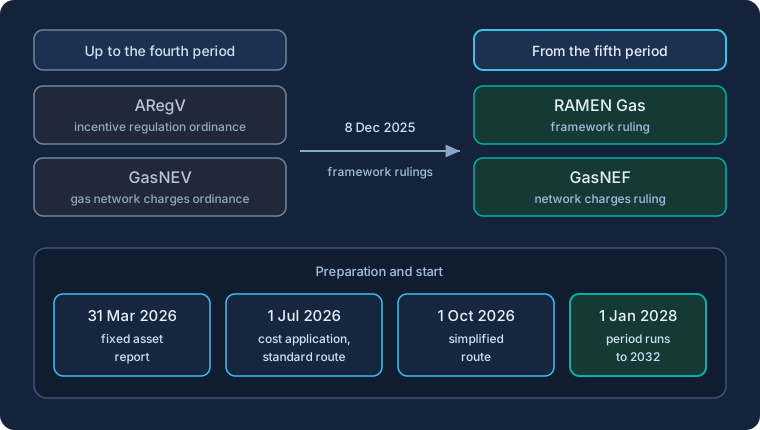
NEST stands for grids that are efficient, secure and transformed, and it is the process through which the Bundesnetzagentur has reworked cost regulation since February 2024; its output for the gas side are the rulings RAMEN Gas and GasNEF, and they apply from 1 January 2028. The framework rulings are dated 8 December 2025 and come from procedures GBK-25-01-1 for electricity and GBK-25-01-2 for gas. For the fifth regulatory period, which runs from 2028 to 2032 in gas, the legal basis is therefore no longer the incentive regulation ordinance and the gas network charges ordinance but these two rulings. The base year of the cost review is 2025 and the reference window covers 2023 to 2025. The fixed asset report fell due on 31 March 2026, the cost application on 1 July 2026 in the standard procedure and on 1 October 2026 in the simplified one. Because the review runs under the new legal basis, earlier review results do not carry over automatically. The Bundesnetzagentur also lists as key points that inefficiencies are to be worked off over three years instead of five, and that the return on equity moves to an international WACC model.
What NEST is
There was a concrete reason. The incentive regulation ordinance comes from a time when gas grids grew and power grids were administered. Neither holds any more.
What the Bundesnetzagentur lists as key points sounds like fine tuning at first: incentive regulation stays in place for all gas grid operators and electricity distribution operators, the regulatory period is shortened only from the period after next, inefficiencies are to be worked off over three years rather than five, and the return on equity moves to an international WACC model. Electricity distribution operators also get a revenue uplift of 1.4 percent, which the authority itself calls the NEST effect.
President Klaus Müller summed it up at the launch by saying cost regulation was being made more effective, simpler and above all less bureaucratic. Whether that holds for an individual application is decided in the review now under way.
What RAMEN Gas and GasNEF replace
Up to the fourth regulatory period, the rules for the revenue cap, the cost review and the efficiency benchmark sat in two ordinances: the incentive regulation ordinance and the gas network charges ordinance. For the fifth period they follow from two rulings of the Bundesnetzagentur.

In practice that means review questions settled over four periods are no longer answered in advance. BET Consulting puts it plainly. Under the new legal basis every cost item goes back on the table in full. Review steps and matters examined in the past are not necessarily taken over again.
Then the second observation from the same source: the room for discretion comes out noticeably smaller than before. Anyone who planned on regulation applied with a sense of proportion should take that assumption out of the model.
All of this reaches well past the rate of return. How the flat rate is derived and what the draft of 3.76 percent does to the revenue cap is covered in the article on the gas rate of return from 2028.
The base year is behind us
Base year 2025. One financial year sets the starting level for five years of revenue cap, and the reference window reaches back to 2023.
That is the uncomfortable side of this deadline. Discover it now and you discover it late.
All the 2026 deadlines have passed: fixed asset report on 31 March, cost application on 1 July in the standard procedure, 1 October in the simplified one. Whatever those files say carries the period.
Plenty remains open all the same. Follow-up questions from the authority, the quality of the reasoning in the accompanying report, the evidence behind contested items, and whether a given item is recognised as permanently non-controllable. That is where the application holds or does not.
Getting efficient faster
One key point from the NEST release deserves more attention than it got: inefficiencies are to be worked off over three years rather than five.
Arithmetically that is the same reduction in less time. An operator whose efficiency score sits below the benchmark has to close the gap faster. Annual burden up, total unchanged.
Shortening the regulatory period itself comes only from the period after next, according to the same release. For the faster efficiency path the authority states no such limitation. How both key points apply per period follows from RAMEN Gas rather than from a press release. This is the point where reading the ruling beats reading the summary.
Two readings of the change
Whether moving from ordinances to rulings is a break or a continuation gets two answers.
Both hold, depending on where you look. Look at the procedure and you see continuity. Write the cost application and you see the hole that four periods of review history leave when they no longer count.
What to do now
Some fifteen months remain until the start. The work sits in the running procedure, no longer in filing the application.

Four steps before the period starts
-
Go through your own review history
Which cost items were recognised in past periods, and on what reasoning? Those items are the risk list, because their recognition no longer follows from the past. A company that knows its contested points can prepare them. A company that finds them in the follow-up question answers under time pressure.
-
Pull up the evidence behind those items
Not the booking, the derivation. What prompted it, what the alternative was, why this amount.
-
Put the faster efficiency path into the medium-term plan
If the reduction runs over three years rather than five, the annual burden shifts noticeably forward. Model both variants while the benchmark result is still open, and know the score at which it gets tight.
-
Read RAMEN Gas itself, not the summary
The key points in the press release do not answer what applies to whom from when. That sits in the ruling, and the differences to the old ordinance are the actual work package for regulatory management.
Further reading
Frequently asked questions
What is NEST?
NEST stands for grids that are efficient, secure and transformed. It is the process through which the Bundesnetzagentur has reworked cost regulation for electricity and gas grid operators since February 2024. Its output is a set of framework rulings dated 8 December 2025, in procedures GBK-25-01-1 for electricity and GBK-25-01-2 for gas. They are the basis for the fifth regulatory period, which starts on 1 January 2028 for gas and 1 January 2029 for electricity.
What do RAMEN Gas and GasNEF replace?
They take the place of the incentive regulation ordinance and the gas network charges ordinance. Up to the fourth regulatory period, the rules for the revenue cap, the cost review and the efficiency benchmark sat in those two ordinances. For the fifth period they follow from the two rulings of the Bundesnetzagentur. Incentive regulation as a system stays, the legal basis underneath it is a different one.
Which base year applies to the cost review?
The base year is 2025 and the reference window covers 2023 to 2025. Every cost item of that single financial year sets the starting level of the revenue cap for the whole period. The fixed asset report was due on 31 March 2026, the cost application on 1 July 2026 in the standard procedure and on 1 October 2026 in the simplified one.
Do earlier review results carry over?
Not automatically. Because the review runs under the new legal basis, BET Consulting expects every cost item to go back on the table in full. Review steps and matters examined in the past are not necessarily taken over again, and the authority's room for discretion comes out smaller than operators are used to.
What does NEST change about efficiency incentives?
The Bundesnetzagentur lists as a key point that inefficiencies are to be worked off over three years instead of five. The pressure from a weak efficiency score therefore spreads over fewer years. Shortening the regulatory period itself comes only from the period after next, according to the same release. How each key point applies per period follows from RAMEN Gas.