Grid connection portal duty under Section 8(7) EEG: the digital connection from 2025
Since 1 January 2025, Section 8(7) EEG has pushed every grid operator into a web portal and shortened the deadlines for small systems.
The duty sounds technical, but its core is practical: faster connections, clear deadlines and a deemed-approval rule that sits on the operator's neck. The political frame of the acceleration sits in the piece on the 2026 grid package and flexible grid connections, the processes after connection in the piece on GPKE and feed-in processes.
Since 1 January 2025, Section 8(7) EEG requires every German grid operator of general supply to provide a real web portal for grid connection requests. It covers renewable and CHP systems up to 30 kW on an existing house connection, the classic rooftop case for a private home. A fillable PDF download does not meet the duty. The real lever, though, is not the portal but the deadlines: for small systems the operator's response window shrinks from eight weeks to one month. If the operator stays silent, a deemed-approval rule takes effect and the system may be connected without its approval. The reason for the duty is sheer volume: in 2024, more than 1.09 million new PV systems came online, plus around 1.2 million registered balcony solar units by early 2026. The rule solves one problem and creates another, because each of the roughly 866 distribution grid operators builds its own portal. A binding technical standard is missing, there are only recommendations from BDEW and VDE FNN. For installation firms working nationwide that means many masks, logins and data formats. The Bundesnetzagentur can enforce the portal duty with an order and penalty payments, and system owners can start an abuse procedure and claim damages under Section 280 ff. of the German Civil Code. For operators the duty is long since in force, the open question is the quality of the implementation.
What Section 8(7) EEG requires since 2025
Every grid operator of general supply must, since 1 January 2025, provide a digital web portal through which connection requests for renewable and CHP systems can be submitted. The legislator wants to clear the bottleneck for connecting small systems. A static PDF download does not meet the duty.
The use case is narrow and hits exactly the mass market: the system up to 30 kW on an already existing grid connection, the typical rooftop photovoltaic install on a private home. Alongside the portal, an information duty applies on the website, and the Bundesnetzagentur lists four points for it.
The duty does not stand alone. It is the second step of a sequence: Section 14e EnWG has required the fully digital connection process for consumption facilities since 1 January 2024. Section 8(7) EEG followed a year later for generation systems. Both were triggered by Solar Package I, which took effect on 16 May 2024.
The deadlines and the deemed-approval rule
The real lever sits not in the portal but in the deadlines. For systems up to 30 kW, Section 8(7) EEG shortens the operator's response window from eight weeks to one month. And if that response fails to arrive, the system may go on the grid anyway.
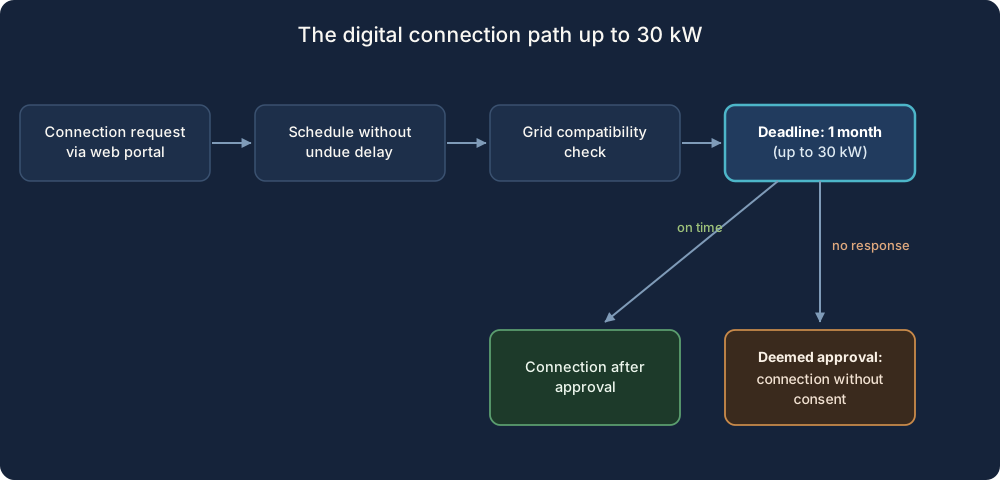
The sequence is staged. After the connection request, the operator must send a schedule of the individual work steps without undue delay, set out in Section 8(5) EEG. For the actual grid compatibility check and the cost estimate it then has one month for systems up to 30 kW, and eight weeks for larger ones.
The easing reaches beyond the smallest class. Solar systems from 30 to 100 kW may also be connected if the operator does not state within eight weeks that the connection is not yet technically suitable. That shifts the balance noticeably: an operator who stays silent loses control over the timing.
Why the duty arrives now
The digitalization is a response to sheer volume. The build-out of small systems has reached a scale that files and email inboxes can no longer handle. The law draws the consequence from a number that broke the million mark for the first time in 2024.

In 2024, more than 1,098,825 new PV systems came online, a record. By early 2026, around 1.2 million registered balcony solar units had been added, and cumulative PV capacity reached about 117 gigawatts at the end of 2025. Every one of these systems needs a connection, and according to an industry report the whole path from inquiry to commissioning took three to six months for around 60 percent of residential PV, often with the grid operator as the bottleneck.
How hard the build-out stresses distribution grids overall is shown in the piece on the Digital Grid Insights on distribution grid digitalization. The digital connection process is only one building block, but one that touches every single system owner directly.
The flip side: 866 portals instead of one standard
The duty solves one problem and creates another. Each grid operator builds its own portal, often bought from different service providers. For installation firms working nationwide that means many different masks, logins and data formats for the same procedure.

A binding technical standard is missing. There are recommendations from BDEW and VDE FNN on the data sets, but no single interface format that every portal would have to implement. On top of that, installers must be listed in the installer register of the respective grid operator, sometimes via a guest entry, before they can even file a request.
The BDEW guideline on implementing Section 6 and Section 19 NAV and Section 8(7) EEG is meant to at least align the formats. It is orientation, not a norm. As long as implementation stays the job of each individual operator, the fragmentation stays too. That is the price of a rollout that obliges 866 organizations at once without giving them a shared system.
What happens on a breach
The duty is not a soft appeal. If an operator provides no usable portal or misses the deadlines, several levers apply at once, on the supervisory side and on the side of the system owners.
- The Bundesnetzagentur can issue an order and impose penalty payments to enforce the provision of the portal.
- Connecting parties can start an abuse procedure if the operator breaches its duties.
- Missed deadlines can trigger damages claims under Section 280 ff. of the German Civil Code, for example for lost feed-in payments.
- Interim legal protection is possible under Section 83 EEG when the connection is urgent.
In practice the deemed-approval rule is the sharpest of these levers, because it works without any procedure. The system owner does not have to sue, it may simply connect after the deadline. That moves the pressure to where it bites: the operator's internal processing speed.
What grid operators should do now
For operators the duty is long since in force, the open question is the quality of the implementation. A portal that only mirrors a form meets the letter but not the purpose. Four steps make the difference between compliance and a working process.
- Align the portal with the data sets: Build the web portal around the data-set recommendations from BDEW and VDE FNN so installers find recurring fields and formats instead of guessing anew in every grid area.
- Automate deadlines in the backend: Model deadline tracking and the deemed-approval rule technically in the system, not in manual follow-up, because a missed one-month deadline automatically works in favor of the system owner.
- Connect the interfaces: Link the portal to your own market communication and to the installer register so connection requests, guest entries and follow-up processes mesh without a media break.
- Measure the process, not the form: Keep the actual processing time up to 30 kW under one month and measure it, instead of meeting the deadline only on paper, because that is where the connection wave either drains or piles up.
Further reading
Frequently asked questions
Since 1 January 2025, every German grid operator of general supply must provide a web portal through which connection requests for renewable and CHP systems up to 30 kW can be submitted. A fillable PDF download does not meet the duty. In addition, operators must publish information on their website about the processing steps, the details applicants must provide, the costs and the required equipment. For systems up to 30 kW on an existing house connection the response deadline shortens to one month.
For systems up to 30 kW on an existing grid connection, a shortened deadline of one month applies instead of the usual eight weeks. Within that time the operator must report the result of the grid compatibility check and a cost estimate. Before that, it must send a schedule of the individual work steps without undue delay.
If the operator does not respond on time, a deemed-approval rule applies: a system up to 30 kW may be connected without explicit approval and without the operator being present. For solar systems from 30 to 100 kW an easing applies if the operator does not object within eight weeks. Missed deadlines can also trigger damages claims under Section 280 ff. of the German Civil Code.
No. A fillable PDF download does not satisfy the duty under Section 8(7) EEG. What is required is a real web portal through which connection requests are submitted online and information is exchanged. The Bundesnetzagentur can enforce provision with an order and penalty payments, and connecting parties can start an abuse procedure.
Grid operators should align their portal with the data-set recommendations from BDEW and VDE FNN so installers find recurring formats. Deadline tracking and the deemed-approval rule belong in the backend, not in manual follow-up. Interfaces to their own market communication and to the installer register should be automated. Above all, the one-month deadline for systems up to 30 kW must be kept in practice, not just on paper.
Let's collaborate
One contact, a team behind it
Thirty minutes on what you're working on, whether grid, metering, market processes, IT architecture or AI. Afterwards you'll know how we'd approach it and who would sit at the table.
Energy and measurement technology since 2010 · innobu GmbH since 2014 · Based in Schleswig-Holstein, Germany
Whoever pitches also delivers: whoever leads the first call stays your contact right through to the steering committee, with established partners in the project. Direct: info@innobu.com