
Publishing 2027 network charges: what has to be ready by 15 October
This article sets out the publication duty under section 20 EnWG for delivery year 2027: what the rule actually demands, which two items make this year's calculation wobble, and how a distribution operator can publish provisional charges that suppliers in the network area can still work with.
The publication duty under section 20 (1) of the German Energy Industry Act is the obligation on every electricity and gas network operator to publish next year's network access charges online immediately once calculated, and by 15 October at the latest. If they are not calculated by then, sentence 2 requires the level expected to result from the revenue cap. For delivery year 2027 the deadline meets two open items: the subsidy for transmission network costs of roughly 5.5 billion euros was only a cabinet decision on 2 September 2026, down from 6.5 billion in 2026, and avoided network charges fall by another 50 percent on 1 January 2027. Most distribution operators will therefore publish provisional figures. That is allowed, but it needs a caveat naming which item is open and when it will be settled, because every supplier in the network area has to calculate by mid-November for a price change on 1 January.
What 15 October demands
The rule allows no leeway. Section 20 (1) sentence 1 EnWG requires network access charges to be published immediately once calculated, and by 15 October of each year at the latest for the following year. An operator who has not finished calculating publishes, under sentence 2, the level expected to result from the revenue cap applicable for the following year. There is no third option.
What gets published is more than a single number. Section 27 StromNEV requires operators to publish the applicable charges on their website and to provide them to anyone on request, immediately, in text form. That means the complete price sheets for withdrawal with and without metered demand. Individual network charges under section 19 StromNEV belong in the same publication and have to be notified to the regulator.
If network access charges have not been determined by 15 October of a year, operators of energy supply networks publish the level of charges that is expected to result on the basis of the revenue cap applicable for the following year.
So nothing about the deadline is new. What is new is how much of it will still be open this year.
Why the 2027 calculation is harder than usual
Two items that move the charge level noticeably are unsettled on the cut-off date. One is federal politics, the other a ruling made long ago that only now starts to hurt.
The subsidy first. On 2 September 2026 the cabinet adopted a draft law amending the Energy Industry Act to grant a subsidy for transmission network costs for 2027 to 2029. The plan is roughly 5.5 billion euros a year, after 6.5 billion in 2026. That is about 15 percent less. The subsidy lowers transmission charges, and those enter every distribution calculation as upstream network costs. On the cut-off date the law will probably not have been promulgated.
The current year shows how strong the lever is: 6.5 billion euros pushed the extra-high-voltage charge from around 6.65 down to 2.86 cents per kilowatt hour, a drop of 57 percent. Network charges overall fell by 17.6 percent in 2026. Exactly that relief will be smaller in 2027.

The second item is avoided network charges. The Bundesnetzagentur ruled on 18 February 2026 to abolish them: half went in mid-2026, another 50 percent goes at the start of 2027, a quarter remains in 2028, and the rule ends in 2029. The regulator puts the annual relief at around 1.5 billion euros.
For a municipal utility with its own combined heat and power plant this lands on both sides at once. Generation loses revenue, and the credits in the network calculation shrink. If both sit in the same company, be careful not to count the effect twice.
A third point is no longer a risk but a closed door: applications for the 2027 capital cost surcharge were due by 30 June 2026. Whoever missed it calculates 2027 without one. None of this says anything about the rate of return for the coming regulatory period, which is set in separate proceedings and takes effect later, as the gas WACC from 2028 shows.
The chain to 1 January 2027
15 October is not a standalone date. It is the middle link of a chain that starts two weeks earlier and only ends on 1 January, and every link depends on the one before it.
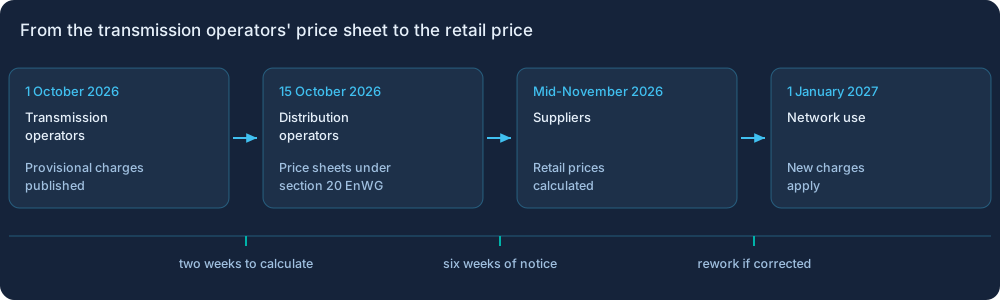
Germany's four transmission system operators traditionally publish their provisional charges on 1 October, as one nationwide price sheet. That leaves a distribution operator barely two weeks to work the upstream costs into its own calculation and put the price sheets online.
Then it is the suppliers' turn, and they carry their own lead times. In basic supply, general prices have to be announced publicly six weeks before they take effect. For negotiated contracts, section 41 EnWG requires one month of notice in text form, including the scope, the reason and the conditions of the change.
Counting backwards: anyone who wants to adjust prices on 1 January 2027 needs reliable network charges by mid-November. That is the real rhythm behind 15 October.
A network charge corrected after the fact costs you an hour. It costs every supplier in your network area a second pricing round, with a right of termination and retroactive billing attached.
Publish provisionally, but cleanly
Most distribution operators will publish provisional charges on 15 October 2026. That was the norm in earlier years and it is legally fine. The care simply shifts from the figure to the caveat.
A caveat that says only "subject to change" helps nobody who has to calculate with it. It becomes useful when it names three things: which item is open, what it depends on, and when it should be settled. "These charges include the planned subsidy for transmission network costs; the law had not been promulgated on 15 October" is a statement a supplier can work with.
| Element | Not enough | Works |
|---|---|---|
| Status | A price sheet with no marking | "Provisional" in the file name and in the header of every price sheet |
| Reason | "Subject to change" | The open item named, for instance the transmission cost subsidy |
| Timing | No date | Date of issue plus the announced date of the final version |
| Placement | A footnote somewhere in the download area | The caveat on the same page as the price sheet |
| Follow-up | Swapped in whenever someone next looks | Suppliers actively told about every change |
One more thing. The figure under sentence 2 is the expected level derived from the revenue cap, not a non-binding estimate. The difference is not a formality. It decides whether a supplier may put the number into its own calculation.
Where the associations disagree
Hardly anyone in the industry argues about the subsidy itself. About the timetable and about avoided network charges, plenty of people do, and the two disputes are running at the same time.
The BDEW welcomes the subsidy continuing and pushes hard on timing: the provision has to pass the Bundestag as soon as possible, because electricity suppliers need to be able to pass the relief on to customers from 1 January 2027. If the procedure slips, the association warns, the pass-through turns inefficient and legally uncertain. Translated: every week the law arrives later shifts work into the network companies and the retail arms.
In the second dispute the two positions face each other more squarely. The Bundesnetzagentur treats avoided network charges as a subsidy with no present justification and puts the relief for network customers at around 1.5 billion euros a year. The VKU disagrees: for operators of decentralised, controllable plants, and above all for municipal combined heat and power, avoided network charges were an important part of the financing, and losing them means substantial revenue shortfalls.
Both are right, just not about the same thing. The regulator is counting network costs across all customers; the association is counting the revenue of one plant class. That contradiction does not get resolved in the calculation. It ends up inside it. If you are pricing in the 2027 step, show the effect on your own generation separately rather than netting it against the relief to network customers.
A third debate, the reform of the charging system itself, does not end that day. The consultation on AgNeS ran to 18 September 2026, the ruling is due in 2026 and the new system applies from 1 January 2029. It does not touch delivery year 2027, but it occupies the same people through the autumn.
What this means for the systems
The real work rarely sits in the calculation spreadsheet. It sits in the maintenance afterwards. New prices have to reach the billing system, market communication and every channel market partners collect them from. Each route carries its own failure mode.

A transposed digit between the price sheet PDF and the system master data usually surfaces in the January billing run. By then the invoices have gone out.
- Billing: create the new price records effective 1 January 2027 and keep the old ones for retroactive calculations
- Market communication: charges reach suppliers through the invoicing processes, so a mid-year change produces correction runs
- Website: the published PDF is the authoritative version, not the table on the intranet
- Special cases: individual charges under section 19 StromNEV and arrangements from the industrial network charges reform belong in the same check
Run the consistency check between PDF, system master data and the data pushed to market partners before 15 October, not after. It costs half a day and saves several in January.
What to do now
Four weeks are enough. What matters is preparing for the 1 October dependency rather than waiting for it.
Six steps to the deadline
-
Finish the model now
Set up the calculation so that on 1 October only the upstream costs have to be dropped in. Building the model that morning burns half the remaining time on formatting.
-
Run two scenarios
One with the planned subsidy, one without it or with it delayed. The gap between them is the range your caveat has to describe. It is also the number your management will ask for.
-
Agree the caveat wording in advance
Between grid economics, legal and communications, and now rather than on 14 October.
-
Give the follow-up a name and a date
A provisional charge that never gets replaced by a final one is the most common quiet failure in this process. A named person and a calendar entry prevent it more reliably than good intentions.
-
Warn the suppliers
A short note to every supplier in the network area saying that 15 October brings provisional figures and when the final ones are due. One email, twenty questions avoided.
-
Schedule the consistency check
Price sheet, billing system, market communication, checked by two pairs of eyes. As its own task with its own date, not an afterthought to the calculation.
The regional spread stays whatever you do: in 2026 household charges ran from 7.23 cents per kilowatt hour in Mecklenburg-Western Pomerania to 11.80 cents in Hamburg. Your customer will still expect the explanation from you rather than from Berlin.
Further reading
Frequently asked questions
What is the network charge publication duty under section 20 EnWG?
Section 20 (1) sentence 1 of the German Energy Industry Act requires operators of energy supply networks to publish network access charges online immediately once calculated, and by 15 October at the latest for the following year. It covers electricity and gas networks and returns every year.
What applies if the charges are not finished on 15 October?
Sentence 2 takes over. The operator publishes the level of charges that is expected to result from the revenue cap applicable for the following year. There is no version of the rule in which nothing appears on the website on 15 October.
Why is the 2027 calculation harder than usual?
Two items are still open on the cut-off date. The subsidy for transmission network costs for 2027 to 2029 was a cabinet decision on 2 September 2026 and has not been promulgated; the plan is roughly 5.5 billion euros a year after 6.5 billion in 2026. At the same time avoided network charges drop by another 50 percent on 1 January 2027.
When do suppliers need the charges at the latest?
Counting back from a price change on 1 January 2027: mid-November. In basic supply, general prices have to be announced publicly six weeks before they take effect, and section 41 EnWG requires one month of notice in text form for negotiated contracts.
How much of a German electricity bill is network charges?
For households they stood at 9.26 cents per kilowatt hour in 2026, or 24.8 percent of the electricity price. The spread between federal states ran from 7.23 cents in Mecklenburg-Western Pomerania to 11.80 cents in Hamburg.
What happens when a provisional charge is corrected later?
The operator publishes the change immediately once the charge is calculated. Every supplier in the network area then has to recalculate, and price changes already sent out can trigger a second round with a right of termination and retroactive billing. That is why a provisional publication needs a date for the switch to final values.