OCPP 2.1 Becomes IEC 63584-210: Smart Charging and V2G Control for Grid Operators
OCPP 2.1 has been officially published as IEC 63584-210 since December 2025. This makes the V2G-capable version of the charging protocol available as an international standard for the first time. This article sorts the new functional blocks for bidirectional charging, DER control and smart charging, and explains why standardized controllability matters for implementing section 14a EnWG in the distribution grid.
OCPP 2.1 was published on 9 December 2025 as IEC 63584-210:2025, with the European version following as EN IEC 63584-210:2026. The Open Charge Point Protocol governs the communication between the charging backend and the charge point, and is now available as a formal standard for the first time in its V2G-capable version. Three functional blocks stand out: bidirectional charging based on ISO 15118-20, a DER control interface for distributed energy resources, and more precise smart charging modes with a dynamic control mode. For grid operators, standardized controllability is the point. Since 1 January 2024, charging equipment above 4.2 kW must be controllable under section 14a EnWG, with the dimming signal running via the smart meter gateway to the energy management system and on to the charge point via OCPP. In Germany, the Bundesnetzagentur counted about 203,951 public charge points on 1 May 2026, a 17 percent rise. The standard does not solve everything: TLS 1.2 as a minimum, older 1.6 hardware and inconsistent implementations remain open points. The basis is in place, the payoff comes from control.
OCPP 2.1 becomes an international standard
OCPP 2.1 has been officially published as IEC 63584-210:2025 since 9 December 2025, with the European version following as EN IEC 63584-210:2026. The Open Charge Point Protocol governs the messages between the charging backend, the Charging Station Management System (CSMS), and the charge point. For the first time, this communication is available as a formal international standard in its V2G-capable version.
The Open Charge Alliance had already released OCPP 2.1 as a specification in January 2025. Its predecessor 2.0.1 had been standardized as IEC 63584 since October 2024. OCA CEO Lonneke Driessen frames the move into the IEC catalogue as a step toward convenient, efficient and secure charging. The practical value of a standard lies elsewhere: it brings conformance testing and reduces the risk of locking into a single vendor.
What OCPP 2.1 adds technically
OCPP 2.1 extends version 2.0.1 with several functional blocks that matter for grid integration. The most important is bidirectional charging based on ISO 15118-20, which turns a vehicle into a controllable energy source. It adds more precise smart charging modes and an interface for distributed energy resources. The mechanics of bidirectional charging are covered in more detail in the piece on bidirectional charging under the MISPEL metering concept.
| Functional block | What it does | Grid benefit |
|---|---|---|
| Bidirectional charging | Charge and discharge schedules via ISO 15118-20 (V2X) | Vehicle becomes a controllable store, feed-in to the grid |
| DER control | Integration of distributed resources such as PV and storage | Charge point as part of a local energy system |
| Smart charging | Dynamic and scheduled control mode, finer load profiles | Load balancing at a limited grid connection |
| Battery swapping, authorization | New flow for swap stations, more authorization options | Broader use cases, including fleets |
In the dynamic control mode, the charging station gets full control over the power drawn, with the backend setting only the frame. This mode is tailored to the requirements of ISO 15118-20 and lets charging adapt automatically to a shifting grid situation. Important for the installed base: OCPP 2.1 builds on the 2.0.1 message architecture and is backward compatible.
What it means for grid operators and section 14a EnWG
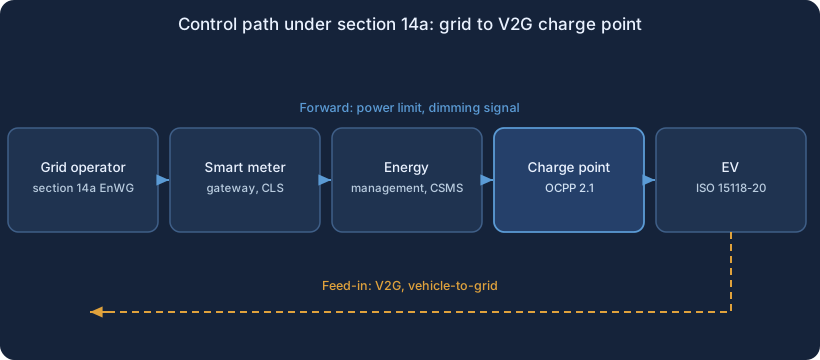
For grid operators, standardized controllability is the core. Since 1 January 2024, new charging equipment above 4.2 kW must be controllable under section 14a of the German Energy Industry Act (EnWG), and in return grid fees fall. The operator does not access the wallbox directly. It sends a dimming signal via the smart meter gateway to the energy management system, which passes the power on to the charge point via OCPP.

OCPP 2.1 provides the standardized messages for this path. Power limits and load profiles can now be set across vendors, instead of patching them through proprietary interfaces. In Germany, the VDE application rule VDE-AR-N 4100:2026-04 has governed the implementation of controllability since April 2026. How that controllable access works through the control box in practice is shown in the piece on the control box and grid control under section 14a. On the building side, the standard meshes with home energy management, described in the article on EEBus and HEMS under IEC 63380. How many charging points a building must provide in the first place is set by the GEIG amendment.
Smart charging and V2G control in practice
Two control modes do the work, the dynamic one and the scheduled one. With them a backend distributes charging power finely and triggers bidirectional sessions. At a site with a tight grid connection, that means load management instead of reinforcement. Elsewhere it means targeted feed-in to the grid. Many vehicles turn into one distributed store that grid operators and aggregators use for flexibility.

The step from the revenue market to grid control is fluid. An aggregator bundles many vehicles into a virtual store and sells flexibility. The grid operator, meanwhile, sets local limits. The business models that follow are sorted in the piece on V2G and digital business models under the EnWG. OCPP 2.1 is the standardized layer beneath both. Both roles speak the same messages.
The standard alone moves no electron. It delivers value only when a backend plans charge and discharge schedules across many charge points wisely. The edge sits not in the protocol, but in the schedule.
Challenges and risks
The standard does not solve everything. Standards stay fragmented, the protocol gets read differently across vendors, and the test cases have gaps. Interoperability stays hard work. And security? Still an open point.
One point is often underestimated. Controlling V2G takes more than OCPP. A suitable metering concept. Clear market roles. A remuneration model that is still maturing. And the TLS 1.2 minimum is a starting point, not a target. How charging infrastructure can be secured is covered in the piece on the BSI minimum requirements for the IT security of charging infrastructure.
What companies should do now
Grid operators and charge point operators should anchor OCPP 2.1 in procurement and roadmap without overstretching the installed base. The key is to test standardized controllability early and to set security above the minimum. Four steps help.
-
Set OCPP 2.1 as the target standard
Align tenders and procurement to OCPP 2.1 and require support for ISO 15118-20. That way V2G capability is not left to chance.
-
Assess the installed base honestly
Check which devices speak 2.0.1 and can be upgraded via firmware. Pure 1.6 hardware needs a replacement plan, not an upgrade promise.
-
Test the section 14a control path
Run the route from the smart meter gateway through the energy management system to the charge point on real hardware before it is needed in the field. Only then does it show whether the power limit arrives cleanly.
-
Set security above TLS 1.2
Establish certificate management and harden the transport security. The standard's minimum is a floor, not a goal.
Further reading
Frequently Asked Questions
OCPP 2.1 is the 2025 version of the Open Charge Point Protocol, which governs the communication between the charging backend (CSMS) and the charge point. It extends OCPP 2.0.1 with functional blocks for bidirectional charging (V2X), DER control and more precise smart charging modes, and it is backward compatible with 2.0.1.
IEC 63584-210 is the international standard under which OCPP 2.1 Edition 1 was published. The Open Charge Alliance and the IEC released it on 9 December 2025 as IEC 63584-210:2025, with the European version as EN IEC 63584-210:2026. This makes the protocol available as a formal standard for the first time in its V2G-capable version.
OCPP 2.1 introduces a dedicated functional block for bidirectional charging and supports ISO 15118-20. The backend can set charging and discharging schedules and trigger feed-in to the grid. A dynamic control mode gives the charging station control over the power drawn. This turns the vehicle into a controllable store for vehicle-to-grid.
Since 1 January 2024, new charging equipment above 4.2 kW must be controllable by the grid operator under section 14a EnWG. The operator sends a dimming signal via the smart meter gateway to the energy management system, which passes the power limit to the charge point via OCPP. OCPP 2.1 provides the standardized messages for power limits and load profiles.
Yes. OCPP 2.1 builds on the 2.0.1 message architecture and is backward compatible. Hardware that already speaks 2.0.1 can be upgraded to 2.1 via firmware. Devices that support only OCPP 1.6 are excluded and have to be replaced to use the new V2G and smart charging features.