GEIG Amendment 2026: the new building charging obligation from the EPBD
The German Building Electromobility Infrastructure Act is being tightened to transpose the new EU buildings directive. Cabinet, Bundestag and Bundesrat moved the amendment forward in 2026, and the duties apply from 2027. This article shows which thresholds apply to new builds, renovations and the existing stock, where the amendment gets stricter and where it leaves room, and what owners, utilities and municipalities should prepare now.
The Building Electromobility Infrastructure Act, GEIG for short, has governed since 2021 how much charging infrastructure must be present when buildings with parking spaces are built or renovated. The 2026 amendment tightens it considerably. It transposes Article 14 of the recast EU buildings directive, Directive (EU) 2024/1275, which entered into force on 28 May 2024 and had to be transposed by 29 May 2026. The federal cabinet adopted the amendment on 13 May 2026, and the Bundestag and Bundesrat approved it on 13 July 2026. The new duties apply from 1 January 2027. For residential buildings the threshold falls from more than 5 to more than 3 parking spaces, for non-residential buildings from more than 6 to more than 5. New is a retrofit duty for existing non-residential buildings with more than 20 parking spaces. The amendment does not only tighten, it also adds flexibility: powerful direct-current charging points may replace several weak ones, and for publicly accessible areas there is a charging-power alternative of at least 1.1 kilowatts per parking space. The real lever is charging at home and at work, where most charging sessions happen. Germany counted around 200,000 public charging points in April 2026, yet charging happens mostly at the owner's own space.
What the GEIG amendment 2026 changes
The GEIG has been in force since 2021. It sets out how much charging infrastructure must be present when buildings with parking spaces are built or renovated. So far it was rather cautious. The 2026 amendment makes it considerably stricter, because Germany has to transpose the new EU buildings directive.
The timeline is no longer a draft. The federal cabinet adopted the amendment on 13 May 2026, and the Bundestag and Bundesrat approved it on 13 July 2026, the Bundestag with 323 votes in favour. The central duties apply from 1 January 2027. The Federal Ministry for Economic Affairs is in the lead, and the amendment is tied to the Buildings Energy Act.
The change in perspective is what matters. The public charger makes the headlines, yet the amendment starts at the building. Where people live and work, the infrastructure that is already there decides whether charging is possible at all. That is exactly what the EU wants to anchor.
From the EPBD 2024 to the new GEIG
Brussels stands behind the amendment. The recast directive on the energy performance of buildings, EPBD for short, entered into force on 28 May 2024. Member states had to transpose it into national law by 29 May 2026. Germany narrowly missed that deadline with the adoption in mid-July 2026.
The core of Article 14 of the directive is simple. Buildings with parking spaces should come with pre-wiring, conduit and charging points, so that later retrofitting stays affordable. The GEIG of 2021 had already transposed the older EPBD version of 2018. It stayed unchanged since. New is the tightening of thresholds and installation duties.
Why is this more than a formality? Because the costly structural preparation is only cheap once, namely when construction is happening anyway. Anyone who has to chase conduit into finished walls and ceilings later pays many times over. The directive forces this provision into the planning stage, instead of leaving it to the future.
The new duties for new builds and renovations
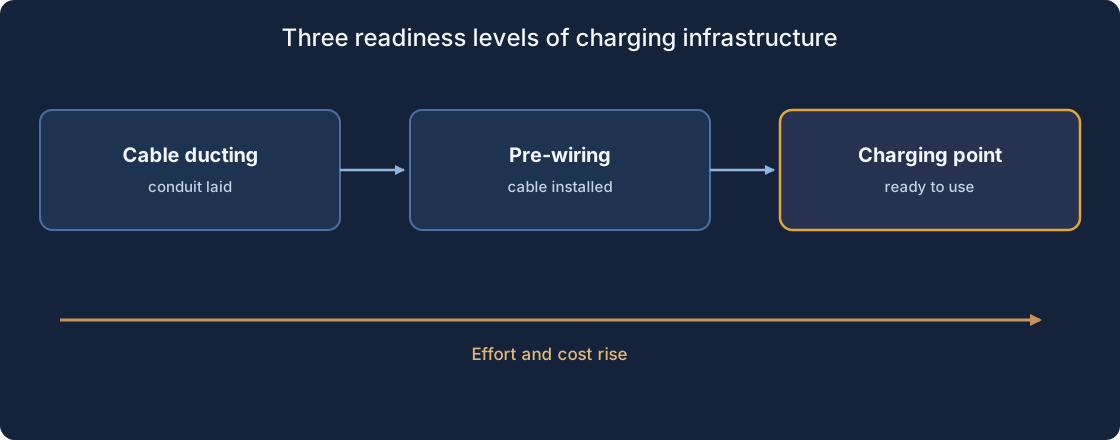
For new and substantially renovated buildings the amendment shifts the thresholds down and raises the installation duty. What matters is a distinction that often gets lost in the debate: cable ducting, pre-wiring and a ready-to-use charging point are three different things.
For residential buildings the threshold falls from more than 5 to more than 3 parking spaces. Then half of the spaces must be pre-wired, the rest fitted with cable ducting, and at least one charging point installed. For non-residential buildings the duty applies from more than 5 instead of more than 6 spaces, with at least one charging point per 5 spaces. Buildings used mainly as offices face stricter requirements.

The duty does not only apply to new builds. It also applies to major renovations, when the car park or the electrical installation is being renewed anyway. That is the moment when the preparation almost comes for free. Miss it, and the groundwork gets rebuilt later at twice the cost.
Retrofit duty for the stock: the real lever
New and, for many owners, most important is the retrofit duty for the existing stock. It needs no construction project. It applies through the passage of time alone.
Affected are existing non-residential buildings with more than 20 parking spaces. From 1 January 2027 they must either provide one charging point per ten spaces or cable ducting for half of the spaces. For publicly accessible areas there is an alternative charging-power requirement of at least 1.1 kilowatts per parking space. Miss the deadline, and a fine is possible.

It sounds technical, but it is a big step. So far a single charging point was enough in existing non-residential buildings above a certain size. Now comes a staggering by the number of spaces. Affected above all are office sites, retail, logistics and public administrations. The rollout needs lead time, because the grid connection and the planning take time. Anyone who only starts at the end of 2026 will struggle.
Stricter and more flexible at once
The amendment is stricter, but not rigid. In several places it opens technical room to move, instead of prescribing a fixed number of charging points. That is the more interesting half of the reform.
For utilities there is a control challenge in this. Many charging points on one connection require load management, otherwise simultaneous charging overloads the grid connection. This is exactly where the building duty meets the digital technology: the backend under OCPP 2.1, the communication between vehicle and charging point under ISO 15118 and the data obligations under DATEX II. The GEIG amendment says how much infrastructure must be there. These standards govern how it works together.
Why private and semi-public charging decides
We are interested in a different number than the one in the headlines. Germany passed the mark of around 200,000 public charging points on 1 April 2026, up about 17 percent within a year. Impressive. Only, hardly anyone charges there when they have the choice.
Most charging sessions happen at the owner's own space or at work, with estimates reaching up to four fifths. That is the reason the EPBD starts at the building and not at the street. Where cars park, charging should be possible. And the cheapest moment to lay that groundwork is conduit and pre-wiring during construction. Later it gets expensive.
Criticism and open questions
The amendment is not uncontested. Critics ask whether the flexible alternatives are enough in practice and whether the stock can meet the deadlines. Both are fair.
The most debated point is the charging-power option of 1.1 kilowatts per space. It sounds pragmatic, but it distributes so little power that a car barely fills up sensibly overnight. For pure maintenance charging it may be fine, as an everyday solution it looks thin. The second bottleneck rarely lies at the charging point itself, but at the grid connection of large car parks. Add to that the shortage of electricians and long lead times. Anyone who considers the IT security of charging stations and grid integration only after installation builds twice.
And the narrow miss of the EU deadline? It is more symbol than scandal. But it shows how tight the timeline was, and hints that the rollout in the stock will not run faster than the legislation itself.
What utilities, real estate and municipalities should do now
Waiting does not help. The retrofit duty from 2027 can only be met cleanly with lead time. These four steps bring the stock and the grid connection into shape in time.
-
Count parking spaces and determine the threshold
Count the spaces per property and assign each building to a threshold. Only then is it clear whether it falls under the new-build, renovation or retrofit duty and how many charging points are required.
-
Clarify grid connection and load management early
The connection is often the bottleneck for large car parks. Check the available capacity and plan load management before many charging points run at once. That saves an expensive second rebuild.
-
Include pre-wiring during renovations
If a renovation of the car park or the electrics is due anyway, conduit and pre-wiring belong in it. That is the cheapest moment and meets the duty almost in passing.
-
Treat charging infrastructure as a business
For utilities and municipal utilities the duty is also an opportunity. Charging infrastructure as a service, load management and matching tariffs can be bundled into an offer that takes the rollout off property owners' hands.
The GEIG amendment moves charging to where it actually happens: the parking space at the building. Anyone who now counts the spaces, clarifies the grid connection and includes pre-wiring during renovations will meet the duty from 2027 without an expensive stopgap.
Further reading
Frequently asked questions
The amendment to the German Building Electromobility Infrastructure Act tightens the requirements for charging infrastructure at buildings. It lowers the thresholds for new builds and renovations, requires pre-wiring and charging points at residential buildings from more than 3 and at non-residential buildings from more than 5 parking spaces, and introduces a retrofit duty for existing non-residential buildings from more than 20 parking spaces.
The federal cabinet adopted the amendment on 13 May 2026, and the Bundestag and Bundesrat approved it on 13 July 2026. The central new duties apply from 1 January 2027, including the retrofit duty for existing non-residential buildings with more than 20 parking spaces.
The retrofit duty applies to existing non-residential buildings with more than 20 parking spaces. From 1 January 2027 they must provide one charging point per ten parking spaces or cable ducting for half of the spaces. For publicly accessible areas there is an alternative charging-power requirement of at least 1.1 kilowatts per parking space.
The GEIG distinguishes three readiness levels. Cable ducting means conduit is laid so a cable can be pulled through later. Pre-wiring means the cable is already in place. The charging point is the ready-to-use charging station. Effort and cost rise with each level, which is why it is cheapest to include the preparation during construction or renovation.
The amendment transposes Article 14 of the recast EU buildings directive, Directive (EU) 2024/1275. The directive entered into force on 28 May 2024 and had to be transposed into national law by 29 May 2026. It requires pre-wiring, cable ducting and charging points for buildings with parking spaces so that later retrofitting stays affordable.
Let's collaborate
One contact, a team behind it
Thirty minutes on what you're working on, whether grid, metering, market processes, IT architecture or AI. Afterwards you'll know how we'd approach it and who would sit at the table.
Energy and measurement technology since 2010 · innobu GmbH since 2014 · Based in Schleswig-Holstein, Germany
Whoever pitches also delivers: whoever leads the first call stays your contact right through to the steering committee, with established partners in the project. Direct: info@innobu.com