Bidirectional Charging and V2G: Germany's MiSpeL Breakthrough
This article sets out seven threads: why bidirectional charging is becoming economic now, how the double-burden problem is solved, how the MiSpeL ruling works with its flat-rate and demarcation options, which timeline applies up to the 30 June 2026 deadline, what technical conditions vehicle-to-grid requires, what the technology delivers economically and for the grid, and what energy utilities and aggregators should do now.
Bidirectional charging becomes economic in Germany for the first time in 2026, because two regulatory building blocks come together. With the ruling on the market integration of storage and charging points (MiSpeL) under Section 85d of the Renewable Energy Act, the Federal Network Agency treats bidirectional charging points largely like stationary battery storage, so an electric car runs inside a home energy management system like a storage unit. The proceeding has run since 31 July 2025, the consultation draft appeared on 18 September 2025, statements ran until 24 October 2025, and the final ruling must be in place by 30 June 2026. MiSpeL offers two routes: the flat-rate option for small systems with a flat 500 kilowatt-hours per kilowatt-peak and year and a single meter, and the demarcation option with quarter-hourly metering for larger systems. In parallel, the EnWG amendment passed by the Bundestag on 13 November 2025 solves the real economic problem: it adds a reference in Section 118 paragraph 6 sentence 3 of the EnWG to Section 21 of the EnFG, so fed-back electricity is treated like storage electricity and no longer charged network fees twice. Technically the ISO 15118-20 standard for AC bidirectional charging and the VDE-AR-N 4105 connection rule in its 2026-03 version carry the market ramp-up, vehicles such as the BMW iX3, several models of the VW ID range, the Renault 5 and the Kia EV9 are ready, and the first commercial V2G offer started in February 2026. Market participants cite a network-charge saving of roughly 110 to 190 euros a year depending on the grid area. For energy utilities and aggregators this opens a new flexibility market that makes vehicle fleets controllable like a virtual power plant.
Why bidirectional charging becomes economic
Bidirectional charging turns the electric car into a storage unit that not only takes in power but also gives it back. With V2H (vehicle-to-home) the car battery supplies the building, with V2G (vehicle-to-grid) it feeds back into the public grid, and with V2L a single device runs directly off the car. The technology has existed for years. What was missing was the economic basis.
The reason was plain and expensive. Anyone who charged grid electricity into a car battery and fed it back later paid network charges and levies twice, once when charging and once when using the power again. This double burden made vehicle-to-grid unprofitable for most households and fleets and left Germany one of the most restrictive markets in Europe until 2025.
In 2026 that turns around. The Federal Network Agency must finalise its ruling on the market integration of storage and charging points, MiSpeL for short, by 30 June 2026, and a parallel amendment to the Energy Industry Act ends the double burden. A technical promise becomes a product you can calculate. For energy utilities, municipal utilities and aggregators this is more than a detail, because every plugged-in vehicle becomes a small, controllable storage cell in the system.
A typical car battery holds several times the capacity of a usual home storage unit. It is only available when the vehicle is plugged in, which on average it is for most of the day. Exactly those hours at the grid are the raw material for the new flexibility models, which borrow the logic of virtual power plants .
The double-burden problem and how it is solved
The core of the problem lay in a single logic of the old rules. When a vehicle charged grid electricity and fed it back later, the regulation treated the fed-back power as new consumption. Network charges then fell due twice, even though the returned power relieves the grid. For the owner too little was left to justify the investment in a wallbox and a suitable vehicle.
The EnWG amendment passed by the Bundestag on 13 November 2025 targets exactly this. It adds a reference in Section 118 paragraph 6 sentence 3 of the EnWG to Section 21 of the EnFG. Bidirectionally used charging points then count as electricity storage, and fed-back power is treated like storage electricity. The second layer of network charges falls away. This storage exemption is time-limited and applies to systems that go into operation within the statutory window.
One clarification keeps the terms clean. The old EEG levy has not existed since July 2022 and does not return here. MiSpeL is about the EEG eligibility of fed-in electricity and about the EnFG levies, so not the old levy but the correct allocation of renewable and grid power. Network charges themselves are governed by the EnWG, and the ongoing reform of the network charge system AgNeS forms the larger frame in which this exemption sits.
Only both building blocks together make V2G economic: MiSpeL allocates renewable and grid power correctly and preserves the EEG support, while the EnWG amendment ends the double network-charge burden on fed-back power. As an order of magnitude, market participants cite a saving of roughly 110 to 190 euros a year depending on the grid area.
How the MiSpeL ruling works: two options
MiSpeL stands for market integration of storage and charging points. The ruling clarifies how subsidised renewable electricity and grid electricity can be cleanly separated inside a storage unit or charging point, so the EEG support is preserved and levies are allocated correctly. For this the Federal Network Agency provides two routes that differ mainly in metering and billing effort.
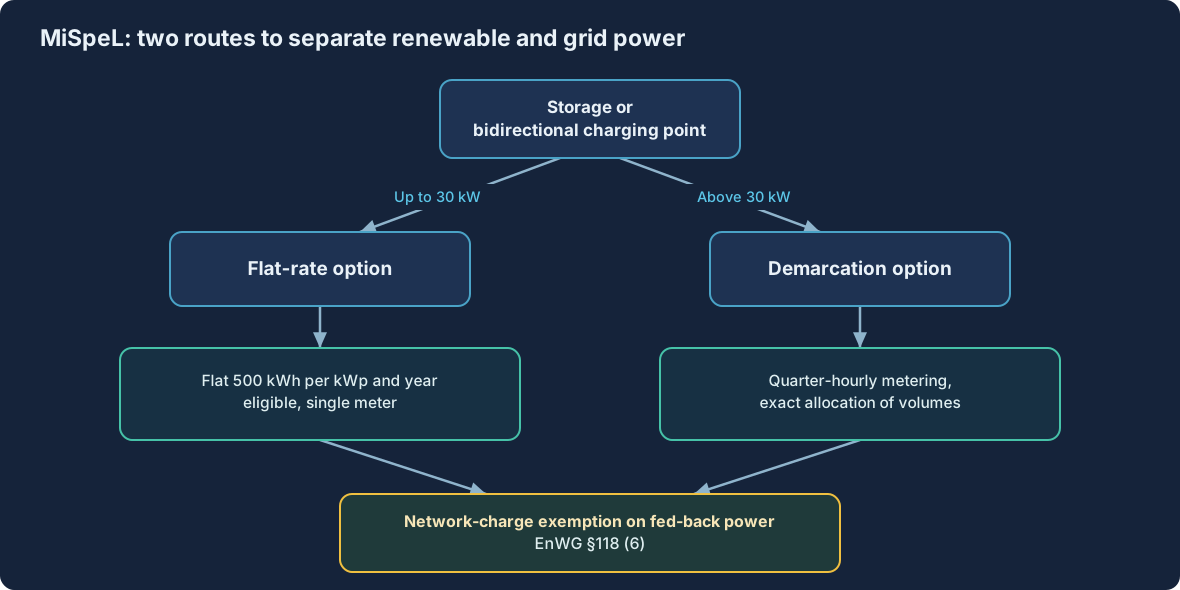
The flat-rate option is meant for small systems and works without elaborate metering. A fixed share of the feed-in counts as eligible, capped at 500 kilowatt-hours per installed kilowatt and year, and a single bidirectional meter is enough. For a 10 kilowatt-peak system that is up to 5,000 kilowatt-hours a year recognised as eligible feed-in. This lowers the hurdle for households and small businesses considerably.
The demarcation option is intended for larger systems and works precisely. It requires quarter-hourly metering and allocates every volume of energy to its source and its eligibility by fixed calculation rules. The effort is higher, but the billing maps the actual energy flow exactly, which is the decisive factor for large systems and fleets. Both options allow a charging point to run inside a home energy management system like a storage unit for the first time, and both lead to the same network-charge exemption on fed-back power.
The timeline: deadline 30 June 2026 and market ramp-up
The schedule is tightly timed, and the most important marker is imminent. The final MiSpeL ruling must be in place under Section 85d of the Renewable Energy Act by 30 June 2026. Until then there is a clearly documented procedure the market can orient itself by.
Opening of the proceeding
The Federal Network Agency opens the ruling procedure on the market integration of storage and charging points under Section 85d of the Renewable Energy Act and Section 62 of the EnFG.
Consultation and statements
The consultation draft appears, accompanied by a workshop on 1 October 2025. By the end of the period more than 47 statements arrive, among others from BDEW, EnBW and bne.
Process rules take effect
The simplified MiSpeL process rules take effect and ease the billing of bidirectional charging without the need for an additional meter.
Final ruling
The Federal Network Agency finalises the MiSpeL ruling. The broad market ramp-up with automated market communication by grid operators follows from late 2026 to 2027.
The market thus becomes real in two stages. First the process rules and the final ruling open the field legally, then fully automated market communication follows. Whoever prepares products and systems early can use the first stage instead of waiting for the second.
Technical conditions: standard, connection rule, vehicles
For vehicle-to-grid to work in daily use, vehicle, wallbox, meter and grid connection have to match. The ISO 15118-20 standard governs the bidirectional data exchange between vehicle and charging point and is the basis for AC bidirectional charging and Plug and Charge in Europe. It was finalised in 2022 and is now reaching series production.

On the grid side, the VDE-AR-N 4105 connection rule in its 2026-03 version sets unified and simplified requirements for connecting bidirectional wallboxes to the low-voltage grid for the first time, which a low-voltage control system then steers. That removes the uncertainty for grid operators and installers about which rules apply to a feed-back-capable wallbox. The wallbox itself is a controllable consumption device whose grid-friendly control is already governed by Section 14a of the EnWG .
On the vehicle side the choice is growing. Models such as the BMW iX3, several models of the VW ID range with a large battery, the Renault 5, the Kia EV9 and the Nissan Leaf via the older CHAdeMO standard support bidirectional charging. AC wallboxes with full ISO 15118-20 support and up to 22 kilowatts are reaching the market in 2025 and 2026. The first official V2G offer in Germany started in February 2026, initially with a narrow combination of vehicle and wallbox. Series readiness is therefore here, and the market stands at the start of its ramp-up. That wallboxes reach buildings at all is also driven by the GEIG amendment.
What it delivers: economics and grid value
The value works on two levels. For the owner, the end of the double burden makes V2G calculable for the first time. Solar power can be used at any hour, load shifted into cheap hours and feed-back remunerated. Add to that the network-charge saving in the low three-figure range a year. In many cases the vehicle replaces part of what would otherwise need a separate home storage unit.
For the energy system the sum is what counts. Every plugged-in vehicle becomes a small, flexibly callable storage cell that can relieve local bottlenecks and buffer generation peaks from wind and sun. This is exactly the decentralised flexibility the grid needs as the share of renewable generation grows.
For energy utilities and aggregators this opens a new flexibility market. Whoever bundles many vehicles can smooth peaks, offer balancing energy and back dynamic tariffs with real storage behaviour. The principle resembles a virtual power plant, except the storage units stand on wheels and hang on the grid at changing places during the day. Which digital business models this opens up is set out in the piece on Vehicle-to-Grid as a business model .
What energy utilities and aggregators should do now
The entry works best along the billing and data processes, not through technology alone. The regulatory clarity is here, the vehicles and wallboxes are coming, and the real bottleneck now lies in the systems that bring metering, market communication and tariff together cleanly.

Four steps order the start. They interlock but can each begin independently.
-
Prepare billing and IT
Map the flat-rate and demarcation options in your billing system and market communication before the mass market arrives. The metering side must be able to handle bidirectional meters.
-
Test a V2G tariff
Set up a V2G or V2H tariff with transparent remuneration for feed-back and a link to a home energy management system, and trial it with a small group of customers.
-
Bundle flexibility
Build vehicle pools as an aggregate and make them usable for balancing energy and grid-friendly control, with clear rules for availability and remuneration.
-
Anchor standards
Fix ISO 15118-20 and VDE-AR-N 4105 in procurement and gather experience from pilot projects early, instead of learning every lesson alone.
Bidirectional charging is therefore less a single product than a building block of the digital energy transition. Its value emerges only in the interplay of regulation, metering, tariff and control. Whoever connects these threads early is ready when the broad market ramp-up begins from late 2026.
Further reading
Frequently asked questions
MiSpeL stands for market integration of storage and charging points. The Federal Network Agency's ruling under Section 85d of the Renewable Energy Act and Section 62 of the EnFG clarifies how subsidised renewable electricity and grid electricity can be cleanly separated inside a storage unit or charging point, so the EEG support is preserved and levies are allocated correctly. What is new is that bidirectional charging points are treated largely like stationary battery storage. The proceeding opened on 31 July 2025, and the final ruling must be in place by 30 June 2026.
The reason was the double burden of network charges. Anyone who charged grid electricity into a car battery and fed it back later paid the charges twice, even though the fed-back power relieves the grid. That made vehicle-to-grid unprofitable for households and fleets. The EnWG amendment passed by the Bundestag on 13 November 2025 changes Section 118 paragraph 6 of the EnWG so that bidirectionally used charging points count as electricity storage. Fed-back power is then treated like storage electricity and no longer charged network fees twice.
Both routes allocate fed-in electricity to its source and its eligibility, with different effort. The flat-rate option is meant for small systems: a fixed share of the feed-in counts as eligible, capped at 500 kilowatt-hours per installed kilowatt and year, and a single bidirectional meter is enough. The demarcation option is intended for larger systems and requires quarter-hourly metering that allocates every volume of energy precisely by fixed calculation rules. Which route fits depends on system size and on the metering and billing effort.
The final ruling must be completed under Section 85d of the Renewable Energy Act by 30 June 2026. The proceeding has run since 31 July 2025, the consultation draft appeared on 18 September 2025, the deadline for statements ended on 24 October 2025, and more than 47 statements were submitted. The simplified MiSpeL process rules take effect from April 2026. The broad market ramp-up with automated handling by grid operators is expected from late 2026 to 2027.
Vehicle, wallbox, meter and grid connection have to match. The ISO 15118-20 standard governs the bidirectional data exchange between vehicle and charging point and is the basis for AC bidirectional charging and Plug and Charge. On the grid side, the VDE-AR-N 4105 connection rule in its 2026-03 version sets unified requirements for connecting bidirectional wallboxes to the low-voltage grid for the first time. On the vehicle side, models such as the BMW iX3, several models of the VW ID range, the Renault 5 and the Kia EV9 support bidirectional charging. The first commercial V2G offer in Germany started in February 2026.