VDE-AR-N 4105 and 4100: Germany's new low-voltage connection rules
The new VDE-AR-N 4105 was published on 26 February 2026, and six weeks later the new VDE-AR-N 4100 took effect. A transition period has been running since then, with the old and the new edition both admissible. It ends on 1 March and 1 April 2027, and by then the technical connection conditions, the notification forms and the assessment process have to be switched over.
VDE-AR-N 4105 is the German application rule for connecting and operating generation plants on the low-voltage grid; it binds grid operators, installers and plant operators, becomes part of the technical connection conditions through Section 19 EnWG, and has been available in the 2026-03 edition since 26 February 2026. Its sibling rule VDE-AR-N 4100 for customer installations followed in the 2026-04 edition on 1 April 2026. The scope of the 4105 now reaches 500 kW of installed capacity: up to 500 kW total capacity and 270 kW of agreed feed-in capacity, plant certificate B and the declaration of conformity fall away, while the grid compatibility assessment stays with the grid operator. Also new are simplified notification forms for plants up to 800 VA and up to 7 kW, the normative classification of feed-back capable charging equipment as storage, and, in the 4100, instrument transformer installations with semi-indirect metering up to 1,000 A plus a dedicated meter-position field for communication modules and control units. The transition periods end on 1 March 2027 for the 4105 and on 1 April 2027 for the 4100.
Two rules, one connection
Anyone connecting on the low-voltage side works with two application rules. One describes the customer installation, the other the generation plant. Both were reissued in 2026, and neither is a recommendation.
The 2026-03 edition appeared on 26 February 2026 and fully replaces the 2018-11 edition with its corrigenda. Clearingstelle EEG|KWKG has listed it as the applicable version since 27 February 2026. Six weeks later came VDE-AR-N 4100 in the 2026-04 edition, the first thorough revision since 2019. The reason was the same in both cases: solar, battery storage, heat pumps, charging equipment and energy management systems are now the normal case on the low-voltage grid, and the Solar Package I had already moved the legal side in 2024.
And it carries on. A partial revision of the 4100 was out for public consultation as draft E VDE-AR-N 4100/A1 from 15 May to 26 June 2026, with publication announced for 2027. So anyone touching their technical connection conditions now had better plan a second round.
Two transition periods, one double standard
The transition sounds like relief. It is the real cost driver.
Until 1 March 2027 connections may be processed under either the old or the new VDE-AR-N 4105; both editions are admissible. The same applies to VDE-AR-N 4100 until 1 April 2027 for projects that were already in planning or under construction on the cut-off date. Two parallel standards means two sets of checks, two sets of forms and two training states in the back office.
There is a side effect that installers feel first. Because each utility decides for itself when to switch, requirements can differ from one grid operator to the next while the transition runs. For a contractor working across regions that is three different forms for the same plant.
Record for every case which edition it was assessed against. Without that note, nobody can show after spring 2027 why a connection was decided the way it was.
Existing installations that stay unchanged are unaffected, as long as safe and trouble-free operation is assured. The 4100 does list a set of triggers that force an upgrade, though: a capacity increase, continuous-load operation, new feed-in, controllable consumption devices under Section 14a EnWG, phase conversion, spatial changes, an additional grid connection or a changed mode of operation. In practice at least one of them applies to every heat pump or wallbox installation.
The 500 kW threshold moves the burden of proof
270 kilowatts of feed-in capacity on a single low-voltage connection, without a plant certificate. That number is where this rulebook turns.
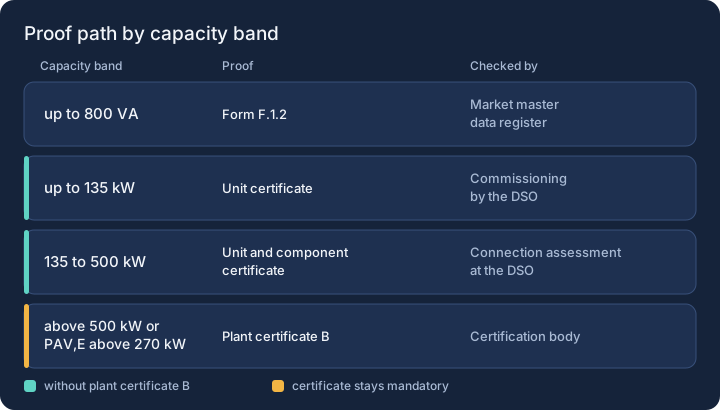
The scope of VDE-AR-N 4105 now reaches 500 kW of installed capacity. It used to stop at 135 kW, and anything above went into the medium-voltage rulebook. With a total capacity up to 500 kW and no more than 270 kW of agreed feed-in capacity at the connection point, plant certificate B and the declaration of conformity fall away; proof runs through unit and component certificates. What an accredited certification body used to check is now checked by the connection assessment in house.
What counts here is active power in kilowatts, not module capacity in kilowatt-peak. That distinction comes from the Solar Package I of 16 May 2024 and still generates queries in the back office, because quotes and data sheets are usually written in kWp.
Plenty changed technically as well. The Q(U) characteristic is now the default setting for reactive power as delivered. Requirements for system-supporting behaviour were extended, among them RoCoF and P(f). PAV,E monitoring was developed further, as was zero feed-in, and there are new variants of grid and plant protection. For the controllability of generation plants the Solar Peak Act remains the legal reference point; the application rule describes the technical side.
A plant with 480 kW installed and 260 kW of feed-in capacity will sit on the low-voltage grid without a plant certificate. Whether the local network can carry it is a question nobody answers but you.
Forms and portals have to follow
The notification forms were revised and their data scope cut. That sounds like swapping a PDF on the website. It is a change to portal screens and to the validation logic behind them.
Form F.1.2 is new: a separate, simplified notification form for small generation plants and storage up to 800 VA, written for laypeople rather than for a qualified electrician. For plants up to 7 kW, form F.1.1 offers a slimmed-down version with far fewer fields than the old data sheet.

And the very small systems? Plug-in solar no longer touches the grid operator at all. Since the Solar Package I, operators register their system only in the Federal Network Agency's market master data register; the separate notification to the grid operator is gone. The volumes behind that are substantial: in early September 2026 around 1.49 million plug-in solar devices with roughly 1.619 gigawatt-peak were recorded as in operation. Growth is cooling, though, with January to July running about 11.5 percent below the same period a year earlier.
What stays untouched is the duty under Section 8(7) EEG to offer a grid connection portal for connection requests up to 30 kW. The duty stands; what changes is the content behind the screen.
Feed-back capable chargers become storage
For the first time it is written into the rule: a feed-back capable charging point is a storage unit. That puts it through the notification path for generation plants, not the one for consumption devices.

For connection administration that means the same checks and proofs as for a battery storage unit, including the behaviour of grid and plant protection. The metering concept has to cover export, not just import. And the classification as a controllable consumption device under Section 14a EnWG sits alongside it; it does not replace the storage view. Keep both in one data field and the problem shows up at billing.
None of this settles the market side. How bidirectional charging is treated in balancing and in contracts is decided by the Metering Point Operation Act and the storage rulings, not by an application rule. The 4105 only says under which technical conditions the device may go on the grid.
Meter position, transformers and Section 14a
VDE-AR-N 4100 covers the customer installation, and therefore the meter position. Three points land directly in metering operations and the rollout.
First, instrument transformer installations are now covered explicitly. The scope includes direct metering up to 63 A and, newly, semi-indirect metering up to 1,000 A. Second, the meter position provides a dedicated field for communication modules, control units or energy management systems. That is exactly the space question the debate about the control box has been rubbing against for years. Third, the rule names short-circuit withstand ratings of 25 kA on the grid side, 10 kA on the load side and 6 kA in the distribution board.
One small clarification matters a lot in practice: voltage sensors upstream of the metering device are permitted, limited to four units drawing at most 1 VA per phase, and explicitly not for billing purposes. That closes a grey area every utility used to decide for itself.
Anyone planning the rollout already has the connection on the desk. The rollout quota for generation plants due on 31 December 2026 and the meter-position requirements of the 4100 hit the same properties, just from two directions.
Relief or loophole
Opinions on the 500 kW threshold split, and they split along the roles.
VDE FNN presents the new edition as simplification: less paperwork for small plants, uniform requirements, more legal certainty for a market that plug-in solar and home storage have long carried into the mainstream. The trades see it much the same way. From an installer's point of view, the plant certificate was a proof that cost months and a five-figure sum on projects of this size.
Trade press coverage adds a different question: has a loophole opened for larger solar plants? The argument goes that 270 kW of feed-in capacity on a low-voltage connection is a different proposition from the 135 kW the rulebook was originally written for, and that the check on whether the network can carry it has moved to precisely the party with its own interest in the answer.
Both sides are right about different things. The proof burden was out of proportion. The assessment work does not disappear, though; it has only moved to another cost centre.
Where it can go wrong
Start with the model. A connection assessment up to 500 kW is only as good as the low-voltage data behind it, and where cable lengths, cross-sections and transformer figures are estimated, the assessment is an estimate with a signature on it.
Then the people. This work arrives without extra headcount, so unless it is anchored explicitly in grid planning, it lands quietly on the back office that is already processing the applications.
Two more risks come from outside. Two editions run side by side until spring 2027, which produces inconsistent connection files, queries from installers and, in a dispute, the question of which edition applied. And the partial revision of the 4100 is due in 2027. A set of connection conditions that only catches up with the current edition today will be back on the desk within a year.
Application rules describe technology, not the individual case. Whether a particular plant is admissible at a particular connection point is decided by the assessment in your own grid, not by the text of the standard.
What grid operators should do now
Five months to the first deadline is enough if the order is right. The connection conditions are the anchor; everything else hangs off them.
The order of work before 1 March 2027
-
Check the connection conditions against both new editions
Find every reference to the 2018-11 or 2019 editions and replace it. Then set the publication route and your own cut-off date. Skip this and the forms and the assessment process hang in the air, because they cite a text that no longer reads that way.
-
Move forms F.1.1 and F.1.2 into the portal
Reconcile field lists and mandatory fields against the reduced data scope. The common failure here: the old mandatory fields stay in place, and the layperson F.1.2 was written for gets stuck on the screen.
-
Describe the connection assessment up to 500 kW as its own step
Who assesses, with which grid model, with what documentation, and at what finding does a request get refused or a feed-in limit agreed. This is the step with the most risk and the least precedent in house, because a certification body used to carry it.
-
Separate feed-back capable chargers in the data model
Storage here, controllable consumption device under Section 14a there. Two attributes, not one.
-
Record the applicable edition per case
One field in the connection file, populated from today.
-
Train before 1 March 2027, not after
Back office, field technicians and the installer register. The contractors notice the difference first, and they will ask you.
Deadline, market roles, systems
1 March 2027VDE-AR-N 4105:2026-03: end of the transition periodfixed
Applicability: Applies to grid operators, installers and plant operators connecting generation plants and storage to the low-voltage grid. Unchanged existing installations are not covered as long as safe and trouble-free operation is assured.
- Electricity grid operatorrole obligationSwitches technical connection conditions, notification forms and the assessment process to the 2026-03 edition and records the applicable edition for every case until then.Typically affected: Customer and grid connection portal, Grid planning, GIS, load flow, Plant master data and MaStR
- Competitive metering point operatoraffectedRegisters generation plants and storage using the new forms and aligns metering concepts with feed-back capable charging equipment treated as storage.Typically affected: Customer and grid connection portal, Grid usage and customer billing
1 April 2027VDE-AR-N 4100:2026-04: end of the transition periodfixed
Applicability: Applies to customer installations on the low-voltage grid. Unchanged existing installations are not covered; triggers for an upgrade include a capacity increase, feed-in, controllable consumption devices under Section 14a EnWG and additional grid connections.
- Electricity grid operatorrole obligationUpdates the technical connection conditions to the 2026-04 edition and checks meter position, instrument transformer installations and short-circuit ratings against the new requirements.Typically affected: Customer and grid connection portal, Plant master data and MaStR
- Default metering point operatoraffectedTakes the new meter-position field for communication modules and control units into account in rollout planning and installation specifications.Typically affected: Gateway administration and CLS management, Field service and work orders
A classification for typical market roles, not a review of your individual case and not legal advice. Whether an obligation applies to your company (thresholds, exemptions) is for your legal department or counsel to confirm. The calendar doesn't replace your own deadline review. Deadline calendar as of: 28 September 2026.
Further Reading
Frequently Asked Questions
The 2026-03 edition was published on 26 February 2026 and fully replaces the 2018-11 edition. Clearingstelle EEG|KWKG has listed it as the applicable version since 27 February 2026. Until 1 March 2027 a transition period runs in which connections may still be processed under the old edition.
The scope of VDE-AR-N 4105 now reaches 500 kW of installed capacity. With a total capacity up to 500 kW and an agreed feed-in capacity up to 270 kW at the connection point, plant certificate B and the declaration of conformity are no longer required. Proof runs through unit and component certificates instead, and the grid compatibility assessment sits with the grid operator.
The forms for the connection process were revised and their data scope cut. Form F.1.2 is a new, simplified notification form for small generation plants and storage up to 800 VA and is written for laypeople rather than electricians. Form F.1.1 covers plants up to 7 kW with far fewer fields than the previous data sheet.
VDE-AR-N 4105:2026-03 classifies feed-back capable charging equipment as storage for the first time in normative terms, and it carries requirements and verification procedures for it. For the connection process that means the same checks as for a battery storage unit, a metering concept that covers export as well as import, and a separate record of the classification as a controllable consumption device under Section 14a EnWG.
Instrument transformer installations are covered explicitly for the first time; the scope includes direct metering up to 63 A and, newly, semi-indirect metering up to 1,000 A. The meter position now provides a dedicated field for communication modules, control units or energy management systems. The rule also names short-circuit withstand ratings of 25 kA on the grid side, 10 kA on the load side and 6 kA in the distribution board.
Existing installations that are not modified do not have to follow the new edition as long as safe and trouble-free operation is assured. Triggers for an upgrade include a capacity increase, new feed-in, controllable consumption devices under Section 14a EnWG, an additional grid connection or a changed mode of operation.
Let's collaborate
One contact, a team behind it
Thirty minutes on what you're working on, whether grid, metering, market processes, IT architecture or AI. Afterwards you'll know how we'd approach it and who would sit at the table.
Energy and measurement technology since 2010 · innobu GmbH since 2014 · Based in Schleswig-Holstein, Germany
Whoever pitches also delivers: whoever leads the first call stays your contact right through to the steering committee, with established partners in the project. Direct: info@innobu.com