
Vehicle-to-Grid 2026: the Business Model
Since 1 January 2026, power fed back from the vehicle battery no longer pays double grid fees. That one change moves the question. Not whether V2G is allowed, but who captures the value. And the value is software. Making money from a battery means forecasting in quarter-hour steps, marketing across several markets at once and settling every kilowatt-hour cleanly between four parties. This article walks through the three revenue streams, the aggregator's role, the digital stack and what utilities and software teams should prepare now.
Vehicle-to-Grid turns from a technology topic into a business model in 2026. On 13 November 2025, the German parliament passed an EnWG amendment that puts power fed back from the vehicle battery on par with stationary storage and ends the double grid-fee burden, effective since 1 January 2026. That opens a competition for three revenue streams that can be stacked: spot-market arbitrage, balancing power through aggregated vehicle pools and avoided grid fees through the modules of section 14a EnWG. According to Agora Verkehrswende, up to 500 euro of arbitrage profit per vehicle and year is achievable by 2030. The value is captured through an aggregator that pools the vehicles, forecasts, markets and settles. The Mobility House plans to offer the charging power for free and refinance it purely through arbitrage. The real bottleneck is data, not cars: only around 3 percent of households have a smart meter, without which market-based marketing cannot be settled. For utilities, that means treating tariff, metering and control as a platform.
Why V2G becomes a business model
For years, bidirectional charging was a feasibility question. Since early 2026 it is a calculation. On 13 November 2025 the German parliament passed an EnWG amendment that puts power fed back from the car battery on par with stationary storage. The double grid-fee burden falls away. That burden had made every feed-back uneconomical, which is why nothing moved before.
The regulatory mechanics behind it, the MiSpeL ruling of the Bundesnetzagentur and its deadlines, are a topic of their own and assumed here. What matters is the consequence. Once the battery may earn money on the grid, permission no longer decides. Whoever markets it best does. And marketing is software.
The market is already here. On 1 January 2026, more than two million battery-electric cars were on German roads for the first time. Even at a cautious plug-in rate, that fleet already provides the flexible capacity of a large power plant.
The three revenue streams
One revenue stream rarely carries a business model. What makes V2G interesting is that the same battery can serve several markets at once, without them colliding. Three of them stack.
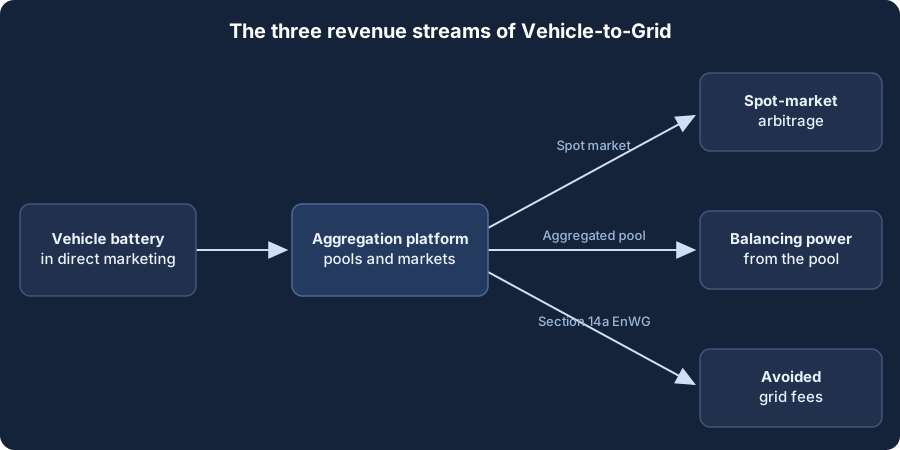
Charge cheaply at night or when wind and sun are plentiful, feed back at the price peak. According to Agora Verkehrswende, up to 500 euro per vehicle and year by 2030. The price curve follows the dynamic electricity tariffs that have been mandatory since 2025.
Pooled vehicles provide second reserve and react automatically to grid-frequency swings. The profit potential is similar to arbitrage according to the study.
The modules of section 14a EnWG lower the grid-fee share, including the time-variable module 3 that has been mandatory since April 2025. This saving is additive to the market earnings.
The value only shows up in the stack. A platform that coordinates schedules, forecasts and market bids pulls more out of the same kilowatt-hour than any single market could on its own. That gap, between a wallbox and a business model, is the whole point.
Who earns what: the role of the aggregator
V2G adds a new role to the value chain. Between the vehicle and the electricity market sits a digital intermediary that pools the batteries and distributes the earnings. Without it, every single car stays too small for the market.
The aggregator handles forecasting, bidding and settlement for a portfolio of many vehicles. The Mobility House takes the model to its edge and plans to offer V2G customers charging power for free, refinanced purely through arbitrage. In Germany this starts in 2026, first with the Renault 5 and the Mercedes-Benz GLC. The condition is a high plug-in time: the longer a vehicle stays connected, the more market access the platform has.
The core shift: The driver does not sell power directly, they provide flexibility. Market access, risk and settlement stay with the platform. That makes the aggregator the real value stage, and the driver receives their share as lower or vanishing charging costs.
The digital stack: platform and standards
Turn a thousand car batteries into a tradable power plant and the hard part is not the wallbox on the wall. It is the software behind it. At the centre sits an orchestration platform that binds vehicles, wallboxes and market access into a virtual power plant and reworks the schedules in real time. That platform is the competitive edge.

Interoperability decides how far this scales. No single protocol covers everything, so the platforms translate between several. ISO 15118-20 handles the bidirectional power flow and plug and charge. OCPP, standardized as OCPP 2.1, connects energy management and charge point, EEBUS works inside the home, OpenADR toward the grid. From 2027, ISO 15118-20 becomes mandatory for new charge points under the EU AFIR regulation.
The market for orchestration software grows from 5.7 billion US dollars in 2025 to 28.4 billion by 2035 according to Future Market Insights, with aggregation and control software as the largest segment. How far vehicle, PV and storage fleets can already be pooled today is covered in the piece on virtual power plants and battery storage .
The bottleneck is data, not the car
The hardware is mature, the regulation is in place. What holds things back is the digital base, without which no kilowatt-hour can be settled. Only around 3 percent of households in Germany have a smart meter, and without it market-based marketing does not work at scale.

There is also a separation to keep clean in the process. When charging, a bidirectional wallbox above 4.2 kilowatts falls under the control rules of section 14a, when discharging the feed-in regime applies. Both states have to be measured and settled separately. ISO 15118-20 is functional as a protocol, but in the field consistent vehicle firmware and an industry-wide mechanism to distribute the required security certificates are still missing.
The real risk: The business model stands or falls with data quality. Settlement between driver, aggregator, charge-point operator and grid operator is the core of market communication. As long as smart meters are missing and certificate distribution is unresolved, V2G stays an offer for the few, however attractive the earnings model looks.
What to prepare now
The commercial start runs in 2026. Scaling arrives with ISO 15118-20 from 2027. For utilities, aggregators and software teams, V2G is less an end-customer offer than a platform question. Set the processes up now and you avoid retrofitting later.
-
Sort out the metering concept
Plan smart meters for the target customers early. They are the gate. Without them nothing is settleable, and the rollout is the slowest link in the whole chain.
-
Build the settlement logic
Bring fed-back power into your own systems. Keep charging and discharging apart, because they sit under different regimes. This is the core of the new market communication, not a manual side calculation bolted on afterwards.
-
Build or buy aggregation
Forecasting and portfolio marketing, built in house or bought through a platform. Marketing single vehicles by hand does not scale.
-
Set the protocol roadmap
ISO 15118-20, OCPP and EEBUS as the target picture, with an eye on the 2027 AFIR obligation. Open standards keep data sovereignty with the operator.
V2G is not a pure charging topic but a data topic. Whoever thinks metering, settlement and aggregation together and bets on open standards can lift the earnings from the fleet instead of being slowed down by the rollout. How AI takes over grid operation itself is explored in the piece on agentic AI in grid management .
Further reading
Frequently asked questions
Vehicle-to-Grid means bidirectional charging, where a vehicle battery does not only draw power but also feeds it back into the grid. That turns the car into a controllable storage unit. Since 1 January 2026, the power fed back in Germany no longer pays double grid fees, because parliament put vehicle batteries on par with stationary storage. Only that makes feeding back economical.
There are three revenue streams that can be stacked. Arbitrage buys power cheaply and feeds it back at the price peak. Balancing power provides second reserve through aggregated vehicle pools. Avoided grid fees come from the modules of section 14a EnWG. The value only appears in combination, because a platform markets the same battery across several markets at once.
According to a study by Agora Verkehrswende and the Reiner Lemoine Institute from November 2025, up to 500 euro of arbitrage profit per vehicle and year is achievable by 2030. Providing balancing power has a similar potential. The earnings depend heavily on electricity prices and on how many hours the vehicle stays plugged in.
The aggregator or energy service provider pools many vehicles into a marketable portfolio and handles forecasting, bidding and settlement. It sits between the vehicle and the electricity market and passes the earnings back to drivers and carmakers. The Mobility House even plans to offer charging power for free and refinance the cost purely through arbitrage.
Interoperability runs across several protocols. ISO 15118-20 governs the bidirectional power flow and plug and charge, OCPP connects energy management and charge point, EEBUS works inside the home and OpenADR toward the grid. ISO 15118-20 becomes mandatory for new charge points from 2027 under the EU AFIR regulation. In the field, consistent vehicle firmware and a mechanism for certificate distribution are still missing.