
MsbG deadlines to 2032: large-consumer quota, modern metering devices, balancing data and deletion periods
All four dates come from Germany's Metering Point Operation Act (MsbG), and each lands somewhere else in the company: the deletion logic in metering data management at metering point operators, network operators and suppliers, a new add-on service at the smart meter gateway, rollout planning for customers above 100,000 kWh, and the remaining stock of old meters. The MsbG itself attaches no administrative fine to any of the four, but the Federal Network Agency (BNetzA) can order measures and enforce them with coercive fines of up to EUR 10 million.
The MsbG deadlines to 2032 are four statutory dates for metering point operators, network operators and suppliers in Germany. By 31 December 2026 they delete or anonymise personal metering data under maximum periods of three years, or one year where a network operator holds the data for network operation, planning, forecasts or the concession fee and where a supplier holds it for energy volume forecasts; this covers data from 2023 and, for the one-year purposes, from 2025 (Sections 60, 66 and 69 MsbG). From 1 January 2028, energy suppliers, direct marketers, plant operators and other entitled parties can require the metering point operator to provide the data communication for the balancing market via the smart meter gateway as an additional service (Section 34(2) sentence 2 no. 5). By 31 December 2028 the default metering point operator equips at least 90 percent of the metering points due in that period for final consumers above 100,000 kWh with smart metering systems (Section 45(1) sentence 1 no. 3), and by 31 December 2032 all other metering points at least with modern metering devices, as far as this is justifiable at no more than EUR 25 gross a year (Sections 29(3) and 32). The MsbG sets no fines; the BNetzA can order measures and enforce them with coercive fines of EUR 1,000 to EUR 10 million.
Four deadlines, three roles, six years
The first of the four deadlines has nothing to do with the rollout. On Thursday, 31 December 2026, the maximum storage period ends for metering data from 2023, and for network planning, forecasts and the concession fee it already ends for data from 2025. It hits network operators and suppliers as well as metering point operators, and it comes back every year. The other three dates sit with the metering point operators and run to Friday, 31 December 2032.
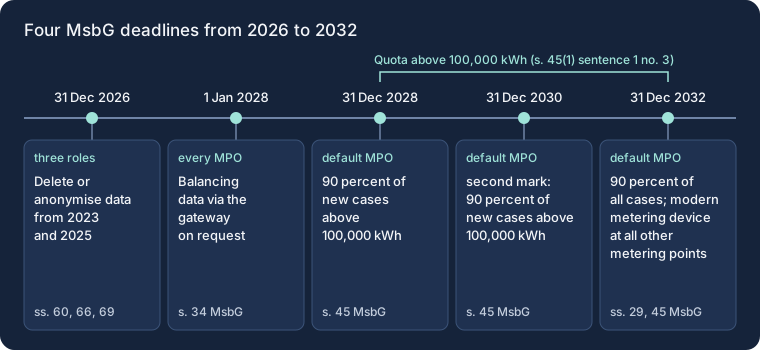
| Date | Who | What | Provision | If missed |
|---|---|---|---|---|
| 31 Dec 2026 (Thu), then every year | metering point operators, network operators, suppliers | Delete or anonymise personal metering data: from 2023 (three-year period), for one-year purposes from 2025 | Sections 60(6), 66(3), 69(3) MsbG | Order under Section 76 MsbG, coercive fine under Section 94 EnWG |
| from 1 Jan 2028 (Sat) | every metering point operator, default or competitive | Offer data communication for the balancing market via the smart meter gateway on request | Section 34(2) sentence 2 no. 5 MsbG | Order under Section 76 MsbG, coercive fine under Section 94 EnWG |
| 31 Dec 2028 (Sun), further milestones 31 Dec 2030 and 31 Dec 2032 | default metering point operator | Smart metering systems at 90 percent of the metering points to be newly equipped for final consumers above 100,000 kWh | Section 45(1) sentence 1 no. 3 MsbG | Order under Sections 45(2) and 76 MsbG, coercive fine EUR 1,000 to EUR 10 million |
| 31 Dec 2032 (Fri) | default metering point operator | All other metering points at least with a modern metering device, as far as economically justifiable | Sections 29(3), 32 MsbG | Order under Section 76 MsbG, coercive fine under Section 94 EnWG |
Each deadline hangs on different systems. Deletion touches metering data management, billing, forecasting and every data store where metering values end up. Balancing data is a product of gateway administration. The two equipment deadlines belong in rollout and installation planning, and in 2032 they compete for the same installation capacity as the 90 percent quotas on the entire stock of all other mandatory cases.
By 31 December 2026: delete data from 2023 and 2025
The deletion period for metering data is a maximum, and it depends on the purpose, not on the record. The MsbG requires all three roles to delete or anonymise personal metering data as soon as storing it is no longer necessary for their task. Only then does it set the outer limit, counted from the end of the calendar year in which the value was collected.
| Role | Purpose | Maximum period | Due on 31 Dec 2026 | Provision |
|---|---|---|---|---|
| Metering point operator | all purposes | 3 years | data from 2023 | Section 60(6) |
| Network operator | network operation, planning, load and feed-in forecasts (Section 66(1) no. 3); concession fee (no. 5) | 1 year | data from 2025 | Section 66(3) sentence 2 no. 1 |
| Network operator | other purposes, such as network usage billing, EEG and CHP settlement, the difference balancing group | 3 years | data from 2023 | Section 66(3) sentence 2 no. 2 |
| Supplier | energy volume forecast (Section 69(1) no. 6) | 1 year | data from 2025 | Section 69(3) sentence 2 no. 1 |
| Supplier | other purposes, such as billing, supplier and tariff switches | 3 years | data from 2023 | Section 69(3) sentence 2 no. 2 |
So one and the same load profile can carry two periods. If a network operator holds a 2025 profile for network planning, it is due at the end of 2026; held for network usage billing, it may stay until the end of 2028. A deletion run that filters only by year of collection therefore deletes either too early or too late. It needs, for each data store, a record of the purpose for which that store holds metering data, and the same record for copies in forecasting models, analyses and backups.

Anonymising is the second option, and for network planning, which would like longer time series than one year, it's the route the law itself describes. Section 52(3) sentence 2 MsbG gives aggregating the data of at least five connection users as an example, subject to the conditions of the GDPR. A load profile that combines the values of at least five connection users can therefore count as anonymised and then falls outside the one-year limit. Metering point operators and suppliers must also observe metrology and calibration law; whatever that requires them to keep longer stays.
Only the BNetzA can deviate, through a determination under Section 47(2) no. 13 or Section 75 MsbG. Check before the first deletion run whether such a determination sets something else for your data. The GDPR states the same principle as storage limitation in Article 5(1)(e); the MsbG sets the outer limit for metering data in years.
From 1 January 2028: balancing data via the gateway
From Saturday, 1 January 2028, the data communication for the balancing market becomes an additional service that a metering point operator must provide when an entitled party asks for it. Section 34(2) sentence 2 no. 5 MsbG describes it as the data communication via the smart meter gateway needed to take part in the balancing market, including the necessary IT connection to the gateway. Energy supply companies, direct marketers, final consumers, parties seeking a connection under the Renewable Energy Sources Act (EEG), plant operators and connection owners can request it, for themselves or for their customers. The duty applies to every metering point operator, default and competitive alike.
The operator may refuse only as long as and to the extent that the service is technically impossible, or where it is exempt under Section 31(1) MsbG; that provision covers smart metering systems whose functions for logging, remote control or master data transmission could be supplied by update until the end of 2025. Reasons must be given in text form (Section 34(2) sentence 5). The default metering point operator may charge an additional reasonable fee under Section 35(1). Unlike early installation, there is no amount the law presumes to be reasonable for this service, and the fee may not include costs that arise anyway from the duties under Sections 29 to 32 (Section 35(2)). Because the default operator's price sheet covers at least three years, the service should already appear in the October 2026 publication; more in our article on metering price sheets under § 37 MsbG.
Whether a plant or a pool may supply balancing reserve is decided not by the metering point operator but by the transmission system operator to whose control area the units are connected, in the prequalification procedure. According to the transmission system operators this includes an IT and delivery concept, a test run and a control-system test in which the TSO checks, among other things, the redundant data link of the provider's control system; regelleistung.net carries the prequalification conditions in a version dated 7 October 2026.
The metering point operator owes the communication; the requirements for it come from the transmission system operator. An offer only makes sense once it is clear which data points and what availability the connecting TSO requires for each type of balancing reserve (FCR, aFRR, mFRR), and those requirements sit in its prequalification conditions, not in the MsbG. A further additional service depends on this: running the communication over an uninterruptible, blackout-proof, dedicated wide-area link (Section 34(2) sentence 2 no. 8). It requires a regulation under Section 34(4). How European balancing energy is traded today is covered in our article on the MARI and PICASSO balancing platforms.
By 31 December 2028: 90 percent above 100,000 kWh
For final consumers using more than 100,000 kWh a year, the mandatory rollout only starts in 2028, and the first quota falls in the same year. Section 45(1) sentence 1 no. 3 MsbG requires the default metering point operator to start equipping these customers in 2028 at the latest and, by the end of 31 December 2028, to have finished at least 90 percent of the metering points to be newly equipped per installation case group in that period. Two more milestones follow: by the end of 2030, again 90 percent of those newly due in the period up to then, and by the end of 2032, 90 percent of all metering points in this group.
The law gives no start date for the first period. For mandatory cases up to 100,000 kWh it does (25 February 2025, no. 4(b)); here it doesn't, and Section 45 doesn't say which existing metering points above 100,000 kWh count as "to be newly equipped in that period"; nor does the law define the term installation case group. We have found no BNetzA interpretation of this. Anyone planning today is better off taking the whole stock above 100,000 kWh as the base, because a base set too small may only show up after the cut-off date, when nothing can be caught up any more. How the quotas for the smaller mandatory cases are counted is set out in our article on the period quota under § 45 MsbG.
What counts as a smart metering system for these customers is set by Section 2 no. 7 MsbG: it includes a metering device with registering load-profile measurement connected to a communication network through a smart meter gateway. For large consumers the job can therefore consist of connecting an existing load-profile meter through a gateway. The default operator may charge a reasonable annual fee, of which at most EUR 80 gross goes to the connecting network operator and the rest to the connection user (Section 30(1) no. 1). Whether a customer is above 100,000 kWh depends on the average of the last three recorded annual consumption values, which the operator checks every year (Section 30(4)); a customer can move between groups.
The quota for plants above 100 kW starts in the same year: by the end of 2028 the equipped metering points must cover at least 90 percent of the capacity commissioned between 1 October 2027 and 30 September 2028 (Section 45(1) sentence 1 no. 1(a)); details in our article on the rollout quota for generation plants. For both groups the default operator must coordinate regularly with distribution and transmission system operators and may agree binding priorities for installations with them (Section 45(3)). Early installations at customer request and optional installations reduce the number of mandatory installations (Section 45(1) sentence 4).
By 31 December 2032: modern metering devices everywhere else
Section 29(3) MsbG closes the gap the mandatory cases leave. Where the law does not provide for a smart metering system, the default metering point operator equips metering points at fixed points of connection of final consumers and plant operators at least with modern metering devices, by the end of 31 December 2032. The condition is in the same sentence: as far as this is economically justifiable under Section 32. Under Section 32(1) it is, if no more than EUR 25 gross a year is charged per point of connection for metering point operation.

New buildings and buildings undergoing major renovation have an earlier date: the device must be in place when the building is completed. The MsbG takes the meaning of major renovation from Article 2 no. 22 of the EU buildings directive (EU) 2024/1275: the cost of renovating the building envelope or technical building systems exceeds 25 percent of the building's value excluding the land, or more than 25 percent of the envelope surface is renovated. The directive lets member states choose between the two criteria. New buildings pass through the grid connection process, where the equipment duty can sit as a check; major renovations are harder to spot, because not every one needs a new connection.
Several duties converge at the end of 2032. Alongside the modern metering device, the stock quotas fall due: 90 percent of all mandatory cases from 6,000 to 100,000 kWh, with a Section 14a agreement or a control unit (Section 45(1) sentence 1 no. 4(e)), 90 percent of all above 100,000 kWh (no. 3(c)) and, for plants, 90 percent of total installed capacity (no. 1(c), no. 2(d)). Leaving the replacement of the last old meters to 2031 and 2032 puts it into the very months when installation capacity for the quotas is scarcest. That's why we see annual tranches from 2027 as the safe route, even though the modern-meter deadline on its own still looks far away.
What the law provides if a deadline is missed
The MsbG contains no provisions on administrative fines; it ends with Section 77 without naming an offence. Under Section 76(1) and (2) MsbG, however, the BNetzA can oblige companies to stop a conduct and order the measures needed to comply with a duty. For the equipment duties, Section 45(2) says so expressly. It can enforce an order via Section 76(4) MsbG together with Section 94 of the Energy Industry Act (EnWG) with a coercive fine of at least EUR 1,000 and at most EUR 10 million. For the deletion periods, the GDPR applies alongside.
The 20 percent quota for the end of 2025 shows how the authority handles rollout quotas. On 27 March 2026 it opened 77 proceedings against companies that, by its figures, had not started the rollout, and said it would set any coercive fine case by case, in particular according to economic capacity. By 21 September 2026 there were 434 proceedings, 150 of them already closed, among other reasons because the quota had been reached or the default responsibility transferred. More in our article on BNetzA sanctions in the smart meter rollout.
Where the deadlines rub against each other
Each of the four deadlines can be planned on its own. Trouble starts where one meets another duty or another role.
Grid planning versus the one-year limit
Network operators need time series for planning and forecasts; the law allows personal values for this only one year after the year of collection. Longer series mean aggregating first, in a way that meets the requirements for anonymisation.
Gateway versus prequalification
The MsbG obliges the metering point operator to communicate; the transmission system operator sets the requirements for taking part. Whether the gateway meets them is only settled in the control-system test.
The base for the 2028 quota
For the first period for large consumers the law has no start date. Until the BNetzA says how it counts, it stays open how many existing metering points enter the 90 percent in 2028.
Installation capacity in 2031 and 2032
Modern metering devices and stock quotas fall on the same year end. Planning both late means competing with yourself for fitters, appointments and access.
For this article we found no public statements by associations or authorities that challenge any of these four deadlines.
What to do now
The next deadline is a little over nine weeks away; the others leave time for planning that looks at them together.
By the end of December 2026
-
Map data stores to purposes
Metering, grid and sales list every data store with metering values: metering data management, billing, forecasting, analyses, backups. Each gets its purpose under Section 60, Section 66(1) or Section 69(1), and with it the period.
-
Run deletion for 2023 and 2025
Delete or anonymise data from 2023 and, for the one-year purposes, from 2025 by 31 December, and log the result.
-
Define aggregation for grid planning
The network operator decides with its data protection officer which aggregated series, covering at least five connection users, it wants to keep beyond the one-year limit.
During 2027
Gateway administration and sales describe the balancing data service as an additional service, with price, ordering route and grounds for refusal, and talk to the connecting transmission system operator about its prequalification conditions. The rollout team counts the stock above 100,000 kWh by installation case group, checks the assignment against the three-year average and plans the 2028 installations with the network operator. For the remaining old meters, set annual tranches to 2032 and add new builds and major renovations as a check in the grid connection process.
Deadline, market roles, systems
31 December 2026Delete or anonymise personal metering data (MsbG maximum periods)Law · adopted
Applicability: Maximum periods: data must be deleted earlier as soon as they are no longer needed for the task. The Federal Network Agency can set different periods (Section 47(2) no. 13, Section 75 MsbG); the part on metering data processing in the MaBiS hub proceedings has not been adopted yet.
If the deadline is missed: Regulator can enforce The MsbG sets no administrative offence. The Federal Network Agency can order measures under Section 76 MsbG and enforce them with coercive fines under Section 94 EnWG (Section 76(4) MsbG). Legal basis ↗
- Electricity grid operatorrole obligationDeletes or anonymises 2025 data held for network operation, planning, forecasts or the concession fee by 31 December 2026; other data from 2023.Typically affected: EDM / MDM, SAP IS-U / S/4HANA Utilities, ISMS and security operations
- Default metering point operatorrole obligationDeletes or anonymises personal metering data from 2023 by 31 December 2026 unless no longer needed earlier.Typically affected: EDM / MDM, Gateway administration and CLS management, ISMS and security operations
- Competitive metering point operatorrole obligationDeletes or anonymises personal metering data from 2023 by 31 December 2026 unless no longer needed earlier.Typically affected: EDM / MDM, Gateway administration and CLS management, ISMS and security operations
- Supplierrole obligationDeletes or anonymises 2025 data held only for energy volume forecasts by 31 December 2026; other data from 2023.Typically affected: EDM / MDM, SAP IS-U / S/4HANA Utilities, ISMS and security operations
1 January 2028Metering point operators: data communication for the balancing market via the gateway on requestLaw · adopted
Applicability: Applies on request of the connection user, connection owner or a third party they appoint at metering points with a smart metering system.
If the deadline is missed: Regulator can enforce The MsbG sets no administrative offence. The Federal Network Agency can order measures under Section 76 MsbG and enforce them with coercive fines under Section 94 EnWG (Section 76(4) MsbG). Legal basis ↗
- Default metering point operatorrole obligationBuilds an offer for balancing market data communication via gateway administration and the CLS channel and sets a price for the additional service.Typically affected: Gateway administration and CLS management, EDM / MDM
- Competitive metering point operatorrole obligationBuilds an offer for balancing market data communication via gateway administration and the CLS channel.Typically affected: Gateway administration and CLS management, EDM / MDM
31 December 2028Smart meter rollout: 90 percent for final consumers above 100,000 kWh by end of 2028Law · adopted
If the deadline is missed: Regulator can enforce If the default metering point operator misses the quota, the Federal Network Agency can order measures under Sections 45(2) and 76 MsbG and enforce them with coercive fines of EUR 1,000 to EUR 10 million (Section 76(4) MsbG, Section 94 EnWG). Legal basis ↗
- Default metering point operatorrole obligationPlans installation and communication for large consumers above 100,000 kWh from 2028 and reaches the 90 percent quota per case group by the end of 2028.Typically affected: Gateway administration and CLS management, Field service and work orders, EDM / MDM
31 December 2032Modern metering devices: equip all remaining metering points by end of 2032Law · adopted
If the deadline is missed: Regulator can enforce The MsbG sets no administrative offence. The Federal Network Agency can order measures under Section 76 MsbG and enforce them with coercive fines under Section 94 EnWG (Section 76(4) MsbG). Legal basis ↗
- Default metering point operatorrole obligationPlans the replacement of remaining Ferraris and electronic meters with modern metering devices by end of 2032.Typically affected: Field service and work orders, EDM / MDM
A classification for typical market roles, not a review of your individual case and not legal advice. Whether an obligation applies to your company (thresholds, exemptions) is for your legal department or counsel to confirm. The calendar doesn't replace your own deadline review. Information as of: 27 October 2026.
Further reading
Frequently asked questions
Metering point operators, network operators and suppliers have to delete or anonymise personal metering data as soon as they no longer need it for their task. At the latest, a metering point operator has three years from the end of the year in which the value was collected (Section 60(6) MsbG). Network operators have one year for network operation, network planning, forecasts and the concession fee, suppliers one year for energy volume forecasts, and three years for all other purposes (Sections 66(3) and 69(3) MsbG).
When 31 December 2026 ends, the three-year period runs out for metering data from 2023, and the one-year period for data from 2025 that a network operator holds for network operation, planning, forecasts or the concession fee, or that a supplier holds for energy volume forecasts. The periods keep running every year. Only a determination by the Federal Network Agency under Section 47(2) no. 13 or Section 75 MsbG can set a different period.
From 1 January 2028, energy suppliers, direct marketers, final consumers, plant operators, connection owners and parties seeking a connection under the EEG can require the metering point operator to provide the data communication via the smart meter gateway that taking part in the balancing market needs, including the IT connection (Section 34(2) sentence 2 no. 5 MsbG). The operator may refuse only while it is technically impossible or while it is exempt under Section 31(1), and must give its reasons in text form.
The default metering point operator has to start installing smart metering systems for final consumers above 100,000 kWh a year in 2028 at the latest. By the end of 2028 it must have equipped at least 90 percent of the metering points to be newly equipped per installation case group in that period, by the end of 2030 again 90 percent of those then due, and by the end of 2032 90 percent of all of them (Section 45(1) sentence 1 no. 3 MsbG).
A modern metering device is a digital meter that shows at least consumption and time of use and can be securely connected to a communication network through a smart meter gateway (Section 2 no. 15 MsbG). Where no smart metering system is planned, the default metering point operator has to fit at least such a device by 31 December 2032, as far as this is economically justifiable at no more than EUR 25 gross a year; in new buildings and major renovations by the time the building is completed (Sections 29(3) and 32 MsbG).
The MsbG contains no provisions on administrative fines. Under Section 76 MsbG the Federal Network Agency can order what is needed to comply, for the installation quotas expressly via Section 45(2), and enforce the order with a coercive fine of EUR 1,000 to EUR 10 million (Section 76(4) MsbG, Section 94 EnWG).
Let's collaborate
One contact, a team behind it
Thirty minutes on what you're working on, whether grid, metering, market processes, IT architecture or AI. Afterwards you'll know how we'd approach it and who would sit at the table.
Energy and measurement technology since 2010 · innobu GmbH since 2014 · Based in Schleswig-Holstein, Germany
Whoever pitches also delivers: whoever leads the first call stays your contact right through to the steering committee, with established partners in the project. Direct: info@innobu.com