Metering price sheets under Section 37 MsbG: what default metering point operators publish by 31 October
This is the first year in which prices for additional services must be reviewed at least every two years, and since July early installation for gas belongs on the list. In 2025 two regional courts struck down excessive fees for early installation, in Halle of up to 883.86 euros; both judgments are now final.
The publication duty under Section 37(1) of the Metering Point Operation Act (MsbG) requires every default metering point operator in Germany to publish, by 31 October each year at the latest, the scope of its installation duties, its standard services and its possible additional services, together with price sheets showing expected prices for at least three years. For 2026 that sensibly means prices for 2027 to 2029, a review of additional-service prices under the two-year rule in force since 23 December 2025, and an offer for early installation at gas metering points, which customers have been able to request since 1 July 2026. Price caps in Sections 30 and 32 limit what operators may charge for standard services; for additional services, Section 35 presumes reasonableness in two cases only: up to 100 euros one-off for early installation at electricity metering points and up to 30 euros a year for passing meter data to third parties. After the final judgments in Halle and Bochum, any higher price needs a cost case that holds up. The law sets no penalty of its own for a missing publication, but the Federal Network Agency can order the publication and enforce the order with coercive fines.
What has to be online by 31 October
Section 37(1) MsbG asks for three items and a price sheet, and it asks every default metering point operator, whatever its size. The operator publishes the scope of its duties under Section 29, meaning which metering points it has to equip with smart metering systems, with a control unit or with modern metering devices; it describes its standard services under Section 34(1); and it lists the additional services under Section 34(2) that it offers. The price sheet contains "expected annual prices for at least three years".
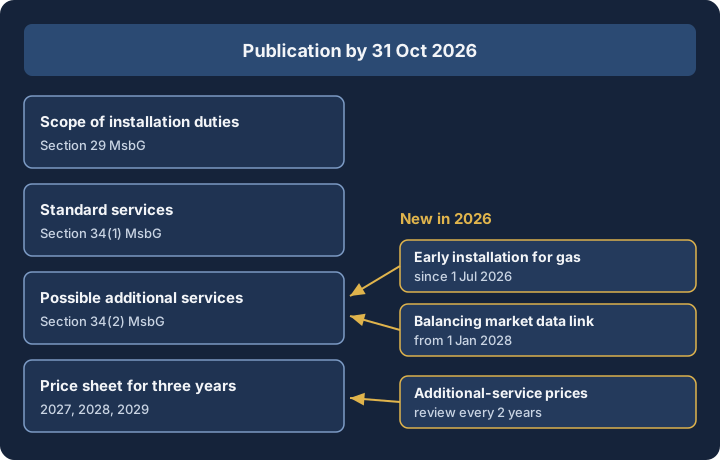
Section 34(1) lists nine standard services, from the processes under Section 60 and the provision of consumption data in an app, a portal or a local display to the data communication needed for control under Section 14a and Section 13a of the Energy Industry Act (EnWG). Whatever the operator owes as a standard service, it may not charge again as an additional service: Section 35(2) excludes costs that arise anyway from the duties in Sections 29 to 32. That is why the service description draws the line between what the price cap already pays for and what may cost extra.
31 October 2026 is a Saturday. The MsbG says "by 31 October at the latest" and does not say whether a publication on Monday, 2 November, would still count; a publication by Friday, 30 October, is on time beyond doubt. Keep the duty apart from Section 37(2): telling an individual customer at least three months before a smart metering system is installed is a separate duty with its own process.
Three changes since the 2025 price sheet
You can't simply roll last year's publication forward. Since 23 December 2025, the third sentence of Section 37(1) has required that prices for additional services under Section 34(2) "are to be reviewed at least every two years and adjusted where necessary" (inserted by Article 17 of the act strengthening consumer protection in the energy sector of 18 December 2025, Federal Law Gazette 2025 I no. 347). Whoever signs off the 2026 price sheet should record when the additional services were last costed and when the next review is due. The law does not require a review date on the price sheet, but one makes the review visible from outside.
Since 1 July 2026, energy suppliers, direct marketers, end customers, plant operators, connection owners and parties seeking a grid connection under the Renewable Energy Sources Act (EEG) can also request early installation of a smart metering system at gas metering points, to be carried out within four months of the order. The 100-euro presumption in Section 35(1) applies expressly to electricity only. For gas the general standard in the first sentence of Section 35(1) applies, a reasonable fee, and without a presumption the operator has to be able to show in a dispute why its price is reasonable.
How an operator connects the gas meter to the gateway depends on its architecture and drives part of the cost; our piece on multi-utility metering through the smart meter gateway covers the background. The third change lies ahead, but inside the period the price sheet covers: from 1 January 2028, data communication through the smart meter gateway for participation in the balancing market is an additional service (Section 34(2), second sentence, no. 5). A price sheet covering 2028 and 2029 should at least list it as a service, if need be with a note that the price is still being set; processes and costs are still hard to pin down today.
Price caps and presumption thresholds in the price sheet
For standard services the price caps in Sections 30 and 32 are hard limits; for additional services Section 35 only sets a presumption. The act on avoiding temporary generation surpluses raised the caps in February 2025 and applies them to the period from 1 January 2025; they do not flow into existing contracts automatically. Our article on the 2025 MsbG amendment and its price caps explains what changed at the time.
| Case | Total limit | Grid operator share | Provision |
|---|---|---|---|
| Smart metering system, 6,000 to 10,000 kWh | €120 a year | at most €80 | Section 30(1) no. 5 |
| Smart metering system, 10,000 to 20,000 kWh, Section 14a device, plant above 7 to 15 kW | €130 a year | at most €80 | Section 30(1) no. 4 |
| Smart metering system, 20,000 to 50,000 kWh, plant above 15 to 25 kW | €190 a year | at most €80 | Section 30(1) no. 3 |
| Smart metering system, 50,000 to 100,000 kWh, plant above 25 to 100 kW | €220 a year | at most €80 | Section 30(1) no. 2 |
| Control unit at the grid connection point, on top | €100 a year, €50 each to connection owner and grid operator | at most €50 | Section 30(2) |
| Smart metering system, optional case | €60 a year | at most €30 | Section 30(3) |
| Modern metering device | €25 a year | no share | Section 32(1) |
| Early installation, electricity (additional service) | €100 one-off, plus €30 a year in optional cases | no share | Section 35(1) no. 1 |
| Daily meter data to third parties (additional service) | €30 a year | no share | Section 35(1) no. 2 |
Above 100,000 kWh there is no fixed cap, only a reasonable fee of which the grid operator pays at most 80 euros. The consumption band follows the average of the last three annual readings; Section 30(4) requires the operator to check that average every year and adjust the fee where necessary. Besides the price sheet, the billing system therefore has to move metering points between bands at the turn of the year.
Every price on the price sheet is expressly "expected", and the uncertainty is greatest for 2028 and 2029. The Federal Network Agency (BNetzA) can adjust the caps by determination under Section 33; an increase for connection users is allowed at most every four years, and connection users may bear no more than half of the combined cap for grid operator and connection user. As long as no such determination exists, the later years can only be planned on today's caps.
What the Halle and Bochum judgments mean for pricing
A price above the presumption threshold is allowed, but it shifts the burden: the operator then has to be able to show that the price is reasonable. Two cases brought in 2025 by the Federation of German Consumer Organisations (vzbv) against grid operators acting as default metering point operators show what that looks like in court. On 21 August 2025 the Regional Court of Halle (case 8 O 17/25) found the prices in a January 2025 price sheet unreasonable that charged 883.86 euros for early installation below 3,000 kWh and 643.86 euros between 3,000 and 6,000 kWh. The price sheet dated from the time when the law presumed 30 euros to be reasonable; the court found the new 100-euro threshold exceeded many times over as well, and the grid operator could not show that its prices were reasonable. Two months later it offered the installation for 99.50 euros. On 30 September 2025 the Regional Court of Bochum (case I-18 O 20/25) upheld a similar claim against another grid operator.

Both judgments are final after the grid operators withdrew their appeals to the higher regional courts in Naumburg and Hamm, according to the vzbv. A third case is pending before the Regional Court of Augsburg (case 083 O 2120/25) over a recurring fee of 68.16 euros a year for households up to 6,000 kWh; that is more than twice the 30 euros a year that Section 35(1) no. 1 presumes reasonable in optional cases. So the recurring fee is under scrutiny too, not just the one-off charge.
An operator that prices above the presumption threshold in its 2026 price sheet because installation really costs it more needs a documented calculation that, under Section 35(2), strips out every cost the mandatory rollout incurs anyway. Without that calculation it risks an injunction claim of the kind the vzbv has brought against three grid operators.
Four open questions
Most questions arise not in the price sheet itself but at its seams with contracts and the billing system.
Existing contracts
In the view of a legal newsletter from rhenag in February 2025, a new price sheet applies first to new contracts only. For existing metering contracts the operator needs a contractual right to adjust prices. The notice period given there is three months; what counts is the contract and the deadlines of the metering switching processes (WiM).
Deferral
The operator may defer early installation for a time, provided and as long as this does not put meeting its installation duties under Section 45 at risk. It has to give reasons in text form and a binding schedule (Section 34(2), sentences four to six). Whether it uses this belongs in the service description.
Gas in the service description
For early installation at gas metering points, the ordering route, the four-month deadline, the gateway connection and the price belong in the publication, even while hardly any orders have come in.
Forecast for 2028 and 2029
Prices for the two later years remain estimates as long as it is open whether the BNetzA sets new caps under Section 33. If they change later, it is advisable to give the reason in the next publication; the law does not require it.
For small operators the publication comes on top of rollout pressure, and with few installations it is harder to back up the cost of each additional service. Of the 813 companies the BNetzA counted on 31 December 2025, 599 served fewer than 30,000 metering locations, and at 14.6 percent their mandatory rollout quota was well below the average of 23.3 percent. On 27 March 2026 the agency opened 77 supervisory proceedings against companies that, by its data, had not yet started the rollout; more in our piece on BNetzA sanctions in the smart meter rollout. It bears on the publication because deferring early installations is only allowed as long as it does not put the quotas at risk.
The dispute over fee levels
Consumer advocates and the industry have argued over fee levels for years, and the price sheets are where the argument becomes visible. In its response to the economics ministry's consultation on 17 May 2024, the vzbv rejected any increase.
"The vzbv is fundamentally opposed to raising the price caps for installing smart meters."
Federation of German Consumer Organisations (vzbv), 17 May 2024 (translated)A legal newsletter from rhenag in February 2025 described the other side like this: as a rule, metering operators "already charge considerably higher reasonable fees for additional services" (translated). In early 2025 grid operators justified higher prices with industry calculations and actual costs, heise reported on 30 January 2025. Lawmakers raised the presumption for early installation to 100 euros in February 2025, and the courts then rejected prices of six to nine times that amount. That has not settled the conflict: the 100-euro presumption covers electricity only, and the Augsburg case on the recurring fee is still open. For the price sheet, this means recurring fees above 30 euros need a justification too.
What applies if the publication is missing
The MsbG sets no penalty of its own for a missing or incomplete publication. The BNetzA can, however, order it under Section 76(2) MsbG and enforce the order with coercive fines under Section 76(4) MsbG read with Section 94 EnWG. Whether breaching such an order can also be fined as an administrative offence is unsettled: Section 76(4) MsbG does refer to the procedural and penalty provisions of the EnWG, but Section 95(1) no. 3(a) EnWG names only orders under the EnWG.
If an item is missing on 31 October, such as the price for gas installation, the deadline for that item has been missed; it can still be added later, and the BNetzA's power to order it remains. A dated version with a version number, an archived previous version and a check that the prices in the billing system match the published price sheet are the sensible minimum.
What to do now
Five days before the cut-off, the work is about completeness and about being able to back up any price above the presumption threshold.
By Friday, 30 October
-
Check the publication against Section 37(1)
Regulatory management and metering: installation duties, standard services, additional services, prices for 2027 to 2029.
-
Add gas and balancing
Metering checks that early installation at gas metering points is in, with service description, deadline and price, and that balancing-market communication from 2028 appears on the price sheet, if need be with a note that the price is still being set; whoever runs the website puts the version online with a date.
-
Record a review date for additional services
Controlling: document when the additional services were last costed; the next review is due two years later at the latest.
In the weeks after
Controlling and metering file a calculation for every additional service priced above the presumption threshold that strips out rollout costs incurred anyway; legal checks existing contracts for a price adjustment right and the notice period that applies. If your company is behind on its quota, align the publication with the rollout plan: deferring early installations must not put the quotas under Section 45 at risk, and the 2026 period quota is one of those quotas.
Deadline, market roles, systems
31 October 2026Default metering point operators: publish services and price sheets by 31 OctoberLaw · adopted
Applicability: Applies only to default metering point operators. Notice of installation to individual customers is governed by Section 37(2) MsbG (at least three months ahead).
If the deadline is missed: Regulator can enforce The MsbG sets no penalty of its own for a missing publication. The Federal Network Agency can order it under Section 76(2) MsbG and enforce the order with coercive fines under Section 94 EnWG (Section 76(4) MsbG); whether breaching such an order can also be fined as an administrative offence under Section 95 EnWG is unsettled: Section 76(4) MsbG does refer to Part 8 of the EnWG and thus to Section 95, but Section 95(1) no. 3(a) EnWG only lists orders under the EnWG, such as Section 65, and none under the MsbG. Legal basis ↗
- Default metering point operatorrole obligationPublishes the scope of its installation duties, standard and additional services and price sheets for at least three years on its website.Typically affected: Customer and grid connection portal, Regulatory management, controlling
A classification for typical market roles, not a review of your individual case and not legal advice. Whether an obligation applies to your company (thresholds, exemptions) is for your legal department or counsel to confirm. The calendar doesn't replace your own deadline review. Information as of: 26 October 2026.
Further reading
Frequently asked questions
Section 37(1) MsbG requires default metering point operators to publish, by 31 October each year at the latest, the scope of their installation duties under Section 29, their standard services under Section 34(1) and their possible additional services under Section 34(2). The publication includes price sheets with expected annual prices for at least three years.
Since 23 December 2025, prices for additional services must be reviewed at least every two years and adjusted where necessary. Since 1 July 2026, eligible parties can also request early installation of a smart metering system at gas metering points. From 2028, data communication for the balancing market becomes an additional service, which falls inside the period of the price sheet.
Section 35(1) MsbG presumes a one-off fee of up to 100 euros gross for early installation at electricity metering points to be reasonable, plus up to 30 euros a year in optional cases. A higher price is not prohibited, but the operator must then be able to show that it is reasonable. For gas metering points, Section 35 sets no amount.
Usually not. In the view of a legal newsletter from rhenag in February 2025, a new price sheet applies first to new contracts only. For existing metering contracts the operator needs a contractual right to adjust prices and has to announce the change with notice; the newsletter puts that notice at three months.
The MsbG sets no penalty of its own. The Federal Network Agency can order the publication under Section 76(2) MsbG and enforce the order with coercive fines under Section 94 EnWG. Whether breaching such an order can also be fined as an administrative offence under Section 95 EnWG is unsettled.
The law asks for expected annual prices for at least three years. For a publication in October 2026, that sensibly means 2027 to 2029. The figures are forecasts; for standard services the price caps in Sections 30 and 32 MsbG remain the ceiling.
Let's collaborate
One contact, a team behind it
Thirty minutes on what you're working on, whether grid, metering, market processes, IT architecture or AI. Afterwards you'll know how we'd approach it and who would sit at the table.
Energy and measurement technology since 2010 · innobu GmbH since 2014 · Based in Schleswig-Holstein, Germany
Whoever pitches also delivers: whoever leads the first call stays your contact right through to the steering committee, with established partners in the project. Direct: info@innobu.com