MARI and PICASSO: how Europe is wiring its balancing markets together
PICASSO and MARI change that, coupling the national markets into two European platforms. In 2026 that network grows noticeably, and it shifts prices for everyone who runs a balancing group or markets flexibility.
PICASSO is the European platform for automatic frequency restoration reserve (aFRR), in operation since June 2022, launched with Germany, Austria and the Czech Republic. Its central activation optimisation clears the cross-border merit order every 4 seconds and forms a marginal price per direction, settled in 15-minute time units. MARI is the European platform for manual frequency restoration reserve (mFRR), in operation since 5 October 2022, launched with CEPS and the four German transmission system operators. In 2026 the network grows: ESO from Bulgaria joined MARI on 18 February, RTE from France on 16 April, PSE from Poland is provisionally planned for September, IPTO from Greece for the year. Both platforms implement the Electricity Balancing Guideline (EU) 2017/2195, aFRR under Article 21, mFRR under Article 20. ACER refined the rules with Decisions 08/2024 and 09/2024 on 9 July 2024. The coupling lowers prices measurably: in Belgium imbalance spreads fell by around 55 percent after joining PICASSO, in the Netherlands by about 20 percent. The value of imbalance energy becomes structurally smaller. Anyone running a balancing group has to adapt forecasting and flexibility marketing.
What PICASSO is and how the platform works
Balancing energy is the reserve that transmission system operators use to keep generation and demand in balance from second to second. When a power plant trips or wind delivers less than forecast, it steps in. For a long time each country bought this reserve on its own national market. PICASSO changes that for the fast, automatically activated secondary reserve, aFRR for short.

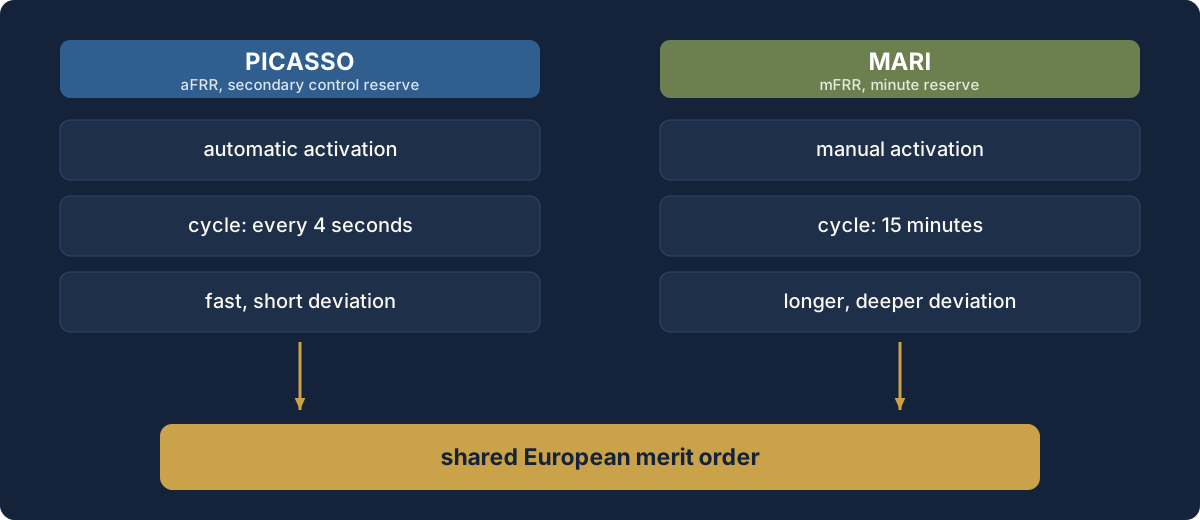
The platform has been in operation since June 2022, launched with Germany, Austria and the Czech Republic, which since September 2025 also procure capacity for aFRR at the Czech border jointly. Its core is the activation optimisation. It gathers the aFRR bids of all connected countries into one shared merit order and activates the cheapest, regardless of where it stands. This runs on a fast clock: every 4 seconds the platform recalculates and forms a marginal price per direction, up and down. Settlement happens in 15-minute time units.
The circle keeps growing. RTE from France joined PICASSO on 2 April 2025, the Netherlands and Belgium are connected. MAVIR from Hungary plans to connect in early 2026, Transelectrica from Romania, by its own announcement, in April 2027. PICASSO is coupled with the imbalance netting process IGCC, which nets opposing imbalances of different control areas before any balancing energy flows at all.
What MARI is and where the difference lies
MARI is the counterpart for manual reserve, mFRR for short. Where PICASSO activates automatically on a second-by-second clock, MARI calls on a 15-minute cycle, for longer and deeper imbalances that the fast reserve no longer carries on its own. Both platforms clear one shared European merit order in the end, just for different reserve types.
MARI has been in operation since 5 October 2022, launched with the Czech operator CEPS and the four German transmission system operators 50Hertz, Amprion, TenneT and TransnetBW. 2026 is the year of the big accessions. ESO from Bulgaria went live on 18 February, RTE from France on 16 April. IPTO from Greece is planned within the year, PSE from Poland provisionally for September 2026. The Nordic operators are coordinating their accession jointly, after the launch of their own Nordic mFRR platform.
On the national level the mFRR stays embedded in the familiar processes. How the European activation meshes with the German balancing group settlement through the MaBiS hub ultimately decides which price reaches the individual balancing group. And the quarter-hour balancing sets the beat at which deviations are measured and priced at all.
The legal framework: Balancing Guideline and ACER
PICASSO and MARI are not a voluntary club of willing grid operators, they are European law. The basis is the Electricity Balancing Guideline, Regulation (EU) 2017/2195. It mandates the shared platforms, the aFRR platform under Article 21 and the mFRR platform under Article 20, and in principle obliges the transmission system operators to connect.
Operators could apply for extensions at first, the so-called derogations. These transitional periods broadly expired in mid-2024. Since then connection is the rule and delay the exception that has to be justified. That is exactly what explains the wave of accessions in 2025 and 2026.
In parallel ACER, the European agency for the cooperation of energy regulators, keeps the rules current. With Decisions 08/2024 and 09/2024 on 9 July 2024, ACER refined the balancing rules. That includes a harmonised marginal pricing method across all platforms, adjusted technical price limits and an elastic demand function that better reflects the trade-off between extra cost and frequency quality. The purpose is efficiency: the cleaner the pricing, the sooner connecting pays off for further countries. ENTSO-E documents the roadmap in its accession roadmaps, most recently in Version 15 of February 2026.
What the coupling does to prices
The effect of the coupling is not theory, it sits in the market data. More connected countries mean a deeper shared merit order, and in a deeper merit order the last, expensive bids are needed less often. Activation prices fall, and with them the swings of the imbalance price.

The numbers from neighbouring countries are clear. In Belgium the spreads between day-ahead and imbalance prices fell by around 55 percent after joining PICASSO. In the Netherlands they shrank by about 20 percent, roughly from 50 to 40 euros per megawatt hour. Germany feels the effect more indirectly, as neighbouring zones join and pour their liquidity into the shared pool.
For marketing this means the value of imbalance energy becomes less event-driven and structurally smaller. A model trained on historic prices from before the coupling knows a world that no longer exists. This is exactly where AI-driven balancing group management comes in, forecasting the imbalance price instead of reacting to it. Simple baseline strategies no longer carry in this environment, what counts is forecast quality and fast reaction within the time unit.
What balancing responsible parties should do now
The platforms are not a distant matter for transmission operators, they carry through into portfolio management. Anyone who runs a balancing group or markets flexibility is better off planning for the consequences now, while the network is still growing.
The next steps
-
Revalue imbalance energy
Mark down the expected return from large spreads, while the risk of an expensive open position stays. Check which positions in the portfolio have counted on high imbalance prices, and how robust they are once those swings get smaller.
-
Sharpen the forecast
The imbalance price becomes structural and less event-driven. Models built on data from before the coupling lose accuracy. Treat the accessions of neighbouring countries as break points in the data, rather than averaging over them.
-
Align flexibility with the new merit order
Position your aFRR and mFRR marketing against the European merit order, not just the national one. A bid now competes with offers from several countries. That changes when and at what price a flexibility is called.
-
Track the roadmap and adapt systems
Keep an eye on the accession roadmaps, each new joiner shifts the pricing. Align data processes and systems with PICASSO's 4-second activation and MARI's 15-minute cycle, so your own control keeps pace with the platform logic.
Further reading
Frequently asked questions
PICASSO is the European platform for automatic frequency restoration reserve (aFRR), MARI the platform for manual frequency restoration reserve (mFRR). PICASSO activates automatically and clears the cross-border merit order every 4 seconds, for fast and short imbalances. MARI activates manually on a 15-minute cycle, for longer and deeper deviations. Both implement the Electricity Balancing Guideline (EU) 2017/2195 and are run jointly by Europe's transmission system operators.
In 2026 several large transmission system operators connect. On MARI, ESO from Bulgaria went live on 18 February 2026 and RTE from France on 16 April 2026, IPTO from Greece is planned within the year, and PSE from Poland provisionally for September 2026. For PICASSO, MAVIR from Hungary plans to connect in early 2026 and Transelectrica from Romania in April 2027. Every accession deepens the shared merit order and pushes prices down.
Both platforms implement the Electricity Balancing Guideline (EU) 2017/2195, the aFRR platform under Article 21 and the mFRR platform under Article 20. Transmission system operators are in principle obliged to connect, and the transitional derogations broadly expired in mid-2024. ACER refined the rules with Decisions 08/2024 and 09/2024 on 9 July 2024, including a harmonised marginal pricing method and an elastic demand function.
More coupled countries mean a deeper shared merit order and therefore lower activation prices. In Belgium the spreads between day-ahead and imbalance prices fell by around 55 percent after joining PICASSO, in the Netherlands by about 20 percent, from roughly 50 to 40 euros per megawatt hour. In Germany the effect is indirect, as neighbouring zones join and share liquidity. The value of imbalance energy becomes less event-driven and structurally smaller.
The expected return from large imbalance spreads falls, while the risk of an open position remains. Strategies built on historic prices from before the coupling lose their basis. Balancing responsible parties and municipal utilities should sharpen their forecasting, align flexibility marketing with the new European merit order, track the accession roadmap of neighbouring countries and adapt their systems to the 4-second and 15-minute logic of the platforms.
Let's collaborate
One contact, a team behind it
Thirty minutes on what you're working on, whether grid, metering, market processes, IT architecture or AI. Afterwards you'll know how we'd approach it and who would sit at the table.
Energy and measurement technology since 2010 · innobu GmbH since 2014 · Based in Schleswig-Holstein, Germany
Whoever pitches also delivers: whoever leads the first call stays your contact right through to the steering committee, with established partners in the project. Direct: info@innobu.com