2027 levies: status before 25 October, open issues and fallback routes
Germany's four transmission system operators must publish the levies under the Energy Financing Act (EnFG) on netztransparenz.de by 25 October 2026, which falls on a Sunday. Suppliers need the figures for pricing and for their price change letters, distribution system operators for their 2027 price sheets. Meanwhile the subsidy towards transmission grid costs, on which the preliminary grid fees rest, still has not passed the Bundestag.
The EnFG levies are the CHP levy and the offshore grid levy; under Section 11 EnFG the transmission system operators publish them by 25 October for the following year, so by 25 October 2026 for 2027. In 2026 they stood at 0.446 and 0.941 cents per kilowatt hour, and with the surcharge for special grid use (1.559 cents) at 2.946 cents in total. Suppliers carry the new values into pricing and customer letters: default suppliers must publish price changes for 1 January 2027 by 20 November, and household customers on special contracts must be told at least one month ahead. Still open is the EUR 5.525 billion federal subsidy towards transmission grid costs. It does not touch the levies but it does touch grid fees: without legal certainty by 7 December 2026, the transmission system operators say their final fees will rise.
Status six days before the deadline
On 19 October 2026 there is no 2027 figure on netztransparenz.de yet. Section 11 EnFG requires publication "by 25 October of a calendar year" (our translation), and since the law names no working day, we expect the Friday before. That's how it went last year: the 2026 levies appeared on the afternoon of Friday, 24 October 2025.
Everything else that goes into the 2027 electricity price is already out. On 1 October 50Hertz, Amprion, TenneT and TransnetBW published their preliminary grid fees, on average 3.54 cents per kilowatt hour at extra-high and high voltage against 2.86 cents this year. Distribution system operators had to follow by 15 October; how that went and which items stayed open is covered in our piece on network charges 2027. For a supplier's price calculation, the levies are now the last missing piece.
Which levies are due on 25 October
The EnFG knows two levies, the CHP levy (KWKG-Umlage) and the offshore grid levy. Section 10(2) has the transmission system operators calculate each one "transparently and separately" (our translation) from its funding requirement and the leviable grid withdrawal, in cents per kilowatt hour. Neither can turn negative, even if an account ran a surplus the year before.
| Item | Legal basis | 2025 | 2026 | 2027 |
|---|---|---|---|---|
| CHP levy | Sections 10, 11 EnFG | 0.277 | 0.446 | by 25 Oct 2026 |
| Offshore grid levy | Sections 10, 11 EnFG | 0.816 | 0.941 | by 25 Oct 2026 |
| Surcharge for special grid use (up to 1 GWh) | Bundesnetzagentur determinations | 1.558 | 1.559 | open |
The 61 percent jump in the CHP levy for 2026 had two causes, according to an analysis by the law firm Stein from March 2026: subsidy payments for new and modernised CHP plants, and a catch-up because the previous year's figure had been set too low. The offshore grid levy rose 15 percent with the cost of connection lines and the compensation paid when a connection is disrupted or delayed. Neither driver has gone away in 2027. We found no forecast of the new values in any primary source, and we won't offer one of our own here.
The transmission system operators usually publish the surcharge for special grid use at the same time, though it has a different legal basis. Since 1 January 2025 it has contained the former Section 19 StromNEV levy plus a surcharge for special feed-in grid use, which spreads the extra cost of integrating renewables across the whole country. Grid operators reported the volumes for it in the pass-through procedure we describe in our article on renewables grid cost pass-through. What matters for pricing is that it comes in three customer groups: in 2026 that meant 1.559 cents up to 1 GWh, 0.050 cents for group B' and 0.025 cents for group C'.
What depends on the subsidy and what does not
The subsidy lowers transmission grid fees and nothing else. On 2 September 2026 the federal cabinet adopted the draft that would add Section 24d to the Energy Industry Act (EnWG) with EUR 5.525 billion a year from the Climate and Transformation Fund for 2027 to 2029; it sits in the Bundestag as printed paper 21/8236 of 28 September. The EnFG levies do not appear in it.
For suppliers that means two uncertainties on two different dates. The levies are fixed on 25 October and won't change afterwards, while grid fees remain provisional. Without the subsidy, 2027 transmission grid fees would be 6.52 rather than 3.54 cents, and the transmission system operators have said their final fees will rise if there is no legal certainty by 7 December 2026. How much of that reaches distribution grid fees depends on how much upstream cost sits in each operator's calculation.
Subsidise grid fees or the levies?
The industry associations don't agree on where the money should go. VKU, the association of municipal utilities, and the Federation of German Consumer Organisations (vzbv) want part of the subsidy spent on the levies, because they are the same everywhere and so relieve every household equally; a subsidy for transmission grids alone works out differently from region to region. BDEW backs the government's approach, according to an overview by the trade paper ZfK on 13 August 2026. The government draft followed the second line. Whether the parliamentary process changes that is open, and any change would come too late for this autumn's pricing anyway.
From netztransparenz.de to the customer letter
A published levy has to land in three places: the distribution system operator's price sheet, the billing conditions and the supplier's calculation. Section 12(1) EnFG lets grid operators charge the levies "as a separate surcharge on grid withdrawal" (our translation), which is why they appear as their own lines next to the grid fee.
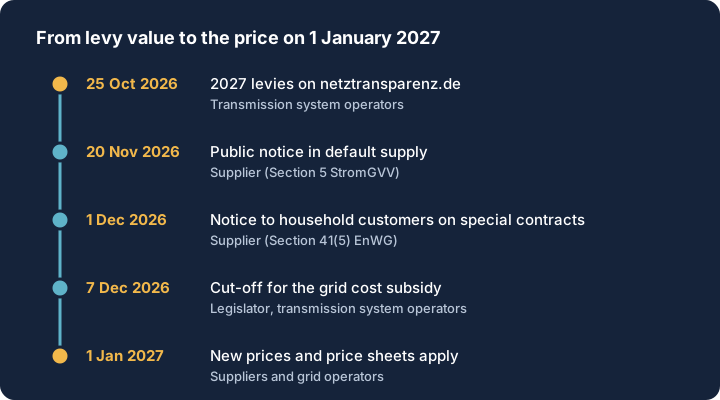
It gets tight on the supplier side, because default suppliers have to publish changed general prices at least six weeks before they take effect under Section 5(2) StromGVV, and send every customer a letter at the same time setting out the scope, reason and conditions of the change. For 1 January 2027 that deadline is 20 November. For household customers on special contracts, Section 41(5) EnWG requires notice at least one month ahead; for all other final customers, two weeks.

One detail helps. If a levy falls, Section 41(6) EnWG lets the supplier pass on the reduction unchanged without prior notice. If it rises, the full notice period applies, and a supplier that shows the levies as separate price components can't simply pass higher figures through the moment they appear: the notice, including the reference to the customer's right to terminate, has to reach the customer in time.
Four open issues
None of these is new, but in 2026 they all land in the same four weeks.
Where dates and responsibilities collide in 2026
Values at the weekend
If the figures only appear on Sunday, data entry and sign-off start on Monday, 26 October. The buffer to 20 November shrinks to 25 days.
Grid fees still provisional
Prices announced by 20 November rest on preliminary grid fees. If the subsidy law turns out differently after 7 December, the calculation is out of date.
Capped consumption points
For consumption points capped under Sections 30 to 36 EnFG, or with an application filed for 2027, only the transmission system operators collect the levies (Section 12(2)). They must not show up a second time on the distribution operator's price sheet.
Surcharge groups
The surcharge for special grid use distinguishes between consumption above and below 1 GWh. The assignment has to be in the system before the first 2027 instalment invoice.
Fallback routes if values come late or differ
Section 11 EnFG has no fallback like Section 20(1) sentence 2 EnWG, which allows expected values for grid fees. The transmission system operators publish the final figure, and it applies for the whole year. For suppliers, the fallback therefore moves into their own planning: anyone who only starts calculating on 26 October has nothing to fall back on if sign-off or printing slips.
We recommend preparing the calculation in variants, say with the 2026 values and a range above them, so that on publication day only the figures need entering. The price change letters then sit ready in the approval workflow with placeholders. They go out once levies and grid fees fit together, because the letter has to state the reason for the change.

The second case is harder: grid fees rise after 7 December because the subsidy does not arrive in time. A second price change for 1 January would no longer be possible for default supply customers, since the six-week period has run out. Suppliers would then have to decide whether to absorb the extra cost until a later date or adjust on 1 February or 1 March. That decision belongs with management now, not in December.
What the law provides if the deadline is missed
The duty under Section 11 EnFG lies with the transmission system operators, and the Bundesnetzagentur monitors under Section 62(1) no. 1(a) EnFG that they calculate and publish the levies properly; it can order publication using its EnWG powers. Breaching an enforceable order is an administrative offence under Section 63(1) no. 2 EnFG, with fines of up to EUR 200,000. Suppliers are bound by the deadlines in Section 41 EnWG and the StromGVV. This describes the legal framework, not an assessment of any individual case. We track the date and roles in our energy transition deadline calendar.
What suppliers and grid operators should settle this week
There is one working week left before 25 October. Most of the steps don't depend on the levy figures and can be done beforehand.
Five steps before the end of October
-
Name one person for 24 to 26 October
Someone checks netztransparenz.de on Friday afternoon, and on Sunday if need be, and passes the figures to pricing and billing.
-
Finish the calculation in two variants
One with the 2026 levies, one with a markup. Add a third line for grid fees without the subsidy, so management knows the order of magnitude if the law fails.
-
Check price sheet against billing system
At the distribution operator: CHP levy, offshore grid levy and surcharge as separate items, groups A', B' and C' assigned correctly, capped consumption points excluded. At the supplier: the same values in the billing conditions.
-
Put the letters with placeholders into sign-off
Still in October, so that printing and dispatch for default supply are done by 20 November.
-
Decide the December question now
What does the company do if grid fees rise after 7 December and the deadline for 1 January has passed: carry the extra cost until the next date, or adjust during the year? A decision in October saves a crisis meeting in December.
How dates like these from regulation and law turn into a working plan at a utility is described on our page on regulatory implementation for grid operators. More articles are collected in the topic field procurement, trading and market design.
Deadline, market roles, systems
25 October 20262027 levies: publication by the transmission system operatorsLaw · adopted
Applicability: Transmission system operators; indirectly all electricity suppliers and electricity DSOs.
If the deadline is missed: Regulator can enforce The Federal Network Agency monitors publication under Section 62(1) no. 1(a) EnFG and can order it using its EnWG powers. Breaching an enforceable order is an administrative offence under Section 63(1) no. 2 EnFG, with fines of up to EUR 200,000. Legal basis ↗
- Electricity grid operatoraffectedElectricity DSOs apply the levies as a surcharge on grid withdrawal in their 2027 price sheets.Typically affected: Grid usage and customer billing, Regulatory management, controlling
- Transmission system operatorrole obligationTransmission system operators publish the 2027 levies on time on their joint website.Typically affected: Regulatory management, controlling, Customer and grid connection portal
- SupplieraffectedSuppliers carry the levies into 2027 pricing and price change letters.Typically affected: Grid usage and customer billing, SAP IS-U / S/4HANA Utilities
A classification for typical market roles, not a review of your individual case and not legal advice. Whether an obligation applies to your company (thresholds, exemptions) is for your legal department or counsel to confirm. The calendar doesn't replace your own deadline review. Information as of: 18 October 2026.
Further reading
Frequently asked questions
Under Section 11 EnFG the transmission system operators publish the 2027 levies by 25 October 2026 on their joint website, netztransparenz.de. 25 October 2026 is a Sunday. Last year the 2026 values came out on Friday, 24 October 2025.
The CHP levy and the offshore grid levy. Each is calculated separately from its funding requirement and the leviable grid withdrawal, in cents per kilowatt hour, and under Section 10 EnFG neither can be negative. The surcharge for special grid use does not rest on the EnFG.
The CHP levy was 0.446 cents per kilowatt hour in 2026, the offshore grid levy 0.941 cents and the surcharge for special grid use 1.559 cents for final customers up to 1 GWh. Together that is 2.946 cents, up from 2.651 cents in 2025.
No. The draft law (Bundestag printed paper 21/8236 of 28 September 2026) provides EUR 5.525 billion a year towards transmission grid costs for 2027 to 2029. The EnFG levies are not covered. The draft has not been passed yet.
Default suppliers publish changed general prices at least six weeks in advance (Section 5(2) StromGVV), so by 20 November 2026 for 1 January 2027. Household customers on special contracts must be notified at least one month in advance under Section 41(5) EnWG, other final customers at least two weeks in advance.
The Bundesnetzagentur monitors publication under Section 62(1) no. 1(a) EnFG and can order it using its EnWG powers. Breaching an enforceable order is an administrative offence under Section 63(1) no. 2 EnFG, with fines of up to EUR 200,000.
Let's collaborate
One contact, a team behind it
Thirty minutes on what you're working on, whether grid, metering, market processes, IT architecture or AI. Afterwards you'll know how we'd approach it and who would sit at the table.
Energy and measurement technology since 2010 · innobu GmbH since 2014 · Based in Schleswig-Holstein, Germany
Whoever pitches also delivers: whoever leads the first call stays your contact right through to the steering committee, with established partners in the project. Direct: info@innobu.com