Renewables grid cost pass-through 2027: what has to reach the TSO by 14 October
One email to the TSO, due Wednesday. Miss it and a year of refunds is gone, no appeal, no second try.
The renewables grid cost pass-through (EE-Netzkostenwälzung) is the mechanism in ruling BK8-24-001-A of the Federal Network Agency (BNetzA) that lets German distribution system operators with a renewables ratio above 2 spread part of their grid costs nationwide; the 2027 amount must reach the transmission system operator responsible for the control area by Wednesday, 14 October 2026. Nothing can be corrected after that, and a late notice cancels the whole year's refund. 238 operators used the scheme in 2026, together EUR 2.725 billion; in year one it was 178. For 2027 a new estimator decides how much renewables capacity in third-party downstream grids may count, capped by what the market master data register shows. Consumer advocates dislike the scheme, the TSOs dislike it for other reasons, and BNetzA evaluates it by mid-2028.
What is due on 14 October
Wednesday, 14 October 2026. That is the cut-off for every eligible distribution system operator to send its 2027 pass-through amount to the TSO responsible for its control area. Why not the 15th? Because the ruling says "by the last working day before 15 October", and this year the 15th falls on a Thursday.
You have already filed once. Sheets B and B1 of the ARegV data template (Section 28 nos. 3 and 4) went to the competent regulator on 1 October, so the authority could check plausibility. Useful, but not decisive.
Decisive is the TSO's inbox.
On 16 October the TSOs and BNetzA compare what arrived. By 25 October the TSOs show on netztransparenz.de how the 2027 surcharge splits between the two mechanisms behind it.
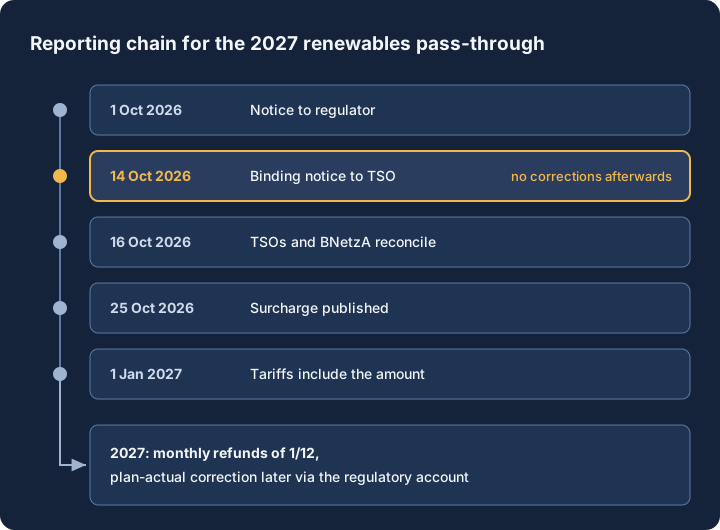
Running grids in two control areas? Then you split the amount by electricity sales and each TSO gets only its share. One more collision: on 15 October the provisional network charges for 2027 are due for publication under Section 20 EnWG. Your price sheet has to carry, to the euro, what you notified 24 hours earlier.
238
grid operators pass part of their costs on in 2026
EUR 2.725 bn
flows through the mechanism nationwide in 2026
1.56 ct/kWh
is what the surcharge for special grid use adds in 2026
How the pass-through amount is calculated
Three steps, repeated for each grid and transformation level. Ratio, share, costs. Sum the levels, and that sum is what you notify.
Cross 2 and you are affected "to a particularly high degree" at that level. 2025 data feeds the 2027 amount. And peak load is net of grid losses and simultaneous per level, so each level can peak at a different hour.
From the ratio comes the share of extra costs, AMK: (0.7 × EKZ − 1.4) / (0.7 × EKZ − 0.4). Multiply that by the level's costs, then by 0.9, a correction factor BNetzA built in on purpose. Which costs? The adjusted 2027 revenue cap, spread across levels by cost-unit accounting, minus the permanently non-controllable items in Section 11(2) sentence 1 nos. 4 and 8 ARegV, minus upstream and avoided costs. Conventional metering is left out.
Numbers help. Below, the formula for four ratios, as a worked example only.
| EKZ of the level | Share AMK | after factor 0.9 | with EUR 10 m level costs |
|---|---|---|---|
| 2.0 or less | no pass-through | 0 percent | EUR 0 |
| 2.5 | about 0.26 | about 23 percent | about EUR 2.3 m |
| 3 | about 0.41 | about 37 percent | about EUR 3.7 m |
| 4 | about 0.58 | about 53 percent | about EUR 5.3 m |
| 6 | about 0.74 | about 66 percent | about EUR 6.6 m |
Steep at first, flat later. An operator sitting at 2.3 should know that a tenth of a point is worth six figures, and that the ruling chamber knows it too.
What changes for 2027
One building block moves. Supplementary ruling BK8-25-005-A of 4 March 2026 rewrites how renewables capacity in third-party downstream grids enters the ratio, and 2027 is the first year it bites.
Before, backfeed from a neighbour's grid pushed up the upstream ratio no matter what produced it. Wind farm, gas engine, all the same. That was a loophole, frankly. Now there is an estimator per third-party downstream level: 0.4 times maximum offtake load plus maximum backfeed load, divided by 0.7. Zero backfeed means zero.
The cap is the renewables capacity actually registered for that third-party operator in the market master data register (MaStR), counted from the voltage level of the connection point downwards. If the connection point sits at HV/MV transformation, plants in the third-party grid at HV/MV, MV, MV/LV and LV all count. For 2027, plants commissioned before 1 January 2026 or temporarily shut down are relevant.
Who checks the cap? You do, if you are the upstream operator claiming money. Not the neighbour, not BNetzA. Its FAQ of 11 September 2026 is candid about the tool: "much more valid data", but overestimation is still possible.
The register becomes a calculation base, not just a filing duty. BNetzA leans more heavily on the net rated capacity recorded there when it checks the figures. Wrong entries by plant operators in your grid now cost money.
Open questions before the deadline
Two days before a deadline, what is still open usually involves somebody else. Another operator's data. A grid transfer. A question from the regulator that nobody has answered yet. The FAQ of Ruling Chamber 8 covers several of these, and it is noticeably more relaxed than the ruling itself.
Take the commonest case: several connection points to one third-party grid. Count the full cap at every point and a single solar park shows up twice. So the FAQ wants an "appropriate" split. Half each for two high-voltage points is fine. Weighting by offtake and backfeed is fine if one point clearly carries more. Choose "a pragmatic approach", it says, and means it.

Grid transfers: follow the revenue cap. When a sub-grid's cap moves to you in 2026, its structural data moves too, on a t-2 basis, so costs and ratio describe the same grid.
Changes between 1 and 14 October are allowed only after feedback from the authority or in agreement with it. Quietly fixing a number in that window is not an option.
And the borderline operator, unsure whether it even qualifies? Not notifying is not a waiver of revenue under the cap. Participation is a right. Small comfort, but comfort.
When the notice is missing or wrong
No fallback exists. Notify late, or not at all, and the 2027 refund is lost; the extra costs land back in your own network charges.
The notice to the regulator saves nothing. According to the FAQ, eligibility lapses even if only the regulator was notified on time by 1 October. The only thing that counts is receipt at the TSO by 14 October.
A wrong amount is slower pain. Once the deadline passes the figure is frozen, even if better data arrives in December, and it goes into the 1 January tariffs at face value. Netting the difference privately with the TSO next year? The FAQ forbids it.
The fix comes through the regulatory account, years later. BNetzA recalculates with the audited revenue cap; the gap stays out of the account balance and instead adjusts a future pass-through. Timing hinges on one date. Approved balance before 1 October: next pass-through. After: the one after that. So the 2025 account approved in August 2027 corrects the 2028 amount, approved in November 2027 it corrects 2029.
Worst case: a negative difference and no eligibility anymore. You were overpaid. You pay the TSO back in monthly twelfths, and you notify that by 15 October as well. BNetzA held a workshop on 27 August 2026 just on this first settlement round. Nobody has done it before.
What the TSOs do with it
Refund within twelve months, normally one twelfth a month. The four TSOs then settle among themselves.
Recovery runs through a surcharge on the network charges of all final consumers. It is billed together with the levy under Section 19(2) StromNEV as the "surcharge for special grid use" (Aufschlag für besondere Netznutzung). For 2026 BNetzA puts it at 1.56 euro cents per kilowatt hour, just under 70 percent of which stems from the renewables pass-through.
If you pass costs on, the money moves both ways. Your level costs drop when tariffs are set, so your charges fall. Yet you collect the nationwide surcharge from your customers like everyone else.
Relief varies enormously. BNetzA's list of 20 July 2026 shows the top 15 amounts at anywhere from 3.1 to 50.5 percent of the respective revenue cap. Forget the euro totals. Look at that ratio.
Relief versus price signal: the dispute
For BNetzA it is about fairness between regions. Its topic page, in our translation: regions "that bear particular cost burdens from the expansion of renewable electricity generation" get relief from 2025. Rural grids host the turbines, the whole country uses the power.
The Federation of German Consumer Organisations (vzbv) sees it differently. At BNetzA's expert exchange on cost allocation on 10 March 2026 it wrote, in our translation: "The problem also remains that a large share of grid costs is passed on through levies, which weakens network charge signals." And it asked back whether it would not be simpler to harmonise distribution network charges nationwide.
The four TSOs criticise from the other side. Their presentation from the same day reads, again in our translation: "The pass-through of renewables-related extra costs partly leads to network charge anomalies at the TSO/DSO interface." A complete removal of these anomalies, they wrote, "cannot currently be avoided" given the renewables pass-through and the lack of a contribution from generators.
BNetzA's reply, as the vzbv quotes it: extra burdens on rural operators from the planned allocation by grid-related final consumption are acceptable, since the same operators gain so much from the renewables relief. One tool to absorb the side effect of another.
The scheme keeps growing regardless. 178 operators and roughly EUR 2.4 billion in 2025. 238 operators and EUR 2.725 billion in 2026. Whether the system stays as it is will be settled by the evaluation due by 30 June 2028. And from 2029 the AgNeS network tariff reform reshuffles cost allocation between grid levels anyway.
What grid operators should do now
Right amount, right TSO, proof of receipt. That is Wednesday. The rest is groundwork for 2028.
Five steps, Wednesday and beyond
-
Match the 1 October and 14 October figures
Lay the regulator figure next to the TSO figure. Different? Then a note from the authority must explain why, and that note goes in the file.
-
Secure recipient and receipt
Confirm the responsible TSO and, across control areas, the split by sales. Ask for a receipt. Wednesday, not Friday: there is no weekend buffer.
-
Build the price sheet on the notified amount
The provisional price sheet due on 15 October must contain exactly the amount notified the day before.
-
Treat the market master data register as a standing task
BNetzA expects grid operators to check plant operators' entries within a reasonable time, especially the connected grid level. For your own ratio and for the caps on third-party grids, the register is now a calculation base. Clean it up only in September 2027 and you calculate the 2028 pass-through with the errors of 2026.
-
Track approval dates in the regulatory account
Whether a plan-actual difference hits the 2028 or the 2029 pass-through is decided by 1 October. Share the date internally with everyone who calculates the pass-through.
Short list, short process. Where it breaks is the handover, regulatory affairs to grid planning, own grid to neighbour, authority to TSO. Compare it with the Section 14d grid expansion plan and you will find much of the same renewables data requested in the same autumn.
Deadline, market roles, systems
14 October 2026Renewables grid cost pass-through: binding notification to the TSOfixed
Applicability: Only DSOs claiming a particular burden from renewables connections under ruling BK8-24-001-A.
- Electricity grid operatoraffectedDSOs with eligible renewables extra costs submit their 2027 pass-through amount to the TSO.Typically affected: Regulatory management, controlling
- Transmission system operatoraffectedTSOs receive the notifications and include the amounts in the nationwide distribution.Typically affected: Regulatory management, controlling
A classification for typical market roles, not a review of your individual case and not legal advice. Whether an obligation applies to your company (thresholds, exemptions) is for your legal department or counsel to confirm. The calendar doesn't replace your own deadline review. Deadline calendar as of: 11 October 2026.
Further Reading
Frequently Asked Questions
It is the mechanism set out in ruling BK8-24-001-A of the Federal Network Agency (BNetzA) of 28 August 2024. Distribution system operators whose renewables ratio exceeds 2 in a grid or transformation level can notify part of that level's costs to their transmission system operator. The TSOs refund the amount and recover it from all final consumers in Germany through the surcharge for special grid use.
By Wednesday, 14 October 2026. The ruling requires the notice by the last working day before 15 October of the preceding year, sent to the transmission system operator responsible for the control area. The notice to the regulator was already due on 1 October.
The TSO's obligation to refund the 2027 amount lapses. According to the Ruling Chamber 8 FAQ, this also applies if only the regulator was notified on time by 1 October. The extra costs then stay in the operator's own network charges. Not taking part does not count as waiving revenue under the revenue cap.
No. No adjustments are allowed after the deadline, even if new information appears before the 1 January price sheet. The notified amount must be priced in from 1 January. Differences are established later in the regulatory account and correct the pass-through amount of a later year.
It changes how renewables capacity in third-party downstream grids enters the ratio. For the 2027 pass-through an estimator based on maximum offtake load and maximum backfeed load applies, capped by the renewables capacity registered for the third-party operator in the market master data register. The upstream operator claiming the pass-through has to run the cap check itself.
According to BNetzA, 1.56 euro cents per kilowatt hour. Just under 70 percent of that comes from the renewables pass-through, the rest from the levy under Section 19 StromNEV. The TSOs publish the 2027 figure on netztransparenz.de by 25 October 2026.
Let's collaborate
One contact, a team behind it
Thirty minutes on what you're working on, whether grid, metering, market processes, IT architecture or AI. Afterwards you'll know how we'd approach it and who would sit at the table.
Energy and measurement technology since 2010 · innobu GmbH since 2014 · Based in Schleswig-Holstein, Germany
Whoever pitches also delivers: whoever leads the first call stays your contact right through to the steering committee, with established partners in the project. Direct: info@innobu.com