Transmission system operators 2027 to 2031: six deadlines from the system stability report to the plan-value model
All six dates come from the Energy Industry Act (EnWG), the Renewable Energy Sources Act (EEG), the Energy Financing Act (EnFG) and two rulings of the Bundesnetzagentur. For five of them the TSOs are the obligated party, yet much of the data sits in the distribution grids, whose operators are required to contribute to the system stability report and the network development plan. What appears on netztransparenz.de on 25 October ends up a few weeks later in DSO price sheets and supplier tariffs.
The German TSO deadlines for 2027 to 2031 are six reporting and publication dates that apply to the four transmission system operators with control area responsibility and, for the plan-value model, to distribution system operators. The system stability report is due on 1 January 2027 (Section 12i EnWG, every two years), the draft network development plans for electricity and for gas and hydrogen are to appear by 31 May 2027 (Sections 12b and 15c EnWG), the five-year forecast of congestion measures goes to the Bundesnetzagentur by 1 July (Section 13(10) EnWG), and 25 October brings the outlook on renewables expansion and EEG payments (Section 74 EEG, Section 60 EnFG) together with the separate disclosure of the two components of the surcharge for special grid use (BK8-24-001-A). By 1 January 2031, DSOs and TSOs are to move the controllable resources that make congestion management in the transmission grid more efficient into the plan-value model (BK6-23-241). None of the deadlines carries its own fine; the Bundesnetzagentur can order compliance and enforce it with coercive fines.
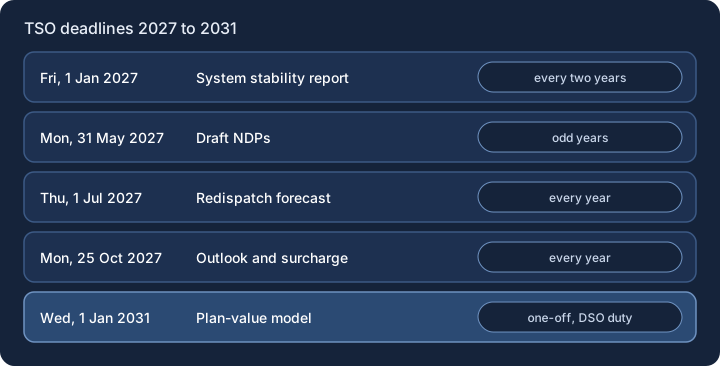
Six deadlines from 2027 to 2031
Five of the six dates fall in 2027 and come round again afterwards: the system stability report every two years, the network development plans in every odd year, and the redispatch forecast, EEG outlook and surcharge every year. Only the sixth is a one-off, aimed at distribution system operators, who are to move plants into the plan-value model of Redispatch 2.0 by 2031. All six rest on law in force or on adopted rulings; none comes from a draft.
| Date | Duty | Who | Source | Consequence |
|---|---|---|---|---|
| Fri, 1 Jan 2027, every two years | System stability report to the regulator: status, needs for the next ten years, options, transformation path | TSOs with control area responsibility; DSOs contribute when asked | Section 12i(1), (2) and (4) EnWG | Enforcement under Section 65(2) EnWG, coercive fines under Section 94 EnWG |
| Mon, 31 May 2027, odd years | Publish and consult on the draft electricity network development plan ("should") and the draft gas and hydrogen plan ("must") | TSOs; coordination office of the gas TSOs; network operators supply information | Section 12b(3) sentences 3 and 4, Section 15c(4) sentence 4 EnWG | Enforcement under Section 65(2) EnWG, coercive fines under Section 94 EnWG |
| Thu, 1 Jul 2027, every year | Five-year forecast of the volume and cost of congestion measures to the Bundesnetzagentur | TSOs jointly | Section 13(10) EnWG | Enforcement under Section 65(2) EnWG, coercive fines under Section 94 EnWG |
| Mon, 25 Oct 2027, every year | Prepare and publish the outlook on renewables expansion and payments for 2028 to 2032 | TSOs | Section 74(1) EEG, Section 60(1) EnFG | Remedy under Section 85(3) EEG with Section 65 EnWG |
| Mon, 25 Oct 2027, every year | Show the contributions of renewables grid cost pass-through and of Section 19(2) sentence 15 StromNEV to the 2028 surcharge separately on netztransparenz.de | TSOs | BK8-24-001-A, operative point 7 sentence 2 | Order under Section 65 EnWG, coercive fines under Section 94 EnWG |
| Wed, 1 Jan 2031 | Move controllable resources that can make congestion management in the transmission grid more efficient into the plan-value model ("should") | DSOs in coordination with the TSO | BK6-23-241, annex BilAReM, section 2.3.1 | Order under Section 65 EnWG |
These reports build on each other: the redispatch forecast takes onshore wind and solar expansion from the previous year's EEG outlook, and the 2025 system stability report drew on the scenario framework that also underlies the network development plan. A DSO that sends data to its TSO is therefore rarely sending it for one report only.
System stability report on 1 January 2027
By Friday, 1 January 2027, the four TSOs with control area responsibility report to the Bundesnetzagentur on the security, reliability, stability and performance of their network and of the electricity supply system. It is the second report under Section 12i EnWG; the first was due on 1 January 2025, and a two-year cycle applies from then on. System stability here is meant technically: whether frequency and voltage stay within limits after a short circuit or the loss of a power plant.
Subsection 2 is unusually precise about the content. It requires the report to set out the status of every area of system stability, identify the need for action even with electricity generated entirely from renewables, and quantify needs for the next ten years. From that, the TSOs derive options, rate them by effect, implementation time, cost and suitability, and present at least one transformation path with concrete measures. They also have to account for progress: the report must state how far the options named in the previous report have been implemented and explain any delays.
According to the Bundesnetzagentur, the 2025 report covered the years 2027 to 2037. As summarised by the trade paper ZfK on 1 August 2025, it dealt with the loss of inertia and reactive power as conventional plants close, grid-forming support from battery storage, rotating synchronous condensers and STATCOMs (static reactive power compensators), and grid restoration without classic black-start plants. In July 2025 the Bundesnetzagentur published its assessment and added regulatory points, such as targeted procurement of system services. For the 2027 report it has six months from receipt; it then submits its assessment and monitoring report to the Federal Ministry for Economic Affairs and publishes both together with the report (Section 12i(5) and (7)).
Two subsections matter for DSOs. Under subsection 4 they must help prepare the report when a TSO asks, and under subsection 6 they provide the regulator with information for its ongoing monitoring of system stability. We expect these requests to get more specific with each report, because reactive power and inertia are increasingly meant to come from plants connected to distribution grids.
Network development plans: drafts by 31 May 2027
By the end of Monday, 31 May 2027, the TSOs are to publish the draft of the next electricity network development plan, and the coordination office of the gas TSOs must publish the draft gas and hydrogen plan on the same day. Only the wording differs: Section 12b(3) sentence 3 EnWG says "should" for electricity, Section 15c(4) sentence 4 says the gas and hydrogen draft "is to be published". Both drafts go out for consultation; for electricity that means the public, grid users, downstream network operators, public bodies and the state energy authorities.

How much a "should" date can bear is visible in the current cycle. On 30 April 2025 the Bundesnetzagentur approved the scenario framework for the 2037/2045 (2025) plan; the TSOs published the first draft on 10 December 2025 and the second on 16 March 2026. Its consultation on the second draft ran until 24 August 2026, and we had found no confirmation by 27 October 2026, although Section 12c(4) EnWG provides for confirmation by 30 June of even years. For the 2027 cycle, the draft scenario framework has been with the Bundesnetzagentur since 30 June 2026 and its consultation closed on 28 September 2026; no approval had been published by 27 October 2026. Whether the electricity draft appears on 31 May 2027 depends on how early that approval comes, given that a little over seven months passed between approval and first draft in 2025. What the 2027 scenario framework contains is covered in our article on the 2027 scenario framework after the consultation.
DSOs feel the plan in two ways. They must give the TSOs the information needed for the plan without delay when asked (Section 12b(3) sentence 4), and as downstream operators they can comment on the draft. For the gas and hydrogen plan, Section 15c(4) expressly lists gas distribution system operators as affected operators, as well as operators of hydrogen networks that are not transport networks. What the 2025 gas plan contains is covered in the article on the integrated gas and hydrogen network development plan.
Redispatch forecast by 1 July
By Thursday, 1 July 2027, the TSOs jointly send the Bundesnetzagentur their forecast of how many congestion measures under Section 13(1) and (2) EnWG will be needed over the next five years and what they will cost. Its assumptions come from that year's system analysis and the supplementary analyses under Section 3(2) of the Grid Reserve Ordinance; the Bundesnetzagentur publishes the result (Section 13(10) sentences 1 to 4).
In the version of 30 June 2026, total costs for 2027 come to EUR 4,580 million, including EUR 1,098 million in grid reserve standby costs, with 21.95 TWh of redispatch in each direction. By 2029 the figures rise to EUR 4,866 million and 25.13 TWh and then stay flat to 2031. Behind them is a system analysis that covers only two periods: April 2026 to March 2027 and April 2028 to March 2029. For comparison, congestion management cost about EUR 3,071 million in 2025 for a volume of 30,319 GWh, according to provisional Bundesnetzagentur figures on SMARD.
The forecast explains the gap itself: its system analyses are meant to establish the capacity needed for secure operation in a worst-case view, and the volumes and costs derived from them should be "assessed accordingly". It is not much use as a budget figure. It's still worth reading, because it shows what the TSOs assume about grid expansion, the coal phase-out and market coupling, and because congestion costs end up with every grid user through network charges. How DSOs are to be compensated for redispatch in future is covered in the article on redispatch without balancing.
Outlook on renewables and EEG payments by 25 October
By Monday, 25 October 2027, the TSOs prepare and publish two outlooks for 2028 to 2032: on the expansion of renewables under Section 74 EEG and on the payments due for it under Section 60 EnFG. The first contains at least installed capacity, full-load hours and annual generation, with capacity broken down into nine energy sources from hydropower to mine gas and solar additionally split into first and second segment. A second one forecasts payments to plant operators and avoided network charges under Section 18 StromNEV. Both must reflect the state of the art and disclose their data and assumptions.
For 2026, the outlook was prepared by the Forschungsstelle für Energiewirtschaft (FfE) on behalf of TenneT and is dated 26 October 2026, as 25 October 2026 was a Sunday. In the trend scenario, installed EEG capacity grows from 231.1 GW at the end of 2026 to 364.6 GW at the end of 2031, driven by roughly 41 GW more solar each on open land and on other sites, mostly rooftops, and about 37 GW more onshore wind. Payments rise from about EUR 18.3 billion in 2027 to about EUR 22.3 billion in 2029 and fall to about EUR 20.6 billion by 2031. According to the report, the drop in 2031 comes from solar plants built around 2010 leaving the 20-year support period. What drives the increase is the exchange price, which the report sees falling from around EUR 106 per MWh in 2026 to about EUR 70 per MWh in 2030: the lower the market value, the higher the market premium. Changes from the EEG 2027 could not yet be taken into account.
Its main use is as the basis for calculating next year's EEG financing requirement, which the TSOs have put at EUR 17.524 billion for 2027. For DSOs the second part is more relevant than the first, because it also forecasts avoided network charges under Section 18 StromNEV.
Surcharge for special grid use: two components shown separately
Every year by 25 October, the TSOs show separately on netztransparenz.de what two levy mechanisms contribute to the next year's surcharge for special grid use: the surcharge for special feed-in-related grid use from renewables grid cost pass-through, and the mechanism under Section 19(2) sentence 15 StromNEV (BK8-24-001-A of 28 August 2024, operative point 7 sentence 2). They may bill both to grid users as a single item (sentence 1). According to the reasoning, the out-of-period expenses of each mechanism are to be shown separately as well (para. 130).
The calculation of the 2027 surcharge on netztransparenz.de is dated 26 October 2026. Of EUR 5.063 billion in costs to be passed through, EUR 3.454 billion comes from renewables grid cost pass-through, just over two thirds, and EUR 1.609 billion from the items under Section 19(2) StromNEV and the network charge exemption for electrolysers under Section 118(6) EnWG. At 2.027 cents per kWh, the surcharge applies to final consumers up to 1 GWh per offtake point (group A'), after 1.559 cents in 2026; it stays at 0.050 and 0.025 cents in groups B' (above 1 GWh) and C' (above 1 GWh, electricity-intensive companies). All figures are subject to a federal subsidy of EUR 5.525 billion towards transmission costs: if there is no legal certainty by 7 December 2026, the TSOs expect a higher final surcharge. Other levies published for 2027 are covered in the article on levies 2027.
25 October is the end of a chain that starts with the DSOs. A DSO that wants the compensation notifies its regulator of the calculated amount by 1 October and reports it to the TSO by the last working day before 15 October (operative point 5). A late report forfeits the reimbursement for that year. Our article on the 2026 reporting round covers renewables grid cost pass-through in detail.
Plan-value model: transfer by 1 January 2031
By Wednesday, 1 January 2031, DSOs, in coordination with the TSOs, are to move at least all controllable resources that can improve the efficiency of congestion management in the transmission grid into the plan-value model. That is section 2.3.1 of the BilAReM annex to ruling BK6-23-241 of 7 May 2026, with which the Bundesnetzagentur reorganised balancing in Redispatch 2.0. It is the only one of the six deadlines where the DSOs themselves are the obligated party.
Plants a DSO has not transferred stay in the forecast model, where the grid operator does not balance redispatch measures at all until 31 December 2031 (section 2.2); the supplier's balancing group absorbs the effect untargeted. Per grid connection point, the TSOs specify how much installed capacity of which plant type is to be transferred. DSOs then form clusters whose plants switch to the plan-value model in full, and a cluster may not mix the two models. Where plants sit in downstream grids, the upstream and downstream DSOs coordinate, and plant operators' wishes are to be considered as long as they do not get in the way of the transfer.

What makes it tight is the calendar of the assignment procedure (section 2.3.2). A transfer only takes effect on 1 January, 1 April, 1 July or 1 October, and not before the nationwide data formats apply; the instructing grid operator must notify the supplier, the scheduling party and the operator of the technical resource electronically at least six months in advance. A DSO that wants a transfer effective 1 January 2031 therefore has to send the notice by 1 July 2030, having tested communication with every affected market role beforehand. A plant cannot go back to the forecast model. That is why we think the deadline is tighter than the year 2031 suggests: for DSOs with many plants behind grid connection points to the transmission grid, the work starts with agreeing the clusters, long before the first notice goes out.
Where DSOs have to contribute
For five of the deadlines the TSOs are the obligated party, but the data often sits in the distribution grid. Three provisions expressly require DSOs to contribute, each for a different reason.
System stability report
Contribution when a TSO asks (subsection 4), plus information for the regulator's monitoring (subsection 6).
Network development plan
Supply the information needed without delay when asked (Section 12b(3) sentence 4); for the gas and hydrogen plan, comment as an affected operator (Section 15c(4)).
Renewables cost pass-through
Notice to the regulator by 1 October, report to the TSO by the last working day before 15 October, or the reimbursement lapses.
What applies if a deadline is missed
None of the six deadlines carries its own administrative fine. For the duties under Sections 12b, 12i, 13(10) and 15c EnWG, the regulator can enforce compliance under Section 65(2) EnWG with coercive fines under Section 94 EnWG; failing to comply with an enforceable order is an administrative offence under Section 95(1) no. 3(a) EnWG. For the EEG outlook the law sets no specific sanction, and the Bundesnetzagentur can order a remedy under Section 85(3) EEG with Section 65 EnWG. Rulings BK8-24-001-A and BK6-23-241 set no specific consequence either; the Bundesnetzagentur can order their implementation under Section 65 EnWG.
For the draft electricity network development plan and for the transfer into the plan-value model the date is worded as "should"; the 2025 network development cycle shows how far such a date stretches. Consequences built into the rules themselves bite sooner than supervision, such as the lost reimbursement after a late renewables pass-through report and the impossibility of returning to the forecast model. This is a general assessment for roles, not a review of your individual case.
Criticism and open points
Of the six, the surcharge drew the sharpest dispute. In the consultation on BK8-24-001-A, some respondents asked for a separate levy for the renewables costs, arguing that passing them through the existing Section 19 StromNEV mechanism would reduce transparency for consumers. The ruling chamber rejected this:
"This publication makes it comprehensible for everyone how the surcharge for special grid use is made up." (our translation)
Yet the overview page on netztransparenz.de shows only the total surcharge per group for 2027; the split in euros is in the linked calculation PDF, and there is no split in cents per kWh by mechanism. Anyone who wants to explain to customers why the group A' surcharge is rising by just under half a cent has to do the maths themselves.
On the EEG outlook, the German Renewable Energy Federation (BEE) objected, according to pv magazine on 26 October 2026, that it was unclear what battery storage build-out had been assumed; more storage could stabilise market values and lower EEG costs. On the network development plan, the TSOs and the Bundesnetzagentur are apart: of 159 proposed measures, the agency considers 118 confirmable and so far sees no sufficient contribution from the rest to the grid reinforcement needed (press release of 12 June 2026). As of 27 October 2026 it is open when the 2027 scenario framework will be approved and whether the federal subsidy towards transmission costs will arrive in time.
What to do before autumn 2027
Most of the work lies with the TSOs; DSOs and suppliers share the consequences. All dates with roles and systems are also in the energy transition deadline calendar.
Next steps by role
-
Name a contact
DSOs: set up one point that takes requests on the system stability report and the network development plan and pulls the answer together from grid planning, grid operation and plant master data.
-
Plan for 25 October
DSOs and suppliers: time the price-sheet and tariff calendar so that the 2028 surcharge can be taken over on Monday, 25 October 2027, with slack for a proviso like the one in 2026.
-
Agree plan-value clusters
DSOs with plants at grid connection points to the transmission grid: obtain the TSO's specification, form clusters, test market communication with every affected market role, and send the last notice for 1 January 2031 by 1 July 2030 at the latest. Transferring earlier spreads the load over several quarterly dates.
-
Ask for data early
TSOs: send requests to DSOs for the 2027 report and the network development plan early enough that "without delay" stays achievable for grid operators with small teams.
Deadline, market roles, systems
1 January 2027TSOs' system stability report (Section 12i EnWG)Law · adopted
If the deadline is missed: Regulator can enforce Section 12i EnWG sets no specific administrative offence. The regulator can enforce the duty under Section 65(2) EnWG with coercive fines under Section 94 EnWG; failing to comply with an enforceable order is an administrative offence under Section 95(1) no. 3(a) EnWG. Legal basis ↗
- Transmission system operatorrole obligationSubmits the system stability report with status and needs for action per area of system stability.Typically affected: Grid control system / SCADA, Regulatory management, controlling
31 May 2027Publish the draft network development plans for electricity and for gas and hydrogenLaw · adopted
If the deadline is missed: Regulator can enforce Sections 12b and 15c EnWG sets no specific administrative offence. The regulator can enforce the duty under Section 65(2) EnWG with coercive fines under Section 94 EnWG; failing to comply with an enforceable order is an administrative offence under Section 95(1) no. 3(a) EnWG. Legal basis ↗
- Gas grid operatoraffectedGas TSOs present the gas and hydrogen draft via the coordination office; gas DSOs can comment on it.Typically affected: Grid planning, GIS, load flow, Regulatory management, controlling
- Transmission system operatorrole obligationPublishes the draft electricity network development plan and consults the public and downstream network operators.Typically affected: Grid planning, GIS, load flow, Regulatory management, controlling
1 July 2027Five-year forecast of congestion measures to the Federal Network Agency (Section 13(10) EnWG)Law · adopted
If the deadline is missed: Regulator can enforce Section 13(10) EnWG sets no specific administrative offence. The regulator can enforce the duty under Section 65(2) EnWG with coercive fines under Section 94 EnWG; failing to comply with an enforceable order is an administrative offence under Section 95(1) no. 3(a) EnWG. Legal basis ↗
- Transmission system operatorrole obligationPrepares the five-year forecast of congestion measures with the other TSOs based on the system analysis and submits it by 1 July.Typically affected: Grid control system / SCADA, Regulatory management, controlling
25 October 2027TSOs: five-year outlook on renewables expansion and EEG paymentsLaw · adopted
If the deadline is missed: Regulator can enforce The EEG sets no specific sanction. The Federal Network Agency monitors the TSOs' duties and can order remedies under Section 85(3) EEG with Section 65 EnWG. Legal basis ↗
- Electricity grid operatoraffectedSupplies data on connected plants and uses the forecast for its own planning.Typically affected: Regulatory management, controlling
- Transmission system operatorrole obligationPrepares the medium-term forecast of renewables expansion and payments and publishes it by 25 October 2027.Typically affected: Regulatory management, controlling, Customer and grid connection portal
25 October 2027Surcharge for special grid use: show contributions separatelyRegulatory ruling · adopted
If the deadline is missed: Regulator can enforce The ruling sets no specific consequence. The regulator can order compliance under Section 65 EnWG and enforce it with coercive fines under Section 94 EnWG. Legal basis ↗
- Electricity grid operatoraffectedTakes the surcharge for special grid use into price sheets and billing.Typically affected: Grid usage and customer billing
- Transmission system operatorrole obligationShows the contributions of both mechanisms for the following year separately on netztransparenz.de by 25 October.Typically affected: Regulatory management, controlling, Customer and grid connection portal
- SupplieraffectedPrices next year's tariffs with the published surcharge.Typically affected: Grid usage and customer billing
1 January 2031Redispatch 2.0: move controllable resources into the plan-value modelRegulatory ruling · adopted
If the deadline is missed: Regulator can enforce The ruling frames the target as a "should" requirement. The Federal Network Agency can order implementation of rulings under Section 65 EnWG. Legal basis ↗
- Electricity grid operatorrole obligationPlans the move of relevant controllable resources into the plan-value model by 2031 with the TSO.Typically affected: Grid control system / SCADA, Direct marketing and remote control, Market communication gateway (EDIFACT, AS4, API)
- Transmission system operatoraffectedAgrees with the DSOs which resources belong in the plan-value model.Typically affected: Grid control system / SCADA
- Direct marketeraffectedSupplies plan values instead of operator forecasts for transferred plants.Typically affected: Trading and procurement system (ETRM)
A classification for typical market roles, not a review of your individual case and not legal advice. Whether an obligation applies to your company (thresholds, exemptions) is for your legal department or counsel to confirm. The calendar doesn't replace your own deadline review. Information as of: 27 October 2026.
Further reading
Frequently asked questions
It is the report that TSOs with control area responsibility have submitted to the regulator every two years since 1 January 2025. It sets out the status of every area of system stability, quantifies the needs of the next ten years and presents at least one transformation path with concrete measures. The next one is due on 1 January 2027; distribution system operators must contribute when asked.
The TSOs are to publish the draft electricity network development plan by the end of 31 May 2027 (Section 12b(3) sentence 3 EnWG, a "should" requirement). The coordination office of the gas TSOs must publish the draft gas and hydrogen plan on the same day (Section 15c(4) EnWG). In the 2025 cycle the first electricity draft only appeared on 10 December 2025.
The TSOs jointly estimate the volume and cost of congestion measures for the next five years and send the forecast to the Bundesnetzagentur by 1 July; the agency publishes it. The version of 30 June 2026 puts total costs for 2027 at EUR 4,580 million and redispatch at 21.95 TWh in each direction. It rests on the system analysis for grid reserve needs and is a worst-case view.
Two things: the outlook on renewables expansion and on the payments due for the following five calendar years (Section 74 EEG, Section 60 EnFG), and, broken down by the two mechanisms, the contributions to next year's surcharge for special grid use on netztransparenz.de (BK8-24-001-A, operative point 7 sentence 2). In 2027 the date is Monday, 25 October.
In the plan-value model the instructing grid operator balances a redispatch measure itself, based on the plant's planned operation and through schedules between its redispatch balancing group and the supplier's balancing group. Under BK6-23-241, DSOs are to move all controllable resources that can make congestion management in the transmission grid more efficient into this model by 1 January 2031.
None of the six deadlines carries its own administrative fine. The regulator can enforce the duties under Section 65 EnWG with coercive fines under Section 94 EnWG, and for the EEG and EnFG via Section 85(3) EEG. Failing to comply with an enforceable order is an administrative offence under Section 95(1) no. 3(a) EnWG.
Let's collaborate
One contact, a team behind it
Thirty minutes on what you're working on, whether grid, metering, market processes, IT architecture or AI. Afterwards you'll know how we'd approach it and who would sit at the table.
Energy and measurement technology since 2010 · innobu GmbH since 2014 · Based in Schleswig-Holstein, Germany
Whoever pitches also delivers: whoever leads the first call stays your contact right through to the steering committee, with established partners in the project. Direct: info@innobu.com